


All Equilibrium - II (icon Equilibrium) questions
Newest firstShowing 101–128 of 128 questions
-
- (A) \(1.9\, g, 0.28\, mol\, L^{-1}\)
- (B) \(13.6\, g, 0.28\, mol\, L^{-1}\)
- (C) \(1.9\, g, 0.14\, mol\, L^{-1}\)
- (D) \(13.6\, g, 0.14\, mol\, L^{-1}\)
Show answer and solution
Correct Answer: (A)
\(\mathop {\mathop {Ca{{(OH)}_2}}\limits_{100\,m\,mol} }\limits_ - + \mathop {\mathop {N{a_2}S{O_4}}\limits_{14\,m\,mol} }\limits_ - \to \mathop {\mathop {CaS{O_4}}\limits_ - }\limits_{14\,m\,mol} + \mathop {\mathop {2NaOH}\limits_ - }\limits_{28\,m\,mol} \)\({w_{CaS{O_4}}} = 14 \times {10^{ - 3}} \times 136 = 1.9\,gm\)
\([O{H^ - }] = \frac{{28}}{{100}} = 0.28\,M\)
-
- (A) \((a)\) and \((b)\)
- (B) \((a), (b)\) and \((c)\)
- (C) \((b)\) and \((c)\)
- (D) \((a), (b)\) and \((d)\)
Show answer and solution
Correct Answer: (B)
\((a)\,\mathop {\mathop {{H_2}S{O_4}}\limits_{400 \times 1 = 40} }\limits_{20} + \mathop {\mathop {2NaOH}\limits_{400 \times 1 = 40} }\limits_0 \to N{a_2}S{O_4} + 2{H_2}O\)\(\therefore [{H^ + }] = \frac{{20 \times 2}}{{800}} = \frac{1}{{20}} \Rightarrow pH = - log\left( {\frac{1}{{20}}} \right)\)
\(\therefore \,pH = 1.3\,\) so \((a)\) is correct
\((b)\,\log \,\left( {\frac{{{K_{{w_2}}}}}{{{K_{{w_1}}}}}} \right) = \frac{{\Delta H}}{{2.303\,R}}\left[ {\frac{1}{{{T_1}}} - \frac{1}{{{T_2}}}} \right]\)
so ionic product of water is temp. dependent hence \((b)\) is correct.
\((c)\,{K_a} = {10^{ - 5}},\,pH = 5 \Rightarrow [{H^ + }] = {10^{ - 5}}\)
\({K_a} = \frac{{c{\alpha ^2}}}{{(1 - \alpha )}} \Rightarrow {K_a} = \frac{{{{[H]}^ + }.\alpha }}{{(1 - \alpha )}}\)
\(\therefore \,{10^{ - 5}} = \frac{{{{10}^{ - 5}}.\alpha }}{{(1 - \alpha )}} \Rightarrow 1 - \alpha = \alpha = \frac{1}{2} = 50\% \)
so \((c)\) is correct
\((d)\) Le-chatelier's principle is applicable to cpmmon-Ion effect so option \((d)\) is wrong
- 103. If \(K_{sp}\) of \(Ag_2CO_3\) is \(8 \times10^{-12},\) the molar solubility of \(Ag_2CO_3\) in \(0.1\,M\,AgNO_3\) is 2019 Medium
- (A) \(8\times 10^{-12}\,M\)
- (B) \(8\times 10^{-11}\,M\)
- (C) \(8\times 10^{-10}\,M\)
- (D) \(8\times 10^{-13}\,M\)
Show answer and solution
Correct Answer: (C)
\(8 \times {10^{ - 12}} = {(2S' + 0.1)^2}S'\)Or \(S' = 8\times 10^{-10}\,M\)
-
- (A) \(S = {\left( {\frac{{{K_{SP}}}}{{6912}}} \right)^{1/7}}\)
- (B) \(S = {\left( {\frac{{{K_{SP}}}}{{144}}} \right)^{1/6}}\)
- (C) \(S = {\left( {\frac{{{K_{SP}}}}{{929}}} \right)^{1/9}}\)
- (D) \(S = {\left( {\frac{{{K_{SP}}}}{{216}}} \right)^{1/7}}\)
Show answer and solution
Correct Answer: (A)
\(Z{r_4}{(P{O_4})_4}(s) \rightleftharpoons \mathop {3Z{r^{4 + }}(aq.)}\limits_{3S\,M} + \mathop {4PO_4^{3 - }(aq.)}\limits_{4S\,M} \)\({K_{sp}} = {[Z{r^{4 + }}]^3}{[P{O_4}^{3 - }]^4} = {(3S)^3}.{(4S)^4} = 6912\,{S^7}\)
\(\therefore S = {\left( {\frac{{{K_{sp}}}}{{6912}}} \right)^{1/7}}\)
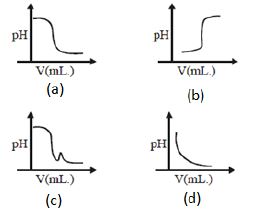
-
- (A) \((a)\)
- (B) \((c)\)
- (C) \((d)\)
- (D) \((b)\)
Show answer and solution
Correct Answer: (A)
The nature of the curve is such that the \(pH\) change of the reaction becomes larger for very small change in volume of titrant. -
- (A) \(a > c > b\)
- (B) \(c > a > b\)
- (C) \(c > b > a\)
- (D) \(a > b > c\)
Show answer and solution
Correct Answer: (A)
Stronger the acidic strength greater will be its electrical conductivity. \(K_a\) value of formic acid \(>\) benzoic acid \(>\) acetic acid -
- (A) \(6.23\times10^{-11}\, M\)
- (B) \(1.84\times10^{-9}\, M\)
- (C) \(\frac{{2.49}}{{1.84}} \times {10^{ - 9}}\,M\)
- (D) \(2.49\times10^{-10}\, M\)
Show answer and solution
Correct Answer: (D)
\({K_{sp}}\) of \(Cd{(OH)_2} = 4{s^3} = 4 \times {(1.84 \times {10^{ - 5}})^3}\)If \(pH = 12\)
\(pOH = 2\)
\([O{H^ - }] = {10^{ - 2}}\,M\)
\({K_{sp}} = [C{d^{2 + }}]{[O{H^ - }]^2}\)
\(4 \times {(1.84 \times {10^{ - 5}})^3} = [C{d^{2 + }}]{[O{H^ - }]^2}\)
\([C{d^{2 + }}] = \frac{{4 \times {{(1.84)}^3} \times {{10}^{ - 15}}}}{{{{10}^{ - 4}}}}\)
\(C{d^{2 + }} = 4 \times 6.22 \times {10^{ - 11}} = 2.49 \times {10^{ - 10}}\,M\)
- 108. The \(pH\) of a \(0.02\,M\,\,NH_4Cl\) solution will be [given \(K_b\,(NH_4OH) = 10^{-5}\) and \(log\,2 = 0.301\) ] 2019 Hard
- (A) \(2.65\)
- (B) \(5.35\)
- (C) \(4.35\)
- (D) \(4.65\)
Show answer and solution
Correct Answer: (B)
For the salt of strong acid and weak base\({H^ + } = \sqrt {\frac{{{K_w} \times C}}{{{K_b}}}} \)
\([{H^ + }] = \sqrt {\frac{{{{10}^{ - 14}} \times 2 \times {{10}^{ - 2}}}}{{{{10}^{ - 5}}}}} \)
\( - \log [{H^ + }] = 6 - \frac{1}{2}\log \,20\)
\(\therefore \,pH = 5.35\)
-
- (A) \(3 \times {10^{ - 19}}\)
- (B) \(12 \times {10^{ - 21}}\)
- (C) \(12 \times {10^{ - 23}}\)
- (D) \(3 \times {10^{ - 22}}\)
Show answer and solution
Correct Answer: (D)
\(Al(O{H_3}) \rightleftharpoons \mathop {A{l^{3 + }}}\limits_s + \mathop {3O{H^ - }}\limits_{(3s + 0.2)} \)\(2.4 \times {10^{ - 24}} = s{(3s + 0.2)^3}\)
-
- (A) \(55\,mL\,\frac{M}{{10}}\,HCl + 45\,mL\,\frac{M}{{10}}\,NaOH\)
- (B) \(75\,mL\,\frac{M}{5}\,HCl + 25\,mL\,\frac{M}{5}\,NaOH\)
- (C) \(100\,mL\,\frac{M}{{10}}\,HCl + 100\,mL\,\frac{M}{{10}}\,NaOH\)
- (D) \(60\,mL\,\frac{M}{{10}}HCl + 40\,mL\,\frac{M}{{10}}NaOH\)
Show answer and solution
Correct Answer: (B)
\(75\,mL\,\frac{M}{5}\,HCl + 25\,ml\,\frac{M}{5}\,NaOH\)\(25\,mL\,\frac{M}{5}\,NaOH\,\) will neutralise \(25\,mL\,\frac{M}{5}\,HCl\)
\(75 - 25 = 50\,mL\,\frac{M}{5}\,HCl\) will remain.
Total volume will be \(75 + 25 = 100\,mL\)
\(50\,mL\,\frac{M}{5}\,HCl\) is diluted to \(100\,mL\)
\([{H^ + }] = [HCl] = \frac{M}{5} \times \frac{{50}}{{100}} = \frac{M}{{10}}\)
\(pH = - {\log _{10}}[{H^ + }] = - {\log _{10}}\,\frac{M}{{10}} = 1\)
-
- (A) \(1.798\)
- (B) \(0.36\)
- (C) \(17.95\)
- (D) \(0.18\)
Show answer and solution
Correct Answer: (D)
\({({K_{sp}})_{PbC{l_2}}} = 3.2 \times {10^{ - 8}} = 32 \times {10^{ - 9}}\)\(PbC{l_2} \leftrightarrow \mathop {P{b^{2 + }}}\limits_s + \mathop {2C{l^ - }}\limits_{2s} \)
\({K_{sp}} = [p{b^{2 + }}]{[C{l^ - }]^2}\)
\({K_{sp}} = 4{s^3} = 32 \times {10^{ - 9}}\)
\({s^3} = 8 \times {10^{ - 9}}\)
\(s = 2 \times {10^{ - 3}}\,M\)
\(\frac{w}{{M.W.}} \times \frac{1}{{{V_L}}} = 2 \times {10^{ - 3}}\)
\(\frac{{0.1}}{{278}} \times \frac{1}{{{V_L}}} = 2 \times {10^{ - 3}}\)
\({V_L} = \frac{{0.1 \times 1000}}{{278 \times 2}} = 0.18\,L\)
-
- (A) \(3.75\)
- (B) \(4.75\)
- (C) \(8.25\)
- (D) \(9. 25\)
Show answer and solution
Correct Answer: (D)
\(N{H_3} + HCl \to N{H_4}Cl\)moles of \(HCl = 0.2\,M \times 25 \times {10^{ - 3}}\,L = 0.005\)
moles \(HCl\) (total consumed)
moles of \(N{H_3} = 0.2\,M \times 50 \times {10^{ - 3}}\,L = 0.01\)
moles \(HCl\)
excess \(N{H_3} = 0.01 - 0.005 = 0.005\) moles
\(1\) mole ammonia \(= 1 \) mole \(N{H_4}Cl\)
\(0.005\,N{H_3} = 0.005\,N{H_4}Cl\)
Total volume
\( = {V_{HCl}} + {V_{N{H_3}}} = 25 + 50\, = 75\,ml\)
\([N{H_3}] = [N{H_4}Cl] = \frac{{0.005\,mole}}{{75 \times {{10}^{ - 3}}\,L}} = 0.066\,M\)
\(pOH = p{K_b} + \log \frac{{[N{H_4}Cl]}}{{[N{H_3}]}}\)
\(pOH = 4.75 + \log \frac{{[0.066]}}{{[0.066]}}\)
\(pOH = 4.75\)
\(pH = 14 - pOH \Rightarrow pH = 9.25\)
-
- (A) \(4: 5\)
- (B) \(1 : 10\)
- (C) \(10 : 1\)
- (D) \(5 : 4\)
Show answer and solution
Correct Answer: (C)
\(HA \leftrightarrow {H^ + } + {A^ - }\)(Unionized, weak acid and common ion effect)
\(HA + NaOH \to NaA + {H_2}O\)
\(NaA \to N{a^ + } + {A^ - }\) (ionized)
\({K_a} = \frac{{[{H^ + }][{A^ - }]}}{{[HA]}}\)
Given, \(pH = 6,\,[{H^ + }] = 1 \times {10^{ - 6}}\)
\([{H^ + }] = \frac{{{K_a}[Acid]}}{{[Salt]}}\)
\(\frac{{[Salt]}}{{[Acid]}} = \frac{{{K_a}}}{{[{H^ + }]}} = \frac{{{{10}^{ - 5}}}}{{{{10}^{ - 6}}}} = 10:1\)
-
- (A) base and acid
- (B) base and base
- (C) acid and acid
- (D) acid and base
Show answer and solution
Correct Answer: (D)
Zinc oxide is an amphoteric oxide, as indicated by the following reactions:\( {\mathrm{ZnO}+\mathrm{Na}_{2} \mathrm{O} \rightarrow \mathrm{Na}_{2} \mathrm{ZnO}_{2}} \)
\({ { (Acid)\quad (Base) \quad (Salt)}} \)
\({\mathrm{ZnO}+\mathrm{CO}_{2} \rightarrow \mathrm{ZnCO}_{3}} \)
\({ { (Base) } \quad { (Acid) \quad (Salt)}}\)
-
- (A) \(7.2\)
- (B) \(6.9\)
- (C) \(7.0\)
- (D) \(1.0\)
Show answer and solution
Correct Answer: (B)
For the salt of weak acid and weak base, we have\(\mathrm{pH} =7+\frac{1}{2} \mathrm{p} K_{\mathrm{a}}-\frac{1}{2} \mathrm{p} K_{\mathrm{b}} \)
\(=7+\frac{1}{2}(3.2)-\frac{1}{2}(3.4) \)
\(=6.9\)
-
- (A) \(320\)
- (B) \(325\)
- (C) \(316\)
- (D) \(330\)
Show answer and solution
Correct Answer: (C)
\(\frac{{V \times 45}}{{100}} + \frac{{(800 - V) \times 20}}{{100}} = \frac{{800 \times 29.875}}{{100}}\)\( \Rightarrow \frac{{9V}}{{20}} + 160 - \frac{V}{5} = 239\)
\( \Rightarrow V = 136\)
- 117. Assuming that the degree of hydrolysis is small, the \(pH\) of \(0.1\, M\) solution of sodium acetate \((K_a\, = 1.0\times10^{- 5})\) will be 2014 Medium
- (A) \(5\)
- (B) \(6\)
- (C) \(8\)
- (D) \(9\)
Show answer and solution
Correct Answer: (D)
sodium acetate is a salt of strong base and weak acid.\(\,pH = 7 + \frac{1}{2}p{K_a} + \frac{1}{2}\,\log \,c\) where
\(p{K_a} = - \log \,{K_a} = - \log \,{10^{ - 5}} = 5\)
\(\log \,c = \log \,{10^{ - 1}} = - 1\)
\(pH = 7 + \frac{5}{2} - \frac{1}{2} = 9.0\)
-
- (A) Ideal solutions
- (B) Colloidal solutions
- (C) True solutions
- (D) Buffer solutions
Show answer and solution
Correct Answer: (D)
Solutions which resist the change in the value of \(pH\) when small amount of acid or base is added to them are known as buffers . -
- (A) \(N^{-3}\)
- (B) \(N_3^ - \)
- (C) \(N_2^ - \)
- (D) \(HN_3^ - \)
Show answer and solution
Correct Answer: (B)
\(\mathop {{N_3}H}\limits_{{\text{Hydrazoic acid}}} \,\, \rightleftharpoons \,N_3^ - \, + \,{H^ + }\)\(i.e,\) conjugate base of hydrazoic acid is \(N_3^-\)
-
- (A) \(S = \{ {K_{sp}}/{\left( {6912} \right)^{1/7}}\}\)
- (B) \(S = {\{ {K_{sp}}/144\} ^{1/7}}\)
- (C) \(S = {\{ {K_{sp}}/6912\} ^{1/7}}\)
- (D) \(S = {\{ {K_{sp}}/6912\} ^7}\)
Show answer and solution
Correct Answer: (C)
\([Z{r_3}{(P{O_4})_4}] \rightleftharpoons \mathop {3Z{r^{4 + }}}\limits_{3S} + \mathop {4P{O_4}^{3 - }}\limits_{4S} \)\({K_{sp}} = {(3S)^3}{(4S)^4}\)
\( = 27{S^3} \times 256{S^4}\)
\( = 6912{S^7}\)
\(\therefore \,S = {\left( {\frac{{{K_{sp}}}}{{6912}}} \right)^{1/2}}\)
-
- (A) \(0.1\)
- (B) \(0.9\)
- (C) \(2\)
- (D) \(9\)
Show answer and solution
Correct Answer: (D)
As \(p H=1 ; H^{+}=10^{-1}=0.1 \,M\)\(p H=2 ; H^{+}=10^{-2}=0.01\, M\)
\(\therefore M_{1}=0.1 ; V_{1}=1\)
\(M_{2}=0.01; V_{2}=?\)
From
\(M_{1} V_{1}=M_{2} V_{2} ; 0.1 \times 1=0.01 \times V_{2}\)
\(V_{2}=10\) litre
volume of water added \(=10-1=9\) litre.
- 122. \(NaOH\) is a strong base. What will be \(pH\) of \(5.0 \times 10^{-2}\,M\) \(NaOH\) solution \((log\,2 = 0.3)\) 2013 Medium
- (A) \(14\)
- (B) \(13.70\)
- (C) \(13\)
- (D) \(12.70\)
Show answer and solution
Correct Answer: (D)
Given \([O{H^ - }] = 5 \times {10^{ - 2}}\)\(\therefore \,pOH = - \log \,5 \times {10^{ - 2}}\)
\( = - \log \,5 + 2\log \,10 = 1.30\)
\(\because \,pH + pOH = 14\)
\(\because \,pH = 14 - pOH\)
\( = 14 - 1.30 = 12.70\)
-
- (A) \(5.1 \times {10^{ - 5}}\,M\)
- (B) \(7.1 \times {10^{ - 8}}\,M\)
- (C) \(4.1 \times {10^{ - 5}}\,M\)
- (D) \(8.1 \times {10^{ - 7}}\,M\)
Show answer and solution
Correct Answer: (A)
Given \(N{a_2}C{O_3} = 1.0 \times {10^{ - 4}}\,M\)\(\therefore \,[CO_3^ - ] = 1.0 \times {10^{ - 4}}\,M\)
\(i.e.\,\,\,s = 1.0 \times {10^{ - 4}}\,M\)
At equilibrium
\([B{a^{ + + }}][CO_3^ - ] = {K_{sp}}\,of\,BaC{O_3}\)
\([B{a^{ + + }}] = \frac{{{K_{sp}}}}{{[CO_3^ - ]}} = \frac{{5.1 \times {{10}^{ - 9}}}}{{1.0 \times {{10}^{ - 4}}}}\)
\( = 5.1 \times {10^{ - 5}}\,M\)
-
- (A) \(F^- < CN^- < NO_2^-\)
- (B) \(NO_2^- < CN^- < F^-\)
- (C) \(F^- < NO_2^- < CN^-\)
- (D) \(NO_2^- < F^- < CN^-\)
Show answer and solution
Correct Answer: (C)
Higher the value of \(K_a\) lower will be the value of \(pK_a\) \(i.e.\) higher will be the acidic nature. Further since \(CN^-, F^-\) and \(NO_2^-\) are conjugate base of the acids \(HCN, HF\) and \(HNO_2\) respectively hence the correct order of base strength will be \(F^- < NO_2^- < CN^-\) ( \(\because \) stronger the acid weaker will be its conjugate base) - 125. What is the \(pH\) of a \(10^{-4}\, M\,OH^-\) solution at \(330\,K\), if \(K_w\) at \(330\,K\) is \(10^{-13.6}\) ? 2013 Medium
- (A) \(4\)
- (B) \(9\)
- (C) \(10\)
- (D) \(9.6\)
Show answer and solution
Correct Answer: (D)
Given at \(330\,K\)\({K_w} = {10^{ - 13.6}}\)
i.e. \(p{K_w} = pH + pOH\)
\(\because \,pOH = - \log [O{H^ - }]\)
\(13.6 = pH + pOH\)
\(pOH = - \log \,{10^{ - 4}}\)
\(13.6 = pH + 4\)
\(\therefore \,pH = 13.6 - 4\)
\( = 9.6\)
-
- (A) \(pH=4.70\)
- (B) \(pH < 4.70\)
- (C) \(pH\) of solution will be equal to \(pH\) of acetic acid
- (D) \(4.76 < pH < 5.0\)
Show answer and solution
Correct Answer: (D)
\(pH = p{K_a} + \log \,\frac{{[salt]}}{{[acid]}}\)\( = 4.76 + \log \,\frac{{\frac{{7.5}}{{500}}}}{{\frac{5}{{500}}}} = 4.7 + \log \,1.5 = 4.87\)
Hence correct answer is \(4.76 < pH < 5.0\)
-
- (A) \(BaSO_4 > Hg_2Cl_2 > Cr_2(SO_4)_3 > CrCl_3\)
- (B) \(BaSO_4 > Hg_2Cl_2 > CrCl_3 > Cr_2 (SO_4)_3\)
- (C) \(BaSO_4 > CrCl_3 > Hg_2Cl_2 > Cr_2(SO_4)_3\)
- (D) \(Hg_2Cl_2 > BaSO_4 > CrCl_3 > Cr_2(SO_4)_3\)
Show answer and solution
Correct Answer: (B)
\(C{r_2}{(S{O_4})_3} \rightleftharpoons \mathop {2C{r^{ + 3 }}}\limits_{2s} + \mathop {3S{O_4}^{ - - }}\limits_{3s} \)\({K_{sp}} = {(2s)^2}{(3s)^2} = 4{s^2} \times 27{s^3} = 108{s^5}\)
\(s = {\left( {\frac{{{K_{sp}}}}{{108}}} \right)^{1/5}}\)
\(H{g_2}C{l_2} \rightleftharpoons \mathop {2H{g^{2 + }}}\limits_{2s} + \mathop {2C{l^ - }}\limits_{2s} \)
\({K_{sp}} = {(2s)^2} \times {(2s)^2} = 16{x^4}\)
\(s = {\left( {\frac{{{K_{sp}}}}{{16}}} \right)^{1/4}}\)
\(BaS{O_4} \rightleftharpoons \mathop {B{a^{ + 2}}}\limits_s + \mathop {S{O_4}^{ - - }}\limits_s \)
\({K_{sp}} = {s^2}\)
\(s = \sqrt {{K_{sp}}} \)
\(CrC{l_3} \rightleftharpoons \mathop {C{r^{3 + }}}\limits_s + \mathop {3C{l^ - }}\limits_{3s} \)
\({K_{sp}} = s \times {(3s)^3} = 27\,{s^4}\)
\(s = {\left( {\frac{{{K_{sp}}}}{{27}}} \right)^{1/4}}\)
Hence the correct order of solubilities of salts is
\(\sqrt {{K_{sp}}} > {\left( {\frac{{{K_{sp}}}}{{16}}} \right)^{1/4}} > {\left( {\frac{{{K_{sp}}}}{{27}}} \right)^{1/4}} > {\left( {\frac{{{K_{sp}}}}{{108}}} \right)^{1/5}}\)
- 128. Which one of the following arrangements represents the correct order of the proton affinity of the given species 2013 Hard
- (A) \({I^ - } < {F^ - } < H{S^ - } < N{H_2}^ - \)
- (B) \(H{S^ - } < N{H_2}^ - < {F^ - } < {I^ - }\)
- (C) \({F^ - } < {I^ - } < N{H_2}^ - < H{S^ - }\)
- (D) \(N{H_2}^ - < H{S^ - } < {I^ - } < {F^ - }\)
Show answer and solution
Correct Answer: (A)
The species with the greatest proton affinity will be the strongest base, and its conjugate acid will be the weakest acid. The weakest acid will have the smallest value of \(K_a\). Since \(HI\) is a stronger acid than \(HF\) which is a stronger acid than \(H_2S\), a partial order of proton affinity is\({I^ - } < {F^ - } < H{S^ - }\)
Since \(NH_3\) is a very weak acid, \(NH_2^ -\) must be a very strong base. Therefore the correct order of proton affinity is \(I^- < F^- < HS^- < NH_2^-\)
No questions on this page match these filters.