


All Chemical bonding and molecular structure questions
Newest firstShowing 151–179 of 179 questions
-
- (A) \(O_2^ + \)
- (B) \(N_2\)
- (C) \(O_2\)
- (D) \(N_2^ + \)
Show answer and solution
Correct Answer: (D)
\({N_{{2^ \oplus }}} \Rightarrow BO = 2.5 \Rightarrow [\pi = Bond = 2\,\& \sigma - Bond = \frac{1}{2}]\)\({N_2} \Rightarrow B.O. = 3.0 \Rightarrow [\pi - Bond = 2\,\& \sigma - Bond = 1]\)
\({O_{{2^ \oplus }}} = B.O. \Rightarrow 2.5 \Rightarrow [\pi - Bond = 1.5\,\& \sigma - Bond = 1]\)
\({O_2} \Rightarrow B.O. \Rightarrow 2 \Rightarrow [\pi - Bond \Rightarrow 1\,\& \sigma - Bond = 1]\)
- 152. In the molecular orbital diagram for the molecular ion, \(N_2^ + \) , the number of electrons in the \({\sigma _{2p}}\) molecular orbital is 2018 Medium
- (A) \(0\)
- (B) \(2\)
- (C) \(3\)
- (D) \(1\)
Show answer and solution
Correct Answer: (D)
Total electrons in \(N_2^ + = (7 \times 2) - 1 = 13\)\(N_2^ + \to {\sigma _{1{s^2}}},\sigma _{1{s^2}}^*,{\sigma _{2{s^2}}},\sigma _{2{s^2}}^*,[\pi _{2{p_x}}^2 = \pi _{2{p_y}}^2]\sigma _{2{p_z}}^1\)
Number of electron in \({\sigma _2}_{{p_z}}\) is \(1\)
-
- (A) \(NF_3-\) trigonal planar
- (B) \(BF_3-\) trigonal planar
- (C) \(AsF_5-\) trigonal bipyramidal
- (D) \(H_2O-\) bent
Show answer and solution
Correct Answer: (A)
\(NF_3\) has trigonal pyramidal geometry. \(N\) atom has one lone pair and three bond pairs of electrons. The electron pair geometry is tetrahedral and molecular geometry is trigonal pyramidal . The bond angles are lower than tetrahedral bond angles due to lone pair - lone pair and lone pair - bond pair repulsions. \(N\) atom is \(sp^3\) hybridised
-
- (A) A bonding \(\pi \) orbital
- (B) A non - bonding orbital
- (C) An antibonding \(\sigma \) orbital
- (D) An antibonding \(\pi \) orbital
Show answer and solution
Correct Answer: (D)
An antibonding \(\pi \) orbital best describes the diagram of a molecular orbital. Two orbitals laterally overlap to form pi bond. Out of phase combination, of these two \(p-\) orbitals, give \(\pi ^*\, MO\). - 155. Which of the following conversions involves change in both shape and hybridisation? 2018 Medium
- (A) \({H_2}O\, \to \,{H_3}{O^ + }\)
- (B) \(B{F_3}\, \to \,BF_4^ - \)
- (C) \(C{H_4}\, \to \,{C_2}{H_6}\)
- (D) \(N{H_3}\, \to \,NH_4^ + \)
Show answer and solution
Correct Answer: (B)
\(B{F_3}\, \to \,BF_4^ - \)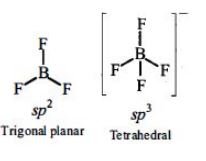
-
- (A) \(BF_3, NF_3, CO_3^{2 - }\)
- (B) \(CO_3^{2 - } , NO_3^- , SO_3\)
- (C) \(NH_3, SO_3, CO_3^{2 - }\)
- (D) \(NCl_3, BCl_3, SO_3\)
Show answer and solution
Correct Answer: (B)
Group Hybridization Shape \((1)\) \(BF_3\)
\(NF_3\)
\(CO_3^{2-}\)
\(sp^2\)
\(sp^3\)
\(sp^2\)
Triangular Planar \((TP)\)
Tetrahedral \((T)\)
\(T.P.\)
\((2)\) \(CO_3^{2-}\)
\(NO_3^-\)
\(SO_3\)
\(sp^2\)
\(sp^2\)
\(sp^2\)
\(\left. \begin{gathered}
T.P. \hfill \\
T.P. \hfill \\
T.P. \hfill \\
\end{gathered} \right\}\) (all have same hybridization)\((3)\) \(NH_3\)
\(SO_3\)
\(CO_3^{2-}\)
\(sp^3\)
\(sp^2\)
\(sp^2\)
\(T\)
\(T.P.\)
\(T.P.\)
\((4)\) \(NCl_3\)
\(BCl_3\)
\(SO_3\)
\(sp^3\)
\(sp^2\)
\(sp^2\)
\(T\)
\(T.P.\)
\(T.P.\)
-
- (A) \(N{O^ + }\)
- (B) \(CO\)
- (C) \(O_2^{2 - }\)
- (D) \(B_2\)
Show answer and solution
Correct Answer: (D)
Total electron\(NO^+\) \(14\)
\(CO\) \(14\)
\(O_2^{2-}\) \(18\)
\(B_2\) \(10\)
\(N{O^ + } \Rightarrow KK.\sigma {(2s)^2}{\sigma ^*}{(2s)^2}.{(\pi 2{p_x})^2}\)
\( = {(\pi 2{p_y})^2}.{(\sigma 2{p_z})^2}\) diamagnetic
\(CO \Rightarrow KK.\sigma {(2s)^2}{\sigma ^*}{(2s)^2}.{(\pi 2{p_x})^2}\)
\( = {(\pi 2{p_y})^2}.{(\sigma 2{p_z})^2}\) diamagnetic
\(O_2^{2 - } \Rightarrow KK.\sigma {(2s)^2}{\sigma ^*}{(2s)^2}.\sigma {(2{p_z})^2}{(\pi 2{p_x})^2}\)
\( = {(\pi 2{p_y})^2}.{\pi ^*}{(2{p_x})^2} = {\pi ^*}{(2{p_y})^2}\) diamagnetic
\({B_2} \Rightarrow KK.\sigma {(2s)^2}{\sigma ^*}{(2s)^2}.\pi {(2{p_x})^1} = \pi {(2{p_y})^1}\) paramagnetic
-
- (A) \(PCl_5,\,IF_5,\, XeO_2F_2\)
- (B) \(BF_3,\,PCl_3,\,XeO_3\)
- (C) \(SF_4,\,XeF_4,\,CCl_4\)
- (D) \(ClF_3,\, XeOF_2,\, XeF_3^+\)
Show answer and solution
Correct Answer: (D)
\(Cl{I_3} \to \) Hybridisation \( = 3 + \frac{1}{2}[7 - 3] = 5\,(s{p^3}d)\)\(XeOF_2 \to \) Hybridisation \( = 3 + \frac{1}{2}[8 - 4] = 5\,(s{p^3}d)\)
\(XeF_3^+ \to \) Hybridisation \( = 3 + \frac{1}{2}[8 - 3 - 1] = 5\,(s{p^3}d)\)
All molecules have \(sp^3d\) hybridization and \(2\) lone pairs. Hence all have identical ( \(T-\) shape).
-
- (A) \(NO_3^-\)
- (B) \(NO_2\)
- (C) \(NO_2^+\)
- (D) \(NO_2^-\)
Show answer and solution
Correct Answer: (C)
The hybridization of \(\mathrm{NO}_{2}^{+}\) is sp.It is a linear molecule.
Rest does not have sp hybridization.
Therefore, the correct option is C.
-
- (A) Assertion is incorrect, reason is correct.
- (B) Assertion is correct, reason is incorrect
- (C) Assertion and reason are correct and reason is the correct explanation for the assertion
- (D) Assertion and reason are correct, but reason is not the correct explanation for the assertion
Show answer and solution
Correct Answer: (B)
Assertion is correct but reason is incorrect. Bonding \(MO\) shows constructive interference of the combining electron oxide waves. -
- (A) \(0.5\)
- (B) \(0.05\)
- (C) \(0\)
- (D) \(1.0\)
Show answer and solution
Correct Answer: (B)
\(1\,e = 1.602 \times {10^{ - 19}}\,C\)\(1\,esu = 3.33 \times {10^{ - 10}}\,C\)
\(\frac{{1\,e}}{{1\,esu}} = \frac{{1.602 \times {{10}^{ - 19}}\,C}}{{3.33 \times {{10}^{ - 10}}\,C}}\)
\(1\,e = 4.802 \times {10^{ - 10}}\,esu\,\)
Dipole moment \(= q \times \) distance
\( \Rightarrow \,1\,D \approx {10^{ - 18}}\,esu\,cm\)
\(0.38 \times {10^{ - 18}}\,esu\,cm = q \times (1.61 \times {10^{ - 8}}\,cm)\)
\(q = 2.36 \times {10^{ - 11}}\,esu\)
\(q = \frac{{2.36 \times {{10}^{ - 11}}\,esu}}{{4.802 \times {{10}^{ - 10}}\,esu}}\)
\(q = 0.049\)
\(q \approx 0.05\) fractional charge
-
- (A) pentagonal planar
- (B) octahedral
- (C) square pyramidal
- (D) trigonal bipyramidal
Show answer and solution
Correct Answer: (C)
In \(XeOF_4\), \(Xe\) is \(sp^3d^2\), hybridised having \(6\) bond pairs and \(1\) lone pair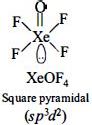
- 163. Amongst \(LiCl, RbCl, BeCl_2\) and \(MgCl_2\) the compounds with the greatest and the least ionic character, respectively are: 2014 Hard
- (A) \(LiCl\) and \(RbCl\)
- (B) \(RbCl\) and \(BeCl_2\)
- (C) \(MgCl_2\) and \(BeCl_2\)
- (D) \(RbCl\) and \(MgCl_2\)
Show answer and solution
Correct Answer: (B)
According to Fajan's rules smaller, highly charged cation has greatest covalent character while large anion with smaller charge has greatest ionic character - 164. The correct order of bond dissociation energy among \(N_2, O_2, O_2^-\) is shown in which of the following arrangements? 2014 Medium
- (A) \(N_2 > O_2^- > O_2\)
- (B) \(O_2^- > O_2 > N_2\)
- (C) \(N_2 > O_2 > O_2^-\)
- (D) \(O_2 > O_2^- > N_2\)
Show answer and solution
Correct Answer: (C)
The bond order of \(N_2,\) \(O_2,\) and \(O_2^-\) are respectively \(3,2\) and \(1.5\)Since higher bond order implies higher bond dissociation energy hence the correct orde will be
\(N_2 > O_2 > O_2^-\)
-
- (A) One \(\sigma \) bond and one \(\pi - \) bond
- (B) One \(\sigma \) bond and two \(\pi - \) bond
- (C) Two \(\sigma \) bond and two \(\pi - \) bond
- (D) Two \(\sigma \) bond and one \(\pi - \) bond
Show answer and solution
Correct Answer: (B)
The structure of \(CaC_2\) is \(Ca^{2+}\) \([: C \equiv C :]^{2-}\) i.e, one \(\sigma \) and two \(\pi \) bonds -
- (A) \(N_2\)
- (B) \(O_2^ - \)
- (C) \(N_2^{2 + }\)
- (D) \(O_2^{2 - }\)
Show answer and solution
Correct Answer: (B)
\(O_2^ - (17) = KK{(\sigma 2s)^2}({\sigma ^*}2{s^2}){(\sigma 2{p_x})^2}\)\({(\pi 2{p_y})^2}{(\pi 2{p_z})^2}{({\pi ^*}2{p_y})^2}{({\pi ^*}2{p_z})^1}\)
one unpaired electron - Paramagnetic
-
- (A) \((CH_3)_3N\)
- (B) \((SiH_3)_3 N\)
- (C) \(P(CH_3)_3\)
- (D) \(P(SiH_3)_3\)
Show answer and solution
Correct Answer: (B)
In case of \(N(SiH_3)_3\, N\) atom is \(sp^2\) hybridised, the lone pair is present in \(2p\) orbital and it is transferred to empty \(d\) orbital of \(Si\) forming \(d\pi -p\pi \) bond . Hence nitrogen with \(sp^2\) hybridization has trigonal planar shape. -
- (A) \(N_2\)
- (B) \(NO\)
- (C) \(CO\)
- (D) \(O_3\)
Show answer and solution
Correct Answer: (B)
The molecular orbital configuration of the molecules given isTotal no. of electrons in \(NO\)
\(=7(N)+8(O)=15\)
Hence \(E.C.\) of \(NO\)
\(KK{[\sigma 2s]^2}{[{\sigma ^*}(2s)]^2}{[\sigma 2{p_z}]^2}\)
\({[\pi (2{p_x})]^2}[\pi {(2{p_y})^2}]{[{\pi ^*}(2{p_x})]^1}\)
Due to presence of one unpaired electron
\(NO\) is paramagnetic.
Except \(NO\) all are diamagnetic dur to absence of unpaired electrons.
-
- (A) \(61\)
- (B) \(38\)
- (C) \(35.5\)
- (D) \(41.5\)
Show answer and solution
Correct Answer: (D)
Given \(e = 1.60 \times 10^{-19}\,C\)\(d = 9.17 \times 10^{-11}\,m\)
From \(\mu = e \times d\)
\(\mu = 1.60 \times 10^{-19} \times 9.17 \times 10^{-11}\)
\(= 14.672 \times 10^{-30}\)
\(\%\) ionic character \( = \frac{{Observed\,dipole\,moment}}{{Dipole\,moment\,for\,100\% \,ionic\,bond}}\)
\( = \frac{{6.104 \times {{10}^{ - 30}}}}{{14.672 \times {{10}^{ - 30}}}} \times 100\)
\( = 41.5\% \)
-
- (A) \({H_2} > {B_2} > L{i_2}\)
- (B) \(L{i_2} > {H_2} > {B_2}\)
- (C) \(L{i_2} > {B_2} > {H_2}\)
- (D) None of these
Show answer and solution
Correct Answer: (D)
None of the given option is correct.The molecular orbital configuration of the given molecules is
\(H_2 = \sigma 1s^2\) (no electron anti-bonding)
\(L{i_2} = \sigma 1{s^2}\,{\sigma ^*}1{s^2}\,\sigma 2{s^2}\,\) (two anti - bonding electrons)
\({B_2} = \sigma 1{s^2}\,{\sigma ^*}1{s^2}\,\sigma 2{s^2}\,{\sigma ^*}2{s^2}\)
\(\left\{ {\pi 2p_y^1 = \pi 2p_z^1} \right\}\)
(\(4\) anti-bonding electrons)
Though the bond order of all the specie are same \((B.O=1)\) but stability is different.
This is due to difference in the presence of no. of anti-bonding electron.
Higher the no. of anti-bonding electron lower is the stability hence the correct order is
\(H_2 > Li_2 >B_2\)
- 171. In which of the following pairs of molecules/ions, both the species are not likely to exist? 2013 Medium
- (A) \(H_{2}^+, He_2^{2-}\)
- (B) \(H_{2}^-, He_2^{2-}\)
- (C) \(H_{2}^{+2}, He_2\)
- (D) \(H_{2}^-, He_2^{2+}\)
Show answer and solution
Correct Answer: (C)
Species having zero or negative bond order do not exist.\(\mathrm{H}_{2}^{2+}(1+1-2=0)=\sigma 1 \mathrm{s}^{0}\)
Bond order \(=0\)
\(\mathrm{He}_{2}(2+2=4)=\sigma 1 \mathrm{s}^{2},{ }^{\star} \mathrm{fs}^{2}\)
Bond order \(=\frac{N_{0}-N_{a}}{2}=\frac{2-2}{2}=0\)
\(\mathrm{So}, \mathrm{both} \mathrm{H}_{2}^{2+}\) and \(\mathrm{He}_{2}\) do not exist.
-
- (A) \(CO_2, NO_2, ClO_2, SiO_2\)
- (B) \(PCl_3,Al Cl_3, BCl_3, SbCl_3\)
- (C) \(BF_3, NF_3, PF_3,Al F_3\)
- (D) \(BF_4^- , CCl_4 , NH_4^+ , PCl_4^+\)
Show answer and solution
Correct Answer: (D)
All have tetrahedral structure - 173. Stability of the species \(Li_2, Li_2^-\) and \(Li_2^+\) increases in the order of : 2013 Medium
- (A) \(Li_2 < Li_2^+ < Li_2^-\)
- (B) \(Li_2^- < Li_2^+ < Li_2\)
- (C) \(Li_2 < Li_2^- < Li_2^+\)
- (D) \(Li_2^- < Li_2 < Li_2^+\)
Show answer and solution
Correct Answer: (B)
Correct option(b) \(\mathrm{Li}_{2}-<\mathrm{Li}_{2}^{+}<\mathrm{Li}_{2}\)
Explanation:
\(\mathrm{Li}_{2}(3+3=6)=\sigma 1 \mathrm{s}^{2}, \quad \hat{\sigma} 1 \mathrm{s}^{2}, \sigma 2 \mathrm{s}^{2}\)
Bond order \(=\frac{N_{b}-N_{a}}{2}=\frac{4-2}{2}=1\)
\(\mathrm{Li}_{2}^{+}(3+3-1=5)=\sigma 1 \mathrm{s}^{2}, \dot{\sigma}^{2} 1 s^{2}, \cdot \sigma 2 s^{1}\)
Bond order \(=\frac{3-2}{2}=\frac{1}{2}=0.5\)
Bond order \(=\frac{4-3}{2}=\frac{1}{2}=0.5\)
Stability order is \(\mathrm{Li}_{2}>\mathrm{Li}_{2}^{+}>\mathrm{Li}_{2}^{-}\) (because Li \(_{2}^{-}\) have more number of electrons in antibonding orbitals which destabilises the species).
- 174. The internuclear distances in \(O -O\) bonds for \(O_2^+ ; O_2 , O_2^-\) and \(O_2^{2-}\) respectively are 2013 Medium
- (A) \(1.30\mathop {\,A}\limits^o ,1.49\,\mathop A\limits^o ,1.12\,\mathop A\limits^o ,1.21\,\mathop A\limits^o \)
- (B) \(1.49\mathop {\,A}\limits^o ,1.21\,\mathop A\limits^o ,1.12\,\mathop A\limits^o ,1.30\,\mathop A\limits^o \)
- (C) \(1.21\mathop {\,A}\limits^o ,1.12\,\mathop A\limits^o ,1.49\,\mathop A\limits^o ,1.30\,\mathop A\limits^o \)
- (D) \(1.12\mathop {\,A}\limits^o ,1.21\,\mathop A\limits^o ,1.30\,\mathop A\limits^o ,1.49\,\mathop A\limits^o \)
Show answer and solution
Correct Answer: (D)
The bond length follows the order\(O_2^+ < O_2 < O_2^- < O_2^{2-}\)
According to this the possible values are
\(1.12\mathop {\,A}\limits^o ,1.21\,\mathop A\limits^o ,1.30\,\mathop A\limits^o ,1.49\,\mathop A\limits^o \)
- 175. The structure of which of the following chloro species can be explained on the basis of \(dsp^2\) hybridization ? 2013 Hard
- (A) \(PdCl_4^{2 - }\)
- (B) \(FeCl_4^{2 - }\)
- (C) \(CoCl_4^{2 - }\)
- (D) \(NiCl_4^{2 - }\)
Show answer and solution
Correct Answer: (A)
\([PdCl_4]^{2-}\) is \(dsp^2\) hybridized and square planar in shape. -
- (A) \(ONCl\) and \(ONO^-\) are isoelectronic.
- (B) \(O_3\) molecule is bent
- (C) Ozone is violet-black in solid state
- (D) Ozone is diamagnetic gas.
Show answer and solution
Correct Answer: (A)
(a) Number of electrons in\(\begin{array}{l}\mathrm{ONCl}=3.2 \mathrm{e}^{-} \\\mathrm{ONO}^{-}=24 \mathrm{e}^{-}\end{array}\)
Thus, ONCl and ONO- are not isoelectronic.
(b) \(\mathrm{O}_{3}\) has bent shape structure. Central atom O is \(s p^{2}\) hybridised with 1 lone pair of electrons.
(c) Ozone is violet-black in solid state.
(d) \(O_{3}\) has no unpaired electrons, thus it is diamagnetic.
- 177. Which one of the following molecules is expected to exhibit diamagnetic behaviour ? 2013 Medium
- (A) \(C_2\)
- (B) \(F_2\)
- (C) \(O_2\)
- (D) \(S_2\)
Show answer and solution
Correct Answer: (A)
The molecules expected to exhibit diamagnetic behavior are
A) \(C_2\) and B) \(F_2\).
A molecule is diamagnetic if all its electrons are paired and paramagnetic if it contains one or more unpaired electrons. Based on Molecular Orbital (MO) theory:
A) \(C_2\) (12 electrons): Configuration is \((\sigma 1 s)^2( \left.\sigma^* 1 s\right)^2(\sigma 2 s)^2\left(\sigma^* 2 s\right)^2\left(\pi 2 p_x\right)^2\left(\pi 2 p_y\right)^2\). All electrons are paired. (Diamagnetic)
B) \(F_2\) (18 electrons): Configuration is \(\sigma 1 s^2 \sigma^* 1 s^2 \sigma 2 s^2 \sigma^* 2 s^2 \sigma 2 p_z^2 \pi 2 p_x^2 \pi 2 p_y^2 \pi^* 2 p_x^2 \pi^* 2 p_y^2\). All electrons are paired. (Diamagnetic)
C) \(O _{ 2 }\) (16 electrons): Has two unpaired electrons in the \(\pi^* 2 p_x\) and \(\pi^* 2 p_y\) orbitals. (Paramagnetic)
D) \(S_2\) (32 electrons): Like \(O_2\), it has two unpaired electrons in its highest occupied molecular orbitals ( \(\pi^* 3 p\) ). (Paramagnetic) -
- (A) \(XeF_4\)
- (B) \(IF_5\)
- (C) \(SbF_5\)
- (D) \(CF_4\)
Show answer and solution
Correct Answer: (B)
The geometry of \(IF_5\) is square pyramidal with an unsymmetric charge distribution therefore this molecule is polar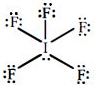
-
- (A) Two \(P\pi - d\pi \) bonds
- (B) One \(P\pi - d\pi \) bonds
- (C) Four \(P\pi - d\pi \) bonds
- (D) Three \(P\pi - d\pi \) bonds
Show answer and solution
Correct Answer: (C)
One \(s\) and three \(p\) orbital undergo \(s p^{3}\) hybridization. Four \(s p^{3}\) hybridorbitals form four \(\sigma\) bonds with oxygen atoms. They are \(\sigma s p^{3}-p .\) Four \(p \pi-d \pi\) bonds are also formed with oxygen atoms by the unpaired electrons.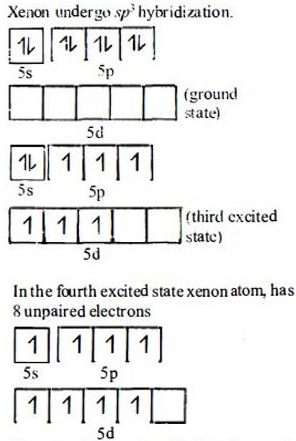

No questions on this page match these filters.