


All JEE Mains 2014 Physics questions
30 chaptersShowing 101–137 of 137 questions
-
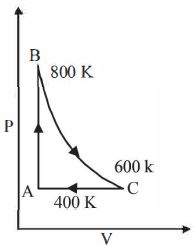
- (A) The change in internal energy in the process \(CA\) is \(700\ R\)
- (B) The change in internal energy in the process \(AB\) is \( -350R\)
- (C) The change in internal energy in the process \(BC\) is \(-500R\)
- (D) The change in internal energy in whole cyclic process is \(250R \)
Show answer and solution
Correct Answer: (C)
In cyclic process, change in total internal energy is zero.\(\Delta {U_{cyclic}} = 0\)
\(\Delta {U_{BC}} = n{C_v}\Delta T = 1 \times \frac{{5R}}{2}\Delta T\)
\(Where,{C_v} = molar\,specific\,heat\,at\,constant\,volume.\)
\(For\,BC,\Delta T = - 200K\)
\(\therefore \,\,\Delta {U_{BC}} = - 500R\)
-
- (A) \(\frac{{{P_0}{T_0}R}}{{{P_0} - \alpha }}\)
- (B) \(\frac{{{P_0}{T_0}R}}{{{P_0} + \alpha }}\)
- (C) \({P_0}{T_0}R\,\ln \,2\)
- (D) \({{P_0}{T_0}R}\)
Show answer and solution
Correct Answer: (A)
\({P_0}{V_0} = nR{T_0}\)\({P_0}V = NRT\)
\({T_f} = 2{T_0}\)
\(W = \int {PdV} \)
\( = \int {\left( {\frac{{nRT}}{V} + \alpha } \right)dV} \)
\(PV = nRT + \alpha V\)
\(\int {PdV = \int\limits_{{T_0}}^{2{T_0}} {nRdT + \int\limits_{{V_1}}^{{V_1}} {\alpha dV} } } \)
\( = nR{T_0} + \alpha \,{V_i}\)
\( = nR{T_0} + \alpha \left( {\frac{{nR{T_0}}}{{{P_0}}}} \right)\)
\( = nR{T_0} \left( {1 + \frac{\alpha }{{{P_0}}}} \right)\)
\(PV = nRT + \alpha V\)
\(\int {PdV = \int {nRdT + \int {\alpha dV} } } \)
\(W = nR{T_0} + \alpha \left[ {\frac{{nR{T_0}}}{{{P_0} - \alpha }}} \right]\)
\(W = nR{T_0}\left[ {1 + \frac{\alpha }{{{P_0} - \alpha }}} \right]\)
\( = n{R_0}{T_0}\left[ {\frac{{{P_0}}}{{{P_0} - \alpha }}} \right]\)
\( = \frac{{nR{T_0}{P_0}}}{{{P_0} - \alpha }}\)
-
- (A) \(8\,min\, 20\, s\)
- (B) \(6\,min\, 2\, s\)
- (C) \(7\, min\)
- (D) \(14\, min\)
Show answer and solution
Correct Answer: (A)
Fromquestion,In \(1\,sec\) heat gained by water
\( = 1\,K\,W - 160J/s\)
\( = 1000\,J/s - 160\,J/s\)
\( = 840\,J/s\)
Total heat required to raise the temperature of water \(\left( {volume\,2L} \right)\,from\,{27^ \circ }c\,to\,{77^ \circ }c\)
\( = {m_{water}} \times sp.ht{\rm{\backslash }}\Delta \theta \)
\( = 2 \times {10^3} \times 4.2 \times 50\)
\(\left[ {mass = density \times volume} \right]\)
\(And,840 \times t = 2 \times {10^3} \times 4.2 \times 50\)
\(or,\,\,\,\,\,\,\,\,\,t = \frac{{2 \times {{10}^3} \times 4.2 \times 50}}{{840}}\)
\(500s = 8\,\min \,20s\)
- 104. In materials like aluminium and copper, the correct order of magnitude of various elastic modulii is 2014 Medium
- (A) Young's modulus \(<\) shear modulus \(<\) bulk modulus
- (B) Bulk modulus \(<\) shear modulus \(<\) Young's modulus
- (C) Shear modulus \(<\) Young's modulus \(<\) bulk modulus
- (D) Bulk modulus \(<\) Young's modulus \(<\) shear modulus
Show answer and solution
Correct Answer: (C)
Poisson's ratio,\(\sigma = \frac{{Iateral\,strain\left( \beta \right)}}{{longitudinal\,strain\left( \alpha \right)}}\)
For material like copper, \(\sigma = 0.33\)
\(And,\,y = 3k\left( {1 - 2\sigma } \right)\)
\(Also,\frac{9}{y} = \frac{1}{k} + \frac{3}{n}\)
\(y = 2n\left( {1 + \sigma } \right)\)
\(Hence,n < y < k\)
-
- (A) \(1.4\,\times 10^4\,N\)
- (B) \(2.7\,\times 10^4\,N\)
- (C) \(3.3\,\times 10^4\,N\)
- (D) \(1.1\,\times 10^4\,N\)
Show answer and solution
Correct Answer: (C)
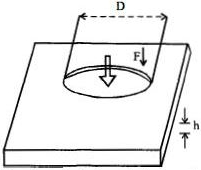
Shearing strain is created along the side surface of the punched disk. Note that the forces exerted on the disk are exerted alongthe circum ference of the disk, and the total force exerted on its center only.
Letus assume that the shearing stress along the side surface of the disk is uniform, then
\(F > \int\limits_{Surface} {d{F_{\max }} = \int\limits_{surface} {{\sigma _{\max }}dA = {\sigma _{\max }}} \int\limits_{surface} {dA} } \)
\( = \int {{\sigma _{\max }}} .A = {\sigma _{\max }}.2\pi \left( {\frac{D}{2}} \right)h\)
\( = 3.5 \times {10^8} \times \left( {\frac{1}{2} \times {{10}^{ - 2}}} \right) \times 0.3 \times {10^{ - 2}} \times 2\pi \)
\( = 3.297 \times {10^4} = 3.3 \times {10^4}N\)
-
- (A) Ethanol \(>\) Water \(>\) Mercury
- (B) Water \(>\) Ethanol \(>\) Mercury
- (C) Mercury \(>\) Ethanol \(>\) Water
- (D) Ethanol \(>\) Mercury \(>\) Water
Show answer and solution
Correct Answer: (A)
\(Compressibility = \frac{1}{{Bulk\,modulus}}\)As bulk modulus is least for ethanol \((0.9)\) and maximum for mercury \((25)\) among ehtanol, mercury and water. Hence
compression in volume \(\frac{{\Delta V}}{V}\)
\(Ethanol>Water>Mercury\)
-
- (A) \(\left( {1 - \frac{d}{R}} \right)\)
- (B) \(\left( {1 - \frac{2d}{R}} \right)\)
- (C) \(\left( {\frac{{R - d}}{{R + d}}} \right)\)
- (D) \(\left( {\frac{{R + d}}{{R - d}}} \right)\)
Show answer and solution
Correct Answer: (A)
Acceleration due to gravity changes with the depth,\(g' = g\left( {1 - \frac{d}{R}} \right)\)
\(pressure,\,P = \rho gh\)
\(Hence\,ratio,\frac{x}{y}is\left( {1 - \frac{d}{R}} \right)\)
-
- (A) \(0.1\)
- (B) \(0.15\)
- (C) \(0.20\)
- (D) \(0.25\)
Show answer and solution
Correct Answer: (A)
Given: Radius of air bubble,\(r = 0.1\,cm = {10^{ - 3}}m\)
Surface tension of liquid,
\(S = 0.06\,N/m = 6 \times {10^{ - 2}}\,N/m\)
Density of liquid, \(\rho = {10^3}\,kg/{m^3}\)
Excess pressure inside the bubble,
\({\rho _{exe}} = 1100N{m^{ - 2}}\)
Depth of bubble below the liquid surface,
\(h=?\)
As we know,
\({\rho _{Excess}} = h\rho g + \frac{{2s}}{r}\)
\( \Rightarrow 1100 = h \times {10^3} \times 9.8 + \frac{{2 \times 6 \times {{10}^{ - 2}}}}{{{{10}^{ - 3}}}}\)
\( \Rightarrow 1100 - 9800h + 120\)
\( \Rightarrow 9800h = 1100 - 120\)
\( \Rightarrow h = \frac{{980}}{{9800}} = 0.1\,m\)
-
- (A) \(R^{2} \sqrt{\frac{\rho_{w} g}{T}}\)
- (B) \(R^{2} \sqrt{\frac{2 \rho_{w} g}{3 T}}\)
- (C) \(R^{2} \sqrt{\frac{3 \rho_{w} g}{T}}\)
- (D) \(R^{2} \sqrt{\frac{\rho_{w} g}{6 T}}\)
Show answer and solution
Correct Answer: (B)
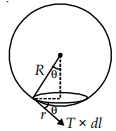
When the bubble gets detached,Buoyant force = force due to surface tension
\(\int T \times d l \sin \theta=\frac{4}{3} \pi R^{3} \rho_{w} g\)
\(\Rightarrow T \times 2 \pi r \times \frac{r}{R}=\frac{4}{3} \pi R^{3} \rho_{w} g\)
\(\Rightarrow r^{2}=\frac{2 R^{4} \rho_{w g} g}{3}\)
\(\Rightarrow r=R^{2} \sqrt{\frac{2 \rho_{w D g}}{3 T}}\)
-
- (A) \(4PV+3ST = 0\)
- (B) \(3PV+4ST = 0\)
- (C) \(2PV+3ST = 0\)
- (D) \(3PV+2ST = 0\)
Show answer and solution
Correct Answer: (B)
Let \(P_i\) and \(R_i\) be the inside pressure and radius of the ith soap bubble respectively.\(\therefore {P_1} = P + \frac{{4T}}{{{R_1}}}.\,\,\,{P_2} = P + \frac{{4T}}{{{R_2}}}\,\,and\,\,{P_3} = P + \frac{{4T}}{{{R_3}}}\)
\(Also\,{P_1}{V_1} + {P_2}{V_2} = {P_3}{V_3}\)
\(\therefore \left( {P + \frac{{4T}}{{{R_1}}}} \right)\frac{{4\pi }}{3}R_1^3 + \left( {P + \frac{{4T}}{{{R_2}}}} \right)\frac{{4\pi }}{3}R_2^3\)
\( = \left( {p + \frac{{4T}}{{{R_3}}}} \right)\frac{{4\pi }}{3}R_3^3\)
\(P\left( {\frac{{4\pi }}{3}R_1^3 + \frac{{4\pi }}{3}R_2^3 - \frac{{4\pi }}{3}R_3^2} \right)\)
\( + \frac{{4T}}{3}\left( {4\pi R_1^2 + 4\pi R_2^2 - 4\pi R_3^2} \right) = 0\)
\(P\left( {{V_1} + {V_2} - {V_3}} \right) + \frac{{4T}}{3}\left( {{S_1} - {S_2} - {S_3}} \right) = 0\)
\(PV + \frac{{4T}}{3}S = 0\,\,\,\,\,\,\, \Rightarrow \,\,\,\,3PV + 4ST = 0\)
-
- (A) \(\frac{{2A}}{{\pi {a^2}}}\sqrt {\frac{h}{g}} \)
- (B) \(\frac{{\sqrt 2A }}{{\pi {a^2}}}\sqrt {\frac{h}{g}} \)
- (C) \(\frac{{2\sqrt 2A }}{{\pi {a^2}}}\sqrt {\frac{h}{g}} \)
- (D) \(\frac{A}{{\sqrt 2 \pi {a^2}}}\sqrt {\frac{h}{g}} \)
Show answer and solution
Correct Answer: (B)
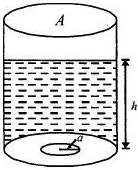
Let the rate of falling water level be \( - \frac{{dh}}{{dt}}\)Initially at \(t = 0\,;\,h = h\)
\(t = t\,;h = 0\)
\(Then,\,A\left( { - \frac{{dh}}{{dt}}} \right) = \pi {a^2}.v\)
\(\left[ {Velocity\,of\,efflux\,of\,liquid\,v = \sqrt {2gh} } \right]\)
Integrating both sides
\(\int\limits_0^t {dt = - \frac{A}{{\sqrt {2g} \pi {a^2}}}{{\int\limits_h^0 h }^{ - 1/2}}dh} \)
\(\left[ t \right]_0^t = - \frac{A}{{\sqrt {2g} \pi {a^2}}} \cdot \left[ {\frac{{{h^{1/2}}}}{{1/2}}} \right]_h^0\)
\(t = \frac{{\sqrt 2 A}}{{\pi {a^2}}}\sqrt {\frac{h}{g}} \)
-
- (A) \(10.7\)
- (B) \(9.6\)
- (C) \(8.5\)
- (D) \(7.6\)
Show answer and solution
Correct Answer: (B)
\({h_1}{\rho _1}g + {h_2}{\rho _2}g = \frac{1}{2}{\rho _1}{v^2}\)\( \Rightarrow 1000 \times 10 \times 3 + 800 \times 10 \times 2\)
\( = \frac{1}{2} \times 1000 \times {v^2}\)
\( \Rightarrow {v^2} = 2 \times \frac{{46000}}{{1000}}\)
\( \Rightarrow v = \sqrt {92} = 9.6\,m/s\)
-
- (A) \(22\)
- (B) \(38\)
- (C) \(6 \)
- (D) \(16 \)
Show answer and solution
Correct Answer: (D)
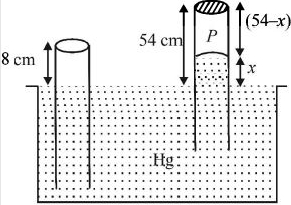
Length of the air column above mercury in the tube is,\(p + x = {P_0}\)
\( \Rightarrow p = \left( {76 - x} \right)\)
\( \Rightarrow 8 \times A \times 76 = \left( {76 - x} \right) \times A \times \left( {54 - x} \right)\)
\(\therefore \,x = 38\)
Thus, lenght of air column \(=54-38=16\,cm.\)
-
- (A) \(7.5\)
- (B) \(8.0\)
- (C) \(10.0\)
- (D) \(12.5\)
Show answer and solution
Correct Answer: (A)
According to \(Bernoulli's\) theorem,\({p_1} + \frac{1}{2}\rho v_1^2 = {P_2} + \frac{1}{2}\rho v_2^2\)
\(\therefore v_2^2 - v_1^2 = 2gh\) \(...\left( 1 \right)\)
According to the equation of continuty
\({A_1}{v_1} = {A_2}{v_2}\) \(...(2)\)
\(\frac{{{A_1}}}{{{A_2}}} = \frac{{6\,m{m^2}}}{{10\,m{m^2}}}\)
\(From\,equation\,\left( 2 \right),\frac{{{A_1}}}{{{A_2}}} = \frac{{{v_2}}}{{{v_1}}} = \frac{6}{{16}}\)
\(or,\,\,{v_2} = \frac{6}{{10}}{v_1}\)
Putting this value of \(v_2\) in equation \((1)\)
\({\left( {\frac{6}{{10}}{v_1}} \right)^2} - {\left( {{v_1}} \right)^2} = 2 \times {10^3} \times 5\)
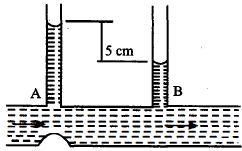
\(\left[ \begin{array}{l}
g = 10m/{s^2} = {10^3}cm/{s^2}\\
and\,h = 5\,cm
\end{array} \right]\)\(Solving\,we\,get\,{v_1} = \frac{{10}}{8}\)
Therefore the rate at which water flows through the tube
\( = {A_1}{v_1} = {A_2}{v_2} = \frac{{6 \times 10}}{8} = 7.5cc/s\)
-
- (A) \(3.5\times10^5\, J\)
- (B) \(4.05\times10^4\, J\)
- (C) \(3.0\times10^5\, J\)
- (D) \(9.0\times10^4\, J\)
Show answer and solution
Correct Answer: (B)
Total volume of rain drops, recrived \(100\,cm\) in a year by area \(1\,m^2\)\( = 1{m^2} \times \frac{{100}}{{100}}m = 1\,{m^3}\)
As we know, density of water,
\(d = {10^3}\,kg/{m^3}\)
Therefore, mass of this volume of water,
\(M = d \times v = {10^3} \times 1 = {10^3}\,kg\)
Average terminal velocity of rain drop
\(v = 9\,m/s\,\left( {given} \right)\)
Therefore, energy transferred by rain,
\(E = \frac{1}{2}m{v^2}\)
\( = \frac{1}{2} \times {10^3} \times {\left( 9 \right)^2}\)
\( = \frac{1}{2} \times {10^3} \times 81 = 4.05 \times {10^4}J\)
-
- (A) \(10^{-1}\,N/m^2\)
- (B) \(10^{-2}\,N/m^2\)
- (C) \(10^{-3}\,N/m^2\)
- (D) \(10^{-4}\,N/m^2\)
Show answer and solution
Correct Answer: (B)
\(\eta = {10^{ - 2}}poise\)\(v = 18\,km/h = \frac{{18000}}{{3600}} = 5m/s\)
\(l = 5\,m\)
\(Strain\,rate = \frac{v}{l}\)
Coefficient of viscosity,
\(\eta = \frac{{shearing\,stress}}{{strain\,rate}}\)
\(\therefore \,Shearing\,stress = \eta \times strain\,rate\)
\( = {10^{ - 2}} \times \frac{5}{5} = {10^{ - 2}}N{m^{ - 2}}\)
-
- (A) \(\frac{{1 + cos\alpha }}{{1 - cos\alpha }}\)
- (B) \(\;\frac{{1 + tan\alpha }}{{1 - tan\alpha }}\)
- (C) \(\;\frac{{1 + sin\alpha }}{{1 - cos\alpha }}\)
- (D) \(\;\frac{{1 + sin\alpha }}{{1 - sin\alpha }}\)
Show answer and solution
Correct Answer: (B)
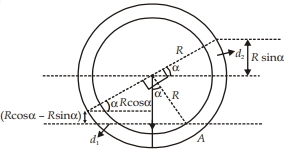
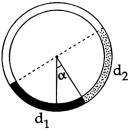
Equating pressure at \(A\)\(\left( {R\cos \alpha + R\sin \alpha } \right){d_2}g = \left( {R\cos \alpha - R\sin \alpha } \right){d_1}g\)
\( \Rightarrow \frac{{{d_1}}}{{{d_2}}} = \frac{{\cos \alpha + \sin \alpha }}{{\cos \alpha - \sin \alpha }} = \frac{{1 + \tan \alpha }}{{1 - \tan \alpha }}\)
-
- (A) \(\left( { - 3\hat i + 4\hat j\,} \right)\,N\)
- (B) \(\left( { - \frac{3}{5}\hat i + \frac{4}{5}\hat j\,} \right)\,N\)
- (C) \(\left( {3\hat i - 4\hat j\,} \right)\,N\)
- (D) \(\left( {\frac{3}{5}\hat i - \frac{4}{5}\hat j\,} \right)\,N\)
Show answer and solution
Correct Answer: (A)
\(\begin{array}{l}
From\,question,\\
Mass\,of\,body,\,m = 5\,kg\\
Vleocity\,at\,t = 0,\\
u = \,\left( {6\hat i - 2\hat j} \right)\,m/s\\
Velocity\,at\,t = 10s,\\
v = + 6\,\hat j\,m/s\\
Force,\,F = ?
\end{array}\)\(\begin{array}{l}
Acceleration,\,a = \frac{{v - u}}{t}\\
= \frac{{6\hat j - \left( {6\hat i - 2\hat j} \right)}}{{10}} = - 3\hat i + 4\hat j\,m/{s^2}\\
Force,\,F = ma\\
= 5 \times \frac{{\left( {3\hat i + 4\hat j} \right)}}{5} = \left( { - 3\hat i + 4\hat j} \right)\,N
\end{array}\) -
- (A) \(22.5\)
- (B) \(15\)
- (C) \(33.7\)
- (D) \(45\)
Show answer and solution
Correct Answer: (A)
\(F=v \frac{d m}{d t}\)\(=v A \rho v\)
\(=v^{2} A \rho\)
\(=(1.5)^{2} \times 10^{-2} \times 10^{3}\)
\(=2.25 \times 10=22.5 N\)
-
- (A) \(\sqrt {2\sqrt 2 \frac{{GM}}{R}} \;\;\;\;\;\;\;\;\;\;\;\;\;\;\)
- (B) \(\;\sqrt {\frac{{GM}}{R}\left( {1 + 2\sqrt 2 } \right)} \)
- (C) \(\frac{1}{2}\sqrt {\frac{{GM}}{R}\left( {1 + 2\sqrt 2 } \right)} \)
- (D) \(\;\sqrt {\frac{{GM}}{R}} \)
Show answer and solution
Correct Answer: (C)
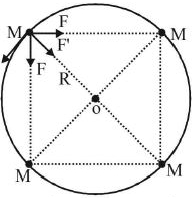
\(2F\cos {45^{ \circ}} + F' = \frac{{M{v^2}}}{R}\,\,\,\,\left( {From\,figure} \right)\)\(where\,F = \frac{{G{M^2}}}{{{{\left( {\sqrt 2 R} \right)}^2}}}\,and\,F' = \frac{{G{M^2}}}{{4{R^2}}}\)
\( \Rightarrow \frac{{2 \times G{M^2}}}{{\sqrt 2 {{\left( {R\sqrt 2 } \right)}^2}}} + \frac{{G{M^2}}}{{4{R^2}}} = \frac{{M{v^2}}}{R}\)
\( \Rightarrow \frac{{G{M^2}}}{R}\left[ {\frac{1}{4} + \frac{1}{{\sqrt 2 }}} \right] = M{v^2}\)
\(\therefore \,v = \sqrt {\frac{{Gm}}{R}\left( {\frac{{\sqrt 2 + 4}}{{4\sqrt 2 }}} \right)} = \frac{1}{2}\sqrt {\frac{{Gm}}{R}\left( {1 + 2\sqrt 2 } \right)} \)
-
- (A) \(\frac{{41G{M^2}}}{{3600{R^2}}}\)
- (B) \(\frac{{41G{M^2}}}{{450{R^2}}}\)
- (C) \(\frac{{59G{M^2}}}{{450{R^2}}}\)
- (D) \(\frac{{G{M^2}}}{{225{R^2}}}\)
Show answer and solution
Correct Answer: (A)
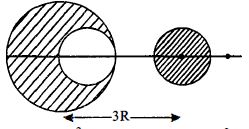
Volume of removed sphere\({V_{remo}} = \frac{4}{3}\pi {\left( {\frac{R}{2}} \right)^3} = \frac{4}{3}\pi {R^3}\left( {\frac{1}{8}} \right)\)
Volume of the sphere (remaining)
\({V_{remain}} = \frac{4}{3}\pi {R^3} - \frac{4}{3}\pi {R^3}\left( {\frac{1}{8}} \right)\)
\( = \frac{4}{3}\pi {R^3}\left( {\frac{7}{8}} \right)\)
Therefore mass of sphere carved and remaining sphere are at respectively \(\frac{1}{8}\,M\,and\,\frac{7}{8}\,M.\)
Therefore, gravitational force between these two sphere
\(F = \frac{{GMm}}{{{r^2}}}\)
\( = \frac{{G\frac{{7M}}{8} \times \frac{1}{8}M}}{{{{\left( {3R} \right)}^2}}} = \frac{7}{{64 \times 9}}\frac{{G{M^2}}}{{{R^2}}}\)
\( = \frac{{41}}{{3600}}\frac{{G{M^2}}}{{{R^2}}}\)
-
- (A) \(500\)
- (B) \(320\)
- (C) \(260\)
- (D) \(220\)
Show answer and solution
Correct Answer: (C)
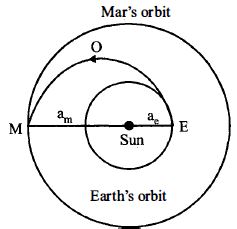
semi major axis of mangalyan\({a_{Mn}} = \frac{{{a_c} + {a_m}}}{2}\)
\( = 1.89 \times {10^{11}}m\)
From kepler's law
\({T^2} \propto {R^3}\)
\(\therefore \,{\left( {\frac{{{T_{mn}}}}{{Te}}} \right)^2} = {\left( {\frac{{{R_M}}}{{{\operatorname{R} _e}}}} \right)^3}\)
\(\therefore {T_{Mn}} = 518\,days\)
\(\therefore \operatorname{Re} duired\,time\, = \frac{{518}}{2} = 260\,days\)
-
- (A) \(71\)
- (B) \(13\sqrt {58}\)
- (C) \(-71\)
- (D) \(1\)
Show answer and solution
Correct Answer: (D)
Gravitational field, \(I = \left( {5\hat i + 12\hat j} \right)\,N/kg\)\(I = - \frac{{dv}}{{dr}}\)
\(v = - \left[ {\int\limits_0^x {{I_x}dx + \int\limits_0^y {{I_y}dy} } } \right]\)
\( = - \left[ {{I_x}.x + {I_y}.y} \right]\)
\( = - \left[ {5\left( {7 - 0} \right) + 12\left( { - 3 - 0} \right)} \right]\)
\( = - \left[ {35 + \left( { - 36} \right)} \right] = 1J/kg\)
i.e., change in gravitational potential \(1J/kg\)
Hence change in gravitational potential energy \(1J\)
-
- (A) \(v_1 = v_2\)
- (B) \(\begin{array}{l}
{v_1}{\mkern 1mu} = {\mkern 1mu} {m_2}{\mkern 1mu} \sqrt {\frac{{2G}}{{d({m_1} + {m_2})}}} \\
{v_2}{\mkern 1mu} = {\mkern 1mu} {m_1}{\mkern 1mu} \sqrt {\frac{{2G}}{{d({m_1} + {m_2})}}}
\end{array}\) - (C) \(\begin{array}{l}
{v_1}{\mkern 1mu} = {\mkern 1mu} {m_1}{\mkern 1mu} \sqrt {\frac{{2G}}{{d({m_1} + {m_2})}}} \\
{v_2}{\mkern 1mu} = {\mkern 1mu} {m_2}{\mkern 1mu} \sqrt {\frac{{2G}}{{d({m_1} + {m_2})}}}
\end{array}\) - (D) \(\begin{array}{l}
{v_1}\, = \,{m_2}\,\sqrt {\frac{{2G}}{{{m_1}}}} \\
{v_2}\, = \,{m_2}\,\sqrt {\frac{{2G}}{{{m_2}}}}
\end{array}\)
Show answer and solution
Correct Answer: (B)
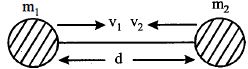
We choose reference point, infinity, where total energy of the system is zero.So initial energy of the system \(=0\)
Final energy
\( = \frac{1}{2}{m_1}v_1^2 + \frac{1}{2}{m_2}v_2^2=\frac{{G{m_1}{m_2}}}{d}\)
From conservation of energy,
\(Initial\, energy=Final\, energy\)
\(\therefore 0 = \frac{1}{2}{m_1}v_1^2 + \frac{1}{2}{m_2}v_2^2 = \frac{{G{m_1}{m_2}}}{d}\)
\(or\,\frac{1}{2}{m_1}v_1^2 + \frac{1}{2}{m_1}v_2^2 = \frac{{G{m_1}{m_2}}}{d}\,\,...\left( i \right)\)
By conservation of linear momentum
\({m_1}{v_1} + {m_2}{v_2} = 0\)
\(or\,\frac{{{v_1}}}{{{v_2}}} = \frac{{{m_2}}}{{{m_1}}} \Rightarrow {v_2} = - \frac{{{m_1}}}{{{m_2}}}{v_1}\)
Putting value of \(v_2\) in equation \((1)\), we get
\({m_1}v_1^2 + {m_2}{\left( { - \frac{{{m_1}{v_1}}}{{{m_2}}}} \right)^2} = \frac{{2G{m_1}{m_2}}}{d}\)
\(\frac{{{m_1}{m_2}v_1^2 + m_1^2v_1^2}}{{{m_2}}} = \frac{{2G{m_1}{m_2}}}{d}\)
\({v_1} = \sqrt {\frac{{2Gm_2^2}}{{d\left( {{m_1} + {m_2}} \right)}}} = {m_2}\sqrt {\frac{{2G}}{{d\left( {{m_1} + {m_2}} \right)}}} \)
\(Similarly\,{v_2} = {m_1}\sqrt {\frac{{2G}}{{d\left( {{m_1} + {m_2}} \right)}}} \)
-
- (A) \(\frac{{{n^2}}}{{2n - 1}}\)
- (B) \(\frac{{2{n^2}}}{{n - 1}}\)
- (C) infinite
- (D) \(n\)
Show answer and solution
Correct Answer: (A)
\(\begin{array}{l}
\left( a \right)\,\,\,\,\,\,Let\,u\,be\,the\,initial\,velocity\,of\,the\,bullet\,of\,\\
\,\,\,\,\,\,\,\,\,\,\,\,mass\,m.\\
\,\,\,\,\,\,\,\,\,\,\,\,After{\rm{ passing}}\,through\,a\,plank\,of\,width\,x,\\
\,\,\,\,\,\,\,\,\,\,\,\,its\,velocity\,decreases\,to\,v.\\
\,\,\,\,\,\,\,\,\,\,\,\,\therefore \,u - v = \frac{4}{n}\,{\kern 1pt} or,\,v = u - \frac{4}{n} = \frac{{u\left( {n - 1} \right)}}{n}\\
\,\,\,\,\,\,\,\,\,\,\,\,\,IfF\,be\,the\,retarding\,force\,applied\,d\,by\,each\,\\
\,\,\,\,\,\,\,\,\,\,\,\,\,plank,\,then\,{\rm{ using}}\,work\, - \,energy\,theorem,\\
Fx = \frac{1}{2}m{u^2} - \frac{1}{2}m{v^2} = \frac{1}{2}m{u^2} - \frac{1}{2}m{u^2}\frac{{\left( {n - {1^2}} \right)}}{{{n^2}}}\\
\,\,\,\,\,\,\,\,\,\,\,\,\,\,\, = \frac{1}{2}m{u^2}\left[ {\frac{{1 - \left( {n - {1^2}} \right)}}{{{n^2}}}} \right]
\end{array}\)\(\begin{array}{l}
Fx = \frac{1}{2}m{u^2}\left( {\frac{{2n - 1}}{{{n^2}}}} \right)\\
Let\,P\,be\,the\,number\,of\,planks\,required\,to\,\\
stope\,the\,bullet.\\
Total\,{\rm{distance}}\,travelled\,by\,the\,bullet\,be\,fore\\
{\rm{ coming}}\,torest = Px\\
{\rm{Using}}\,{\rm{work - energy}}\,{\rm{theorem}}\,{\rm{aging,}}\\
F\left( {Px} \right) = \frac{1}{2}m{u^2} - 0\\
or,\,P\left( {Fx} \right) = P\left[ {\frac{1}{2}m{u^2}\frac{{\left( {2n - 1} \right)}}{{{n^2}}}} \right] = \frac{1}{2}m{u^2}\\
\therefore \,P = \,\frac{{{n^2}}}{{2n - 1}}\,
\end{array}\) -
- (A) \(\frac {1}{2}\,mv^2\)
- (B) \(mv^2\)
- (C) \(\frac {1}{3}\,mv^2\)
- (D) \(\frac {1}{6}\,mv^2\)
Show answer and solution
Correct Answer: (D)
We can find the effective mass of the spring by finding its kinetic energy. This requires adding all the length elements' kinetic energy, and requires the following integral:\(T=\int_{m} \frac{1}{2} u^{2} d m\)
since the spring is uniform, \(d m=\left(\frac{d y}{L}\right) m,\) where \(L\) is the length of the spring. Hence,
\(T =\int_{0}^{L} \frac{1}{2} u^{2}\left(\frac{d y}{L}\right) m\)
\(=\frac{1}{2} \frac{m}{L} \int_{0}^{L} u^{2} d y\)
The velocity of each mass element of the spring is directly proportional to its length, i.e.
\(u=\frac{v y}{L},\) from which it follows\(:\)
\({T=\frac{1}{2} \frac{m}{L} \int_{0}^{L}\left(\frac{v y}{L}\right)^{2} d y}\)
\({=\frac{1}{2} \frac{m}{L^{3}} v^{2} \int_{0}^{L} y^{2} d y}\)
\({=\frac{1}{2} \frac{m}{L^{3}} v^{2}\left[\frac{y^{3}}{3}\right]_{0}^{L}}\)
\({=\frac{1}{2} \frac{m}{3} v^{2}}\)
-
- (A) \(\frac{u}{{12}}\left( {\hat i\, + \,\sqrt 3 \hat j} \right)\)
- (B) \(\frac{u}{{12}}\left( {\hat i\, - \,\sqrt 3 \hat j} \right)\)
- (C) \(\frac{u}{{12}}\left( {-\hat i\, + \,\sqrt 3 \hat j} \right)\)
- (D) \(\frac{u}{{12}}\left( {-\hat i\, - \,\sqrt 3 \hat j} \right)\)
Show answer and solution
Correct Answer: (D)
From the law of consevation of momentum we know that,\(\begin{array}{l}
{m_1}{u_1} + {m_2}{u_2} + ...... = {m_1}{v_1} + {m_2}{v_2} + ....\\
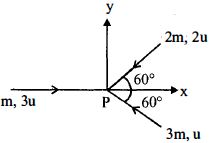
Given\,{m_1}\, = \,m,{m_2} = 2m\,and\,{m_3} = 3m\\
and\,{u_1} = 3u,\,{u_2} = 2u\,and\,{u_3} = u
\end{array}\)Let the velocity when the stick \(= \overrightarrow v \)
Then, according to question,
\(\begin{array}{l}
m \times 3u\left( i \right) + 2m \times 2u\left( { - \hat i\cos {{60}^ \circ } - \hat j\sin {{60}^ \circ }} \right)\\
+ 3\,m \times u\left( { - \hat i\cos {{60}^ \circ } + \hat j\sin {{60}^ \circ }} \right)\\
= \left( {m + 2m + 3m} \right)\,\overrightarrow v \\
\Rightarrow \,3mu\hat i - 4mu\frac{{\hat i}}{2} - 4mu\left( {\frac{{\sqrt 3 }}{2}\hat j} \right) - 3mu\frac{{\hat i}}{2}\\
\,\,\,\,\,\,\,\,\,\,\,\,\,\,\,\,\,\,\,\,\,\,\,\,\,\,\,\,\,\,\,\,\,\,\,\,\,\, + 3mu\left( {\frac{{\sqrt 3 }}{2}\hat j} \right) = 6m\,\overrightarrow v \\
\Rightarrow \,mu\hat i\, - \frac{3}{2}mu\hat i - \frac{{\sqrt 3 }}{2}mu\hat j = 6m\,\overrightarrow v \\
\Rightarrow \frac{1}{2}mu\hat i - \frac{{\sqrt 3 }}{2}mu\hat j = 6m\,\overrightarrow v \\
\Rightarrow \,\overrightarrow v = \frac{u}{{12}}\,\left( { - \hat i - \sqrt 3 \hat j} \right)
\end{array}\)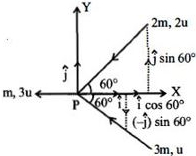
-
- (A) \(\frac{1}{2}\left( {a{L^2} + b{L^3}} \right)\)
- (B) \(\;\frac{{a{L^2}}}{2} + \frac{{b{L^3}}}{3}\)
- (C) \(\;\frac{1}{2}\) \(\left( {\frac{{a{L^2}}}{2} + \frac{{b{L^3}}}{3}} \right)\)
- (D) \(\;a{L^2} + b{L^3}\)
Show answer and solution
Correct Answer: (B)
Work done in stretching the \(rubber-band\) by a distance \(dx\) is\(dW =F dx =\) \(\left( {ax + b{x^2}} \right)dx\)
Integrating both sides,
\(W = \int\limits_0^L {axdx} \, + \,\int\limits_0^L {b{x^2}\,dx = \frac{{a{L^2}}}{2}} + \frac{{b{L^3}}}{3}\)
-
- (A) \(1.73\)
- (B) \(3.0\)
- (C) \(3.46\)
- (D) \(6.0\)
Show answer and solution
Correct Answer: (B)
\(\begin{array}{l}
Given\,:\,m = 0.160kg\\
\theta = {60^ \circ }\\
V = 10\,m/s\\
Angular\,momentu\,m\,L = \vec r \times m\,\vec V\\
= H\,mv\,\cos \theta \\
= \,mv\frac{{{V^2}{{\sin }^2}\theta }}{{2g}}\cos \theta \,\,\,\left[ {H = \frac{{{V^2}{{\sin }^2}\theta }}{{2g}}} \right]\\
= \frac{{{{10}^2} \times {{\sin }^2}{{60}^ \circ } \times \cos {{60}^ \circ }}}{{2 \times 10}} \times \left( {0.16 \times 10} \right)\\
= 3\,kg\,{m^2}/s
\end{array}\) -
- (A) \(\sin \,\phi = \,\cos \,\phi \)
- (B) \(\sin \,\phi = \frac{1}{2}\,\cos \,\theta \)
- (C) \(\sin \,\phi = \frac{2}{3}\,\cos \,\theta \)
- (D) \(\sin \,\phi = \frac{3}{4}\,\cos \,\theta \)
Show answer and solution
Correct Answer: (C)
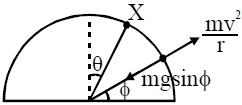
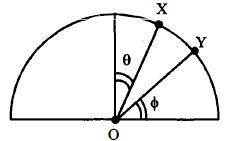
\(\frac{\mathrm{mv}^{2}}{\mathrm{r}}=\mathrm{mg} \sin \phi\) \(...(i)\)\(\mathrm{mg} \mathrm{r} \cos \theta=\frac{1}{2} \mathrm{mv}^{2}+\mathrm{rg} \sin \phi\)
\(\frac{\mathrm{v}^{2}}{\mathrm{rg}}=2 \cos \theta-2 \sin \phi \ldots \ldots(\mathrm{ii})\)
\(\sin \phi=2 \cos \theta-2 \sin \phi\)
\(3 \sin \phi=2 \cos \theta\)
\(\sin \phi=\frac{2}{3} \cos \phi\)
-
- (A) \(1.0\)
- (B) \(4.2\)
- (C) \(6.17\)
- (D) \(9.8\)
Show answer and solution
Correct Answer: (C)
\(\begin{array}{l}
Let\,'t'\,be\,the\,\,time\,taken\,by\,the\,bullet\,\,to\,hit\,the\,{\rm{target}}{\rm{.}}\\
\therefore \,{\rm{700 = }}\,{\rm{m = 63}}{{\rm{0}}^{ - 1}}t\\
\Rightarrow t = \frac{{700m}}{{630m{s^{ - 1}}}} = \frac{{10}}{9}\sec \\
For\,velrtical\,motion,\\
Here,\,u = 0\\
\therefore \,h = \frac{1}{2}g{t^2}
\end{array}\)\(\begin{array}{l}
= \frac{1}{2} \times 10 \times {\left( {\frac{{10}}{9}} \right)^2}\\
= \frac{{500}}{{81}}m = 6.17\,m\\
Therefore,\,the\,rifle\,must\,be\,{\rm{aimed}}\,{\rm{6}}{\rm{.17}}\,{\rm{m}}\,{\rm{above}}\,{\rm{the}}\,{\rm{center}}\,{\rm{of}}\,{\rm{the}}\,\\
{\rm{target}}\,{\rm{to}}\,{\rm{hit}}\,{\rm{the}}\,{\rm{target}}{\rm{.}}\,
\end{array}\) -
- (A) \({\tan ^{ - 1}}\frac{2}{3}\)
- (B) \({\tan ^{ - 1}}\frac{3}{2}\)
- (C) \({\tan ^{ - 1}}\frac{7}{4}\)
- (D) \({\tan ^{ - 1}}\frac{4}{5}\)
Show answer and solution
Correct Answer: (C)
\(\begin{array}{l}
\,\,\,\,\,\,\,\,\,From\,question,\\
\,\,\,\,\,\,\,\,\,Horizontal\,velocity\,\left( {initial} \right),\\
\,\,\,\,\,\,\,\,\,{u_x} = \frac{{40}}{2} = 20m/s\\
\,\,\,\,\,\,\,\,\,Vertical\,velocity\,\left( {initial} \right),\\
\,\,\,\,\,\,\,\,\,\,50 = {u_y}t + \frac{1}{2}g{t^2}\\
\Rightarrow \,{u_y} \times 2 + \frac{1}{2}\left( { - 10} \right) \times 4\\
or,\,50 = 2{u_y} - 20
\end{array}\)\(\begin{array}{l}
or,\,\,{u_y} = \frac{{70}}{2} = 35m/s\\
\therefore \,\tan \,\theta = \frac{{{u_y}}}{{{u_x}}} = \frac{{35}}{{20}} = \frac{7}{4}\\
\Rightarrow \,\,Angle\,\theta {\tan ^{ - 1}}\frac{7}{4}
\end{array}\) -
- (A) \(gH=(n-2)^2u^2\)
- (B) \(2gH=nu^2(n-2)\)
- (C) \(gH=(n-2)u^2\)
- (D) \(2gH=n^2u^2\)
Show answer and solution
Correct Answer: (B)
\(\begin{array}{l}
Speed\,on\,reaching\,ground\,v = \sqrt {{u^2} + 2gh} \\
Now,\,v = u + at\\
\Rightarrow \,\,\,\,\sqrt {{u^2} + 2gh} = - u + gt\\
Time\,taken\,to\,reach\,highest\,{\rm{point}}\,is\,t = \frac{u}{g},\\
\Rightarrow t = \frac{{u + \sqrt {{u^2} + 2gH} }}{g} = \frac{{nu}}{g}\left( {from\,question} \right)\\
\Rightarrow 2gH = n\left( {n - 2} \right){u^2}
\end{array}\)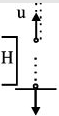
-
- (A) \(\frac{{M\alpha }}{{4\pi {R^2}\sigma }}\,\ln \left( {\frac{3}{2}} \right)\)
- (B) \(\frac{{M\alpha }}{{4\pi {R^2}\sigma }}\,\ln \left( {\frac{16}{3}} \right)\)
- (C) \(\frac{{M\alpha }}{{16\pi {R^2}\sigma }}\,\ln \left( {\frac{16}{3}} \right)\)
- (D) \(\frac{{M\alpha }}{{16\pi {R^2}\sigma }}\,\ln \left( {\frac{3}{2}} \right)\)
Show answer and solution
Correct Answer: (C)
In the given problem, fall in temperature of sphere,\(dT = \left( {3{T_0} - 2{T_0}} \right) = {T_0}\)
Tmperature of surrounding, \({T_{surr}} = {T_0}\)
Initial temperature of sphere, \({T_{initial}} = 3{T_0}\)
Specific heat of the material of the sphere varies as,
\(c = \alpha {T^3}\,per\,unit\,mass\,\left( {\alpha = a\,constant} \right)\)
Applying formula,
\(\frac{{dT}}{{dt}} = \frac{{\sigma A}}{{McJ}}\left( {{T^4} - T_{surr}^4} \right)\)
\( \Rightarrow \frac{{{T_0}}}{{dt}} = \frac{{\sigma 4\pi {R^2}}}{{M\alpha {{\left( {3{T_0}} \right)}^3}\,J}}\left[ {{{\left( {3{T_0}} \right)}^4} - {{\left( {{T_0}} \right)}^4}} \right]\)
\( \Rightarrow dt = \frac{{M\alpha 27T_0^4J}}{{\alpha 4\pi {R^2} \times 80T_0^4}}\)
Solving we get,
Time taken for the sphere to cool down temperature \(2{T_{{0^,}}}\)
\(t = \frac{{M\alpha }}{{16\pi {R^2}\sigma }}In\left( {\frac{{16}}{3}} \right)\)
-
- (A) \(3.75\)
- (B) \(8.6\)
- (C) \(9.6\)
- (D) \(6.5\)
Show answer and solution
Correct Answer: (B)
From \(Newton's\,law\) of cooling,\(t = \frac{1}{k}{\log _e}\left( {\frac{{{\theta _2} - {\theta _0}}}{{{\theta _1} - {\theta _0}}}} \right)\)
From question and above equation,
\(5 = \frac{1}{k}{\log _e}\frac{{\left( {40 - 30} \right)}}{{\left( {80 - 130} \right)}}\,\,\,\,\,\,\,\,\,\,\,\,\,\,...\left( 1 \right)\)
\(And,t = \frac{1}{k}{\log _e}\frac{{\left( {32 - 30} \right)}}{{\left( {62 - 30} \right)}}\,\,\,\,\,\,\,\,\,\,\,\,\,\,\,\,...\left( 2 \right)\)
Dividing equation \((2)\) by \((1)\),
\(\frac{t}{5} = \frac{{\frac{1}{k}{{\log }_e}\frac{{\left( {32 - 30} \right)}}{{\left( {62 - 30} \right)}}}}{{\frac{1}{k}{{\log }_e}\frac{{\left( {40 - 30} \right)}}{{\left( {80 - 30} \right)}}}}\)
On solving we get, time taken to cool down from \({62^ \circ }C\,to\,{32^ \circ }C,\)
\(t=8.6\,minutes.\)
-
- (A) \(25\)
- (B) \(10\)
- (C) \(15\)
- (D) \(20\)
Show answer and solution
Correct Answer: (B)
By \(Newton's\,law\) of cooling\(\frac{{{\theta _1} - {\theta _2}}}{t} = - K\left[ {\frac{{{\theta _1} + {\theta _2}}}{2} - {\theta _0}} \right]\)
where \({\theta _0}\) is the temperature of surrounding. Now, hot water cools from \({60^ \circ }C\,to\,{50^ \circ }C\) in \(10\,minutes,\)
\(\frac{{60 - 50}}{{10}} = - K\left[ {\frac{{60 + 50}}{2}{\theta _0}} \right]\,\,\,\,\,\,\,\,\,\,...\left( i \right)\)
Agian, it cools from \({50^ \circ }C\,to\,{42^ \circ }C\) in next \(10\,minutes.\)
\(\frac{{50 - 42}}{{10}} = - K\left[ {\frac{{50 + 42}}{2} - {\theta _0}} \right]\,\,\,\,\,\,\,\,\,\,...\left( {ii} \right)\)
Dividing equations \((i)\) by \((ii)\) we get
\(\frac{1}{{0.8}} = \frac{{55 - {\theta _0}}}{{46 - {\theta _0}}}\)
\(\frac{{10}}{8} = \frac{{55 - {\theta _0}}}{{46 - {\theta _0}}}\)
\(460 - 10{\theta _0} = 440 - 8{\theta _0}\)
\(2{\theta _0} = 20\)
\({\theta _0} = {10^ \circ }c\)
-
- (A) \(2.4\)
- (B) \(4.8\)
- (C) \(6.0\)
- (D) \(1.2\)
Show answer and solution
Correct Answer: (B)
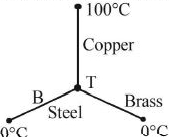
Rate of heat flow is given by,\(Q = \frac{{KA\left( {{\theta _1} - {\theta _2}} \right)}}{l}\)
Where, \(K=coefficient\,of\,thermal\,conductivity\)
\(l=length\,of\,rod\,and\,A=Area\,of\,cross-section\,of\,rod\)
If the junction temperature is \(T\), then
\({Q_{Copper}} = {Q_{Brass}} + {Q_{Steel}}\)
\(\frac{{0.92 \times 4\left( {100 - T} \right)}}{{46}} = \frac{{0.26 \times 4 \times \left( {T - 0} \right)}}{{13}} + \)
\(\frac{{0.12 \times4\times \left( {T - 0} \right)}}{{12}}\)
\( \Rightarrow 200 - 2T = 2T + T\)
\( \Rightarrow T = {40^ \circ }C\)
\(\therefore \,\,{Q_{Copper}} = \frac{{0.92 \times 4 \times 60}}{{46}} = 4.8\,cal/s\)
No questions on this page match these filters.