


હેલોઆલ્કેન અને હેલોએરિન સંયોજનો ના બધા પ્રશ્નો
નવા પહેલા82 માંથી 51–82 પ્રશ્નો
-
- (A) ધનાયન \(B\) વધુ સ્થિર છે અને ઝડપી દરે પ્રમાણમાં રચના કરે છે
- (B) ધનાયન \(A\) વધુ સ્થિર છે અને ધીમા દરે પ્રમાણમાં રચના કરે છે
- (C) ધનાયન \(B\) વધુ સ્થિર છે અને ધીમા દરે પ્રમાણમાં રચના કરે છે
- (D) ધનાયન \(A\) વધુ સ્થિર છે અને ઝડપી દરે પ્રમાણમાં રચના કરે છે
જવાબ અને ઉકેલ જુઓ
સાચો જવાબ: (A)
This is more stable due to secondary cation formation and formed with faster rate due to low activation energy.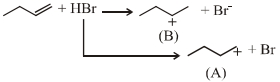
-
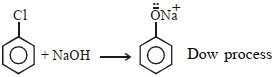
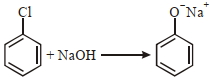
- (A) \(573\, K ,\, Cu , 300\, atm\)
- (B) \(623\, K ,\, Cu , 300\, atm\)
- (C) \(573\, K , 300\, atm\)
- (D) \(623\, K , 300\, atm\)
જવાબ અને ઉકેલ જુઓ
સાચો જવાબ: (D)
Temperature \(=623 K\)Pressure \(=300 atm\)
- 53. \({H}_{4} {P}_{2} {O}_{7}, {H}_{4} {P}_{2} {O}_{5}\) અને \({H}_{4} {P}_{2} {O}_{6}\)માં \('P'\)ની ઓક્સિડેશન અવસ્થા અનુક્રમે છે? 2021 અઘરું
- (A) \(5,3\) અને \(4\)
- (B) \(6,4\) અને \(5\)
- (C) \(5,4\) અને \(3\)
- (D) \(7,5\) અને \(6\)
જવાબ અને ઉકેલ જુઓ
સાચો જવાબ: (A)
Oxidation state of \({P}\) in \({H}_{4} {P}_{2} {O}_{7}, {H}_{4} {P}_{2} {O}_{5}\) and \({H}_{4} {P}_{2} {O}_{6}\) is \(5,3 \& 4\) respectively\({H}_{4} {P}_{2} {O}_{7}\)
\(2 {x}+4(+1)+7(-2)=0\)
\({x}=+5\)
\({H}_{4} {P}_{2} {O}_{5}\)
\(2 {x}+4(+1)+5(-2)=0\)
\({x}=+3\)
\({H}_{4} {P}_{2} {O}_{6}\)
\(2 {x}+4(+1)+6(-2)=0\)
\({x}=+4\)
-
- (A) \({HOCl}\)
- (B) પ્રવાહી \(NH_{3}\)
- (C) મંદ \(HNO_{2}\)
- (D) સાંદ્ર. \({HIO}_{3}\)
જવાબ અને ઉકેલ જુઓ
સાચો જવાબ: (D)
lodination of alkane is reversible reaction.It can be irreversible in the presence of strong oxidising agent like conc. \({HNO}_{3}\) or conc. \({HIO}_{3}\)
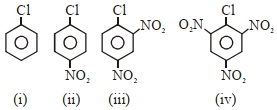
- 55. નીચે આપેલા સંયોજનોનો કેન્દ્રાનુરાગી વિસ્થાપન પ્રક્રિયા તરફના ચઢતા વલણ દર્શાવતાનો સાચો ક્રમ શોધો.
 2021 સરળ
- (A) \(( iv ) < ( iii ) < ( ii ) < ( i )\)
- (B) \(( iv ) < ( i ) < ( ii ) < ( iii )\)
- (C) \(( iv ) < ( i ) < ( iii ) < ( ii )\)
- (D) \(( i ) < ( ii ) < ( iii ) < ( iv )\)
જવાબ અને ઉકેલ જુઓ
સાચો જવાબ: (D)
For nucleophile substitution in aromatic halidesCorrect order is :
\(( i ) < ( ii ) < ( iii ) < ( iv )\)
More No. of \(NO _{2}\) substituted aromatic halide, increase the rate of nucleophile substitution reaction in aromatic halides.
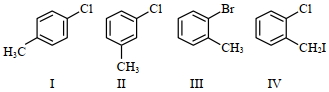
-
- (A) \(II\)
- (B) \(IV\)
- (C) \(I\)
- (D) \(III\)
જવાબ અને ઉકેલ જુઓ
સાચો જવાબ: (B)
Other compounds halide can't be removed because corresponding \({C}^{+}\) is highly unstable.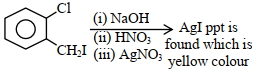
-
- (A) \({H}_{2} {O}_{2}\)
- (B) \({Cl}_{2} {C}={CCl}_{2}\)
- (C) \({CCl}_{4}\)
- (D) પ્રવાહી \({CO}_{2}\)
જવાબ અને ઉકેલ જુઓ
સાચો જવાબ: (C)
\({CO}_{2}, {CCl}_{4}\) and \({Cl}_{2} {C}={CCl}_{2}\) are used as dry cleaning agents for clothes.\({H}_{2} {O}_{2}\) is used as bleaching agent in laundry.
-
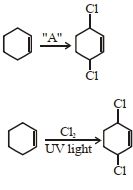
- (A) \(A = HCl ;\) નિર્જળ \(AlCl _{3}\)
- (B) \(A = HCl , ZnCl _{2}\)
- (C) \(A = Cl _{2} ; UV\) પ્રકાશ
- (D) \(A = Cl _{2}\); અંધારું, નિર્જળ \(AlCl _{3}\)
જવાબ અને ઉકેલ જુઓ
સાચો જવાબ: (C)
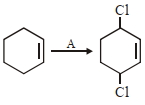
For substitution at allylic position in the given compound, the reagent used is \(Cl _{2} / uv\) light.The reaction is free radical halogenation.
-
- (A) \(a - ii , b - i , c - iv , d - iii\)
- (B) \(a-i i i, b-i v, c-i i, d-i\)
- (C) \(a-iii, b-i, c-i v, d-i i\)
- (D) \(a - ii , b - iv , c - i , d - iii\)
જવાબ અને ઉકેલ જુઓ
સાચો જવાબ: (B)
\((a)\) Alcoholic potassium hydroxide \(\rightarrow\) used for \(\beta-\) elimination\((b)\) \(Pd / BaSO _{4} \rightarrow\) Lindlar's catalyst
\((c)\) \(BHC\) (Benzene hexachloride) \(\rightarrow\) Obtained by addition reactions
\((d)\) Polyacetylene \(\rightarrow\) Electrodes in batteries
- 60. \(AgNO\) \(_{3}\) દ્રાવણ તરફ નીચેના કાર્બનિક પરમાણુઓની પ્રતિક્રિયાશીલતાનો ક્રમ ઘટતો ક્રમ કયો છે?
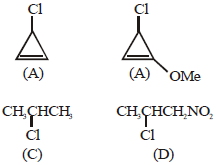 2020 મધ્યમ
- (A) \(( A )>( B )>( D )>( C )\)
- (B) \(( A )>( B )>( C )>( D )\)
- (C) \((C)>(D)>(A)>(B)\)
- (D) \((B)>(A)>(C)>(D)\)
જવાબ અને ઉકેલ જુઓ
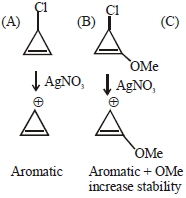
સાચો જવાબ: (D)
\((C)\) \(\begin{gathered} \begin{array}{*{20}{c}} {C{H_3} - CH - C{H_3}} \\ {|\,\,\,\,\,\,\,\,\,\,\,\,} \\ {Cl\,\,\,\,\,\,\,\,\,\,} \\ {\,\,\,\,\,\,\,\,\,\, \downarrow AgN{O_3}} \end{array} \hfill \\ \begin{array}{*{20}{c}} { \oplus \,\,\,\,} \\ {C{H_3} - CH - C{H_3}} \\ {({2^o}\,Cation)} \end{array} \hfill \\ \end{gathered} \)\((D)\) \(\begin{gathered} \begin{array}{*{20}{c}} {C{H_3} - CH - C{H_3}} \\ {|\,\,\,\,\,\,\,\,\,\,\,\,} \\ {Cl\,\,\,\,\,\,\,\,\,\,} \\ {\,\,\,\,\,\,\,\,\, \downarrow AgN{O_3}} \end{array} \hfill \\ \begin{array}{*{20}{c}} { \oplus \,\,\,\,\,\,\,\,\,\,\,\,\,\,\,\,\,\,\,\,} \\ {C{H_3} - CH - C{H_2} - N{O_2}} \\ {{2^o}\,Cation\,and\,\left( { - I\,of\,N{O_2}} \right)} \end{array} \hfill \\ \end{gathered}\)
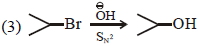
- 61. નીચેના કયા સંયોજનોમાં કેન્દ્રાનુરાગી વિસ્થાપન પર \(OH ^{-}\) આયન દ્વારા બંધારણમાં રીટેન્શન બતાવશે? 2020 મધ્યમ
- (A) \(\begin{array}{*{20}{c}} {C{H_3} - CH - C{H_2}Br} \\ {|\,\,\,\,\,\,\,\,\,\,\,\,} \\ {{C_2}{H_5}\,\,\,\,} \end{array}\)
- (B) \(\begin{array}{*{20}{c}} {C{H_3} - CH - Br} \\ {|\,\,\,} \\ {\,\,\,\,\,\,\,{C_6}{H_5}} \end{array}\)
- (C) \(\begin{array}{*{20}{c}} {C{H_3} - CH - Br} \\ {|\,\,\,} \\ {\,\,\,\,C{H_3}} \end{array}\)
- (D) \(\begin{array}{*{20}{c}} {\,\,\,\,\,\,Br} \\ {\,\,\,|\,} \\ {C{H_3} - C - H} \\ {\,\,\,|} \\ {\,\,\,\,\,\,\,\,\,\,\,\,\,\,\,{C_6}{H_{13}}} \end{array}\)
જવાબ અને ઉકેલ જુઓ
સાચો જવાબ: (A)
\((1)\)\(\begin{array}{*{20}{c}} { * \,\,\,\,\,\,\,\,\,\,\,\,\,\,\,\,\,\,\,\,\,\,\,\,\,\,\,\,\,\,\,} \\ {C{H_3} - CH - C{H_2} - Br\,\xrightarrow[{{S_{{N^2}}}}]{{\mathop O\limits^ \ominus H}}} \\ {|\,\,\,\,\,\,\,\,\,\,\,\,\,\,\,\,\,\,\,\,\,\,\,\,\,\,\,\,\,\,\,\,} \\ {Et\,\,\,\,\,\,\,\,\,\,\,\,\,\,\,\,\,\,\,\,\,\,\,\,\,\,\,\,\,} \end{array}\)\(\begin{array}{*{20}{c}} { * \,\,\,\,\,\,\,\,\,\,\,\,} \\ {C{H_3} - CH - C{H_2}OH} \\ {|\,\,\,\,\,\,\,\,\,\,\,\,\,\,} \\ {Et\,\,\,\,\,\,\,\,\,\,\,} \end{array}\)\((2)\)\(\begin{array}{*{20}{c}} {C{H_3} - CH - Br\,\xrightarrow[{{S_{{N^2}}}}]{{\mathop O\limits^ \ominus H}}} \\ {|\,\,\,\,\,\,\,\,\,\,\,\,\,\,\,\,\,\,\,} \\ {ph\,\,\,\,\,\,\,\,\,\,\,\,\,\,\,} \end{array}\)\(\begin{array}{*{20}{c}} {ph - CH - OH} \\ {|\,\,\,\,\,\,\,\,} \\ {C{H_3}} \end{array}\)
\((4)\)\(\begin{array}{*{20}{c}} {C{H_3} - CH - Br\,\xrightarrow[{{S_{{N^2}}}}]{{\mathop O\limits^ \ominus H}}} \\ {|\,\,\,\,\,\,\,\,\,\,\,\,\,\,\,\,\,\,\,} \\ {{C_6}{H_{13}\,\,\,\,\,\,}} \end{array}\)\(\begin{array}{*{20}{c}} {C{H_3} - CH - OH} \\ {|\,\,\,\,\,} \\ {\,\,\,\,{C_6}{H_3}} \end{array}\)
As language given, we have to go with option \((1)\) as stereochemistry of chiral centre is not distortet.
- 62. નીચેના સંયોજનોમાં ડિહાઈડ્રોહેલોજીનેશન \((E_1)\) પ્રક્રિયાનો પ્રતિક્રિયાશીલતાનો ઘટતો ક્રમ કયો છે?
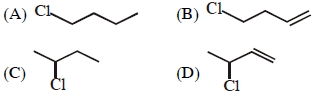 2020 અઘરું
- (A) \(B > D > A > C\)
- (B) \(B > D > C > A\)
- (C) \(D > B > C > A\)
- (D) \(B > A > D > C\)
જવાબ અને ઉકેલ જુઓ
સાચો જવાબ: (C)
Reactivity \(D > B > C > A\) Carbocation formed from \(D\) is most stable Carbocation formed from \(A\) is least stable - 63. નીચેની પ્રક્રિયામાં મુખ્ય નીપજ કઈ છે: \(CH _{3} CH = CHCH \left( CH _{3}\right)_{2} \stackrel{ HBr }{\longrightarrow}\) 2020 મધ્યમ
- (A) \(CH _{3} CH _{2} CH _{2} C ( Br )\left( CH _{3}\right)_{2}\)
- (B) \(Br \left( CH _{2}\right)_{3} CH \left( CH _{3}\right)_{2}\)
- (C) \(CH _{3} CH _{2} CH ( Br ) CH \left( CH _{3}\right)_{2}\)
- (D) \(CH _{3} CH ( Br ) CH _{2} CH \left( CH _{3}\right)_{2}\)
જવાબ અને ઉકેલ જુઓ
સાચો જવાબ: (A)
\(CH _{3} CH = CHCH \\left( CH _{3}\\right)_{2} + H^{+} \longrightarrow CH _{3} CH _{2} \stackrel{+}{C} H CH \\left( CH _{3}\\right)_{2}\)
\(CH _{3} CH _{2} \stackrel{+}{C} H CH \\left( CH _{3}\\right)_{2} \stackrel{1,2-H\, shift}{\longrightarrow} CH _{3} CH _{2} CH _{2} \stackrel{+}{C} \\left( CH _{3}\\right)_{2}\)
\(CH _{3} CH _{2} CH _{2} \stackrel{+}{C} \\left( CH _{3}\\right)_{2} + Br^{-} \longrightarrow CH _{3} CH _{2} CH _{2} C ( Br )\\left( CH _{3}\\right)_{2}\)
-
- (A) \((A)\) અને \((R)\) બંને સાચા વિધાનો છે પરંતુ \((R)\) એ \((A)\) ની સાચી સમજૂતી નથી
- (B) \((A)\) અને \((R)\) બંને ખોટા વિધાનો છે
- (C) \((A)\) અને \((R)\) બંને સાચા વિધાનો છે અને \((R)\) એ \((A)\) ની સાચી સમજૂતી છે
- (D) \((A)\) સાચુ વિધાન છે પરંતુ \((R)\) ખોટુ વિધાન છે
જવાબ અને ઉકેલ જુઓ
સાચો જવાબ: (D)
Due to resonance there is partial double bond character between carbon and chlorine, hence it do not undergoes nucleophilic substitution reaction -
- (A) \(CH_2 = CH -Cl\)
- (B) \(CHCl_3\)
- (C) \((CH_3)_3CCl\)
- (D) \(CCl_4\)
જવાબ અને ઉકેલ જુઓ
સાચો જવાબ: (C)
\((CH_3)_3CCl\) will give \(Cl^-\) and most stable carbocation. Hence \((CH_3)_3CCl\) likely to give a precipitate with \(AgNO_3\) solution -
- (A) \((A) < (B) < (C) < (D)\)
- (B) \((A) < (B) < (D) < (C)\)
- (C) \((B) < (A) < (D) < (C)\)
- (D) \((B) < (A) < (C) < (D)\)
જવાબ અને ઉકેલ જુઓ
સાચો જવાબ: (D)
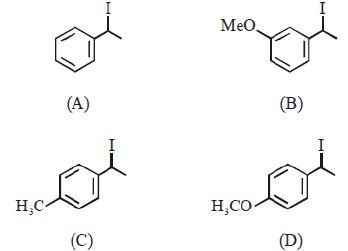
Rate of \(S_N1\) reaction \(\alpha \) stability of \({C^ \oplus } - I.M\) -
- (A) \(\begin{array}{*{20}{c}}
{C{H_2} - CH - C{H_3}} \\
{|\,\,\,\,\,\,\,\,\,\,\,\,\,\,\,\,\,\,|\,\,\,\,\,\,\,\,\,\,\,\,\,\,\,\,\,\,\,\,\,\,\,\,\,} \\
{Cl\,\,\,\,\,\,\,\,\,\,\,\,\,Cl\,\,\,\,\,\,\,\,\,\,\,\,\,\,\,\,\,\,\,\,\,\,}
\end{array}\) - (B) \(\begin{array}{*{20}{c}}
{C{H_2} - C{H_2} - C{H_2}\,\,\,\,\,\,\,\,\,\,\,\,\,\,\,\,\,\,\,\,\,\,\,\,\,\,\,\,} \\
{\,|\,\,\,\,\,\,\,\,\,\,\,\,\,\,\,\,\,\,\,\,\,\,\,\,\,\,\,\,\,\,\,\,\,\,\,\,\,\,\,|\,\,\,\,\,\,\,\,\,\,\,\,\,\,\,\,\,\,\,\,\,\,\,\,\,\,\,\,\,\,\,\,\,\,\,} \\
{\,\,\,\,\,\,\,\,\,\,\,\,\,\,\,Cl\,\,\,\,\,\,\,\,\,\,\,\,\,\,\,\,\,\,\,\,\,\,\,\,\,\,\,\,\,\,\,\,\,Cl\,\,\,\,\,\,\,\,\,\,\,\,\,\,\,\,\,\,\,\,\,\,\,\,\,\,\,\,\,\,\,\,\,\,\,\,\,\,\,\,\,\,\,\,\,\,\,\,\,}
\end{array}\) - (C) \(\begin{array}{*{20}{c}}
{CH - CH - C{H_2} - C{H_3}} \\
{\,\,\,|\,\,\,\,\,\,\,\,\,\,\,\,\,\,\,\,\,\,\,\,\,\,\,\,\,\,\,\,\,\,\,} \\
{Cl\,\,\,\,\,\,\,\,\,\,\,\,\,\,\,\,\,\,\,\,\,\,\,\,}
\end{array}\) - (D) \(\begin{array}{*{20}{c}} {Cl} \\ | \\ {C{H_3} - C - C{H_3}} \\ | \\ {Cl} \end{array}\)
જવાબ અને ઉકેલ જુઓ
સાચો જવાબ: (D)
\(\underset{(I)}{\mathop{\underset{({{C}_{3}}{{H}_{6}}C{{l}_{2}})}{\mathop{\begin{matrix}
\begin{matrix}
\,\,Cl \\
| \\
\end{matrix} \\
{{H}_{3}}C-C-C{{H}_{3}} \\
| \\
\,\,Cl \\
\end{matrix}}}\,}}\,\) \(\xrightarrow[{(aq.)}]{{KOH}}\) \(\mathop {\mathop {\begin{array}{*{20}{c}}
{\begin{array}{*{20}{c}}
{\,\,\,\,OH} \\
|
\end{array}} \\
{C{H_3} - C - C{H_3}} \\
| \\
{\,\,\,\,OH}
\end{array}}\limits_{Unstable} }\limits \xrightarrow{{{H_2}O}}\) \(\mathop {\begin{array}{*{20}{c}}
O \\
{||} \\
{C{H_3} - C - C{H_3}}
\end{array}}\limits_{(II)} \) \(\xrightarrow[{(II)\,{H_2}O\,/\,{H^ \oplus }}]{{(I)\,C{H_3}MgBr}}\) \({\mathop {\begin{array}{*{20}{c}}
{\begin{array}{*{20}{c}}
{\,\,\,\,OH} \\
|
\end{array}} \\
{C{H_3} - C - C{H_3}} \\
| \\
{\,\,\,\,C{H_3}}
\end{array}}\limits_{{3^0}\,alcohol} }\) \(\xrightarrow[{Lucas\,\,\,Test}]{{Anhy.\,ZnC{l_3}\, + \,HCl}}\) Gives turbidity immediately - (A) \(\begin{array}{*{20}{c}}
-
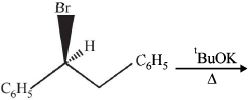
- (A) \(( \pm ){C_6}{H_5}CH({O^t }Bu)C{H_2}{C_6}{H_5}\)
- (B) \(C_6H_5CH=CHC_6H_5\)
- (C) \(( + ){C_6}{H_5}CH({O^t }Bu)C{H_2}{C_6}{H_5}\)
- (D) \(( - ){C_6}{H_5}CH({O^t }Bu)C{H_2}{C_6}{H_5}\)
જવાબ અને ઉકેલ જુઓ
સાચો જવાબ: (B)
Carrying out dehydrohalogenation with a bulky base such as potassium tert-butoxide ( \(t\) -\(BuOK\) ) in \(1,2\) -diphenyl1-bromoethane \((t-\mathrm{BuOH})\) favors the formation of the alkene via \(E_2\) mechanism. The reaction involved is
-
- (A) \(CH_2 = CHCH_2CH = CHCH_3\)
- (B) \(CH_2= CHCH = CHCH_2CH_3\)
- (C) \(CH_3CH = C = CHCH_2CH_3\)
- (D) \(CH_3CH = CH - CH = CHCH_3\)
જવાબ અને ઉકેલ જુઓ
સાચો જવાબ: (D)
\(\,\begin{array}{*{20}{c}}
{C{H_3} - CH - C{H_2} - CH - C{H_2} - C{H_3}}\\
{\,\,\,\,\,\,\,\,\,\,\,\,\,\,\,\,\,\,\,\,\,\,\,\,\,\,\,\,\,\,|\,\,\,\,\,\,\,\,\,\,\,\,\,\,\,\,\,\,\,\,\,\,\,\,\,\,\,\,\,\,\,\,\,\,\,|\,\,\,\,\,\,\,\,\,\,\,\,\,\,\,\,\,\,\,\,\,\,\,\,\,\,\,\,\,\,\,\,\,\,\,\,\,\,\,\,\,\,\,\,\,\,\,\,\,\,\,\,}\\
{\,\,\,\,\,\,\,\,\,Br\,\,\,\,\,\,\,\,\,\,\,\,\,\,\,\,\,\,\,\,\,\,\,\,\,\,\,\,\,\,\,Br\,\,\,\,\,\,\,\,\,\,\,\,\,\,\,\,\,\,\,\,\,\,\,\,\,\,\,\,\,\,}
\end{array}\) \(\xrightarrow[{{E_2}}]{{KOH,\,C{H_3}OH\,\Delta }}\) \(\mathop {C{H_3} - CH = CH - CH = CH - C{H_3}}\limits_{{\text{(Saytzeff product)}}} \) -
- (A) \((III) < (II) < (I)\)
- (B) \((II) < (I) < (III)\)
- (C) \((I) < (III) < (II)\)
- (D) \((II) < (III) < (I)\)
જવાબ અને ઉકેલ જુઓ
સાચો જવાબ: (B)
Secondary, tertiary and benzylic halides appear to react by a mechanism that involves the formation of a carbocation and proceeds through \(\mathrm{S}_{\mathrm{N}} 1\) mechanism which takes place in two steps. The first step is the slow step \(-\) it is the rate-determining step. In this step, a molecule of alkyI halide ionizes and becomes an alkyl cation. Therefore, greater the stability of carbocation greater will be its tendency to react via \(S_{N} 1\) mechanism.\(\mathrm{R}-\mathrm{X} \rightleftharpoons \mathrm{R}^{+}+\mathrm{X}^{-}\)
In the second step, the intermediate alkyl cation reacts rapidly with water to produce alcohol.
\(\mathrm{R}^{+}+\mathrm{H}_{2} \mathrm{O} \rightleftharpoons \mathrm{ROH}\)
Hence, the order of reactivity of halides for the \(\mathrm{S}_{\mathrm{N}} 1\) mechanism is \(\mathrm{II}<\mathrm{I}<\mathrm{III}\).
-
- (A) \(NaI\)
- (B) \(NaOEt/ EtOH\)
- (C) \(NaOH/H_2O\)
- (D) \(NaOH /H_2O-EtOH\)
જવાબ અને ઉકેલ જુઓ
સાચો જવાબ: (A)
Alkyl chloride or bromide undergo substitution and get converted to an alkyl iodide on treatment with a solution of sodium iodide in acetone. e.g. \(CH_3CH_2CH_2Br + NaI\) \(\xrightarrow{{acetone}}\) \(CH_3CH_2CH_2I\) + \(NaBr\) This reaction is also known as Finkelstein Reaction -
- (A) ફ્રિંકલસ્ટેઇન પ્રક્રિયા
- (B) સ્વાર્ટઝ પ્રક્રિયા
- (C) મુક્તમૂલક ફ્લોરિનેશન
- (D) સેન્ડમેયર પ્રક્રિયા
જવાબ અને ઉકેલ જુઓ
સાચો જવાબ: (B)
Alkyl fluorides can be prepared by action of mercurous fluoride or antimony trifluorides (inorganic fluorides) on corresponding alkyl halide. This reaction is known as Swarts reaction.\(C H_{3} B r+A g F \rightarrow \underset{\text { Methyl fluoride}}{C H_3F}+A g B r\)
But, when aciton of Nallacetone takes place on alkyl chloride of bromide alkyl lodide forms. This reaction is called Finkelstein reaction
\(C_{2} H_{2} C I \stackrel{N a t}{\longrightarrow} C_{2} H_{5} I+N a C I\)
Free redical fluorination is highly explosive reaction, so not preferred for the preparation of fluoride.
- 73. \(CH_3Cl, CH_3Br, CH_3I\) અને \(CH_3F\) સંયોજનો માટે \(C-\)હેલોજન બંધલંબાઇનો સાચો વધતો ક્રમ જણાવો. 2014 મધ્યમ
- (A) \(CH_3F < CH_3Cl < CH_3Br < CH_3I\)
- (B) \(CH_3F < CH_3Br < CH_3Cl < CH_3I\)
- (C) \(CH_3F < CH_3I < CH_3Br < CH_3Cl\)
- (D) \(CH_3Cl< CH_3Br < CH_3F < CH_3I\)
જવાબ અને ઉકેલ જુઓ
સાચો જવાબ: (A)
The correct order of increasing bond length is \(CH_3F < CH_3Cl < CH_3Br < CH_3I\) -
- (A) \(C_6H_5CHC_6H_5Br\)
- (B) \(C_6H_5CH_2Br\)
- (C) \(C_6H_5CHCH_3Br\)
- (D) \(C_6H_5CCH_3C_6H_5Br\)
જવાબ અને ઉકેલ જુઓ
સાચો જવાબ: (C)
\(C_6H_5CHCH_3Br\) being an optically active secondary alkyl bromide undergoes \(S_N2\) nucleophilic substitution reaction. Hence it undergoes complete inversion of configuration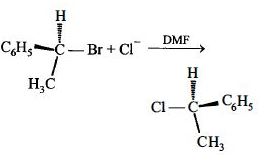
- 75. \({S_{{N^2}}}\) પ્રકિયા માં નીચેના સંયોજનો માટે પ્રતિક્રિયાશીલતાનો યોગ્ય ક્રમ કયો હશે ? 2014 મધ્યમ
- (A) \(CH_3Cl > (CH_3)_2CHCl > CH_3CH_2Cl > ( CH_3)_3CCl\)
- (B) \(CH_3Cl > CH_3CH_2 Cl > (CH_3)_2CHCl > (CH_3)_3CCl\)
- (C) \(CH_3CH_2 Cl > CH_3Cl > (CH_3)_2CHCl > (CH_3)_3CCl\)
- (D) \((CH_3 )_2CHCl > CH_3CH_2Cl > CH_3Cl > (CH_3)_3CCl\)
જવાબ અને ઉકેલ જુઓ
સાચો જવાબ: (B)
Rate of \({S_{{N^2}}} \propto \frac{1}{\text { Steric crowding of }^{\prime} C^{\prime}}\)As steric hindrance (crowding) increases, the rate of \({S_{{N^2}}}\) reaction decreases.
The order of reactivity towards \({S_{{N^2}}}\) reaction for alkyl halides is
Primary halides \(>\) Secondary halides \(>\) Tertiary halides
- 76. સિલ્વર પાવડર સાથે ટ્રાઈક્લોરોઇથેન \(1, 1, 1-\) ની પ્રક્રિયા દ્વારા રચાયેલ મુખ્ય કાર્બનિક નીપજ કઈ છે ?: 2014 અઘરું
- (A) એસીટીલીન
- (B) ઇથિન
- (C) \(2 -\) બ્યુટીન
- (D) \(2 -\) બ્યુટીન
જવાબ અને ઉકેલ જુઓ
સાચો જવાબ: (C)
\(2 \mathrm{CH}_{3}-\mathrm{CCl}_{3} \stackrel{6 \mathrm{Ag}}{\longrightarrow} \mathrm{CH}_{3}-\mathrm{C} \equiv \mathrm{C}-\mathrm{CH}_{3}+6 \mathrm{AgCl}\) -
- (A) \({S_{{N^1}}}\) દ્વારા દ્વિતીયક આલ્કોહોલ
- (B) \({S_{{N^1}}}\) દ્વારા તૃતીયક આલ્કોહોલ
- (C) \({S_{{N^2}}}\) દ્વારા દ્વિતીયક આલ્કોહોલ
- (D) \({S_{{N^2}}}\) દ્વારા તૃતીયક આલ્કોહોલ
જવાબ અને ઉકેલ જુઓ
સાચો જવાબ: (B)
The reaction of alcohol with Lucas reagent is mostly an \({S_{{N^1}}}\) reaction and the rate of reaction is directly proportional to the stability of carbocation formed in the reaction. Since \(3^o R-O H\) forms \(3^o\) carbocation (most stable), hence it will react fastest. -
- (A) \(Br^- > I^->Cl^-\)
- (B) \({I^ - } > B{r^ - } > C{l^{^ - }}\)
- (C) \(C{l^{^ - }} > B{r^ - } > {I^ - }\)
- (D) \(C{l^{^ - }} > {I^ - } > B{r^ - }\)
જવાબ અને ઉકેલ જુઓ
સાચો જવાબ: (B)
Since the leaving group breaks away as a base, it is easier to displace weaker bases as compared to stronger bases. Thus less basic the substituent. the more easily it is displaced. Since the basic strength of the given groups is in order. \({I^ - } < B{r^ - } < Cl^-\) Thus the order of halogen leaving groups is \({I^ - } > B{r^ - } > C{l^{^ - }}\) -
- (A) \(RI > RBr > RCl\)
- (B) \(RCl > RBr> RI\)
- (C) \(RBr >RCl >RI\)
- (D) \(RBr > RI > RCl\)
જવાબ અને ઉકેલ જુઓ
સાચો જવાબ: (A)
For a given alkyl group, the order of reactivity is\(\mathop {\underline {R - I\, > \,R\, - \,Br\, > \,R\, - \,Cl\, > \,R\, - \,F} }\limits_{\;{\text{ }}increasing{\text{ }}bond{\text{ }}energy} \)
decreasing halogen reactivity.
This order depends on the carbon-halogen bond energy; the carbon-fluorine bond energy is maximum and thus fluorides are least reactive while carbon - iodide bond energy is maximum hence iodides are most reactive.
- 80. ફ્રિડલ-ક્રાફ્ટ આલ્કાઇલેશન પ્રક્રિયામાં નીચેના પૈકી ક્યુ એ \(2-\)ફિનાઇલબ્યુટેન મુખ્ય નીપજ તરીકે આપશે નહિ? 2013 અઘરું
- (A) \(1-\) બ્યુટીન \(+ HF\)
- (B) \(2-\) બ્યુટેનોલ\(+ H_2SO_4\)
- (C) બ્યુટેનોઇલ ક્લોરાઇડ \(+ AlCl_3\) , ત્યારબાદ \(Zn, HCl\)
- (D) બ્યુટાઇલ ક્લોરાઇડ \(+ AlCl_3\)
જવાબ અને ઉકેલ જુઓ
સાચો જવાબ: (C)
The fridal - crafts alkylation reaction will give propyl ohenyl ketone which further on clemmenson's reduction will give butyl benzene\({C_6}{H_6}\, + \,C{H_3}C{H_2}C{H_2}COCl\,\xrightarrow{{AlC{l_3}}}\) \({C_6}{H_5}COC{H_2}C{H_2}C{H_3}\,\xrightarrow{{Zn - Hg\,/\,HCl}}\) \(\mathop {{C_6}{H_5}C{H_2}C{H_2}C{H_2}C{H_3}}\limits_{Butyl\,\,benzene} \)
- 81. વિલિયમસન મિશ્રિત ઇથરના સંશ્લેષણમાં પ્રાથમિક અને તૃતીય આલ્કાઈલ સમૂહ છે જો ત્રીજા ભાગનો ઉપયોગ થાય છે, તો.... 2013 અઘરું
- (A) કાર્બન-હેલોજન બંધની ધીમી તંગીને કારણે પ્રતિક્રિયા દર ધીમું થશે.
- (B) આલ્કીન મુખ્ય નીપજ હશે
- (C) સરળ ઇથર મિશ્રિત ઇથરને બદલે રચાય છે.
- (D) અપેક્ષિત મિશ્ર ઇથર બનાવવામાં આવશે.
જવાબ અને ઉકેલ જુઓ
સાચો જવાબ: (B)
The tertiary alkylhalide undergo elimination reaction to give alkenes\(\begin{array}{*{20}{c}}
{\,\,\,\,\,\begin{array}{*{20}{c}}
{\,\,\,\,C{H_3}\,\,} \\
{|\,\,\,\,}
\end{array}} \\
{C{H_3} - C - X + } \\
{\,\,\,\,\,|\,\,\,\,} \\
{\,\,\,\,\,\,\,\,\,C{H_3}\,\,\,}
\end{array}\) \(NaOC_2H_5\,\to \) \(\mathop {\begin{array}{*{20}{c}}
{\,\,\,\,\,C{H_3}} \\
{|\,} \\
{C{H_3} - C = C{H_2}}
\end{array}}\limits_{2\, - \,methyl\,propane} \) -
- (A) એરાઇલ હેલાઇડના બે અણુ
- (B) એરાઇલ હેલાઇડ અને આલ્કાઇલ હેલાઇડ દરેકનો એક અણુ
- (C) એરાઇલ હેલાઇડ અને ફિનોલ દરેકનો એક અણુ
- (D) આલ્કાઇલ હેલાઇડના બે અણુ
જવાબ અને ઉકેલ જુઓ
સાચો જવાબ: (B)
Reaction between alkyl halide, aryl halide and sodium in presence of ether is known as Wurtz fitting reaction \({C_6}H_5Cl + 2Na + ClC{H_3} \to \mathop {{C_6}{H_5}C{H_3}}\limits_{{\text{Toluene}}} + 2NaCl\)

આ પેજ પર આ ફિલ્ટર મુજબ કોઈ પ્રશ્ન નથી.