


हैलोऐल्केन तथा हैलोऐरीन के सभी प्रश्न
नए पहले77 में से 51–77 प्रश्न
-
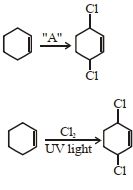
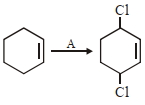
- (A) \(A = HCl\); निर्जलीय \(AlCl _{3}\)
- (B) \(A = HCl ; ZnCl _{2}\)
- (C) \(A = Cl _{2}\); \(UV\) प्रकाश
- (D) \(A = Cl _{2}\); अंधकार, निर्जलीय \(AlCl _{3}\)
उत्तर और हल देखें
सही उत्तर: (C)
For substitution at allylic position in the given compound, the reagent used is \(Cl _{2} / uv\) light.The reaction is free radical halogenation.
-
- (A) कार्बधनायन \(B\) अधिक स्थायी है और अपेक्षाकत तीव्र गति से निर्मित होता है।
- (B) कार्बधनायन \(A\) अधिक स्थायी है और अपेक्षाकत धीमी गति से निर्मित होता है।
- (C) कार्बधनायन \(B\) अधिक स्थायी है और अपेक्षाकत धीमी गति से निर्मित होता है।
- (D) कार्बधनायन \(A\) अधिक स्थायी है और अपेक्षाकत तीव्र गति से निर्मित होता है।
उत्तर और हल देखें
सही उत्तर: (A)
This is more stable due to secondary cation formation and formed with faster rate due to low activation energy.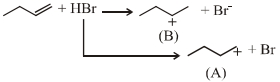
-
- (A) \(5,3\) तथा \(4\)
- (B) \(6,4\) तथा \(5\)
- (C) \(5,4\) तथा \(3\)
- (D) \(7,5\) तथा \(6\)
उत्तर और हल देखें
सही उत्तर: (A)
Oxidation state of \(\mathrm{P}\) in \(\mathrm{H}_{4} \mathrm{P}_{2} \mathrm{O}_{7}, \mathrm{H}_{4} \mathrm{P}_{2} \mathrm{O}_{5}\) and \(\mathrm{H}_{4} \mathrm{P}_{2} \mathrm{O}_{6}\) is \(5,3 \& 4\) respectively\(\mathrm{H}_{4} \mathrm{P}_{2} \mathrm{O}_{7}\)
\(2 \mathrm{x}+4(+1)+7(-2)=0\)
\(\mathrm{x}=+5\)
\(\mathrm{H}_{4} \mathrm{P}_{2} \mathrm{O}_{5}\)
\(2 \mathrm{x}+4(+1)+5(-2)=0\)
\(\mathrm{x}=+3\)
\(\mathrm{H}_{4} \mathrm{P}_{2} \mathrm{O}_{6}\)
\(2 \mathrm{x}+4(+1)+6(-2)=0\)
\(\mathrm{x}=+4\)
-
- (A) \(\mathrm{HOCl}\)
- (B) तनु \(HNO _{2}\)
- (C) द्रव \(NH _{3}\)
- (D) सान्द्र \(HIO _{3}\)
उत्तर और हल देखें
सही उत्तर: (D)
lodination of alkane is reversible reaction.It can be irreversible in the presence of strong oxidising agent like conc. \(\mathrm{HNO}_{3}\) or conc. \(\mathrm{HIO}_{3}\)
- 55. निम्नलिखित में से कौन से एक रासायनिक एजेंट का उपयोग कपड़ों की निर्जल धुलाई में नहीं होता है \(?\) 2021 मध्यम
- (A) \(\mathrm{H}_{2} \mathrm{O}_{2}\)
- (B) \(\mathrm{Cl}_{2} \mathrm{C}=\mathrm{CCl}_{2}\)
- (C) \(\mathrm{CCl}_{4}\)
- (D) द्रव \(CO _{2}\)
उत्तर और हल देखें
सही उत्तर: (C)
\(\mathrm{CO}_{2}, \mathrm{CCl}_{4}\) and \(\mathrm{Cl}_{2} \mathrm{C}=\mathrm{CCl}_{2}\) are used as dry cleaning agents for clothes.\(\mathrm{H}_{2} \mathrm{O}_{2}\) is used as bleaching agent in laundry.
-
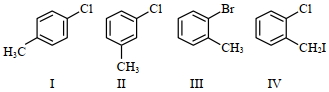
- (A) \(II\)
- (B) \(IV\)
- (C) \(I\)
- (D) \(III\)
उत्तर और हल देखें
सही उत्तर: (B)
Other compounds halide can't be removed because corresponding \(\mathrm{C}^{+}\) is highly unstable.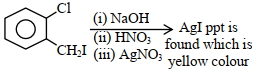
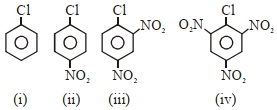
- 57. निम्नलिखित यौगिकों का, नाभिक स्नेही प्रतिस्थापन अभिक्रिया के लिए दर बढ़ने का सही क्रम है :
 2021 आसान
- (A) \(( iv ) < ( iii ) < ( ii ) < ( i )\)
- (B) \(( iv ) < ( i ) < ( ii ) < ( iii )\)
- (C) \(( iv ) < ( i ) < ( iii ) < ( ii )\)
- (D) \(( i ) < ( ii ) < ( iii ) < ( iv )\)
उत्तर और हल देखें
सही उत्तर: (D)
For nucleophile substitution in aromatic halidesCorrect order is :
\(( i ) < ( ii ) < ( iii ) < ( iv )\)
More No. of \(NO _{2}\) substituted aromatic halide, increase the rate of nucleophile substitution reaction in aromatic halides.
-
- (A) \(a - ii , b - i , c - iv , d - iii\)
- (B) \(a-i i i, b-i v, c-i i, d-i\)
- (C) \(a-iii, b-i, c-i v, d-i i\)
- (D) \(a - ii , b - iv , c - i , d - iii\)
उत्तर और हल देखें
सही उत्तर: (B)
\((a)\) Alcoholic potassium hydroxide \(\rightarrow\) used for \(\beta-\) elimination\((b)\) \(Pd / BaSO _{4} \rightarrow\) Lindlar's catalyst
\((c)\) \(BHC\) (Benzene hexachloride) \(\rightarrow\) Obtained by addition reactions
\((d)\) Polyacetylene \(\rightarrow\) Electrodes in batteries
-
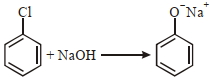
- (A) \(573\, K ,\, Cu , 300\, atm\)
- (B) \(623\, K ,\, Cu , 300\, atm\)
- (C) \(573\, K , 300\, atm\)
- (D) \(623\, K , 300\, atm\)
उत्तर और हल देखें
सही उत्तर: (D)
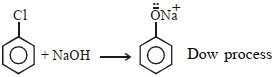
Temperature \(=623 K\)Pressure \(=300 atm\)
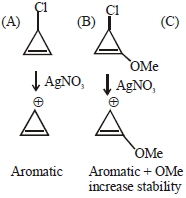
-
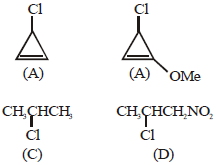
- (A) \(( A )>( B )>( D )>( C )\)
- (B) \(( A )>( B )>( C )>( D )\)
- (C) \((C)>(D)>(A)>(B)\)
- (D) \((B)>(A)>(C)>(D)\)
उत्तर और हल देखें
सही उत्तर: (D)
\((C)\) \(\begin{gathered} \begin{array}{*{20}{c}} {C{H_3} - CH - C{H_3}} \\ {|\,\,\,\,\,\,\,\,\,\,\,\,} \\ {Cl\,\,\,\,\,\,\,\,\,\,} \\ {\,\,\,\,\,\,\,\,\,\, \downarrow AgN{O_3}} \end{array} \hfill \\ \begin{array}{*{20}{c}} { \oplus \,\,\,\,} \\ {C{H_3} - CH - C{H_3}} \\ {({2^o}\,Cation)} \end{array} \hfill \\ \end{gathered} \)\((D)\) \(\begin{gathered} \begin{array}{*{20}{c}} {C{H_3} - CH - C{H_3}} \\ {|\,\,\,\,\,\,\,\,\,\,\,\,} \\ {Cl\,\,\,\,\,\,\,\,\,\,} \\ {\,\,\,\,\,\,\,\,\, \downarrow AgN{O_3}} \end{array} \hfill \\ \begin{array}{*{20}{c}} { \oplus \,\,\,\,\,\,\,\,\,\,\,\,\,\,\,\,\,\,\,\,} \\ {C{H_3} - CH - C{H_2} - N{O_2}} \\ {{2^o}\,Cation\,and\,\left( { - I\,of\,N{O_2}} \right)} \end{array} \hfill \\ \end{gathered}\)
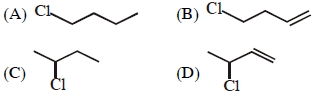
- 61. निम्न यौगिकों के डिहाइड्रोहैलोजेनेशन \(\left( E _{1}\right)\) अभिक्रिया के प्रति अभिक्रियाशीलता का घटता क्रम है
 2020 कठिन
- (A) \(B > D > A > C\)
- (B) \(B > D > C > A\)
- (C) \(D > B > C > A\)
- (D) \(B > A > D > C\)
उत्तर और हल देखें
सही उत्तर: (C)
Reactivity \(D > B > C > A\) Carbocation formed from \(D\) is most stable Carbocation formed from \(A\) is least stable - 62. निम्नलिखित अभिक्रिया में बनने वाला मुख्य उत्पाद है \(CH _{3} CH = CHCH \left( CH _{3}\right)_{2} \stackrel{ HBr }{\longrightarrow}\) 2020 मध्यम
- (A) \(CH _{3} CH _{2} CH _{2} C ( Br )\left( CH _{3}\right)_{2}\)
- (B) \(Br \left( CH _{2}\right)_{3} CH \left( CH _{3}\right)_{2}\)
- (C) \(CH _{3} CH _{2} CH ( Br ) CH \left( CH _{3}\right)_{2}\)
- (D) \(CH _{3} CH ( Br ) CH _{2} CH \left( CH _{3}\right)_{2}\)
उत्तर और हल देखें
सही उत्तर: (A)
\(CH _{3} CH = CHCH \\left( CH _{3}\right)_{2} + H^{+} \longrightarrow CH _{3} CH _{2} \stackrel{+}{C}HCH \\left( CH _{3}\right)_{2}\)
\(CH _{3} CH _{2} \stackrel{+}{C}HCH \\left( CH _{3}\right)_{2} \xrightarrow{\text{1,2-hydride shift}} CH _{3} CH _{2} CH _{2} \stackrel{+}{C} \\left( CH _{3}\right)_{2}\)
\(CH _{3} CH _{2} CH _{2} \stackrel{+}{C} \\left( CH _{3}\right)_{2} + Br^{-} \longrightarrow CH _{3} CH _{2} CH _{2} C ( Br ) \\left( CH _{3}\right)_{2}\)
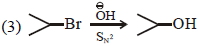
- 63. निम्नलिखित में से कौन सा यौगिक \(OH ^{-}\) आयन द्वारा नाभिकरागी प्रतिस्थापन पर विन्यास में धारण दिखाएगा ? 2020 मध्यम
- (A) \(\begin{array}{*{20}{c}} {C{H_3} - CH - C{H_2}Br} \\ {|\,\,\,\,\,\,\,\,\,\,\,\,} \\ {{C_2}{H_5}\,\,\,\,} \end{array}\)
- (B) \(\begin{array}{*{20}{c}} {C{H_3} - CH - Br} \\ {|\,\,\,} \\ {\,\,\,\,\,\,\,{C_6}{H_5}} \end{array}\)
- (C) \(\begin{array}{*{20}{c}} {C{H_3} - CH - Br} \\ {|\,\,\,} \\ {\,\,\,\,C{H_3}} \end{array}\)
- (D) \(\begin{array}{*{20}{c}} {\,\,\,\,\,\,Br} \\ {\,\,\,|\,} \\ {C{H_3} - C - H} \\ {\,\,\,|} \\ {\,\,\,\,\,\,\,\,\,\,\,\,\,\,\,{C_6}{H_{13}}} \end{array}\)
उत्तर और हल देखें
सही उत्तर: (A)
\((1)\)\(\begin{array}{*{20}{c}} { * \,\,\,\,\,\,\,\,\,\,\,\,\,\,\,\,\,\,\,\,\,\,\,\,\,\,\,\,\,\,\,} \\ {C{H_3} - CH - C{H_2} - Br\,\xrightarrow[{{S_{{N^2}}}}]{{\mathop O\limits^ \ominus H}}} \\ {|\,\,\,\,\,\,\,\,\,\,\,\,\,\,\,\,\,\,\,\,\,\,\,\,\,\,\,\,\,\,\,\,} \\ {Et\,\,\,\,\,\,\,\,\,\,\,\,\,\,\,\,\,\,\,\,\,\,\,\,\,\,\,\,\,} \end{array}\)\(\begin{array}{*{20}{c}} { * \,\,\,\,\,\,\,\,\,\,\,\,} \\ {C{H_3} - CH - C{H_2}OH} \\ {|\,\,\,\,\,\,\,\,\,\,\,\,\,\,} \\ {Et\,\,\,\,\,\,\,\,\,\,\,} \end{array}\)\((2)\)\(\begin{array}{*{20}{c}} {C{H_3} - CH - Br\,\xrightarrow[{{S_{{N^2}}}}]{{\mathop O\limits^ \ominus H}}} \\ {|\,\,\,\,\,\,\,\,\,\,\,\,\,\,\,\,\,\,\,} \\ {ph\,\,\,\,\,\,\,\,\,\,\,\,\,\,\,} \end{array}\)\(\begin{array}{*{20}{c}} {ph - CH - OH} \\ {|\,\,\,\,\,\,\,\,} \\ {C{H_3}} \end{array}\)
\((4)\)\(\begin{array}{*{20}{c}} {C{H_3} - CH - Br\,\xrightarrow[{{S_{{N^2}}}}]{{\mathop O\limits^ \ominus H}}} \\ {|\,\,\,\,\,\,\,\,\,\,\,\,\,\,\,\,\,\,\,} \\ {{C_6}{H_{13}\,\,\,\,\,\,}} \end{array}\)\(\begin{array}{*{20}{c}} {C{H_3} - CH - OH} \\ {|\,\,\,\,\,} \\ {\,\,\,\,{C_6}{H_3}} \end{array}\)
As language given, we have to go with option \((1)\) as stereochemistry of chiral centre is not distortet.
-
- (A) \((A)\) तथा \((R)\) दोनों सही हैं परन्तु \(( R ),( A )\) की सही व्याख्या नहीं है।
- (B) \((A)\) तथा \((R)\) दोनों ही गलत हैं।
- (C) \((A)\) तथा \((R)\) दोनों सही हैं तथा \((R)\), \((A)\) की सही व्याख्या है।
- (D) \((A)\) सही है परन्तु \((R)\) गलत है।
उत्तर और हल देखें
सही उत्तर: (D)
Due to resonance there is partial double bond character between carbon and chlorine, hence it do not undergoes nucleophilic substitution reaction -
- (A) \(CH_2 = CH -Cl\)
- (B) \(CHCl_3\)
- (C) \((CH_3)_3CCl\)
- (D) \(CCl_4\)
उत्तर और हल देखें
सही उत्तर: (C)
\((CH_3)_3CCl\) will give \(Cl^-\) and most stable carbocation. Hence \((CH_3)_3CCl\) likely to give a precipitate with \(AgNO_3\) solution -
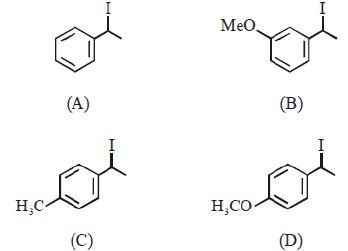
- (A) \((A) < (B) < (C) < (D)\)
- (B) \((A) < (B) < (D) < (C)\)
- (C) \((B) < (A) < (D) < (C)\)
- (D) \((B) < (A) < (C) < (D)\)
उत्तर और हल देखें
सही उत्तर: (D)
Rate of \(S_N1\) reaction \(\alpha \) stability of \({C^ \oplus } - I.M\) -
- (A) \(\begin{array}{*{20}{c}}
{C{H_2} - CH - C{H_3}} \\
{|\,\,\,\,\,\,\,\,\,\,\,\,\,\,\,\,\,\,|\,\,\,\,\,\,\,\,\,\,\,\,\,\,\,\,\,\,\,\,\,\,\,\,\,} \\
{Cl\,\,\,\,\,\,\,\,\,\,\,\,\,Cl\,\,\,\,\,\,\,\,\,\,\,\,\,\,\,\,\,\,\,\,\,\,}
\end{array}\) - (B) \(\begin{array}{*{20}{c}}
{C{H_2} - C{H_2} - C{H_2}\,\,\,\,\,\,\,\,\,\,\,\,\,\,\,\,\,\,\,\,\,\,\,\,\,\,\,\,} \\
{\,|\,\,\,\,\,\,\,\,\,\,\,\,\,\,\,\,\,\,\,\,\,\,\,\,\,\,\,\,\,\,\,\,\,\,\,\,\,\,\,|\,\,\,\,\,\,\,\,\,\,\,\,\,\,\,\,\,\,\,\,\,\,\,\,\,\,\,\,\,\,\,\,\,\,\,} \\
{\,\,\,\,\,\,\,\,\,\,\,\,\,\,\,Cl\,\,\,\,\,\,\,\,\,\,\,\,\,\,\,\,\,\,\,\,\,\,\,\,\,\,\,\,\,\,\,\,\,Cl\,\,\,\,\,\,\,\,\,\,\,\,\,\,\,\,\,\,\,\,\,\,\,\,\,\,\,\,\,\,\,\,\,\,\,\,\,\,\,\,\,\,\,\,\,\,\,\,\,}
\end{array}\) - (C) \(\begin{array}{*{20}{c}}
{CH - CH - C{H_2} - C{H_3}} \\
{\,\,\,|\,\,\,\,\,\,\,\,\,\,\,\,\,\,\,\,\,\,\,\,\,\,\,\,\,\,\,\,\,\,\,} \\
{Cl\,\,\,\,\,\,\,\,\,\,\,\,\,\,\,\,\,\,\,\,\,\,\,\,}
\end{array}\) - (D) \(\begin{array}{*{20}{c}}
{Cl} \\
| \\
{C{H_3} - C - C{H_3}} \\
| \\
{Cl}
\end{array}\)
उत्तर और हल देखें
सही उत्तर: (D)
\(\underset{(I)}{\mathop{\underset{({{C}_{3}}{{H}_{6}}C{{l}_{2}})}{\mathop{\begin{matrix}
\begin{matrix}
\,\,Cl \\
| \\
\end{matrix} \\
{{H}_{3}}C-C-C{{H}_{3}} \\
| \\
\,\,Cl \\
\end{matrix}}}\,}}\,\) \(\xrightarrow[{(aq.)}]{{KOH}}\) \(\mathop {\mathop {\begin{array}{*{20}{c}}
{\begin{array}{*{20}{c}}
{\,\,\,\,OH} \\
|
\end{array}} \\
{C{H_3} - C - C{H_3}} \\
| \\
{\,\,\,\,OH}
\end{array}}\limits_{Unstable} }\limits \xrightarrow{{{H_2}O}}\) \(\mathop {\begin{array}{*{20}{c}}
O \\
{||} \\
{C{H_3} - C - C{H_3}}
\end{array}}\limits_{(II)} \) \(\xrightarrow[{(II)\,{H_2}O\,/\,{H^ \oplus }}]{{(I)\,C{H_3}MgBr}}\) \({\mathop {\begin{array}{*{20}{c}}
{\begin{array}{*{20}{c}}
{\,\,\,\,OH} \\
|
\end{array}} \\
{C{H_3} - C - C{H_3}} \\
| \\
{\,\,\,\,C{H_3}}
\end{array}}\limits_{{3^0}\,alcohol} }\) \(\xrightarrow[{Lucas\,\,\,Test}]{{Anhy.\,ZnC{l_3}\, + \,HCl}}\) Gives turbidity immediately - (A) \(\begin{array}{*{20}{c}}
-
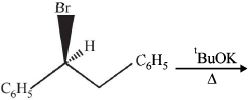
- (A) \(( \pm ){C_6}{H_5}CH({O^t }Bu)C{H_2}{C_6}{H_5}\)
- (B) \(C_6H_5CH=CHC_6H_5\)
- (C) \(( + ){C_6}{H_5}CH({O^t }Bu)C{H_2}{C_6}{H_5}\)
- (D) \(( - ){C_6}{H_5}CH({O^t }Bu)C{H_2}{C_6}{H_5}\)
उत्तर और हल देखें
सही उत्तर: (B)
Carrying out dehydrohalogenation with a bulky base such as potassium tert-butoxide ( \(t\) -\(BuOK\) ) in \(1,2\) -diphenyl1-bromoethane \((t-\mathrm{BuOH})\) favors the formation of the alkene via \(E_2\) mechanism. The reaction involved is
-
- (A) \(CH_2 = CHCH_2CH = CHCH_3\)
- (B) \(CH_2= CHCH = CHCH_2CH_3\)
- (C) \(CH_3CH = C = CHCH_2CH_3\)
- (D) \(CH_3CH = CH - CH = CHCH_3\)
उत्तर और हल देखें
सही उत्तर: (D)
\(\,\begin{array}{*{20}{c}}
{C{H_3} - CH - C{H_2} - CH - C{H_2} - C{H_3}}\\
{\,\,\,\,\,\,\,\,\,\,\,\,\,\,\,\,\,\,\,\,\,\,\,\,\,\,\,\,\,\,|\,\,\,\,\,\,\,\,\,\,\,\,\,\,\,\,\,\,\,\,\,\,\,\,\,\,\,\,\,\,\,\,\,\,\,|\,\,\,\,\,\,\,\,\,\,\,\,\,\,\,\,\,\,\,\,\,\,\,\,\,\,\,\,\,\,\,\,\,\,\,\,\,\,\,\,\,\,\,\,\,\,\,\,\,\,\,\,}\\
{\,\,\,\,\,\,\,\,\,Br\,\,\,\,\,\,\,\,\,\,\,\,\,\,\,\,\,\,\,\,\,\,\,\,\,\,\,\,\,\,\,Br\,\,\,\,\,\,\,\,\,\,\,\,\,\,\,\,\,\,\,\,\,\,\,\,\,\,\,\,\,\,}
\end{array}\) \(\xrightarrow[{{E_2}}]{{KOH,\,C{H_3}OH\,\Delta }}\) \(\mathop {C{H_3} - CH = CH - CH = CH - C{H_3}}\limits_{{\text{(Saytzeff product)}}} \) -
- (A) \((III) < (II) < (I)\)
- (B) \((II) < (I) < (III)\)
- (C) \((I) < (III) < (II)\)
- (D) \((II) < (III) < (I)\)
उत्तर और हल देखें
सही उत्तर: (B)
Secondary, tertiary and benzylic halides appear to react by a mechanism that involves the formation of a carbocation and proceeds through \(\mathrm{S}_{\mathrm{N}} 1\) mechanism which takes place in two steps. The first step is the slow step \(-\) it is the rate-determining step. In this step, a molecule of alkyI halide ionizes and becomes an alkyl cation. Therefore, greater the stability of carbocation greater will be its tendency to react via \(S_{N} 1\) mechanism.\(\mathrm{R}-\mathrm{X} \rightleftharpoons \mathrm{R}^{+}+\mathrm{X}^{-}\)
In the second step, the intermediate alkyl cation reacts rapidly with water to produce alcohol.
\(\mathrm{R}^{+}+\mathrm{H}_{2} \mathrm{O} \rightleftharpoons \mathrm{ROH}\)
Hence, the order of reactivity of halides for the \(\mathrm{S}_{\mathrm{N}} 1\) mechanism is \(\mathrm{II}<\mathrm{I}<\mathrm{III}\).
-
- (A) \(NaI\)
- (B) \(NaOEt/ EtOH\)
- (C) \(NaOH/H_2O\)
- (D) \(NaOH /H_2O-EtOH\)
उत्तर और हल देखें
सही उत्तर: (A)
Alkyl chloride or bromide undergo substitution and get converted to an alkyl iodide on treatment with a solution of sodium iodide in acetone. e.g.\(CH_3CH_2CH_2Br + NaI\) \(\xrightarrow{{acetone}}\) \(CH_3CH_2CH_2I\) + \(NaBr\)
This reaction is also known as Finkelstein Reaction
-
- (A) फिंकलस्टाइन अभ्भिक्रिया
- (B) स्वार्टस अभिक्रिया
- (C) मुक्त मूलक फ्लोरिनेशन
- (D) सैन्डमायर अभभिक्रिया
उत्तर और हल देखें
सही उत्तर: (B)
Alkyl fluorides can be prepared by action of mercurous fluoride or antimony trifluorides (inorganic fluorides) on corresponding alkyl halide. This reaction is known as Swarts reaction.\(C H_{3} B r+A g F \rightarrow \underset{\text { Methyl fluoride}}{C H_3F}+A g B r\)
But, when aciton of Nallacetone takes place on alkyl chloride of bromide alkyl lodide forms. This reaction is called Finkelstein reaction
\(C_{2} H_{2} C I \stackrel{N a t}{\longrightarrow} C_{2} H_{5} I+N a C I\)
Free redical fluorination is highly explosive reaction, so not preferred for the preparation of fluoride.
- 73. \(1, 1,1 -\) ट्राइक्लोरोईथेन को सिल्वर पाउडर के साथ क्रिया करने पर सबसे बड़ी मात्रा में बना आरगैनिक यौगिक होता है: 2014 कठिन
- (A) एसिटिलीन
- (B) ईथीन
- (C) \(2 -\) ब्युटाइन
- (D) \(2 -\) ब्युटीन
उत्तर और हल देखें
सही उत्तर: (C)
\(2 \mathrm{CH}_{3}-\mathrm{CCl}_{3} \stackrel{6 \mathrm{Ag}}{\longrightarrow} \mathrm{CH}_{3}-\mathrm{C} \equiv \mathrm{C}-\mathrm{CH}_{3}+6 \mathrm{AgCl}\) -
- (A) \(C_6H_5CHC_6H_5Br\)
- (B) \(C_6H_5CH_2Br\)
- (C) \(C_6H_5CHCH_3Br\)
- (D) \(C_6H_5CCH_3C_6H_5Br\)
उत्तर और हल देखें
सही उत्तर: (C)
\(C_6H_5CHCH_3Br\) being an optically active secondary alkyl bromide undergoes \(S_N2\) nucleophilic substitution reaction. Hence it undergoes complete inversion of configuration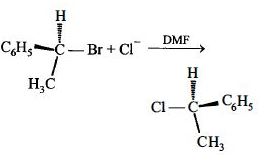
- 75. यौगिकों \(CH _{3} Cl , CH _{3} Br , CH _{3} I\) और \(CH _{3} F\) में कार्बन-हैलोजन बाँड की बढ़ती लम्बाई का ठीक क्रम है। 2014 मध्यम
- (A) \(CH_3F < CH_3Cl < CH_3Br < CH_3I\)
- (B) \(CH_3F < CH_3Br < CH_3Cl < CH_3I\)
- (C) \(CH_3F < CH_3I < CH_3Br < CH_3Cl\)
- (D) \(CH_3Cl< CH_3Br < CH_3F < CH_3I\)
उत्तर और हल देखें
सही उत्तर: (A)
The correct order of increasing bond length is\(CH_3F < CH_3Cl < CH_3Br < CH_3I\)
-
- (A) \(CH_3Cl > (CH_3)_2CHCl > CH_3CH_2Cl > ( CH_3)_3CCl\)
- (B) \(CH_3Cl > CH_3CH_2 Cl > (CH_3)_2CHCl > (CH_3)_3CCl\)
- (C) \(CH_3CH_2 Cl > CH_3Cl > (CH_3)_2CHCl > (CH_3)_3CCl\)
- (D) \((CH_3 )_2CHCl > CH_3CH_2Cl > CH_3Cl > (CH_3)_3CCl\)
उत्तर और हल देखें
सही उत्तर: (B)
Rate of \({S_{{N^2}}} \propto \frac{1}{\text { Steric crowding of }^{\prime} C^{\prime}}\)As steric hindrance (crowding) increases, the rate of \({S_{{N^2}}}\) reaction decreases.
The order of reactivity towards \({S_{{N^2}}}\) reaction for alkyl halides is
Primary halides \(>\) Secondary halides \(>\) Tertiary halides
-
- (A) सेकेण्डरी ऐल्कोहॉल \({S_{{N^1}}}\) द्वारारा
- (B) टर्शियरी ऐल्कोहॉल \({S_{{N^1}}}\) द्वारा
- (C) सेकेण्डरी ऐल्कोहॉल \({S_{{N^2}}}\) द्वारा
- (D) टर्शियरी ऐल्कोहॉल \(S _{ N } 2\) द्वारा
उत्तर और हल देखें
सही उत्तर: (B)
The reaction of alcohol with Lucas reagent is mostly an \({S_{{N^1}}}\) reaction and the rate of reaction is directly proportional to the stability of carbocation formed in the reaction. Since \(3^{o} R-O H\) forms \(3^{o}\) carbocation (most stable), hence it will react fastest.

इस पेज पर इन फ़िल्टर से कोई प्रश्न नहीं मिला।