


All Haloalkanes and Haloarenes questions
Newest firstShowing 51–82 of 82 questions
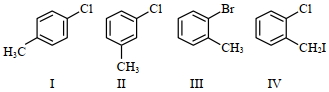
-
- (A) \(II\)
- (B) \(IV\)
- (C) \(I\)
- (D) \(III\)
Show answer and solution
Correct Answer: (B)
Other compounds halide can't be removed because corresponding \(\mathrm{C}^{+}\) is highly unstable.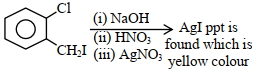
-
- (A) Carbocation \(B\) is more stable and formed relatively at faster rate
- (B) Carbocation \(A\) is more stable and formed relatively at slow rate
- (C) Carbocation \(B\) is more stable and formed relatively at slow rate
- (D) Carbocation \(A\) is more stable and formed relatively at faster rate
Show answer and solution
Correct Answer: (A)
This is more stable due to secondary cation formation and formed with faster rate due to low activation energy.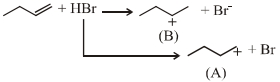
-
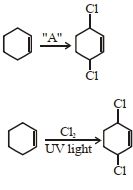
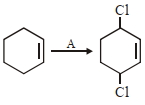
- (A) \(A = HCl ;\) Anhydrous \(AlCl _{3}\)
- (B) \(A = HCl , ZnCl _{2}\)
- (C) \(A = Cl _{2} ; UV\) light
- (D) \(A = Cl _{2}\); dark, Anhydrous \(AlCl _{3}\)
Show answer and solution
Correct Answer: (C)
For substitution at allylic position in the given compound, the reagent used is \(Cl _{2} / uv\) light.The reaction is free radical halogenation.
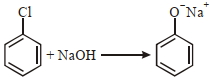
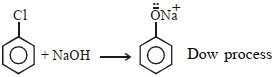
- 54. \({image}\) The above reaction requires which of the following reaction conditions ?
 2021 Medium
- (A) \(573\, K ,\, Cu , 300\, atm\)
- (B) \(623\, K ,\, Cu , 300\, atm\)
- (C) \(573\, K , 300\, atm\)
- (D) \(623\, K , 300\, atm\)
Show answer and solution
Correct Answer: (D)
Temperature \(=623 K\)Pressure \(=300 atm\)
-
- (A) \(a - ii , b - i , c - iv , d - iii\)
- (B) \(a-i i i, b-i v, c-i i, d-i\)
- (C) \(a-iii, b-i, c-i v, d-i i\)
- (D) \(a - ii , b - iv , c - i , d - iii\)
Show answer and solution
Correct Answer: (B)
\((a)\) Alcoholic potassium hydroxide \(\rightarrow\) used for \(\beta-\) elimination\((b)\) \(Pd / BaSO _{4} \rightarrow\) Lindlar's catalyst
\((c)\) \(BHC\) (Benzene hexachloride) \(\rightarrow\) Obtained by addition reactions
\((d)\) Polyacetylene \(\rightarrow\) Electrodes in batteries
-
- (A) \(\mathrm{HOCl}\)
- (B) Liquid \(NH_{3}\)
- (C) dilute \(HNO_{2}\)
- (D) Concentrated \(\mathrm{HIO}_{3}\)
Show answer and solution
Correct Answer: (D)
lodination of alkane is reversible reaction.It can be irreversible in the presence of strong oxidising agent like conc. \(\mathrm{HNO}_{3}\) or conc. \(\mathrm{HIO}_{3}\)
- 57. The correct order of the following compounds showing increasing tendency towards nucleophilic substitution reaction is :-
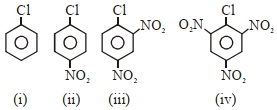 2021 Easy
- (A) \(( iv ) < ( iii ) < ( ii ) < ( i )\)
- (B) \(( iv ) < ( i ) < ( ii ) < ( iii )\)
- (C) \(( iv ) < ( i ) < ( iii ) < ( ii )\)
- (D) \(( i ) < ( ii ) < ( iii ) < ( iv )\)
Show answer and solution
Correct Answer: (D)
For nucleophile substitution in aromatic halidesCorrect order is :
\(( i ) < ( ii ) < ( iii ) < ( iv )\)
More No. of \(NO _{2}\) substituted aromatic halide, increase the rate of nucleophile substitution reaction in aromatic halides.
-
- (A) \(5,3\) and \(4\)
- (B) \(6,4\) and \(5\)
- (C) \(5,4\) and \(3\)
- (D) \(7,5\) and \(6\)
Show answer and solution
Correct Answer: (A)
Oxidation state of \(\mathrm{P}\) in \(\mathrm{H}_{4} \mathrm{P}_{2} \mathrm{O}_{7}, \mathrm{H}_{4} \mathrm{P}_{2} \mathrm{O}_{5}\) and \(\mathrm{H}_{4} \mathrm{P}_{2} \mathrm{O}_{6}\) is \(5,3 \& 4\) respectively\(\mathrm{H}_{4} \mathrm{P}_{2} \mathrm{O}_{7}\)
\(2 \mathrm{x}+4(+1)+7(-2)=0\)
\(\mathrm{x}=+5\)
\(\mathrm{H}_{4} \mathrm{P}_{2} \mathrm{O}_{5}\)
\(2 \mathrm{x}+4(+1)+5(-2)=0\)
\(\mathrm{x}=+3\)
\(\mathrm{H}_{4} \mathrm{P}_{2} \mathrm{O}_{6}\)
\(2 \mathrm{x}+4(+1)+6(-2)=0\)
\(\mathrm{x}=+4\)
- 59. Which one of the following chemical agent is not being used for dry-cleaning of clothes? 2021 Medium
- (A) \(\mathrm{H}_{2} \mathrm{O}_{2}\)
- (B) \(\mathrm{Cl}_{2} \mathrm{C}=\mathrm{CCl}_{2}\)
- (C) \(\mathrm{CCl}_{4}\)
- (D) Liquid \(\mathrm{CO}_{2}\)
Show answer and solution
Correct Answer: (C)
\(\mathrm{CO}_{2}, \mathrm{CCl}_{4}\) and \(\mathrm{Cl}_{2} \mathrm{C}=\mathrm{CCl}_{2}\) are used as dry cleaning agents for clothes.\(\mathrm{H}_{2} \mathrm{O}_{2}\) is used as bleaching agent in laundry.
- 60. The decreasing order of reactivity of the following organic molecules towards \(AgNO\) \(_{3}\) solution is :
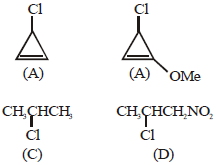 2020 Medium
- (A) \(( A )>( B )>( D )>( C )\)
- (B) \(( A )>( B )>( C )>( D )\)
- (C) \((C)>(D)>(A)>(B)\)
- (D) \((B)>(A)>(C)>(D)\)
Show answer and solution
Correct Answer: (D)
\((C)\) \(\begin{gathered} \begin{array}{*{20}{c}} {C{H_3} - CH - C{H_3}} \\ {|\,\,\,\,\,\,\,\,\,\,\,\,} \\ {Cl\,\,\,\,\,\,\,\,\,\,} \\ {\,\,\,\,\,\,\,\,\,\, \downarrow AgN{O_3}} \end{array} \hfill \\ \begin{array}{*{20}{c}} { \oplus \,\,\,\,} \\ {C{H_3} - CH - C{H_3}} \\ {({2^o}\,Cation)} \end{array} \hfill \\ \end{gathered} \)\((D)\) \(\begin{gathered} \begin{array}{*{20}{c}} {C{H_3} - CH - C{H_3}} \\ {|\,\,\,\,\,\,\,\,\,\,\,\,} \\ {Cl\,\,\,\,\,\,\,\,\,\,} \\ {\,\,\,\,\,\,\,\,\, \downarrow AgN{O_3}} \end{array} \hfill \\ \begin{array}{*{20}{c}} { \oplus \,\,\,\,\,\,\,\,\,\,\,\,\,\,\,\,\,\,\,\,} \\ {C{H_3} - CH - C{H_2} - N{O_2}} \\ {{2^o}\,Cation\,and\,\left( { - I\,of\,N{O_2}} \right)} \end{array} \hfill \\ \end{gathered}\)
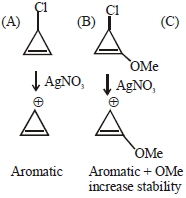
- 61. The decreasing order of reactivity towards dehydrohalogenation \((E_1)\) reaction of the following compounds is
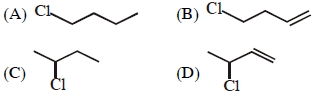 2020 Hard
- (A) \(B > D > A > C\)
- (B) \(B > D > C > A\)
- (C) \(D > B > C > A\)
- (D) \(B > A > D > C\)
Show answer and solution
Correct Answer: (C)
Reactivity \(D > B > C > A\) Carbocation formed from \(D\) is most stable Carbocation formed from \(A\) is least stable - 62. The major product formed in the following reaction is : \(CH _{3} CH = CHCH \left( CH _{3}\right)_{2} \stackrel{ HBr }{\longrightarrow}\) 2020 Medium
- (A) \(CH _{3} CH _{2} CH _{2} C ( Br )\left( CH _{3}\right)_{2}\)
- (B) \(Br \left( CH _{2}\right)_{3} CH \left( CH _{3}\right)_{2}\)
- (C) \(CH _{3} CH _{2} CH ( Br ) CH \left( CH _{3}\right)_{2}\)
- (D) \(CH _{3} CH ( Br ) CH _{2} CH \left( CH _{3}\right)_{2}\)
Show answer and solution
Correct Answer: (A)
\(CH _{3} CH = CHCH \\left( CH _{3}\\right)_{2} + H^{+} \longrightarrow CH _{3} CH _{2} \stackrel{+}{C} H CH \\left( CH _{3}\\right)_{2}\)
\(CH _{3} CH _{2} \stackrel{+}{C} H CH \\left( CH _{3}\\right)_{2} \stackrel{1,2-H\, shift}{\longrightarrow} CH _{3} CH _{2} CH _{2} \stackrel{+}{C} \\left( CH _{3}\\right)_{2}\)
\(CH _{3} CH _{2} CH _{2} \stackrel{+}{C} \\left( CH _{3}\\right)_{2} + Br^{-} \longrightarrow CH _{3} CH _{2} CH _{2} C ( Br )\\left( CH _{3}\\right)_{2}\)
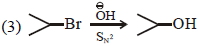
- 63. Which of the following compounds will show retention in configuration on nucleophic substitution by \(OH ^{-}\) ion \(?\) 2020 Medium
- (A) \(\begin{array}{*{20}{c}} {C{H_3} - CH - C{H_2}Br} \\ {|\,\,\,\,\,\,\,\,\,\,\,\,} \\ {{C_2}{H_5}\,\,\,\,} \end{array}\)
- (B) \(\begin{array}{*{20}{c}} {C{H_3} - CH - Br} \\ {|\,\,\,} \\ {\,\,\,\,\,\,\,{C_6}{H_5}} \end{array}\)
- (C) \(\begin{array}{*{20}{c}} {C{H_3} - CH - Br} \\ {|\,\,\,} \\ {\,\,\,\,C{H_3}} \end{array}\)
- (D) \(\begin{array}{*{20}{c}} {\,\,\,\,\,\,Br} \\ {\,\,\,|\,} \\ {C{H_3} - C - H} \\ {\,\,\,|} \\ {\,\,\,\,\,\,\,\,\,\,\,\,\,\,\,{C_6}{H_{13}}} \end{array}\)
Show answer and solution
Correct Answer: (A)
\((1)\)\(\begin{array}{*{20}{c}} { * \,\,\,\,\,\,\,\,\,\,\,\,\,\,\,\,\,\,\,\,\,\,\,\,\,\,\,\,\,\,\,} \\ {C{H_3} - CH - C{H_2} - Br\,\xrightarrow[{{S_{{N^2}}}}]{{\mathop O\limits^ \ominus H}}} \\ {|\,\,\,\,\,\,\,\,\,\,\,\,\,\,\,\,\,\,\,\,\,\,\,\,\,\,\,\,\,\,\,\,} \\ {Et\,\,\,\,\,\,\,\,\,\,\,\,\,\,\,\,\,\,\,\,\,\,\,\,\,\,\,\,\,} \end{array}\)\(\begin{array}{*{20}{c}} { * \,\,\,\,\,\,\,\,\,\,\,\,} \\ {C{H_3} - CH - C{H_2}OH} \\ {|\,\,\,\,\,\,\,\,\,\,\,\,\,\,} \\ {Et\,\,\,\,\,\,\,\,\,\,\,} \end{array}\)\((2)\)\(\begin{array}{*{20}{c}} {C{H_3} - CH - Br\,\xrightarrow[{{S_{{N^2}}}}]{{\mathop O\limits^ \ominus H}}} \\ {|\,\,\,\,\,\,\,\,\,\,\,\,\,\,\,\,\,\,\,} \\ {ph\,\,\,\,\,\,\,\,\,\,\,\,\,\,\,} \end{array}\)\(\begin{array}{*{20}{c}} {ph - CH - OH} \\ {|\,\,\,\,\,\,\,\,} \\ {C{H_3}} \end{array}\)
\((4)\)\(\begin{array}{*{20}{c}} {C{H_3} - CH - Br\,\xrightarrow[{{S_{{N^2}}}}]{{\mathop O\limits^ \ominus H}}} \\ {|\,\,\,\,\,\,\,\,\,\,\,\,\,\,\,\,\,\,\,} \\ {{C_6}{H_{13}\,\,\,\,\,\,}} \end{array}\)\(\begin{array}{*{20}{c}} {C{H_3} - CH - OH} \\ {|\,\,\,\,\,} \\ {\,\,\,\,{C_6}{H_3}} \end{array}\)
As language given, we have to go with option \((1)\) as stereochemistry of chiral centre is not distortet.
-
- (A) Both \((A)\) and \((R)\) are correct statements but \((R)\) is not the correct explanation of \((A)\)
- (B) Both \((A)\) and \((R)\) are wrong statements
- (C) Both \((A)\) and \((R)\) are correct statements and \((R)\) is the correct explanation of \((A)\)
- (D) \((A)\) is a correct statement but \((R)\) is a wrong statement.
Show answer and solution
Correct Answer: (D)
Due to resonance there is partial double bond character between carbon and chlorine, hence it do not undergoes nucleophilic substitution reaction -
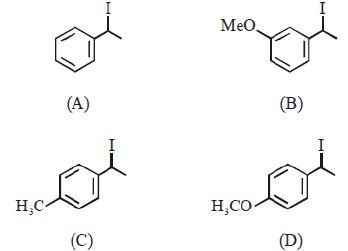
- (A) \((A) < (B) < (C) < (D)\)
- (B) \((A) < (B) < (D) < (C)\)
- (C) \((B) < (A) < (D) < (C)\)
- (D) \((B) < (A) < (C) < (D)\)
Show answer and solution
Correct Answer: (D)
Rate of \(S_N1\) reaction \(\alpha \) stability of \({C^ \oplus } - I.M\) -
- (A) \(CH_2 = CH -Cl\)
- (B) \(CHCl_3\)
- (C) \((CH_3)_3CCl\)
- (D) \(CCl_4\)
Show answer and solution
Correct Answer: (C)
\((CH_3)_3CCl\) will give \(Cl^-\) and most stable carbocation. Hence \((CH_3)_3CCl\) likely to give a precipitate with \(AgNO_3\) solution -
- (A) \(\begin{array}{*{20}{c}}
{C{H_2} - CH - C{H_3}} \\
{|\,\,\,\,\,\,\,\,\,\,\,\,\,\,\,\,\,\,|\,\,\,\,\,\,\,\,\,\,\,\,\,\,\,\,\,\,\,\,\,\,\,\,\,} \\
{Cl\,\,\,\,\,\,\,\,\,\,\,\,\,Cl\,\,\,\,\,\,\,\,\,\,\,\,\,\,\,\,\,\,\,\,\,\,}
\end{array}\) - (B) \(\begin{array}{*{20}{c}}
{C{H_2} - C{H_2} - C{H_2}\,\,\,\,\,\,\,\,\,\,\,\,\,\,\,\,\,\,\,\,\,\,\,\,\,\,\,\,} \\
{\,|\,\,\,\,\,\,\,\,\,\,\,\,\,\,\,\,\,\,\,\,\,\,\,\,\,\,\,\,\,\,\,\,\,\,\,\,\,\,\,|\,\,\,\,\,\,\,\,\,\,\,\,\,\,\,\,\,\,\,\,\,\,\,\,\,\,\,\,\,\,\,\,\,\,\,} \\
{\,\,\,\,\,\,\,\,\,\,\,\,\,\,\,Cl\,\,\,\,\,\,\,\,\,\,\,\,\,\,\,\,\,\,\,\,\,\,\,\,\,\,\,\,\,\,\,\,\,Cl\,\,\,\,\,\,\,\,\,\,\,\,\,\,\,\,\,\,\,\,\,\,\,\,\,\,\,\,\,\,\,\,\,\,\,\,\,\,\,\,\,\,\,\,\,\,\,\,\,}
\end{array}\) - (C) \(\begin{array}{*{20}{c}}
{CH - CH - C{H_2} - C{H_3}} \\
{\,\,\,|\,\,\,\,\,\,\,\,\,\,\,\,\,\,\,\,\,\,\,\,\,\,\,\,\,\,\,\,\,\,\,} \\
{Cl\,\,\,\,\,\,\,\,\,\,\,\,\,\,\,\,\,\,\,\,\,\,\,\,}
\end{array}\) - (D) \(\begin{array}{*{20}{c}}
{Cl} \\
| \\
{C{H_3} - C - C{H_3}} \\
| \\
{Cl}
\end{array}\)
Show answer and solution
Correct Answer: (D)
\(\underset{(I)}{\mathop{\underset{({{C}_{3}}{{H}_{6}}C{{l}_{2}})}{\mathop{\begin{matrix}
\begin{matrix}
\,\,Cl \\
| \\
\end{matrix} \\
{{H}_{3}}C-C-C{{H}_{3}} \\
| \\
\,\,Cl \\
\end{matrix}}}\,}}\,\) \(\xrightarrow[{(aq.)}]{{KOH}}\) \(\mathop {\mathop {\begin{array}{*{20}{c}}
{\begin{array}{*{20}{c}}
{\,\,\,\,OH} \\
|
\end{array}} \\
{C{H_3} - C - C{H_3}} \\
| \\
{\,\,\,\,OH}
\end{array}}\limits_{Unstable} }\limits \xrightarrow{{{H_2}O}}\) \(\mathop {\begin{array}{*{20}{c}}
O \\
{||} \\
{C{H_3} - C - C{H_3}}
\end{array}}\limits_{(II)} \) \(\xrightarrow[{(II)\,{H_2}O\,/\,{H^ \oplus }}]{{(I)\,C{H_3}MgBr}}\) \({\mathop {\begin{array}{*{20}{c}}
{\begin{array}{*{20}{c}}
{\,\,\,\,OH} \\
|
\end{array}} \\
{C{H_3} - C - C{H_3}} \\
| \\
{\,\,\,\,C{H_3}}
\end{array}}\limits_{{3^0}\,alcohol} }\) \(\xrightarrow[{Lucas\,\,\,Test}]{{Anhy.\,ZnC{l_3}\, + \,HCl}}\) Gives turbidity immediately - (A) \(\begin{array}{*{20}{c}}
-
- (A) \((III) < (II) < (I)\)
- (B) \((II) < (I) < (III)\)
- (C) \((I) < (III) < (II)\)
- (D) \((II) < (III) < (I)\)
Show answer and solution
Correct Answer: (B)
Secondary, tertiary and benzylic halides appear to react by a mechanism that involves the formation of a carbocation and proceeds through \(\mathrm{S}_{\mathrm{N}} 1\) mechanism which takes place in two steps. The first step is the slow step \(-\) it is the rate-determining step. In this step, a molecule of alkyI halide ionizes and becomes an alkyl cation. Therefore, greater the stability of carbocation greater will be its tendency to react via \(S_{N} 1\) mechanism.\(\mathrm{R}-\mathrm{X} \rightleftharpoons \mathrm{R}^{+}+\mathrm{X}^{-}\)
In the second step, the intermediate alkyl cation reacts rapidly with water to produce alcohol.
\(\mathrm{R}^{+}+\mathrm{H}_{2} \mathrm{O} \rightleftharpoons \mathrm{ROH}\)
Hence, the order of reactivity of halides for the \(\mathrm{S}_{\mathrm{N}} 1\) mechanism is \(\mathrm{II}<\mathrm{I}<\mathrm{III}\).
-
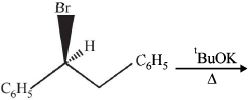
- (A) \(( \pm ){C_6}{H_5}CH({O^t }Bu)C{H_2}{C_6}{H_5}\)
- (B) \(C_6H_5CH=CHC_6H_5\)
- (C) \(( + ){C_6}{H_5}CH({O^t }Bu)C{H_2}{C_6}{H_5}\)
- (D) \(( - ){C_6}{H_5}CH({O^t }Bu)C{H_2}{C_6}{H_5}\)
Show answer and solution
Correct Answer: (B)
Carrying out dehydrohalogenation with a bulky base such as potassium tert-butoxide ( \(t\) -\(BuOK\) ) in \(1,2\) -diphenyl1-bromoethane \((t-\mathrm{BuOH})\) favors the formation of the alkene via \(E_2\) mechanism. The reaction involved is
-
- (A) \(CH_2 = CHCH_2CH = CHCH_3\)
- (B) \(CH_2= CHCH = CHCH_2CH_3\)
- (C) \(CH_3CH = C = CHCH_2CH_3\)
- (D) \(CH_3CH = CH - CH = CHCH_3\)
Show answer and solution
Correct Answer: (D)
\(\,\begin{array}{*{20}{c}}
{C{H_3} - CH - C{H_2} - CH - C{H_2} - C{H_3}}\\
{\,\,\,\,\,\,\,\,\,\,\,\,\,\,\,\,\,\,\,\,\,\,\,\,\,\,\,\,\,\,|\,\,\,\,\,\,\,\,\,\,\,\,\,\,\,\,\,\,\,\,\,\,\,\,\,\,\,\,\,\,\,\,\,\,\,|\,\,\,\,\,\,\,\,\,\,\,\,\,\,\,\,\,\,\,\,\,\,\,\,\,\,\,\,\,\,\,\,\,\,\,\,\,\,\,\,\,\,\,\,\,\,\,\,\,\,\,\,}\\
{\,\,\,\,\,\,\,\,\,Br\,\,\,\,\,\,\,\,\,\,\,\,\,\,\,\,\,\,\,\,\,\,\,\,\,\,\,\,\,\,\,Br\,\,\,\,\,\,\,\,\,\,\,\,\,\,\,\,\,\,\,\,\,\,\,\,\,\,\,\,\,\,}
\end{array}\) \(\xrightarrow[{{E_2}}]{{KOH,\,C{H_3}OH\,\Delta }}\) \(\mathop {C{H_3} - CH = CH - CH = CH - C{H_3}}\limits_{{\text{(Saytzeff product)}}} \) -
- (A) \(NaI\)
- (B) \(NaOEt/ EtOH\)
- (C) \(NaOH/H_2O\)
- (D) \(NaOH /H_2O-EtOH\)
Show answer and solution
Correct Answer: (A)
Alkyl chloride or bromide undergo substitution and get converted to an alkyl iodide on treatment with a solution of sodium iodide in acetone. e.g.\(CH_3CH_2CH_2Br + NaI\) \(\xrightarrow{{acetone}}\) \(CH_3CH_2CH_2I\) + \(NaBr\)
This reaction is also known as Finkelstein Reaction
-
- (A) Finkelstein reaction
- (B) Swarts reaction
- (C) Free radical fluorination
- (D) Sandmeyer's reaction
Show answer and solution
Correct Answer: (B)
Alkyl fluorides can be prepared by action of mercurous fluoride or antimony trifluorides (inorganic fluorides) on corresponding alkyl halide. This reaction is known as Swarts reaction.\(C H_{3} B r+A g F \rightarrow \underset{\text { Methyl fluoride}}{C H_3F}+A g B r\)
But, when aciton of Nallacetone takes place on alkyl chloride of bromide alkyl lodide forms. This reaction is called Finkelstein reaction
\(C_{2} H_{2} C I \stackrel{N a t}{\longrightarrow} C_{2} H_{5} I+N a C I\)
Free redical fluorination is highly explosive reaction, so not preferred for the preparation of fluoride.
- 73. For the compounds \(CH_3Cl, CH_3Br, CH_3I\) and \(CH_3F\), the correct order of increasing \(C-\) halogen bond length is 2014 Medium
- (A) \(CH_3F < CH_3Cl < CH_3Br < CH_3I\)
- (B) \(CH_3F < CH_3Br < CH_3Cl < CH_3I\)
- (C) \(CH_3F < CH_3I < CH_3Br < CH_3Cl\)
- (D) \(CH_3Cl< CH_3Br < CH_3F < CH_3I\)
Show answer and solution
Correct Answer: (A)
The correct order of increasing bond length is\(CH_3F < CH_3Cl < CH_3Br < CH_3I\)
-
- (A) \(C_6H_5CHC_6H_5Br\)
- (B) \(C_6H_5CH_2Br\)
- (C) \(C_6H_5CHCH_3Br\)
- (D) \(C_6H_5CCH_3C_6H_5Br\)
Show answer and solution
Correct Answer: (C)
\(C_6H_5CHCH_3Br\) being an optically active secondary alkyl bromide undergoes \(S_N2\) nucleophilic substitution reaction. Hence it undergoes complete inversion of configuration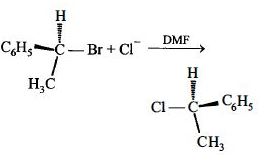
- 75. In \({S_{{N^2}}}\) reactions, the correct order of reactivity for the following compounds : 2014 Medium
- (A) \(CH_3Cl > (CH_3)_2CHCl > CH_3CH_2Cl > ( CH_3)_3CCl\)
- (B) \(CH_3Cl > CH_3CH_2 Cl > (CH_3)_2CHCl > (CH_3)_3CCl\)
- (C) \(CH_3CH_2 Cl > CH_3Cl > (CH_3)_2CHCl > (CH_3)_3CCl\)
- (D) \((CH_3 )_2CHCl > CH_3CH_2Cl > CH_3Cl > (CH_3)_3CCl\)
Show answer and solution
Correct Answer: (B)
Rate of \({S_{{N^2}}} \propto \frac{1}{\text { Steric crowding of }^{\prime} C^{\prime}}\)As steric hindrance (crowding) increases, the rate of \({S_{{N^2}}}\) reaction decreases.
The order of reactivity towards \({S_{{N^2}}}\) reaction for alkyl halides is
Primary halides \(>\) Secondary halides \(>\) Tertiary halides
- 76. The major organic compound formed by the reaction of \(1, 1, 1-\) trichloroethane with silver powder is : 2014 Hard
- (A) Acetylene
- (B) Ethene
- (C) \(2 -\) Butyne
- (D) \(2 -\) Butene
Show answer and solution
Correct Answer: (C)
\(2 \mathrm{CH}_{3}-\mathrm{CCl}_{3} \stackrel{6 \mathrm{Ag}}{\longrightarrow} \mathrm{CH}_{3}-\mathrm{C} \equiv \mathrm{C}-\mathrm{CH}_{3}+6 \mathrm{AgCl}\) -
- (A) secondary alcohol by \({S_{{N^1}}}\)
- (B) tertiary alcohol by \({S_{{N^1}}}\)
- (C) secondary alcohol by \({S_{{N^2}}}\)
- (D) tertiary alcohol by \({S_{{N^2}}}\)
Show answer and solution
Correct Answer: (B)
The reaction of alcohol with Lucas reagent is mostly an \({S_{{N^1}}}\) reaction and the rate of reaction is directly proportional to the stability of carbocation formed in the reaction. Since \(3^{o} R-O H\) forms \(3^{o}\) carbocation (most stable), hence it will react fastest. -
- (A) \(Br^- > I^->Cl^-\)
- (B) \({I^ - } > B{r^ - } > C{l^{^ - }}\)
- (C) \(C{l^{^ - }} > B{r^ - } > {I^ - }\)
- (D) \(C{l^{^ - }} > {I^ - } > B{r^ - }\)
Show answer and solution
Correct Answer: (B)
Since the leaving group breaks away as a base, it is easier to displace weaker bases as compared to stronger bases. Thus less basic the substituent. the more easily it is displaced. Since the basic strength of the given groups is in order.\({I^ - } < B{r^ - } < Cl^-\)
Thus the order of halogen leaving groups is
\({I^ - } > B{r^ - } > C{l^{^ - }}\)
- 79. In Williamson synthesis of mixed ether having a primary and a tertiary alkyl group if tertiary halide is used, then 2013 Hard
- (A) Rate of reaction will be slow due to slow cleavage of carbon-halogen bond.
- (B) Alkene will be the main product
- (C) Simple ether will form instead of mixed ether.
- (D) Expected mixed ether will be formed.
Show answer and solution
Correct Answer: (B)
The tertiary alkylhalide undergo elimination reaction to give alkenes\(\begin{array}{*{20}{c}}
{\,\,\,\,\,\begin{array}{*{20}{c}}
{\,\,\,\,C{H_3}\,\,} \\
{|\,\,\,\,}
\end{array}} \\
{C{H_3} - C - X + } \\
{\,\,\,\,\,|\,\,\,\,} \\
{\,\,\,\,\,\,\,\,\,C{H_3}\,\,\,}
\end{array}\) \(NaOC_2H_5\,\to \) \(\mathop {\begin{array}{*{20}{c}}
{\,\,\,\,\,C{H_3}} \\
{|\,} \\
{C{H_3} - C = C{H_2}}
\end{array}}\limits_{2\, - \,methyl\,propane} \) -
- (A) \(RI > RBr > RCl\)
- (B) \(RCl > RBr> RI\)
- (C) \(RBr >RCl >RI\)
- (D) \(RBr > RI > RCl\)
Show answer and solution
Correct Answer: (A)
For a given alkyl group, the order of reactivity is\(\mathop {\underline {R - I\, > \,R\, - \,Br\, > \,R\, - \,Cl\, > \,R\, - \,F} }\limits_{\;{\text{ }}increasing{\text{ }}bond{\text{ }}energy} \)
decreasing halogen reactivity.
This order depends on the carbon-halogen bond energy; the carbon-fluorine bond energy is maximum and thus fluorides are least reactive while carbon - iodide bond energy is maximum hence iodides are most reactive.
-
- (A) two molecules of aryl halides
- (B) one molecule of each of aryl- halide and alkyl-halide.
- (C) one molecule of each of aryl-halide and phenol.
- (D) two molecules of aralkyl-halides.
Show answer and solution
Correct Answer: (B)
Reaction between alkyl halide, aryl halide and sodium in presence of ether is known as Wurtz fitting reaction\({C_6}H_5Cl + 2Na + ClC{H_3} \to \mathop {{C_6}{H_5}C{H_3}}\limits_{{\text{Toluene}}} + 2NaCl\)
- 82. Which of the following would not give \(2-\) phenylbutane as the major product in a Friedel-Crafts alkylation reaction ? 2013 Hard
- (A) \(1-\) butene \(+ HF\)
- (B) \(2-\) butanol \(+ H_2SO_4\)
- (C) Butanoyl chloride \(+ AlCl_3\) then \(Zn, HCl\)
- (D) Butyl choloride \(+ AlCl_3\)
Show answer and solution
Correct Answer: (C)
The fridal - crafts alkylation reaction will give propyl phenyl ketone which further on clemmenson's reduction will give butyl benzene\({C_6}{H_6}\, + \,C{H_3}C{H_2}C{H_2}COCl\,\xrightarrow{{AlC{l_3}}}\) \({C_6}{H_5}COC{H_2}C{H_2}C{H_3}\,\xrightarrow{{Zn - Hg\,/\,HCl}}\) \(\mathop {{C_6}{H_5}C{H_2}C{H_2}C{H_2}C{H_3}}\limits_{Butyl\,\,benzene} \)

No questions on this page match these filters.