


પ્રશ્નો
23 પ્રશ્નો23 માંથી 1–23 પ્રશ્નો
-
- (A) \(2 \mathrm{~mm}\)
- (B) \(2 \mathrm{~cm}\)
- (C) \(0.02 \mathrm{~mm}\)
- (D) \(0.2 \mathrm{~mm}\)
જવાબ અને ઉકેલ જુઓ
સાચો જવાબ: (A)
Width of \(1^{\text {st }}\) secondary maxima \(=\frac{\lambda}{a} \cdot D\)Here
\( a=0.2 \times 10^{-3} \mathrm{~m} \)
\( \lambda=400 \times 10^{-9} \mathrm{~m} \)
\( D=100 \times 10^{-2}\)
Width of \(1^{\text {st }}\) secondary maxima
\( =\frac{400 \times 10^{-9}}{0.2 \times 10^{-3}} \times 100 \times 10^{-2} \)
\( =2 \mathrm{~mm}\)
-
- (A) \(30^{\circ}\)
- (B) \(15^{\circ}\)
- (C) \(60^{\circ}\)
- (D) \(45^{\circ}\)
જવાબ અને ઉકેલ જુઓ
સાચો જવાબ: (C)
પ્રથમ ન્યૂનતમ માટે a \(\sin \theta=\lambda\)\(\sin \theta=\frac{\lambda}{\mathrm{a}}=\frac{1}{2}\)
\(\theta=30^{\circ}\)
કોણીય પહોળાઈ \(=60^{\circ}\)
-
- (A) \(40\)
- (B) \(20\)
- (C) \(30\)
- (D) \(10\)
જવાબ અને ઉકેલ જુઓ
સાચો જવાબ: (C)
For first minima\(\text { a } \sin \theta=\lambda\)
\( \Rightarrow \sin \theta=\frac{\lambda}{a}=\frac{5000 \times 10^{-10}}{1 \times 10^{-6}}=\frac{1}{2} \)
\( \Rightarrow \theta=30^{\circ}\)
-
- (A) \(0.26\)
- (B) \(0.20\)
- (C) \(0.54\)
- (D) \(45\)
જવાબ અને ઉકેલ જુઓ
સાચો જવાબ: (B)
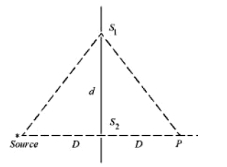
Path difference for minima at \(\mathrm{P}\)\( 2 \sqrt{\mathrm{D}^2+\mathrm{d}^2}-2 \mathrm{D}=\frac{\lambda}{2} \)
\( \therefore \sqrt{\mathrm{D}^2+\mathrm{d}^2}-\mathrm{D}=\frac{\lambda}{4} \)
\( \therefore \sqrt{\mathrm{D}^2+\mathrm{d}^2}=\frac{\lambda}{4}+\mathrm{D} \)
\( \Rightarrow \mathrm{D}^2+\mathrm{d}^2=\mathrm{D}^2+\frac{\lambda^2}{16}+\frac{\mathrm{D} \lambda}{2} \)
\( \Rightarrow \mathrm{d}^2=\frac{\mathrm{D} \lambda}{2}+\frac{\lambda^2}{16}\)
\( \Rightarrow \mathrm{d}^2=\frac{0.2 \times 400 \times 10^{-9}}{2}+\frac{4 \times 10^{-14}}{4} \)
\( \Rightarrow \mathrm{d}^2 \approx 400 \times 10^{-10} \)
\( \therefore \mathrm{d}=20 \times 10^{-5} \)
\( \Rightarrow \mathrm{d}=0.20 \mathrm{~mm}\)
-
- (A) \(1\)
- (B) \(2\)
- (C) \(3\)
- (D) \(5\)
જવાબ અને ઉકેલ જુઓ
સાચો જવાબ: (B)
\(\mathrm{d}=1 \mathrm{~mm}, \mathrm{D}=1 \mathrm{~m}, \lambda=500 \mathrm{~nm}\)\(10\left(\frac{\lambda \mathrm{D}}{\mathrm{d}}\right)=\frac{2 \lambda \mathrm{D}}{\mathrm{a}}\)
\(\mathrm{a}=\frac{\mathrm{d}}{5}\)
\(=\frac{10 \times 10^{-4} \mathrm{~m}}{5}\)
\(=2 \times 10^{-4}\)
-
- (A) \(5\)
- (B) \(6\)
- (C) \(4\)
- (D) \(8\)
જવાબ અને ઉકેલ જુઓ
સાચો જવાબ: (D)
\(I_{\max }=(\sqrt{\mathrm{I}}+\sqrt{4 \mathrm{I}})^2=9 \mathrm{I}\)\(\mathrm{I}_{\min }=(\sqrt{4 \mathrm{I}}-\sqrt{\mathrm{I}})^2=\mathrm{I}\)
\(\therefore \mathrm{I}_{\max }-\mathrm{I}_{\min }=8 \mathrm{I}\)
-
- (A) \(30^{\circ}\)
- (B) \(60^{\circ}\)
- (C) \(90^{\circ}\)
- (D) \(45^{\circ}\)
જવાબ અને ઉકેલ જુઓ
સાચો જવાબ: (A)
સંપૂર્ણ પ્રતિબિંબ પર વક્રીભવન કિરણ અને પ્રતિબિંબિત કિરણ લંબરૂપ હોય છે.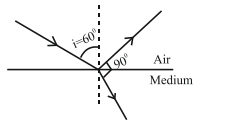
-
- (A) \(5\)
- (B) \(8\)
- (C) \(2\)
- (D) \(16\)
જવાબ અને ઉકેલ જુઓ
સાચો જવાબ: (C)
\( \text {For } n^{\text {th }} \text { minima } \)
\( b \sin \theta=n \lambda \)
\( (\lambda \text { is } \operatorname{small} \text { so } \sin \theta \text { is small, hence } \sin \theta \simeq \tan \theta) \)
\( b \tan \theta=n \lambda \)
\( b \frac{y}{D}=n \lambda \)
\( \Rightarrow y_n=\frac{n \lambda D}{b} \text { (Position of } n^{\text {th }} \text { minima) }\)
\( \mathrm{B} \rightarrow 1^{\mathrm{st}} \text { minima, } \mathrm{A} \rightarrow 3^{\mathrm{rc}} \text { minima } \)
\( \mathrm{y}_3=\frac{3 \lambda \mathrm{D}}{\mathrm{b}}, \mathrm{y}_1=\frac{\lambda \mathrm{D}}{\mathrm{b}} \)
\( \Delta \mathrm{y}=\mathrm{y}_3-\mathrm{y}_1=\frac{2 \lambda \mathrm{D}}{\mathrm{b}} \)
\( 3 \times 10^{-3}=\frac{2 \times 6000 \times 10^{-10} \times 0.5}{\mathrm{~b}} \)
\( \mathrm{~b}=\frac{2 \times 6000 \times 10^{-10} \times 0.5}{3 \times 10^{-3}} \)
\( \mathrm{~b}=2 \times 10^{-4} \mathrm{~m} \)
\( x=2\)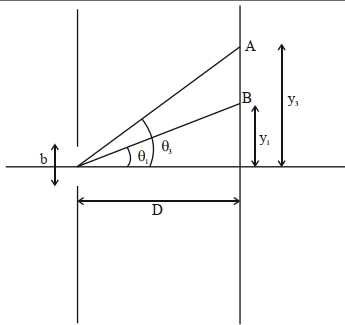
-
- (A) \(6\)
- (B) \(8\)
- (C) \(5\)
- (D) \(9\)
જવાબ અને ઉકેલ જુઓ
સાચો જવાબ: (A)
\(\sin \theta=\theta=\frac{2 \lambda}{b}\)\(=\frac{2 \times 600 \times 10^{-9}}{4 \times 10^{-4}}=3 \times 10^{-3} \mathrm{rad}\)
કુલ વિચલન \((3+3) \times 10^{-3}=6 \times 10^{-3} \mathrm{rad}\)
-
- (A) \(272\)
- (B) \(274\)
- (C) \(275\)
- (D) \(277\)
જવાબ અને ઉકેલ જુઓ
સાચો જવાબ: (C)
\(\mathrm{y}=\frac{\lambda \mathrm{D}}{\mathrm{d}}=\frac{550 \times 10^{-9} \times 100 \times 10^{-2}}{0.2 \times 10^{-3}}=275\)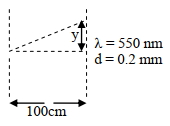
-
- (A) \(I_0 / 4\)
- (B) \(I_0\)
- (C) \(I_0 / 2\)
- (D) \(I_0 / 8\)
જવાબ અને ઉકેલ જુઓ
સાચો જવાબ: (A)
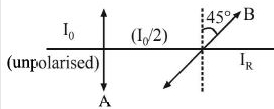
Intensity of emergent light\(=\frac{I_0}{2} \cos ^2 45^{\circ}=\frac{I_0}{4}\) -
- (A) \(\;\frac{{I_o}}{8}\)
- (B) \(\;I_o\)
- (C) \(\;\frac{{I_o}}{2}\)
- (D) \(\;\frac{{I_o}}{4}\)
જવાબ અને ઉકેલ જુઓ
સાચો જવાબ: (D)
તીવ્રતા વચ્ચેનો સંબંધ\(I=\left( {\frac{{{I_0}}}{2}} \right) {\cos ^2}\theta=\frac{{{I_0}}}{2} {\cos ^2}45^\circ =\frac{{{I_0}}}{4}\)
-
- (A) \(60^{\circ}\)
- (B) \(30^{\circ}\)
- (C) \(90^{\circ}\)
- (D) \(45^{\circ}\)
જવાબ અને ઉકેલ જુઓ
સાચો જવાબ: (D)
Let \(I_0\) be intensity of unpolarised light incident on first polaroid.\(I_1=\) Intensity of light transmitted from \(1^{\text {st }}\) polaroid
\(=\frac{I_0}{2}\)
\(\theta\) be the angle between \(1^{\text {st }}\) and \(2^{\text {nd }}\) polaroid
\(\phi\) be the angle between \(2^{\text {nd }}\) and \(3^{\text {rd }}\) polaroid
\(\theta+\phi=90^{\circ}\) (as \(1^{\text {st }}\) and \(3^{\text {rd }}\) polaroid are crossed)
\(\phi=90^{\circ}-\theta\)
\(\mathrm{I}_2=\) Intensity from \(2^{\text {nd }}\) polaroid
\(I_2=I_1 \cos ^2 \theta=\frac{I_0}{2} \cos ^2 \theta\)
\(\mathrm{I}_3=\) Intensity from \(3^{\text {rd }}\) polaroid
\(\mathrm{I}_3=\mathrm{I}_2 \cos ^2 \phi\)
\(\mathrm{I}_3=\mathrm{I}_1 \cos ^2 \theta \cos ^2 \phi\)
\(\mathrm{I}_3=\frac{\mathrm{I}_0}{2} \cos ^2 \theta \cos ^2 \phi\)
\(\phi=90-\theta\)
\(I_3=\frac{I_0}{2} \cos ^2 \theta \sin ^2 \theta\)
\(I_3=\frac{I_0}{2}\left[\frac{2 \sin \theta \cos \theta}{2}\right]^2\)
\(I_3=\frac{I_0}{8} \sin ^2 2 \theta\)
\(\mathrm{I}_3\) will be maximum when \(\sin 2 \theta=1\)
\( 2 \theta=90^{\circ} \)
\( \theta=45^{\circ}\)
-
- (A) બંને ગોલીય અને નળાકારીય
- (B) નળાકારીય
- (C) સમતલીય
- (D) ગોલીય
જવાબ અને ઉકેલ જુઓ
સાચો જવાબ: (D)
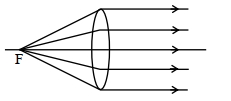
પ્રકાશ સમાંતર બહાર આવે છે.\(\therefore\) પ્લાનર તરંગઅગ્ર
-
- (A) 11
- (B) 12
- (C) 13
- (D) 14
જવાબ અને ઉકેલ જુઓ
સાચો જવાબ: (C)
અસુસંગત તરંગ માટે \(I_1=I_A+I_B \Rightarrow I_1=I_0+9 I_0\)
\(I_1=10 I_0\)
સુસંગત તરંગ માટે \(I_2=I_A+I_B+2 \sqrt{I_A I_B} \cos 60^{\circ}\)
\(I_2=I_0+9 I_0+2 \sqrt{9 I_0^2} \cdot \frac{1}{2}=13 I_0\)
\(\frac{I_1}{I_2}=\frac{10}{13}\) -
- (A) \(60 \mathrm{~mm}\)
- (B) \(24 \mathrm{~mm}\)
- (C) \(120 \mathrm{~mm}\)
- (D) \(12 \mathrm{~mm}\)
જવાબ અને ઉકેલ જુઓ
સાચો જવાબ: (B)
રેખીય પહોળાઈ\(\mathrm{W} =\frac{2 \lambda \mathrm{d}}{\mathrm{a}}=\frac{2 \times 6 \times 10^{-7} \times 0.2}{1 \times 10^{-5}}\)
\(=2.4 \times 10^{-2}=24 \mathrm{~mm}\)
-
- (A) \(1 / 2\)
- (B) \(3 / 4\)
- (C) \(1 / 3\)
- (D) \(1 / 4\)
જવાબ અને ઉકેલ જુઓ
સાચો જવાબ: (A)
\( \Delta \mathrm{x}=\frac{7 \lambda}{4} \)\( \phi=\frac{2 \pi}{\lambda} \Delta \mathrm{x}=\frac{2 \pi}{\lambda} \times \frac{7 \lambda}{4}=\frac{7 \pi}{2} \)
\( \mathrm{I}=\mathrm{I}_{\max } \cos ^2\left(\frac{\phi}{2}\right) \)
\( \frac{\mathrm{I}}{\mathrm{I}_{\max }}=\cos ^2\left(\frac{\phi}{2}\right)=\cos ^2\left(\frac{7 \pi}{2 \times 2}\right)=\cos ^2\left(\frac{7 \pi}{4}\right) \)
\(=\cos ^2\left(2 \pi-\frac{\pi}{4}\right) \)
\(=\cos ^2 \frac{\pi}{4} \)
\(=\frac{1}{2}\)
-
- (A) \(5\)
- (B) \(8\)
- (C) \(9\)
- (D) \(10\)
જવાબ અને ઉકેલ જુઓ
સાચો જવાબ: (C)
\(\mathrm{n}_2 \lambda_2=\mathrm{n}_1 \lambda_1\)\(\frac{\mathrm{n}_2}{\mathrm{n}_1}=\frac{\lambda_1}{\lambda_2}=\frac{450}{650}=\frac{9}{13}\)
\(\mathrm{n}_2=9\)
-
- (A) \(121\)
- (B) \(122\)
- (C) \(124\)
- (D) \(125\)
જવાબ અને ઉકેલ જુઓ
સાચો જવાબ: (D)
ધારો કે દરેક સ્લિટને કારણે પડદા પર પ્રકાશની તીવ્રતા \(\mathrm{I}_0\) છે.આથી પડદાના કેન્દ્ર પર તીવ્રતા \(4 \mathrm{I}_0\) છે.
કેન્દ્રથી y અંતરે તીવ્રતા-
\(\mathrm{I}=\mathrm{I}_0+\mathrm{I}_0+2 \sqrt{\mathrm{I}_0 \mathrm{I}_0} \cos \phi\)
\(\mathrm{I}_{\max }=4 \mathrm{I}_0\)
\(\frac{\mathrm{I}_{\max }}{2}=2 \mathrm{I}_0=2 \mathrm{I}_0+2 \mathrm{I}_0 \cos \phi\)
\(\cos \phi=0\)
\(\phi=\frac{\pi}{2}\)
\(\mathrm{~K} \Delta \mathrm{x}=\frac{\pi}{2}\)
\(\frac{2 \pi}{\lambda} \mathrm{d} \sin \theta=\frac{\pi}{2}\)
\(\frac{2}{\lambda} \mathrm{d} \times \frac{\mathrm{y}}{\mathrm{D}}=\frac{1}{2}\)
\(\mathrm{y}=\frac{\lambda \mathrm{D}}{4 \mathrm{~d}}=\frac{5 \times 10^{-7} \times 1}{4 \times 10^{-3}}\)
\(=125 \times 10^{-6}\)
\(=125\)
-
- (A) \(9: 1\)
- (B) \(16: 1\)
- (C) \(1: 1\)
- (D) \(4: 1\)
જવાબ અને ઉકેલ જુઓ
સાચો જવાબ: (A)
Since, Intensity \(\propto\) width of slit \((\omega)\)\(\text { so, } I_1=I, I_2=4 \mathrm{I}\)
\(I_{\min }=\left(\sqrt{I_1}-\sqrt{I_2}\right)^2=I\)
\(I_{\max }=\left(\sqrt{I_1}+\sqrt{I_2}\right)^2=9 \mathrm{I}\)
\(\frac{I_{\max }}{I_{\min }}=\frac{9 \mathrm{I}}{\mathrm{I}}=\frac{9}{1}\)
-
- (A) \(1\)
- (B) \(2\)
- (C) \(3\)
- (D) \(4\)
જવાબ અને ઉકેલ જુઓ
સાચો જવાબ: (D)
\((\mu-1) \mathrm{t}=\mathrm{n} \lambda\)\((1.5-1) \mathrm{t}=4 \times 500 \times 10^{-9} \mathrm{~m}\)
\(\mathrm{t}=4000 \times 10^{-9} \mathrm{~m}\)
\(\mathrm{t}=4 \mu \mathrm{m}\)
-
- (A) \(10\)
- (B) \(15\)
- (C) \(20\)
- (D) \(25\)
જવાબ અને ઉકેલ જુઓ
સાચો જવાબ: (A)
\(\beta=\frac{\lambda \mathrm{D}}{\mathrm{d}}=\frac{5 \times 10^{-7} \times 2}{3 \times 10^{-4}}=\frac{10 \times 10^{-3}}{3} \mathrm{~m}\)\(3^{\text {rd }}\) મહત્તમ માટે \(y_3=3 \beta=10 \times 10^{-3} \mathrm{~m}=10 \mathrm{~mm}\)
-
- (A) \(197\)
- (B) \(198\)
- (C) \(199\)
- (D) \(200\)
જવાબ અને ઉકેલ જુઓ
સાચો જવાબ: (D)
\(\mathrm{I}=\mathrm{I}_0 \cos ^2\left(\frac{\Delta \phi}{2}\right)\)\(\frac{\mathrm{I}_0}{4}=\cos ^2\left(\frac{\Delta \phi}{2}\right)\)
\(\Delta \phi=\frac{2 \pi}{3}\)
\(\frac{2 \pi}{\lambda}\left(\frac{\mathrm{yd}}{\mathrm{D}}\right)=\frac{2 \pi}{3}\)
\(\mathrm{y}=\frac{\lambda \mathrm{D}}{3 \mathrm{~d}}=\frac{600 \times 10^{-9} \times 1}{3 \times 10^{-3}}=2 \times 10^{-4} \mathrm{~m}\)
આ પેજ પર આ ફિલ્ટર મુજબ કોઈ પ્રશ્ન નથી.