


પ્રશ્નો
14 પ્રશ્નો14 માંથી 1–14 પ્રશ્નો
-
- (A) \(625\, nm, 500\, nm\)
- (B) \(380\, nm, 525\, nm\)
- (C) \(380\, nm, 500\, nm\)
- (D) \(400\, nm, 500\, nm\)
જવાબ અને ઉકેલ જુઓ
સાચો જવાબ: (A)
For maxima,\(\operatorname{dsin} \theta=n \lambda\)
\(\lambda=\frac{\mathrm{d} \theta}{\mathrm{n}}\) ( \(\because \,\sin \theta \approx \theta \) when \(\theta\) is small )
\(=\frac{2500}{n}\, n m\)
Take \(n=4,5\) for \(\lambda=625\, \mathrm{nm}\) and \(500 \,\mathrm{nm}\)
-
- (A) \(\sqrt {\frac{5}{3}} \)
- (B) \(\frac{3}{{\sqrt 5 }}\)
- (C) \(\frac{5}{{\sqrt 3 }}\)
- (D) \(\frac{4}{3}\)
જવાબ અને ઉકેલ જુઓ
સાચો જવાબ: (B)
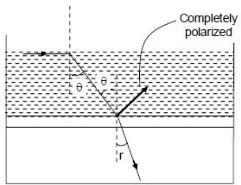
\(\sin 90^{\circ}=\mu \sin \theta\)\(\Rightarrow \quad \sin \theta=\frac{1}{\mu}\)
\({\mu \sin \theta=1.5 \sin r}\)
\({\mu \tan \theta=1.5}\)
\( \Rightarrow \tan \theta = \frac{{1.5}}{\mu }\)
\(\sin \theta = \frac{3}{{\sqrt {9 + 4{\mu ^2}} }} = \frac{1}{\mu }\)
\(9{\mu ^2} = 9 + 4{\mu ^2}\)
\( \Rightarrow \mu = \frac{3}{{\sqrt 5 }}\)
-
- (A) \(457.5\times10^{-9}\) radian
- (B) \(610\times10^{-9}\) radian
- (C) \(305\times10^{-9}\) radian
- (D) \(152.5\times10^{-9}\) radian
જવાબ અને ઉકેલ જુઓ
સાચો જવાબ: (C)
Limit of resolution of telescope \(=\frac{1.22 \lambda}{\mathrm{D}}\)\(\theta = \frac{{1.22 \times 500 \times {{10}^{ - 9}}}}{{200 \times {{10}^{ - 2}}}}\) \( = 305 \times {10^{ - 9}}\,{\text{radian}}\)
-
- (A) \(\frac{\lambda }{{2\left( {\sqrt 5 - 2} \right)}}\)
- (B) \(\frac{\lambda }{{\left( {\sqrt 5 - 2} \right)}}\)
- (C) \(\frac{\lambda }{{2\left( {5 - \sqrt 2 } \right)}}\)
- (D) \(\frac{\lambda }{{\left( {5 - \sqrt 2 } \right)}}\)
જવાબ અને ઉકેલ જુઓ
સાચો જવાબ: (A)
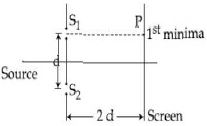
\(\sqrt{(2 d)^{2}+(d)^{2}}-2 d=\frac{\lambda}{2}\)\(\Rightarrow \quad(\sqrt{5}-2) d=\frac{\lambda}{2}\)
\(\Rightarrow \quad d=\frac{\lambda}{2(\sqrt{5}-2)}\)
-
- (A) \(10\)
- (B) \(05\)
- (C) \(04\)
- (D) \(09\)
જવાબ અને ઉકેલ જુઓ
સાચો જવાબ: (B)
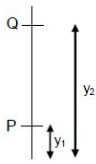
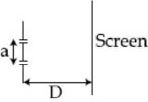
For diffractionLocation of \(1^{\text {st }}\) minima
\({y_1} = \frac{{D\lambda }}{a} = 0.2469\,D\lambda \)
Location of \(2^{\text {nd }}\) minima
\({{\text{y}}_2} = \frac{{2{\text{D}}\lambda }}{{\text{a}}} = 0.4938\,{\text{D}}\lambda \)
Now for interference
Path for interference
Path difference at \(P\)
\(\frac{d y}{D}=4.8 \lambda\)
Path difference at \(P\)
\(\frac{d y}{D}=9.6 \lambda\)
So orders of maxima in between \(\mathrm{P}\) and \(\mathrm{Q}\) is
\(5,\,6,\,7,\,8,\,9\)
So \(5\) bright fringes all present between \(\mathrm{P}\) and \(\mathrm{Q}\)
-
- (A) \(16 : 9\)
- (B) \(25 : 9\)
- (C) \(4 : 1\)
- (D) \(5 : 3\)
જવાબ અને ઉકેલ જુઓ
સાચો જવાબ: (B)
\(\left( {\frac{{\sqrt {{I_1}} + \sqrt {{I_2}} }}{{\sqrt {{I_1}} - \sqrt {{I_2}} }}} \right) = \frac{{16}}{1}\) ; \(\frac{\sqrt{I_{1}}+\sqrt{I_{2}}}{\sqrt{I_{1}}-\sqrt{I_{2}}}=\frac{4}{1}\)\( \Rightarrow \quad 3\sqrt {{I_1}} = 5\sqrt {{I_2}} \)
\(\Rightarrow \quad \frac{I_{1}}{I_{2}}=\frac{25}{9}\)
-
- (A) \(0.48\)
- (B) \(0.38\)
- (C) \(0.24\)
- (D) \(0.12\)
જવાબ અને ઉકેલ જુઓ
સાચો જવાબ: (C)
Numerical aperature of the microscope is given as\({\text{NA}} = \frac{{0.61\,\lambda }}{{\text{d}}}\)
Where \(\mathrm{d}=\) minimum sparaton between two points to be seen as distinct
\({\text{d}} = \frac{{0.61\,\,\lambda }}{{{\text{NA}}}} = \) \(\frac{{(0.61) \times \left( {5000 \times 10\,{{\text{m}}^{ - 10}}} \right)}}{{1.25}}\) \( = 2.4 \times {10^{ - 7}}{\text{m}}\)
\( = 0.24\,\mu m\)
-
- (A) \(10.67\)
- (B) \(1.80\)
- (C) \(5.33\)
- (D) \(16\)
જવાબ અને ઉકેલ જુઓ
સાચો જવાબ: (A)
since unpolarised light falls on \(\mathrm{P}_{1}\)\(\Rightarrow\) Intensity of light transmitted from \(P_{1}=\frac{I_{0}}{2}\).
Pass axis of \(\mathrm{P}_{2}\) will be at an angle of \(30^{\circ}\) with \(\mathrm{P}_{1}\)
\(\therefore\) Intensity of light transmitted from
\(P_{2}=\frac{I_{0}}{2} \cos ^{2} 30^{\circ}=\frac{3I_{0}}{8}\)
Pass axis of \(\mathrm{P}_{3}\) is at an angle of \(60^{\circ}\) with \(\mathrm{P}_{2}\)
\(\therefore \) Intensity of light transmitted from
\({P_3} = \frac{{3{I_0}}}{8}{\cos ^2}{60^\circ } = \frac{{3{I_0}}}{{32}}\)
\(\therefore\left(\frac{I_{0}}{I}\right)=\frac{32}{3}=10.67\)
-
- (A) \(1.5 \times {10^{ - 7}}\,rad\)
- (B) \(2.0 \times {10^{ - 7}}\,rad\)
- (C) \(3.0 \times {10^{ - 7}}\,rad\)
- (D) \(4.5 \times {10^{ - 7}}\,rad\)
જવાબ અને ઉકેલ જુઓ
સાચો જવાબ: (C)
Limit of resolution \(=\frac{1.22 \lambda}{\mathrm{d}}\)\(=\frac{1.22 \times 600 \times 10^{-9}}{250 \times 10^{-2}}\)
\(=2.9 \times 10^{-7} \mathrm{rad}\)
-
- (A) \(0.74\)
- (B) \(0.85\)
- (C) \(0.94\)
- (D) \(0.80\)
જવાબ અને ઉકેલ જુઓ
સાચો જવાબ: (B)
\(\Delta x=\frac{\lambda}{8}\)Phase \(|\Delta P|=\frac{2 \pi}{\lambda} \times \frac{\lambda}{8}=\frac{\pi}{4}\)
\(\therefore \) \(\mathrm{I}_{\mathrm{res}}=I+I+2I \cos \left(\frac{\mathrm{R}}{4}\right)\)
\(=\,2I\left(1+\frac{1}{\sqrt{2}}\right)=2I \times 1.7\)
\(\therefore \quad \frac{I_{res }}{I_{\operatorname{man}}}=\frac{2I\times 1.7}{41}=0.85\)
-
- (A) \(640\)
- (B) \(320\)
- (C) \(321\)
- (D) \(641\)
જવાબ અને ઉકેલ જુઓ
સાચો જવાબ: (D)
\(\Delta X_{\max }=d \sin \theta=0.32 \sin 30=0.16\, \mathrm{mm}\)\(\therefore n = \frac{{\Delta {X_{\max }}}}{\lambda }\)
\( = \frac{{0.16 \times {{10}^{ - 3}}}}{{500 \times {{10}^{ - 9}}}}\)
\(=\frac{0.16 \times 10^{6}}{500}=\frac{1600}{5}=320\)
Number of \(\mathrm{BFs}=(2 n+1)=641\)
-
- (A) \({\left( {\sqrt 3 + 1} \right)^4}\,:\,16\)
- (B) \(25\,:\,9\)
- (C) \(9\,:\,1\)
- (D) \(4\,:\,1\)
જવાબ અને ઉકેલ જુઓ
સાચો જવાબ: (C)
\(\frac{{{I_{\max }}}}{{{I_{\min }}}} = \frac{9}{1}\) -
- (A) \(\frac{{2nD\lambda }}{{a\left( {\mu - 1} \right)}}\)
- (B) \(\frac{{nD\lambda }}{{a\left( {\mu - 1} \right)}}\)
- (C) \(\frac{{2D\lambda }}{{a\left( {\mu - 1} \right)}}\)
- (D) \(\frac{{n\lambda }}{{\left( {\mu - 1} \right)}}\)
જવાબ અને ઉકેલ જુઓ
સાચો જવાબ: (D)
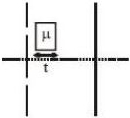
Path difference at central maxima \(\Delta x=(\mu-1)\, t,\) whole pattern will shift by same amount which will be given by\((\mu-1) \,t \frac{D}{d}=n \frac{\lambda D}{d},\) according to eh question \(t=\frac{n \lambda}{(\mu-1)}\)
No option is matching, therefore question should be award bonus.
\(\therefore \) Correct option should be (Bonus)
-
- (A) \(\frac{\lambda }{{2\,\left( {\mu - 1} \right)}}\)
- (B) \(\frac{\lambda }{{\,\left( {\mu - 1} \right)}}\)
- (C) \(\frac{\lambda }{{\,\left( {2\mu - 1} \right)}}\)
- (D) \(\frac{{2\lambda }}{{\,\left( {\mu - 1} \right)}}\)
જવાબ અને ઉકેલ જુઓ
સાચો જવાબ: (B)
\(\Delta x=(\mu-1)\, t=1 \lambda\)for one maximum shift
\(t=\frac{\lambda}{\mu-1}\)
આ પેજ પર આ ફિલ્ટર મુજબ કોઈ પ્રશ્ન નથી.