


પ્રશ્નો
20 પ્રશ્નો20 માંથી 1–20 પ્રશ્નો
-
- (A) \(4320\)
- (B) \(432000\)
- (C) \(4800\)
- (D) \(4.32\)
જવાબ અને ઉકેલ જુઓ
સાચો જવાબ: (A)
Work done \(= P \Delta V\)\(=3 \times 10^5 \times 1600 \times 10^{-6}\)
\(=480\,J\)
Only \(10 \%\) of heat is used in work done.
Hence \(\Delta Q=4800\,J\)
The rest goes in internal energy, which is \(90\,\%\) of heat.
Change in internal energy \(=0.9 \times 4800=4320\,J\)
-
- (A) \(4\)
- (B) \(2\)
- (C) \(8\)
- (D) \(2.67\)
જવાબ અને ઉકેલ જુઓ
સાચો જવાબ: (C)
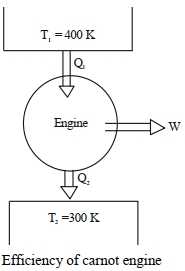
\(\eta=1-\frac{ T _2}{ T _1}=\frac{ W }{ Q _1}\)\(\Rightarrow \frac{ W }{ Q _1}=1-\frac{300}{400}=\frac{1}{4}\)
\(\Rightarrow \frac{2 kJ }{ Q _1}=\frac{1}{4}\)
\(\Rightarrow Q _1=8\,kJ\)
-
- (A) \(360\)
- (B) \(1000\)
- (C) \(900\)
- (D) \(300\)
જવાબ અને ઉકેલ જુઓ
સાચો જવાબ: (B)
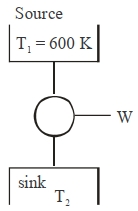
\(\text { Initially } \eta=\frac{1}{2}\)\(\eta=1-\frac{ T _2}{ T _1}\)
\(\therefore \frac{1}{2}=1-\frac{ T _2}{600} \quad \Rightarrow T _2=300\,K\)
\(\Rightarrow \frac{ T _2}{600}=\frac{1}{2} \quad\)
Now efficiency is increased to \(70 \%\) and \(T _2=300\) \(K\), Let temp of source \(T _1= T\)
\(\Rightarrow \frac{7}{10}=1-\frac{300}{T}\)
\(\Rightarrow \frac{300}{ T }=1-\frac{7}{10}\)
\(\Rightarrow \frac{300}{ T }=\frac{3}{10} \quad \therefore T =1000\,K\)
-
- (A) \(6\)
- (B) \(0\)
- (C) \(-4.5\)
- (D) \(4.5\)
જવાબ અને ઉકેલ જુઓ
સાચો જવાબ: (D)
\(\text { As } \Delta q =0\)\(\Delta u =- W\)
\(W =\int PdV\)
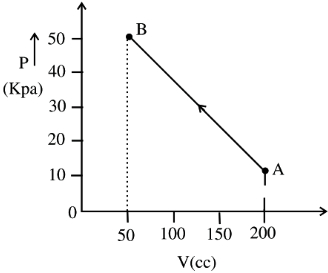
\(\Delta u =- W =30 \times 10^3 \times 150 \times 10^{-6}\)
\(=4500 \times 10^{-3}\)
\(=4.5\,J\)
-
- (A) \(16.5\)
- (B) \(33\)
- (C) \(66\)
- (D) \(62\)
જવાબ અને ઉકેલ જુઓ
સાચો જવાબ: (D)
\(T _{ H }=99^{\circ} C =99+273\)\(\qquad=372\,K\)
\(1-\frac{ T _{ C }}{ T _{ H }}=\frac{1}{3}\)
\(\frac{ T _{ C }}{ T _{ H }}=\frac{2}{3} \quad(1) \Rightarrow T _{ C }=\frac{2}{3} \times 372\)
\(1-\frac{ T _{ C }+ X }{ T _{ H }}=\frac{1}{6}\)
\(\frac{5}{6}=\frac{ T _{ C }+ X }{ T _{ H }}\)
\(\frac{5}{6}=\frac{248+ X }{372}\)
\(248+ X =5 \times 62\)
\(X =310-248=62\,K\)
-
- (A) \(P _0(4)^{\frac{1}{\gamma}}\)
- (B) \(P _0(4)^\gamma\)
- (C) \(P _0\)
- (D) \(4 P _0\)
જવાબ અને ઉકેલ જુઓ
સાચો જવાબ: (B)
As gas is suddenly compressed, the processes is adiabatic.Equation of gas for adiabatic process is
\(PV ^\gamma=\text { constant. }\)
\(\Rightarrow P _1 V _1^\gamma= P _2 V _2^\gamma\)
\(\Rightarrow P _0 V _0^\gamma= P _2\left(\frac{ V _0}{4}\right)^\gamma\)
\(\Rightarrow P _2= P _0(4)^\gamma\)
-
- (A) ફક્ત \(A\) અને \(E\)
- (B) ફક્ત \(B\) અને \(D\)
- (C) ફક્ત \(B\) અને \(D\)
- (D) ફક્ત \(C\) અને \(D\)
જવાબ અને ઉકેલ જુઓ
સાચો જવાબ: (D)
\(dQ = dU + dW \Rightarrow dU = nC _{ V } dT\)\(dU =0 \quad \text { (for isothermal) }\)
\(U =\text { constant }\)
\(Also dQ > 0 \quad \text { (supplied) }\)
Hence,\(dW > 0\)
-
- (A) \(270\)
- (B) \(262\)
- (C) \(278\)
- (D) \(360\)
જવાબ અને ઉકેલ જુઓ
સાચો જવાબ: (C)
Taking volume constant:\(\frac{ P _1}{ T _1}=\frac{ P _2}{ T _2}\)\(\Rightarrow P _2=\frac{ P _1}{ T _1} \times T _2=\frac{270 \times(309)}{300}\)
\(=278\,kPa\)
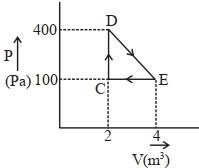
- 9. એક થર્મોડાયનેમિક તંત્ર ચક્રિય પ્રક્રિયા કરે છે. પ્રક્રિયામાં થતું કુલ કાર્ય \(...............\,J\) છે.
 2023 સરળ
- (A) \(100\)
- (B) \(300\)
- (C) \(0\)
- (D) \(200\)
જવાબ અને ઉકેલ જુઓ
સાચો જવાબ: (B)
\(\text { On } P - V \text { scale area of loop }=\text { work done }\)\(\Rightarrow W =+\frac{1}{2}(2) \times 300\)
\(W =300\,J\)
-
- (A) \(1200\)
- (B) \(600\)
- (C) \(500\)
- (D) \(800\)
જવાબ અને ઉકેલ જુઓ
સાચો જવાબ: (D)
\(dQ=dU+dw\)\(\frac{\mathrm{dU}}{\mathrm{dt}}=\frac{\mathrm{dQ}}{\mathrm{dt}}-\frac{\mathrm{dw}}{\mathrm{dt}}\)
\(\frac{\mathrm{dU}}{\mathrm{dt}}=1000-200=800 \mathrm{~W}\)
-
- (A) તંત્રને કોઈ ઉષ્મા આપવામાં આવતી નથી.
- (B) વાયુનું તાપમાન વધે છે.
- (C) આંતરિક ઉર્જામાં થતો ફેરફાર વાયુ પર થતા કાર્ય જેટલો છે.
- (D) આંતરિક ઉર્જામાં કોઈ ફેરફાર થતો નથી.
જવાબ અને ઉકેલ જુઓ
સાચો જવાબ: (D)
(1) \(\Delta Q=0\)(2) \(\Delta Q =\Delta U +\Delta W\)
\(\Rightarrow \Delta U =-\Delta W\)
adiabatic compression \(( V \downarrow)\)
\(\Delta W =- ve \Rightarrow \Delta U =+ ve\)
\(\Delta U \uparrow \Rightarrow T \uparrow\)
\(\Delta U \neq 0\)
-
- (A) \(A-II, B-I, C-III, D-IV\)
- (B) \(A-II, B-I, C-IV, D-III\)
- (C) \(A-I, B-II, C-IV, D-III\)
- (D) \(A-I, B-II, C-III, D-IV\)
જવાબ અને ઉકેલ જુઓ
સાચો જવાબ: (B)
\(\Delta U = nC _{ v } \Delta T\)For isothermal process \(T\) is constant
So \(\Delta U =0\)
\(A \longrightarrow II\)
Adiabatic process
\(\Delta Q =0\)
\(\Delta Q =\Delta U +\Delta W\)
\(\quad \Delta U =-\Delta W\)
Work done by gas is positive
So \(\Delta U\) is negative
\(B \longrightarrow I\)
For Isochoric process \(\Delta W =0\)
\(C \longrightarrow IV\)
For Isobaric process
\(\Delta W = P \Delta V \neq 0\)
\(\Delta U = nC _{ V } \Delta T \neq 0\)
Heat absorbed goes partly to increase internal energy and partly do work.
-
- (A) \(A\) સાચું છે પણ \(R\) ખોટું નથી.
- (B) \(A\) ખોટું છે પણ \(R\) સાચું નથી.
- (C) \(A\) અને \(R\) બંને સાચાં છે અને \(R\) એ \(A\) ની સાચી સમજૂતી આપે છે.
- (D) \(A\) અને \(R\) બંને સાચાં છે પરંતુ \(R\) એ \(A\) ની સાચી સમજૂતી આપતું નથી.
જવાબ અને ઉકેલ જુઓ
સાચો જવાબ: (C)
First law of thermodynamics is based on law of conservation of energy and it can be written as \(dQ = dU - dW\) where \(d\)W is work done on the system -
- (A) વિધાન \(I\) સાચું છે.પરંતુ વિધાન \(II\) ખોટું છે.
- (B) બંને વિધાન \(I\) અને વિધાન \(II\) સાચાં છે.
- (C) બંને વિધાન \(I\) અને વિધાન \(II\) ખોટા છે.
- (D) વિધાન \(I\) ખોટું છે. પરંતુ વિધાન \(II\) સાચું છે.
જવાબ અને ઉકેલ જુઓ
સાચો જવાબ: (D)
Statement \(I:\) \(\Delta Q > 0\)According to \(1^{\text {st }}\) law of thermodynamics
\(\Delta Q =\Delta U + W\)
If \(\Delta Q > 0, \Delta U < 0\) and \(W > 0\) is also possible.
Hence \(\Delta T < 0\), so \(T\) decreases.
Statement \(I\) is false
Statement \(II:\) W \( > 0\)
\(\therefore \int Pdv > 0\)
Therefore volume of system must increase during positive work done by the system.
Statement \(II\) is true
-
- (A) \(A\) સાચું છે પણ \(R\) ખોટું નથી.
- (B) \(A\) અને \(R\) બંને સાચાં છે પરંતુ \(R\) એ \(A\) ની સાચી સમજૂતી આપતું નથી.
- (C) \(A\) ખોટું છે પણ \(R\) સાચું છે.
- (D) \(A\) અને \(R\) બંને સાચાં છે અને \(R\) એ \(A\) ની સાચી સમજૂતી આપે છે.
જવાબ અને ઉકેલ જુઓ
સાચો જવાબ: (D)
Both \(A\) and \(R\) are true and \(R\) is the correct explanation of \(A\) -
- (A) ફકત \(2,3\) અને \(4\)
- (B) ફકત \(2\) અને \(3\)
- (C) ફકત \(2\) અને \(4\)
- (D) ફકત \(1\) અને \(2\)
જવાબ અને ઉકેલ જુઓ
સાચો જવાબ: (C)
\(\eta=\left(1-\frac{273}{373}\right) \times 100=26.8 \%\) -
- (A) \(8\)
- (B) \(8^{\frac{3}{2}}\)
- (C) \(\frac{1}{8}\)
- (D) \(4\)
જવાબ અને ઉકેલ જુઓ
સાચો જવાબ: (D)
Isothermal process, \(T =\) constant\(PV =n R T=\text { constant }\)
\(P _1 V_1= P _2 V_2\)
\(PV = P _{ A }( V / 8)\)
\(P _{ A }=8 P\)
Adiabatic process, PV \(\gamma=\) constant \(\gamma\) for monoatomic gas is \(\frac{5}{3}\).
\(P _1 V _1^\gamma= P _2 V _2^\gamma\)
\(\frac{ P _{ B }}{ P }=\left(\frac{ V _1}{ V _2}\right)^\gamma=\left(\frac{ V }{ V / 8}\right)^{\frac{5}{3}}\)
\(P _{ B }=32 P\)
\(\frac{ P _{ B }}{ P _{ A }}=\frac{32 P }{8 P }=4\)
-
- (A) \(0.5\)
- (B) \(3\)
- (C) \(2\)
- (D) \(1\)
જવાબ અને ઉકેલ જુઓ
સાચો જવાબ: (B)
\(B =-\frac{ dP }{ dv / v }\)\(Pv ^3= a\)
Differentiating w.r.t to pressure
\(v^3+P 3 v^2 \frac{d v}{d P}=0\)
\(v=-3 \frac{P d v}{d P}=0\)
\(v=-3 \frac{P d v}{d P}\)
\(\frac{d P . v}{d v}=-3 P\)
\(B=-\left(\frac{d P v}{d v}\right)=-(-3 P)=3 P\)
-
- (A) \(W=T R[\sqrt{2}-2]\)
- (B) \(W=\frac{T}{R}[\sqrt{2}-2]\)
- (C) \(W=\frac{R}{T}[2-\sqrt{2}]\)
- (D) \(W=R T[2-\sqrt{2}]\)
જવાબ અને ઉકેલ જુઓ
સાચો જવાબ: (D)
\(T_1 V_1^{\gamma-1}=T_2 V_2^{\gamma-1}\)\(T V^{1 / 2}=T_2(2 V)^{1 / 2}\)
\(T_2=\frac{T}{\sqrt{2}}\)
\(W=\frac{R\left(T_1-T_2\right)}{\gamma-1}=\frac{R\left(T-\frac{T}{\sqrt{2}}\right)}{\frac{1}{2}}=R T(2-\sqrt{2})\)
-
- (A) સમોષ્મી
- (B) સમતાપી
- (C) સમઆયતનિક
- (D) સમદાબી
જવાબ અને ઉકેલ જુઓ
સાચો જવાબ: (B)
\(T =\) constant \(\Rightarrow U =\) constant
આ પેજ પર આ ફિલ્ટર મુજબ કોઈ પ્રશ્ન નથી.