


પ્રશ્નો
3 પ્રશ્નો3 માંથી 1–3 પ્રશ્નો
-
- (A) \(1.5\)
- (B) \(1.4\)
- (C) \(1.3\)
- (D) \(1.6\)
જવાબ અને ઉકેલ જુઓ
સાચો જવાબ: (B)
Volume of the gas\(v=\frac{m}{d}\) and
using \(P V^{7}=\) constant
\(\frac{P^{\prime}}{P}=\frac{V}{V^{\prime}}=\left(\frac{d^{\prime}}{d}\right)^{\gamma}\)
\(\alpha 128=(32)^{\gamma}\)
\(\gamma=\frac{7}{5}=1.4\)
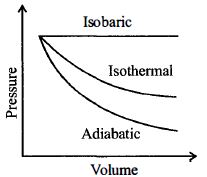
- 2. આપેલ વાયુ નું વિસ્તરણ \(V_1\) થી \(V _2\) અલગ અલગ પ્રક્રિયા દ્વારા કરવામાં આવે તો કઈ પ્રક્રિયામાં સૌથી વધુ કાર્ય થાય?
 2013 મધ્યમ
- (A) બધી પ્રક્રિયામાં સમાન
- (B) સમદાબી પ્રક્રિયા
- (C) સમતાપી પ્રક્રિયા
- (D) સમોષ્મિ પ્રક્રિયા
જવાબ અને ઉકેલ જુઓ
સાચો જવાબ: (B)
Work done \(=\) Area bounded by \(PV\) graph and volume axis Among the three process, bounded area by \(PV\) graph and volume axis is greatest for isobaric process, hence work done is greatest for isobaric process -
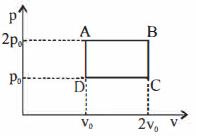
- (A) \(4P_0V_0\)
- (B) \(P_0V_0\)
- (C) \(\left( {\frac{{13}}{2}} \right)\) \( P_0V_0\)
- (D) \(\;\left( {\frac{{11}}{2}} \right)\) \( P_0V_0\)
જવાબ અને ઉકેલ જુઓ
સાચો જવાબ: (C)
\(Heat\,given\,to\,system = {\left( {n{C_V}\Delta T} \right)_{A \to B}} + {\left( {n{C_P}\Delta T} \right)_{B \to C}}\)\( = {\left[ {\frac{3}{2}\left( {nR\Delta T} \right)} \right]_{A \to B}} + {\left[ {\frac{5}{2}\left( {nR\Delta T} \right)} \right]_{B \to C}}\)
\( = {\left[ {\frac{3}{2} \times {V_0}\Delta P} \right]_{A \to B}} + \left[ {\frac{5}{2} \times 2{P_0} \times {V_0}} \right]\)
\( = \frac{{13}}{2}{P_0}{V_0}\)
આ પેજ પર આ ફિલ્ટર મુજબ કોઈ પ્રશ્ન નથી.