


પ્રશ્નો
24 પ્રશ્નો24 માંથી 1–24 પ્રશ્નો
-
- (A) \(1: 5\)
- (B) \(1: 3\)
- (C) \(5: 3\)
- (D) \(3: 5\)
જવાબ અને ઉકેલ જુઓ
સાચો જવાબ: (D)
\( \mathrm{n}_1 \times \frac{\mathrm{hc}}{\lambda_1}=200 \)\( \mathrm{n}_2 \times \frac{\mathrm{hc}}{\lambda_2}=200 \)
\( \frac{\mathrm{n}_{\mathrm{l}}}{\mathrm{n}_2}=\frac{\lambda_1}{\lambda_2}=\frac{300}{500} \)
\( \frac{\mathrm{n}_1}{\mathrm{n}_2}=\frac{3}{5}\)
-
- (A) \(4.13 \mathrm{eV}\)
- (B) \(1 \mathrm{eV}\)
- (C) \(3.13 \mathrm{eV}\)
- (D) \(7.26 \mathrm{eV}\)
જવાબ અને ઉકેલ જુઓ
સાચો જવાબ: (B)
\(\mathrm{E}_{\text {photon }}\) = (કાર્ય વિધેય) \(+\mathrm{K} \cdot \mathrm{E}_{\max }\)\(\therefore 4.13=3.13+\mathrm{K} \cdot \mathrm{E}_{\max }\)
\(\therefore \mathrm{K} \cdot \mathrm{E}_{\max }=1 \mathrm{eV}\)
-
- (A) \(\frac{I}{2}\)
- (B) \(4\) \( I\)
- (C) \(2 \ \mathrm{I}\)
- (D) \( I\)
જવાબ અને ઉકેલ જુઓ
સાચો જવાબ: (D)
As amount of energy incident on cell is same so current will remain same. - 4. \(6.63 \mathrm{eV}\) જેટલું કાર્ય વિધેય ધરાવતી ધાતુ માટે સીમાંત (થ્રેશોલ્ડ) આવૃત્તિ .......... છે. 2024 અઘરું
- (A) \(16 \times 10^{1 \mathrm{~s}} \mathrm{~Hz}\)
- (B) \(16 \times 10^{12} \mathrm{~Hz}\)
- (C) \(1.6 \times 10^{12} \mathrm{~Hz}\)
- (D) \(1.6 \times 10^{15} \mathrm{~Hz}\)
જવાબ અને ઉકેલ જુઓ
સાચો જવાબ: (D)
\( \phi_0=h v_0 \)\( 6.63 \times 1.6 \times 10^{-19}=6.63 \times 10^{-34} v_0 \)
\( v_0=\frac{1.6 \times 10^{-19}}{10^{-34}} \)
\( v_0=1.6 \times 10^{15} \mathrm{~Hz}\)
-
- (A) \(0.2 \mathrm{~m}^2\)
- (B) \(0.02 \mathrm{~m}^2\)
- (C) \(20 \mathrm{~m}^2\)
- (D) \(0.1 \mathrm{~m}^2\)
જવાબ અને ઉકેલ જુઓ
સાચો જવાબ: (B)
દબાણ \(=\frac{I}{C}=\frac{F}{A}\)\(\Rightarrow \frac{360}{10^{-4} \times 3 \times 10^8}=\frac{2.4 \times 10^{-4}}{A}\)
\(\Rightarrow A=2 \times 10^{-2} \mathrm{~m}^2=0.02 \mathrm{~m}^2\)
-
- (A) \(3\)
- (B) \(2\)
- (C) \(1\)
- (D) \(5\)
જવાબ અને ઉકેલ જુઓ
સાચો જવાબ: (A)
Correct answer is : \(3\)
We know for point source, \(I \propto \frac{1}{r^2}=\frac{K}{4 \pi r^2}\)
\(r_1=2 m, r_2=4 m=2 r_1 \)
\(I_0=16 \times 10^{-8} W / m ^2\)
at \(2 m\),
\(I_1=\frac{I_0}{(2)^2}=\frac{16 \times 10^{-8}}{4} \)
\(I_1=4 \times 10^{-8} \)
\( I_2=\frac{I_0}{4_2}=\frac{16 \times 10^{-8}}{16}=10^{-8} \)
\(\left|I_2-I_1\right|=3 \times 10^{-8} W / m ^2, x=3\)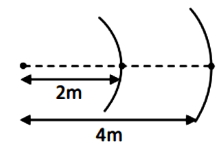
-
- (A) \(\mathrm{K}_{\mathrm{p}}>\mathrm{K}_{\mathrm{e}}\)
- (B) \(\mathrm{K}_{\mathrm{p}}=\mathrm{K}_{\mathrm{e}}\)
- (C) \(\mathrm{K}_{\mathrm{p}}=\mathrm{K}_{\mathrm{e}}^2\)
- (D) \(\mathrm{K}_{\mathrm{p}}<\mathrm{K}_{\mathrm{e}}\)
જવાબ અને ઉકેલ જુઓ
સાચો જવાબ: (D)
પ્રોટોન અને ઇલેક્ટ્રોનની ડી બ્રોગ્લી તરંગલંબાઈ \(=\lambda\)\(\because \lambda=\frac{\mathrm{h}}{\mathrm{p}}\)
\(\therefore \mathrm{p}_{\text {proton }}=\mathrm{p}_{\text {electron }}\)
\(\because \mathrm{KE}=\frac{\mathrm{p}^2}{2 \mathrm{~m}}\)
\(\therefore \mathrm{KE}_{\text {proton }}<\mathrm{KE}_{\text {electron }}\)
\({\left[\mathrm{K}_{\mathrm{p}}<\mathrm{K}_{\mathrm{e}}\right]}\)
-
- (A) \(1: 1836\)
- (B) \(1: \frac{1}{1836}\)
- (C) \(1: \frac{1}{\sqrt{1836}}\)
- (D) \(1: \sqrt{1836}\)
જવાબ અને ઉકેલ જુઓ
સાચો જવાબ: (A)
\(\lambda\) બંને માટે સમાન છે \(\mathrm{P}=\frac{\mathrm{h}}{\lambda}\) બંને માટે સમાન\(\mathrm{P}=\sqrt{2 \mathrm{mK}}\)
આથી,
\(\mathrm{K} \propto \frac{1}{\mathrm{~m}}\)
\(\Rightarrow \frac{\mathrm{KE}_{\mathrm{p}}}{\mathrm{KE}_{\mathrm{e}}}=\frac{\mathrm{m}_{\mathrm{e}}}{\mathrm{m}_{\mathrm{p}}}=\frac{1}{1836}\)
-
- (A) \(\frac{1}{1}\)
- (B) \(\frac{1}{8}\)
- (C) \(\frac{8}{1}\)
- (D) \(\frac{1}{4}\)
જવાબ અને ઉકેલ જુઓ
સાચો જવાબ: (B)
For photon\(\mathrm{E}_{\mathrm{p}}=\frac{\mathrm{hc}}{\lambda_{\mathrm{p}}} \Rightarrow \lambda_{\mathrm{p}}=\frac{\mathrm{hc}}{\mathrm{E}_{\mathrm{p}}}\)
For electron
\( \lambda_{\mathrm{e}}=\frac{\mathrm{h}}{\mathrm{m}_{\mathrm{e}} \mathrm{v}_{\mathrm{e}}}=\frac{\mathrm{hv}_{\mathrm{e}}}{2 \mathrm{~K}_{\mathrm{e}}} \)
\( \text { Given } \mathrm{v}_{\mathrm{e}}=0.25 \mathrm{c} \)
\( \lambda_{\mathrm{e}}=\frac{\mathrm{h} \times 0.25 \mathrm{c}}{2 \mathrm{~K}_{\mathrm{e}}}=\frac{\mathrm{hc}}{8 \mathrm{~K}_{\mathrm{e}}}\)
Also \(\lambda_{\mathrm{p}}=\lambda_{\mathrm{e}}\)
\( \frac{\mathrm{hc}}{\mathrm{E}_{\mathrm{p}}}=\frac{\mathrm{hc}}{8 \mathrm{~K}_{\mathrm{e}}} \)
\( \frac{\mathrm{K}_{\mathrm{e}}}{\mathrm{E}_{\mathrm{p}}}=\frac{1}{8}\)
-
- (A) \(4 \mathrm{~V}\)
- (B) \(4.1 \mathrm{~V}\)
- (C) \(2 \mathrm{~V}\)
- (D) \(1.5 \mathrm{~V}\)
જવાબ અને ઉકેલ જુઓ
સાચો જવાબ: (C)
\(\frac{\mathrm{hc}}{\lambda}-\phi=\mathrm{eV}\)\(\Rightarrow \frac{1240}{300} \mathrm{eV}-2.13 \mathrm{eV}=\mathrm{eVs}\)
\(\Rightarrow 4.13 \mathrm{eV}-2.13 \mathrm{eV}=\mathrm{eVs}\)
\(\Rightarrow\) તેથી, \(\mathrm{V}_5=2 \mathrm{volt}\)
-
- (A) \(5 \lambda\)
- (B) \(3 \lambda\)
- (C) \(9 \lambda\)
- (D) \(4.5 \lambda\)
જવાબ અને ઉકેલ જુઓ
સાચો જવાબ: (C)
\(\mathrm{E}=\phi+\mathrm{K}_{\max }\)
\(\phi=\frac{\mathrm{hc}}{\lambda_0}\)
\(\mathrm{K}_{\max }=\mathrm{eV}_0\)
\(8 \mathrm{e}=\frac{\mathrm{hc}}{\lambda}-\frac{\mathrm{hc}}{\lambda_0} \ldots . . \text { (i) }\)
\(2 \mathrm{e}=\frac{\mathrm{hc}}{3 \lambda}-\frac{\mathrm{hc}}{\lambda_0} \ldots . . . \text { (ii) }\)
\(\text {on solving (i) (ii) }\)
\(\lambda_0=9 \lambda\) -
- (A) \(2.46 \times 10^{-3} \mathrm{~kg} \mathrm{~m} / \mathrm{s}\)
- (B) \(2.16 \times 10^{-3} \mathrm{~kg} \mathrm{~m} / \mathrm{s}\)
- (C) \(1.58 \times 10^{-3} \mathrm{~kg} \mathrm{~m} / \mathrm{s}\)
- (D) \(4.32 \times 10^{-3} \mathrm{~kg} \mathrm{~m} / \mathrm{s}\)
જવાબ અને ઉકેલ જુઓ
સાચો જવાબ: (B)
\(\mathrm{p}=\frac{\mathrm{E}}{\mathrm{C}}=\frac{6.48 \times 10^5}{3 \times 10^8}=2.16 \times 10^{-3}\) -
- (A) \(9 \times 10^{18}\)
- (B) \(6 \times 10^{15}\)
- (C) \(5 \times 10^{15}\)
- (D) \(7 \times 10^{16}\)
જવાબ અને ઉકેલ જુઓ
સાચો જવાબ: (C)
\(\mathrm{P}=\mathrm{nh \nu}\)\(\mathrm{n}=\frac{\mathrm{P}}{\mathrm{h} \nu}=\frac{2 \times 10^{-3}}{6.63 \times 10^{-34} \times 6 \times 10^{14}}\)
\(=5 \times 10^{15}\)
-
- (A) વિધાન-\(I\) સાચું છે અને વિધાન-\(II\) ખોટું છે.
- (B) વિધાન-\(I\) ખોટું છે પરંતુ વિધાન-\(II\) સાચું છે.
- (C) બંને વિધાન-\(I\) અને વિધાન-\(II\) ખોટાં છે.
- (D) બંને વિધાન-\(I\) અને વિધાન-\(II\) સાચાં છે.
જવાબ અને ઉકેલ જુઓ
સાચો જવાબ: (A)
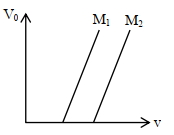
\(\mathrm{eV}_0=\mathrm{hv}-\phi\)\(\mathrm{V}_0=\frac{\mathrm{h}}{\mathrm{e}} \mathrm{v}-\frac{\phi}{\mathrm{e}}\)
\(\mathrm{M}_2\) દ્રવ્યનું કાર્યવિધેય વધારે છે, તેથી વિધાન-\((II)\) ખોટું છે.
વિકલ્પ \((1)\) સાચો છે.
-
- (A) બંન \(A\) અને \(R\) સાયાં છે અન \(R\) એ \(A\) ની સાચી સમજૂતી આપે છે.
- (B) \(A\) સાયું છે પરંતુ \(R\) સાચું નથી.
- (C) બંન \(A\) અને \(R\) સાયાં છે અને \(R\) એ \(A\) ની સાયી સમજૂતી આપતું નથી.
- (D) \(A\) સાચું નથી પરંતુ \(R\) સાયું છે.
જવાબ અને ઉકેલ જુઓ
સાચો જવાબ: (D)
Intensity of light \(\mathrm{I}=\frac{\mathrm{nh} \nu}{\mathrm{A}}\)Here \(\mathrm{n}\) is no. of photons per unit time.
\(\mathrm{n}=\frac{\mathrm{IA}}{\mathrm{h} v}\) so on increasing frequency \(v, \mathrm{n}\) decreases taking intensity constant.
\(\mathrm{k}_{\max }=\mathrm{h} v-\phi\)
So on increasing \(v\), kinetic energy increases.
-
- (A) \(E\) માત્ર
- (B) \(C\) માત્ર
- (C) \(B, D\) માત્ર
- (D) \(A, C\) માત્ર
જવાબ અને ઉકેલ જુઓ
સાચો જવાબ: (B)
(સિદ્ધાંત)ફોટોઇલેક્ટ્રિક અસર પ્રકાશનો કણ સ્વભાવ સાબિત કરે છે.
- 17. નીચેનામાંથી કયું વિધાન સ્થગિત સ્થિતિમાન \(\left(\mathrm{V}_0\right)\) વિશે સાચું નથી? 2024 અઘરું
- (A) તે ઉત્સર્જક દ્રવ્યના સ્વભાવ પર આધાર રાખે છે.
- (B) તે આપાત પ્રકાશની આવૃત્તિ પર આધાર રાખે છે.
- (C) તે આપાત પ્રકાશની તીવ્રતામાં વધારા સાથે વધે છે.
- (D) તે ઉત્સર્જિત ઇલેક્ટ્રોનની મહત્તમ ગતિઊર્જાના \(1 / \mathrm{e}\) ગણું છે.
જવાબ અને ઉકેલ જુઓ
સાચો જવાબ: (C)
\(\mathrm{KE}_{\max }=\mathrm{h} v-\phi_0=\mathrm{eV}\) -
- (A) \(0.5 \mathrm{eV}\)
- (B) \(1.68 \mathrm{eV}\)
- (C) \(2.48 \mathrm{eV}\)
- (D) \(1.98 \mathrm{eV}\)
જવાબ અને ઉકેલ જુઓ
સાચો જવાબ: (D)
\(\mathrm{eV}=\mathrm{hv}-\phi\)\(0.5 \mathrm{~V}=2.48-\phi\)
કાર્ય વિધેય \((\phi)=2.48 \mathrm{~V}-0.5 \mathrm{~V}=1.98 \mathrm{~V}\)
-
- (A) \(1: 8\)
- (B) \(1: 2\)
- (C) \(4: 1\)
- (D) \(8: 1\)
જવાબ અને ઉકેલ જુઓ
સાચો જવાબ: (D)
\(\lambda= \frac{\mathrm{h}}{\mathrm{p}}=\frac{\mathrm{h}}{\mathrm{mv}} \Rightarrow \mathrm{v}=\frac{\mathrm{h}}{\mathrm{m} \lambda}\)\(\frac{\mathrm{v}_{\mathrm{p}}}{\mathrm{v}_\alpha}=\frac{\mathrm{m}_\alpha}{\mathrm{m}_{\mathrm{p}}} \times \frac{\lambda_\alpha}{\lambda_{\mathrm{p}}}\)
\(=4 \times 2=8\)
- 20. પ્રોટોન, ઈલેક્ટ્રોન અને આલ્ફા પાર્ટિકલ સમાન ઊર્જા ધરાવે છે. તેમની ડી-બ્રોગ્લી તરંગલંબાઇની સરખામણી _______ તરીકે કરવામાં આવશે. 2024 અઘરું
- (A) \(\lambda_{\mathrm{e}}>\lambda_\alpha>\lambda_{\mathrm{p}}\)
- (B) \(\lambda_\alpha<\lambda_p<\lambda_c\)
- (C) \(\lambda_p<\lambda_e<\lambda_a^p\)
- (D) \(\lambda_p>\lambda_c^p>\lambda_a\)
જવાબ અને ઉકેલ જુઓ
સાચો જવાબ: (B)
\(\lambda_{\mathrm{DB}}=\frac{\mathrm{h}}{\mathrm{p}}=\frac{\mathrm{h}}{\sqrt{2 \mathrm{mk}}}\)\(\Rightarrow \lambda_{\mathrm{DB}} \alpha \frac{1}{\sqrt{\mathrm{m}}}\)
\(\Rightarrow \lambda_{\mathrm{a}}<\lambda_{\mathrm{p}}<\lambda_{\mathrm{c}}\)
-
- (A) \(215 \mathrm{~nm}\)
- (B) \(414 \mathrm{~nm}\)
- (C) \(400 \mathrm{~nm}\)
- (D) \(200 \mathrm{~nm}\)
જવાબ અને ઉકેલ જુઓ
સાચો જવાબ: (B)
For \(P.E.E.\) : \(\lambda \leq \frac{h c}{W_e}\)\(\lambda \leq \frac{1240 \mathrm{~nm}-\mathrm{eV}}{3 \mathrm{eV}}\)
\(\lambda \leq 413.33 \mathrm{~nm}\)
\(\lambda_{\max } \approx 414 \mathrm{~nm}\) for \(P.E.E.\)
-
- (A) \(122\)
- (B) \(125\)
- (C) \(130\)
- (D) \(135\)
જવાબ અને ઉકેલ જુઓ
સાચો જવાબ: (A)
\(10.2 \mathrm{eV}=\frac{\mathrm{hc}}{\lambda}\)\(\lambda=\frac{1245 \mathrm{eV}-\mathrm{nm}}{10.2 \mathrm{eV}}=122.06 \mathrm{~nm}\)
-
- (A) બમણી
- (B) ચોગણી
- (C) શૂન્ય
- (D) અડધી
જવાબ અને ઉકેલ જુઓ
સાચો જવાબ: (C)
કારણ કે \(\frac{\mathrm{f}}{2}<\mathrm{f}_0\)એટલે કે, આપાત આવૃત્તિ થ્રેશોલ્ડ આવૃત્તિ કરતાં ઓછી છે. તેથી ફોટોઇલેક્ટ્રોનનું ઉત્સર્જન થશે નહીં.
\(\Rightarrow\) પ્રવાહ \(=0\)
-
- (A) પ્લાન્ક અચળાંક અને વિદ્યુતભારનો ગુણોત્તર
- (B) ધાતુનું કાર્યવિધેય
- (C) ઇલેક્ટ્રોનનો વિદ્યુતભાર
- (D) પ્લાન્ક અચળાંક
જવાબ અને ઉકેલ જુઓ
સાચો જવાબ: (D)
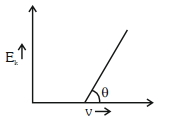
\(\text { K.E. }=\mathrm{hf}-\phi\)\(\tan \theta=\mathrm{h}\)
આ પેજ પર આ ફિલ્ટર મુજબ કોઈ પ્રશ્ન નથી.