


All D and f- block elements questions
Newest firstShowing 201–211 of 211 questions
- 201. A pink coloured salt turns blue on heating. The presence of which cation is most likely ? 2015 Medium
- (A) \(Co^{2+}\)
- (B) \(Cu^{2+}\)
- (C) \(Zn^{2+}\)
- (D) \(Fe^{2+}\)
Show answer and solution
Correct Answer: (A)
\(Zn^{2+}\) salts are white. Usually \(Fe^{2+}\) salts are rarely pink. \(Cu^{2+}\) salts are usually blue in hydrated form. \(Co^{2+}\) is pink in aqueous solution -
- (A) \(L\to M\) charge transfer transition
- (B) \(\sigma - \sigma ^*\) transition
- (C) \(M\to L\) charge transfer transition
- (D) \(d - d\) transition
Show answer and solution
Correct Answer: (A)
\(K M n O_{4} \rightarrow K^{+}+M n O_{4}^{-}\)\(\therefore \ln M n O_{4}^{-},\) Mn has \(+7\) oxidation state having no electron in d-orbitals. It ts considered that higher the oxidation state of metal, greater is the tendency to occur \(L \rightarrow M\) charge transfer,
because ligand is able to donate the electron into the vacant ( - orbital of metal.
since, charge transfer is laporate as well as spin allowed, therefore, it shows colour
-
- (A) \((NH_4)_3 [As (Mo_3O_{10})_4]\)
- (B) \(BaCrO_4\)
- (C) \(Zn_2[Fe(CN)_6]\)
- (D) \(K_3[Co(NO_2)_6]\)
Show answer and solution
Correct Answer: (C)
\(Z n_{2}\left[F e(C N)_{6}\right], K_{3}\left[C o\left(N O_{2}\right)_{6}\right] \) and \(\left(N H_{4}\right)_{3} A s\left[M o_{3} O_{l 0}\right]_{4}\) show color due to d-d transition while \(B a C r O_{4}\) is coloured due to charge transfer phenomenon.Further according to spectrochemical series the strong ligand possessing complex has higher energy and hence lower wavelength. Therefore, complexes containing \(N O_{2}, N H_{4}^{+}, O^{2-}\) etc., ligands show yellow colour while \(\mathrm{CN}^{-}\) forces the complex to impart white colour.
Spectrochemical series \(I^{-} < B r^{-} < S^{2-} < S C N^{-} < C I^{-} < N O_{3}^{-} < N_{3}^{-} < F^{-} < O H^{-}\)
\( < C_{2} O_{4}^{2-}=H_{2} O < N C S^{-} < C H_{3} C N < p y < N H_{3} < e n\)
\( < b i p y < phen < N o_{2}^{-} < p p h_{3} < C N^{-}=C O\)
-
- (A) \(Na_2Cr_2O_7\) is less soluble than \(K_2Cr_2O_7\)
- (B) \(Na_2Cr_2O_7\) is primary standard in volumetry
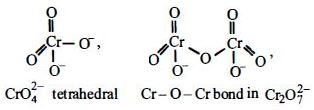
- (C) \(CrO_4^{2-}\) is tetrahedral in shape
- (D) \(CrO_7^{2-}\) has a \(Cr- O- Cr\) bond
Show answer and solution
Correct Answer: (A)
\(Na_2Cr_2O_7\) is used as primary standard in volumetryHydration energy of \(Na^+\) is greater then \(K^+\). Because of smaller size of \(Na^+\) , \(Na_2Cr_2O_7\) is more soluble than \(K_2Cr_2O_7\).
- 205. Chloro compound of Vanadium has only spin magnetic moment of \(1.73\, BM\). This Vanadium chloride has the formula 2014 Hard
- (A) \(VCl_2\)
- (B) \(VCl_4\)
- (C) \(VCl_3\)
- (D) \(VCl_5\)
Show answer and solution
Correct Answer: (B)
\(\mu = \sqrt {n(n + 2)} \)\(1.73 = \sqrt {n(n + 2)} \)
On calculating the value of \(n\) we find \(n=1\)
No. of unpaired electrons \(= 1\)
hence its consfiguration will be
\(V(23) = [Ar] 3d^3\,4s^2\)
\(V^{4+} = [Ar]3d^1\)
Its chloride has the formula \(VCl_4\)
- 206. Which of the following is not formed when \(H_2S\) reacts with acidic \(K_2Cr_2O_7\) solution ? 2014 Medium
- (A) \(CrSO_4\)
- (B) \(Cr_2(SO_4)_3\)
- (C) \(K_2SO_4\)
- (D) \(S\)
Show answer and solution
Correct Answer: (A)
\(K_2Cr_2O_7+ 4H_2SO_4+ 3H_2S\) \(\longrightarrow\) \(K_2SO_4 + Cr_2 (SO_4)_3 + 7H_2O + 3S\) -
- (A) \(Ti\,(22)\)
- (B) \(V\,(23)\)
- (C) \(Cr\,(24)\)
- (D) \(Mn\,(25)\)
Show answer and solution
Correct Answer: (D)
Maganese exhibits the large number of oxidation states. The most common oxidation states of \(Mn\) are \(+ 2 , + 3 ,+ 4, + 6\) and \(+7.\) -
- (A) \(Cr\,(Z=24)\)
- (B) \(Mn\,(Z = 25)\)
- (C) \(Fe\,(Z=26)\)
- (D) \(Co\,(Z = 27)\)
Show answer and solution
Correct Answer: (D)
\(E^{0}_{C r^{3+} / C r^{2+}}=\,-\,0.41\, V \)\(\mathrm{E}^{0}_{\mathrm{Fe}^{3+} / \mathrm{Fe}^{2+}}=+0.77 \,\mathrm{V}\)
\(\mathrm{E}^{0}_{\mathrm{Co}^{3+} / \mathrm{Co}^{2+}}=+1.97\, \mathrm{V}\)
\(E^{0}_{\mathrm{Mn}^{3+} / \mathrm{Mn}^{2+}}=+1.57\, \mathrm{V}\)
-
- (A) \(Cu_2O\) is colourless
- (B) Copper \((I)\) compounds are colourless except when colour results from charge transfer
- (C) Copper \((I)\) compounds are diamagnetic.
- (D) \(Cu_2S\) is black.
Show answer and solution
Correct Answer: (A)
\(Cu_2O\) is red in colour. - 210. Potassium dichromate when heated with concentrated sulphuric acid and a soluble chloride, gives brown-red vapours of: 2013 Hard
- (A) \(CrO3\)
- (B) \(CrCl_3\)
- (C) \(CrO_2Cl_2\)
- (D) \(Cr_2O_3\)
Show answer and solution
Correct Answer: (C)
Solid potassium dichromate when heated with concentrated sulphuric acid and a soluble chloride gives orange red vapours of a volatile oily liquid \(Cr{O_2}C{l_2}\)\(K_2Cr_2O_7 + 4NaCl + 6H_2SO_4\) \(\longrightarrow\)
\(\begin{array}{l}
2KHS{O_4} + 4NaHS{O_4} + 2Cr{O_2}C{l_2}\\
\,\,\,\,\,\,\,\,\,\,\,\,\,\,\,\,\,\,\,\,\,\,\,\,\,\,\,\,\,\,\,\,\,\,\,\,\,\,\,\,\,\,\,\,\,\,\,{\rm{chromyl \,chloride}}
\end{array}\) -
- (A) \(MnSO_4\)
- (B) \(Mn_2O_7\)
- (C) \(MnO_2\)
- (D) \(Mn_2O_3\)
Show answer and solution
Correct Answer: (B)
\(KMnO_4\) reacts with \(H_2SO_4\) to form \(Mn_2O_7\) which is highly explosive substance\(2KMn{O_4} + {H_2}S{O_4} \to {K_2}S{O_4} + M{n_2}{O_7} + {H_2}O\)
No questions on this page match these filters.