


प्रश्न
9 प्रश्न9 में से 1–9 प्रश्न
-
- (A) \(\underline{N}{H }_{3} \stackrel{ H ^{+}}{\longrightarrow}\)
- (B) \(\underline {Xe}F _{4}+ SbF _{5} \rightarrow\)
- (C) \(H _{2} \underline SO _{4}+ NaCl \xrightarrow{{420\,\,K}}\)
- (D) \(H _{3} \underline PO _{2} \xrightarrow{{ Disproportionation }}\)
उत्तर और हल देखें
सही उत्तर: (B)
\(XeF _{4}+ SbF _{5} \rightarrow\left[ XeF _{3}\right]^{+}\left[ SbF _{6}\right]^{-}\)\(sp ^{3} d ^{2}\,\,\,\,\, sp ^{3} d\,\,\, \quad sp ^{3} d\,\,\,\,\, \quad sp ^{3} d ^{2}\)
-
- (A) \(\left[ Ni ( CN )_{4}\right]^{2-}\)
- (B) \(\left[ CrF _{6}\right]^{3-}\)
- (C) \(BrF _{5}\)
- (D) \(XeF _{4}\)
उत्तर और हल देखें
सही उत्तर: (A)
\(\left[ Ni ( CN )_{4}\right]^{2-}\)\(dsp\)\(^{2}\) hybridisation.
-
- (A) आयन-द्विध्रुव \(>\) आयन-आयन \(>\) द्विध्रुव-द्विध्रुव
- (B) द्विध्रुव-द्विध्रुव \(>\) आयन-द्विध्रुव \(>\) आयन-आयन
- (C) आयन-द्विध्रुव \(>\) द्विध्रुव-द्विध्रुव \(>\) आयन-आयन
- (D) आयन-आयन \(>\) आयन-द्विध्रुव \(>\) द्विध्रुव-द्विध्रुव
उत्तर और हल देखें
सही उत्तर: (D)
Interionic\(/\) Intermolecular forces \(\propto\) charge on the speciesIons are charged species whereas dipoles are partially charged.
\(\therefore\) Ion-Ion \(\,>\,\) Ion-dipole \(\,>\,\) dipole-dipole
Hence, option \(d\) is correct.
-
- (A) हाइड्रोजन आबन्ध तथा लन्डन परिक्षेपण
- (B) द्विध्रुव-द्विध्रुव तथा हाइड्रोजन आबन्ध
- (C) लन्डन परिक्षेपण तथा द्विध्रुव-द्विध्रुव
- (D) लन्डन परिक्षेपण, द्विध्रुव-द्विध्रुव तथा हाइड्रोजन आबन्ध
उत्तर और हल देखें
सही उत्तर: (C)
Ethyl acetate is polar molecule. Hence there will be dipole-dipole
attraction and london dispersion forces are present. -
- (A) \(\mathrm{O}_{2}^{-}\) अथवा \(\mathrm{O}_{2}^{+}\)
- (B) \(\mathrm{O}_{2}\) अथवा \(\mathrm{O}_{2}^{+}\)
- (C) \(\mathrm{O}_{2}\) अथवा \(\mathrm{O}_{2}^{-}\)
- (D) \(\mathrm{O}_{2}, \mathrm{O}_{2}^{-}\) अथवा \(\mathrm{O}_{2}^{+}\)
उत्तर और हल देखें
सही उत्तर: (A)
\(\begin{array}{|c|c|c|} \hline & \text { unpaired electron } & \text { magnetic moment } \\ \hline O _{2}^{\oplus} & 1 & 1.73 B . M \\ \hline O _{2}^{\ominus} & 1 & 1.73 B . M \\ \hline O _{2} & 2 & 2.83 B.M \\ \hline \end{array}\) -
- (A) \(1.67\)
- (B) \(0.67\)
- (C) \(1.33\)
- (D) \(2.33\)
उत्तर और हल देखें
सही उत्तर: (A)
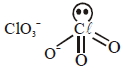
\(3 \mathrm{Cl}_{2}+6 \mathrm{NaOH} \rightarrow 5 \mathrm{NaCl}+\mathrm{NaClO}_{3}+3 \mathrm{H}_{2} \mathrm{O}\)\(\quad \quad \quad \quad \quad \quad \quad \quad (\mathrm{X})\quad \quad \quad(\mathrm{Y})\)
\(\mathrm{NaCl}+\mathrm{AgNO}_{3} \rightarrow \mathrm{AgCl} \downarrow+\mathrm{NaNO}_{3}\)
\((\mathrm{X})\)
Bond order of \(\mathrm{Cl}-\mathrm{O}\) Bond \(=1+\frac{2}{3}=\frac{5}{3}\)
\(=1.66\) or \(1.67\)
- 7. स्पीशीज \(NO , NO ^{+}, NO ^{2+}\) तथा \(NO ^{-}\)में, वह एक जिसकी आबन्ध सामर्थ्य न्यूनतम है, होगी 2020 कठिन
- (A) \(NO ^{2+}\)
- (B) \(NO ^{+}\)
- (C) \(NO\)
- (D) \(NO ^{-}\)
उत्तर और हल देखें
सही उत्तर: (D)
Bond order of \(NO ^{2+}=2.5\)Bond order of \(NO ^{+}=3\)
Bond order of \(NO =2.5\)
Bond order of \(NO ^{-}=2\)
Bond order \(\alpha\) bond strength.
-
- (A) त्रिकोणीय द्विपिरैमिडी
- (B) वर्ग समतलीय
- (C) चतुष्फलकीय
- (D) पिरैमिडी
उत्तर और हल देखें
सही उत्तर: (A)
\(4 \sigma\) bonds \(+1\) lone pairShape (including lone pair of electrons) is Trigonal bipyramidal

-
- (A) वर्ग पिरामिडल
- (B) चतुष्फलकीय
- (C) वर्ग समतलीय
- (D) आयताकार समतलीय
उत्तर और हल देखें
सही उत्तर: (A)
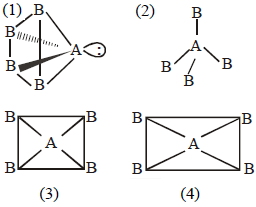
\((1)\) If \(AB _{4}\) molecule is a square pyramidal then it has one lone pair and their structure should be and it should be polar because dipole moment of lone pair of \('A'\) never be cancelled by others.\((2)\) If \(AB _{4}\) molecule is a tetrahedral then it has no lone pair and their structure should be and it should be non polar due to perfect symmetry.
\((3)\) If \(AB _{4}\), molecule is a square planar then it should be non polar because vector sum of dipole moment is zero.
\((4)\) If \(AB _{4}\) molecule is a rectangular planar then it should be non polar because vector sum of dipole moment is zero.
इस पेज पर इन फ़िल्टर से कोई प्रश्न नहीं मिला।