


All JEE Mains 2021 Physics questions
32 chaptersShowing 651–685 of 685 questions
-
- (A) \({R}_{1}>{R}_{2}\) and \({H}_{1}={H}_{2}\)
- (B) \({R}_{1}={R}_{2}\) and \({H}_{1}<{H}_{2}\)
- (C) \({R}_{1}<{R}_{2}\) and \({H}_{1}<{H}_{2}\)
- (D) \({R}_{1}={R}_{2}\) and \({H}_{1}={H}_{2}\)
Show answer and solution
Correct Answer: (B)
Range \({R}=\frac{{u}^{2} \sin 2 \theta}{{g}}\) and same for \(\theta\) and \(90-\theta\)So same for \(42^{\circ}\) and \(48^{\circ}\)
Maximum height \({H}=\frac{{u}^{2} \sin ^{2} \theta}{2 {g}}\)
\({H}\) is high for higher \(\theta\)
So \({H}\) for \(48^{\circ}\) is higher than \({H}\) for \(42^{\circ}\)
-
- (A) \(\tan ^{-1} \alpha, \frac{\alpha^{2}}{4 \beta}\)
- (B) \(\tan ^{-1} \beta, \frac{\alpha^{2}}{2 \beta}\)
- (C) \(\tan ^{-1} \alpha, \frac{4 \alpha^{2}}{\beta}\)
- (D) \(\tan ^{-1}\left(\frac{\beta}{\alpha}\right), \frac{\alpha^{2}}{\beta}\)
Show answer and solution
Correct Answer: (A)
\(y =\alpha x -\beta x ^{2}\)comparing with trajectory equation
\(y = x \tan \theta-\frac{1}{2} \frac{ gx ^{2}}{ u ^{2} \cos ^{2} \theta}\)
\(\tan \theta=\alpha \Rightarrow \theta=\tan ^{-1} \alpha\)
\(\beta=\frac{1}{2} \frac{ g }{ u ^{2} \cos ^{2} \theta}\)
\(u ^{2}=\frac{ g }{2 \beta \cos ^{2} \theta}\)
Maximum height : \(H\)
\(H =\frac{ u ^{2} \sin ^{2} \theta}{2 g }=\frac{ g }{2 \beta \cos ^{2} \theta} \frac{\sin ^{2} \theta}{2 g }\)
\(H =\frac{\tan ^{2} \theta}{4 \beta}=\frac{\alpha^{2}}{4 \beta}\)
-
- (A) \(125\)
- (B) \(250\)
- (C) \(300\)
- (D) \(200\)
Show answer and solution
Correct Answer: (A)
\(S=u t+\frac{1}{2} a t^2\)\(-75=+10 t+\frac{1}{2}(-10) t^2\)
\(\Rightarrow t=5 sec\)
Object takes \(t=5 s\) to fall on ground
Height of balloon from ground
\(H=75+u t\)
\(H=75+10 \times 5=125 m\)
-
- (A) \(\frac{4 \alpha \beta}{(\alpha+\beta)} t ^{2}\)
- (B) \(\frac{2 \alpha \beta}{(\alpha+\beta)} t ^{2}\)
- (C) \(\frac{\alpha \beta}{2(\alpha+\beta)} t ^{2}\)
- (D) \(\frac{\alpha \beta}{4(\alpha+\beta)} t ^{2}\)
Show answer and solution
Correct Answer: (C)
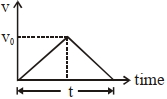
\(v _{0}=\alpha t _{1}\) and \(0= v _{0}-\beta t _{2} \Rightarrow v _{0}=\beta t _{2}\)\(t _{1}+ t _{2}= t\)
\(v _{0}\left(\frac{1}{\alpha}+\frac{1}{\beta}\right)= t\)
\(\Rightarrow v _{0}=\frac{\alpha \beta t }{\alpha+\beta}\)
Distance \(=\) area of \(v - t\) graph
\(=\frac{1}{2} \times t \times v _{0}=\frac{1}{2} \times t \times \frac{\alpha \beta t }{\alpha+\beta}=\frac{\alpha \beta t ^{2}}{2(\alpha+\beta)}\)
-
- (A) \(100\)
- (B) \(20\)
- (C) \(14\)
- (D) \(1\)
Show answer and solution
Correct Answer: (D)
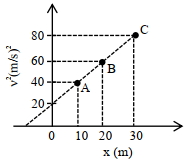
\({y}={m} {x}+{C}\)\({v}^{2}=\frac{20}{10} {x}+20\)
\({v}^{2}=2 {x}+20\)
\(2 {v} \frac{{d} {v}}{{d} {x}}=2\)
\(\therefore {a}={v} \frac{{d} {v}}{{d} {x}}=1\)
-
- (A) \(\left(\frac{3 v_{0}^{2}}{2 \alpha}\right)^{\frac{1}{2}}\)
- (B) \(\left(\frac{2 v_{0}}{3 \alpha}\right)^{\frac{1}{3}}\)
- (C) \(\left(\frac{2 v_{0}^{2}}{3 \alpha}\right)^{\frac{1}{2}}\)
- (D) \(\left(\frac{3 v_{0}^{2}}{2 \alpha}\right)^{\frac{1}{3}}\)
Show answer and solution
Correct Answer: (D)
\(F=-\alpha x^{2}\)\(m a=-\alpha x^{2}\)
\(a=\frac{-\alpha x^{2}}{m}\)
\(\frac{v d v}{d x}=-\frac{\alpha}{m} x^{2}\)
\(\int_{v_{0}}^{0} v d v=\int_{0}^{x}-\frac{\alpha}{m} x^{2} d x\)
\(\left(\frac{v^{2}}{2}\right)^{0}=-\frac{\alpha}{m}\left(\frac{x^{3}}{3}\right)_{0}^{x}\)
\(\frac{-v_{0}^{2}}{2}=-\frac{\alpha}{m} \frac{x^{3}}{3}\)
\(x=\left(\frac{3 m v_{0}^{2}}{2 \alpha}\right)^{\frac{1}{3}}\)
-
- (A) \(\frac{a_{1}+a_{2}}{a_{2}}\)
- (B) \(\frac{ a _{2}}{ a _{1}}\)
- (C) \(\frac{ a _{1}}{ a _{2}}\)
- (D) \(\frac{a_{1}+a_{2}}{a_{1}}\)
Show answer and solution
Correct Answer: (B)
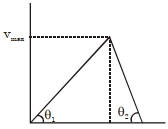
Draw vt curve\(\tan \theta_{1}=a_{1}=\frac{v_{\max }}{t_{1}}\) And \(\tan \theta_{2}=a_{2}=\frac{v_{\max }}{t_{2}}\)
\(\div\) above
\(\frac{t_{1}}{t_{2}}=\frac{a_{2}}{a_{1}}\)
-
- (A) \(35\)
- (B) \(45\)
- (C) \(50\)
- (D) \(25\)
Show answer and solution
Correct Answer: (B)
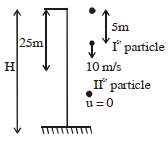
displacement of the first stone when second is dropped \(=5 m\),time difference in dropping of the stones is \(t =\frac{2 h }{ g }=1\; s\)
\(h =\frac{1}{2} g t ^{2}=\frac{1}{2} g ( t -1)^{2}+25 \Rightarrow t =3 \;s\)
thus, \(h =\frac{1}{2} g t ^{2}=\frac{1}{2} \times 10 \times (3)^{2}= 4 5 \;m\)
-
- (A) \(\sqrt{\frac{ v ^{2}+ u ^{2}}{2}}\)
- (B) \(\frac{ v - u }{2}\)
- (C) \(\frac{ u + v }{2}\)
- (D) \(\sqrt{\frac{ v ^{2}- u ^{2}}{2}}\)
Show answer and solution
Correct Answer: (A)
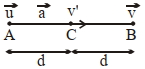
\(\left( v ^{\prime}\right)^{2}= u ^{2}+2 ad\)\(v ^{2}=\left( v ^{\prime}\right)^{2}+2 ad\)
solving, we get
\(v^{\prime}=\sqrt{\frac{v^{2}+u^{2}}{2}}\)
-
- (A) \(12\)
- (B) \(16\)
- (C) \(8\)
- (D) \(24\)
Show answer and solution
Correct Answer: (A)
\({V}=\sqrt{5000+24 {x}}\)\(\frac{{d} {V}}{{dx}}=\frac{1}{2 \sqrt{5000+24 {x}}} \times 24=\frac{12}{\sqrt{5000+24 {x}}}\)
\(\text { now } {a}={V} \frac{{dV}}{{dx}}\)
\(\quad=\sqrt{5000+24 {x}} \times \frac{12}{\sqrt{5000+24 {x}}}\)
\(\qquad {a}=12 {m} / {s}^{2}\)
-
- (A) \(\frac{{{t_1}{t_2}}}{{{t_2} - {t_1}}}\)
- (B) \(\;\frac{{{t_1}{t_2}}}{{{t_2} + {t_1}}}\)
- (C) \({t_1} - {t_2}\)
- (D) \(\frac{{{t_1} + {t_2}}}{2}\)
Show answer and solution
Correct Answer: (B)
\(\begin{array}{l}
Let\,{v_1}\,is\,the\,velocity\,of\,preeti\,on\,stationary\,escalator\,and\,\\
d\,is\,the\,{\rm{distance}}\,travelled\,bt\,her\\
\therefore \,{v_1} = \frac{d}{{{t_1}}}\\
Again\,let\,{v_2}\,is\,the\,velocity\,of\,escalator\,\\
\therefore \,{v_2} = \frac{d}{{{t_2}}}
\end{array}\)\(\begin{array}{l}
\therefore \,Net\,velocity\,of\,preeti\,on\,moving\,escalator\,with\,respect\,\\
to\,the\,ground\,\\
\,\,\,\,\,\,\,\,\,\,\,v = {v_1} + {v_2} = \frac{d}{{{t_1}}} + \frac{d}{{{t_2}}} = d\left( {\frac{{{t_1} + {t_2}}}{{{t_t}{t_2}}}} \right)\\
The\,time taken by her to walk up on the moving escalatror will be\\
\,\,\,\,\,\,t = \frac{d}{v} = \frac{d}{{d\left( {\frac{{{t_1} + {t_2}}}{{{t_1}{t_2}}}} \right)}} = \frac{{{t_1}{t_2}}}{{{t_1} + {t_2}}}
\end{array}\) -
- (A) \(2 n^{2} v^{3}\)
- (B) \(2 {mv}^{3}\)
- (C) \(2 n v^{3}\)
- (D) \(2 {mnv}^{3}\)
Show answer and solution
Correct Answer: (B)
\(t =m x^{2}+n x\)\(\frac{1}{v}=\frac{d t}{d x}=2 m x+n\)
\(v=\frac{1}{2 m x+n}\)
\(\frac{d v}{d t}=-\frac{2 m}{(2 m x+n)^{2}}\left(\frac{d x}{d t}\right)\)
\(a=-(2 m) v^{3}\)
-
- (A) \(v_{0}+g+F\)
- (B) \(v_{0}+\frac{g}{2}+\frac{F}{3}\)
- (C) \(v_{0}+\frac{g}{2}+F\)
- (D) \(v_{0}+2 g+3 F\)
Show answer and solution
Correct Answer: (B)
\(v = v _{0}+ g t + Ft ^{2}\)\(\frac{ ds }{ dt }= v _{0}+ gt + Ft ^{2}\)
\(\int ds =\int_{0}^{1}\left( v _{0}+ gt + Ft ^{2}\right) dt\)
\(s=\left[v_{0} t+\frac{g t^{2}}{2}+\frac{F t^{3}}{3}\right]_{0}^{1}\)
\(s=v_{0}+\frac{g}{2}+\frac{F}{3}\)
-
- (A) \(80\)
- (B) \(10\)
- (C) \(60\)
- (D) \(50\)
Show answer and solution
Correct Answer: (D)
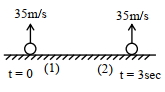
When both balls will collied\({y}_{1}={y}_{2}\)
\(35 {t}-\frac{1}{2} \times 10 \times {t}^{2}=35({t}-3)-\frac{1}{2} \times 10 \times({t}-3)^{2}\)
\(35 {t}-\frac{1}{2} \times 10 \times {t}^{2}=35 {t}-105-\frac{1}{2} \times 10 \times {t}^{2}\)
\(\quad-\frac{1}{2} \times 10 \times 3^{2}+\frac{1}{2} \times 10 \times 6 {t}\)
\(0=150-30 {t}\)
\({t}=5 {sec}\)
\(\therefore\) Height at which both balls will collied
\({h}=35 {t}-\frac{1}{2} \times 10 \times {t}^{2}\)
\(=35 \times 5-\frac{1}{2} \times 10 \times 5^{2}\)
\({h}=50 {m}\)
-
- (A) \(1 \,drop/ second\)
- (B) \(2 \,drops / second\)
- (C) \(1\, drops / 7 seconds\)
- (D) \(3\, drops / 2 seconds\)
Show answer and solution
Correct Answer: (A)
In 4 sec. \(1^{\text {st }}\) drop will travel \(\Rightarrow \frac{1}{2} \times(9.8) \times(4)^{2}=78.4 m\)\(\therefore 2^{\text {nd }}\) drop would have travelled \(\Rightarrow 78.4-34.3=44.1 m\).
Time for \(2^{\text {nd }}\) drop
\(\frac{1}{2}(9.8) t ^{2}=44.1\)
\(t=3 sec\)
\(\therefore\) each drop have time gap of \(1 sec\)
\(\therefore 1\) drop per sec
-
- (A) \(4.18\)
- (B) \(2.94\)
- (C) \(2.45\)
- (D) \(7.35\)
Show answer and solution
Correct Answer: (D)
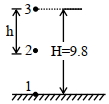
\({H}=\frac{1}{2} {gt}^{2}\)\(\frac{9.8 \times 2}{9.8}={t}^{2}\)
\({t}=\sqrt{2}\, {sec}\)
\(\Delta\) \(t:\) time interval between drops
\({h}=\frac{1}{2} {g}(\sqrt{2}-\Delta {t})^{2}\)
\(0=\frac{1}{2} {g}(\sqrt{2}-2 \Delta {t})^{2}\)
\(\Delta {t}=\frac{1}{\sqrt{2}}\)
\({h}=\frac{1}{2} {g}\left(\sqrt{2}-\frac{1}{\sqrt{2}}\right)^{2}=\frac{1}{2} \times 9.8 \times \frac{1}{2}=\frac{9.8}{4}=2.45\, {m}\)
\({H}-{h}=9.8-2.45\)
\(=7.35\, {m}\)
-
- (A) \(8\)
- (B) \(4\)
- (C) \(6\)
- (D) \(4\)
Show answer and solution
Correct Answer: (C)
\(\frac{\Delta T }{\Delta t }= K \left( T _{ t }- T _{ s }\right)\)\(\frac{61-59}{4}= K \left(\frac{61+59}{2}-30\right)\)
\(\frac{51-49}{ t }= K \left(\frac{51+49}{2}-30\right)\)
\(\frac{ t }{4}=\frac{60-30}{50-30}=\frac{30}{20}\)
\(t =6\) minutes
-
- (A) \(2\)
- (B) \(3\)
- (C) \(1\)
- (D) \(4\)
Show answer and solution
Correct Answer: (A)
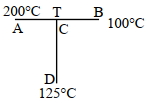
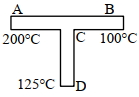
Rods are identical so\({R}_{{AB}}={R}_{{CD}}=10 {Kw}^{-1}\)
\({C}\) is mid-point of \({AB}\), so
\({R}_{{AC}}={R}_{{CB}}=5 {K} {w}^{-1}\)
at point \({C}\)
\(\frac{200-{T}}{5}=\frac{{T}-125}{10}+\frac{{T}-100}{5}\)
\(2(200-{T})={T}-125+2({T}-100)\)
\(400-2 {T}={T}-125+2 {T}-200\)
\({T}=\frac{725}{5}=145^{\circ} {C}\) \({I}_{{b}}=\frac{145-125}{10} {w}=\frac{20}{10} {w}\)
\({I}_{{h}}=2 {w}\)
-
- (A) \(\frac{{{K_1}{K_2}}}{{{K_1} + {K_2}}}\)
- (B) \(\frac{{2{K_1}{K_2}}}{{{K_1} + {K_2}}}\)
- (C) \(\frac{ K _{1}+ K _{2}}{2 K _{1} K _{2}}\)
- (D) \(\frac{ K _{1}+ K _{2}}{ K _{1} K _{2}}\)
Show answer and solution
Correct Answer: (B)
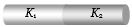
In series \({R_{eq}} = {R_1} + {R_2}\)==> \(\frac{{2l}}{{{K_{eq}}A}} = \frac{l}{{{K_1}A}} + \frac{l}{{{K_2}A}}\)
==> \(\frac{2}{{{K_{eq}}}} = \frac{1}{{{K_1}}} + \frac{1}{{{K_2}}}\)
==> \({K_{eq}} = \frac{{2{K_1}{K_2}}}{{{K_1} + {K_2}}}\)
-
- (A) \(57\)
- (B) \(60\)
- (C) \(61\)
- (D) \(570\)
Show answer and solution
Correct Answer: (A)
By newton's law of cooling (with approximation)\(\frac{\Delta {T}}{\Delta {t}}=-{C}\left({T}_{{avg}}-{T}_{{s}}\right)\)
\(1^{\text {st }}\, \frac{-10^{\circ} {C}}{5\, {min}}=-{C}\left(70^{\circ} {C}-25^{\circ} {C}\right)\)
\({C}=\frac{2}{45}\, {min}^{-1}\)
\(2^{\text {nd }} \,\frac{{T}-65}{5 {min}}=-{C}\left(\frac{{T}+65}{2}-25\right)=-\left(\frac{2}{45}\right)\left(\frac{{T}+15}{2}\right)\)
\(9({T}-65)=-({T}+15)\)
\(10 {T}=570\)
\({T}=57^{\circ} {C}\)
-
- (A) \(\frac{\theta_{1} R_{1}+\theta_{2} R_{2}}{R_{1}+R_{2}}\)
- (B) \(\frac{\theta_{1} R _{2}-\theta_{2} R _{1}}{ R _{2}- R _{1}}\)
- (C) \(\frac{\theta_{1} R _{2}+\theta_{2} R _{1}}{ R _{1}+ R _{2}}\)
- (D) \(\frac{\theta_{1} R_{1}+\theta_{2} R_{2}}{R_{1}+R_{2}}\)
Show answer and solution
Correct Answer: (C)
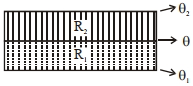
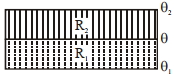
Heat flow rate will be same through both\(\therefore \frac{\theta_{1}-\theta}{ R _{1}}=\frac{\theta-\theta_{2}}{ R _{2}}\)
\(R _{2} \theta_{1}- R _{2} \theta= R _{1} \theta- R _{1} \theta_{2}\)
\(\theta=\frac{ R _{2} \theta_{1}+ R _{1} \theta_{2}}{ R _{1}+ R _{2}}\)
-
- (A) \(\frac{4 \pi {Kr}_{1} {r}_{2}\left(\theta_{2}-\theta_{1}\right)}{{r}_{2}-{r}_{1}}\)
- (B) \(\frac{\pi{r}_{1} {r}_{2}\left(\theta_{2}-\theta_{1}\right)}{{r}_{2}-{r}_{1}}\)
- (C) \(\frac{{K}\left(\theta_{2}-\theta_{1}\right)}{{r}_{2}-{r}_{1}}\)
- (D) \(\frac{{K}\left(\theta_{2}-\theta_{1}\right)\left({r}_{2}-{r}_{1}\right)}{4 \pi {r}_{1} {r}_{2}}\)
Show answer and solution
Correct Answer: (A)
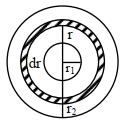
Thermal resistance of spherical sheet of thicleness \(dr\) and radius \(r\) is\({d} {R}=\frac{{dr}}{{K}\left(4 \pi {r}^{2}\right)}\)
\({R}=\int_{{r}_{1}}^{{r}_{2}} \frac{{dr}}{{K}\left(4 \pi {r}^{2}\right)}\)
\({R}=\frac{1}{4 \pi {K}}\left(\frac{1}{{r}_{1}}-\frac{1}{{r}_{2}}\right)=\frac{1}{4 \pi {K}}\left(\frac{{I}_{2}-{r}_{1}}{{r}_{1} {I}_{2}}\right)\)
Thermal current (i) \(=\frac{\theta_{2}-\theta_{1}}{R}\)
\({i} =\frac{4 \pi {Kr}_{1} {r}_{2}\left(\theta_{2}-\theta_{1}\right)}{{r}_{2}-{r}_{1}}\)
-
- (A) Both \(A\) and \(R\) are correct and \(R\) is the correct explanation of \(A\).
- (B) \(A\) is not correct but \(R\) is correct.
- (C) Both \(A\) and \(R\) are correct but \(R\) is not the correct explanation of \(A\).
- (D) \(A\) is correct but \(R\) is not correct.
Show answer and solution
Correct Answer: (C)
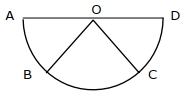
\(|\overrightarrow{A B}|=|\overrightarrow{B C}|=|\overrightarrow{C D}|\)Here, \(O\) is the centre of semi- circle
\(\therefore|\overrightarrow{O A}|=|\overrightarrow{O B}|=|\overrightarrow{O C}|=|\overrightarrow{O D}|\)
Using vector law of addition, we can write,
\(\overrightarrow{ AB }=\overrightarrow{ AO }+\overrightarrow{ OB }\)
\(\overrightarrow{ AC }=\overrightarrow{ AO }+\overrightarrow{ OC }\)
\(\overrightarrow{ AD }=\overrightarrow{ AO }+\overrightarrow{ OD }=2 \overrightarrow{ AO }\)
After adding all, we get,
\(\overrightarrow{A B}+\overrightarrow{A C}+\overrightarrow{A D}=4 \overrightarrow{A O}+\overrightarrow{O B}+\overrightarrow{O C}\)
Reason \(R\) is the direct result of Polygon law of vector addition
Therefore, Polygon law is applicable in both but the equation given in the reason is not useful in explaining the assertion.
-
- (A) \(\sqrt{A^{2}+B^{2}-\sqrt{2} A B}\)
- (B) \(\sqrt{A^{2}+B^{2}}\)
- (C) \(\sqrt{A^{2}+B^{2}+\sqrt{2} A B}\)
- (D) \(\sqrt{A^{2}+B^{2}+\sqrt{2} A B}\)
Show answer and solution
Correct Answer: (A)
\(\vec{A} \vec{B}=|\vec{A} \times \vec{B}|\)\(A B \cos \theta=A B \sin \theta \Rightarrow \theta=45^{\circ}\)
\(|\vec{A}-\vec{B}|=\sqrt{A^{2}+B^{2}-2 A B \cos 45^{\circ}}\)
\(=\sqrt{A^{2}+B^{2}-\sqrt{2} A B}\)
-
- (A) \(90\)
- (B) \(135\)
- (C) \(180\)
- (D) \(45\)
Show answer and solution
Correct Answer: (C)
\(=PQ \sin \theta\)\(= PQ \sin \theta\)
\(\Rightarrow \theta=180^{\circ}\)
-
- (A) \(-16 \hat{i}-24 \hat{j}+32 \hat{k}\)
- (B) \(16 \hat{i}+24 \hat{j}-32 \hat{k}\)
- (C) \(16 \hat{i}+24 \hat{j}+32 \hat{k}\)
- (D) \(16 \hat{i}-24 \hat{j}+32 \hat{k}\)
Show answer and solution
Correct Answer: (B)
We know,\(\because \overrightarrow{ OA }+\overrightarrow{ OB }+\overrightarrow{ OC }+\overrightarrow{ OD }+\overrightarrow{ OE }+\overrightarrow{ OF }+\overrightarrow{ OG }+\overrightarrow{ OH }=\overrightarrow{0}\)
By triangle law of vector addition, we can write
\(\overrightarrow{ AB }=\overrightarrow{ AO }+\overrightarrow{ OB } ; \overrightarrow{ AC }=\overrightarrow{ AO }+\overrightarrow{ OC }\)
\(\overrightarrow{ AD }=\overrightarrow{ AO }+\overrightarrow{ OD } ; \overrightarrow{ AE }=\overrightarrow{ A O }+\overrightarrow{ OE }\)
\(\overrightarrow{ AF }=\overrightarrow{ AO }+\overrightarrow{ OF } \quad ; \overrightarrow{ AG }=\overrightarrow{ AO }+\overrightarrow{ OG }\)
\(\overrightarrow{ AH }=\overrightarrow{ A O }+\overrightarrow{ OH }\)
Now
\(\overrightarrow{ AB }+\overrightarrow{ AC }+\overrightarrow{ AD }+\overrightarrow{ AE }+\overrightarrow{ AF }+\overrightarrow{ AG }+\overrightarrow{ AH }\)
\(=(7 \overrightarrow{ AO })+\overrightarrow{ OB }+\overrightarrow{ OC }+\overrightarrow{ OD }+\overrightarrow{ OE }+\overrightarrow{ OF }+\overrightarrow{ OG }+\overrightarrow{ OH }\)
\(=(7 \overrightarrow{ AO })+\overrightarrow{0}-\overrightarrow{ OA }\)
\(=(7 \overrightarrow{ AO })+\overrightarrow{ AO }\)
\(=8 \overrightarrow{ A O }=8(2 \hat{ i }+3 \hat{ j }-4 \hat{ k })\)
\(=16 \hat{i}+24 \hat{j}-32 \hat{k}\)
-
- (A) Statement\(-I\) is false but Statement\(-II\) is true
- (B) Statement\(-I\) is true but Statement\(-II\) is false
- (C) Both Statement\(-I\) and Statement\(-II\) are false
- (D) Both Statement\(-I\) and Statement\(-II\) are true.
Show answer and solution
Correct Answer: (D)
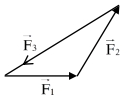
Here \(\overrightarrow{{F}}_{1}+\overrightarrow{{F}}_{2}+\overrightarrow{{F}}_{3}=0\)\(\overrightarrow{{F}}_{1}+\overrightarrow{{F}}_{2}=-\overrightarrow{{F}}_{3}\)
Since \(\overrightarrow{{F}}_{\text {net }}=0\) (equilibrium)
Both statements correct
-
- (A) Statement\(-I\) is false but Statement\(-II\) is true
- (B) Both Statement\(-I\) and Statement\(-II\) are true
- (C) Statement\(-I\) is true but Statement\(-II\) is false
- (D) Both Statement\(-I\) and Statement\(-II\) are false.
Show answer and solution
Correct Answer: (B)
\(\overrightarrow{{A}}=\overrightarrow{{P}}+\overrightarrow{{Q}}\)\(\overrightarrow{{B}}=\overrightarrow{{P}}-\overrightarrow{{Q}} \quad \overrightarrow{{P}} \perp \overrightarrow{{Q}}\)
\(|\overrightarrow{{A}}|=|\overrightarrow{{B}}|=\sqrt{{P}^{2}+{Q}^{2}}\)
\(|\overrightarrow{{A}}+\overrightarrow{{B}}|=\sqrt{2\left({P}^{2}+{Q}^{2}\right)(1+\cos \theta)}\)
\(\text { For }|\overrightarrow{{A}}+\overrightarrow{{B}}|=\sqrt{3\left({P}^{2}+{Q}^{2}\right)}\)
\(\theta_{1}=60^{\circ}\)
For \(|\vec{A}+\vec{B}|=\sqrt{2\left(P^{2}+Q^{2}\right)}\)
\(\theta_{2}=90^{\circ}\)
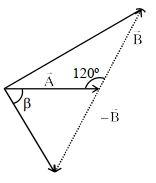
- 679. The angle between vector \((\overrightarrow{{A}})\) and \((\overrightarrow{{A}}-\overrightarrow{{B}})\) is :
 2021 Hard
- (A) \(\tan ^{-1}\left(\frac{-\frac{{B}}{2}}{{A}-{B} \frac{\sqrt{3}}{2}}\right)\)
- (B) \(\tan ^{-1}\left(\frac{{A}}{0.7 {B}}\right)\)
- (C) \(\tan ^{-1}\left(\frac{\sqrt{3} {B}}{2 {A}-{B}}\right)\)
- (D) \(\tan ^{-1}\left(\frac{{B} \cos \theta}{{A}-{B} \sin \theta}\right)\)
Show answer and solution
Correct Answer: (C)
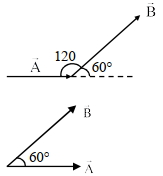
Angle between \(\overrightarrow{{A}}\) and \(\overrightarrow{{B}}, \theta=60^{\circ}\)Angle betwenn \(\overrightarrow{{A}}\) and \(\overrightarrow{{A}}-\overrightarrow{{B}}\)
\(\tan \alpha=\frac{B \sin \theta}{A-B \cos \theta}\)
\(=\frac{B \sqrt{\frac{3}{2}}}{A-B \times \frac{1}{2} 2}\)
\(\tan \alpha=\frac{\sqrt{3} B}{2 A-B}\)
-
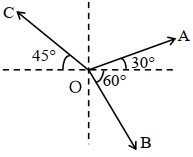
- (A) \(\tan ^{-1} \frac{(1-\sqrt{3}-\sqrt{2})}{(1+\sqrt{3}+\sqrt{2})}\)
- (B) \(\tan ^{-1} \frac{(\sqrt{3}-1+\sqrt{2})}{(1+\sqrt{3}-\sqrt{2})}\)
- (C) \(\tan ^{-1} \frac{(\sqrt{3}-1+\sqrt{2})}{(1-\sqrt{3}+\sqrt{2})}\)
- (D) \(\tan ^{-1} \frac{(1+\sqrt{3}-\sqrt{2})}{(1-\sqrt{3}-\sqrt{2})}\)
Show answer and solution
Correct Answer: (A)
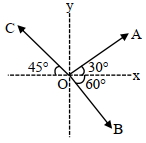
Let magnitude be equal to \(\lambda\).\(\overrightarrow{ OA }=\lambda\left[\cos 30^{\circ} \hat{ i }+\sin 30 \hat{ j }\right]=\lambda\left[\frac{\sqrt{3}}{2} \hat{ i }+\frac{1}{2} \hat{ j }\right]\)
\(\overrightarrow{ OB }=\lambda\left[\cos 60^{\circ} \hat{ i }-\sin 60 \hat{ j }\right]=\lambda\left[\frac{1}{2} \hat{ i }-\frac{\sqrt{3}}{2} \hat{ j }\right]\)
\(\overrightarrow{ OC }=\lambda\left[\cos 45^{\circ}(-\hat{ i })+\sin 45 \hat{ j }\right]=\lambda\left[-\frac{1}{\sqrt{2}} \hat{ i }+\frac{1}{\sqrt{2}} \hat{ j }\right]\)
\(\therefore \overrightarrow{ OA }+\overrightarrow{ OB }-\overrightarrow{ OC }\)
\(=\lambda\left[\left(\frac{\sqrt{3}+1}{2}+\frac{1}{\sqrt{2}}\right) \hat{ i }+\left(\frac{1}{2}-\frac{\sqrt{3}}{2}-\frac{1}{\sqrt{2}}\right) \hat{ j }\right]\)
\(\therefore\) Angle with \(x\)-axis
\(\tan ^{-1}\left[\frac{\frac{1}{2}-\frac{\sqrt{3}}{2}-\frac{1}{\sqrt{2}}}{\frac{\sqrt{3}}{2}+\frac{1}{2}+\frac{1}{\sqrt{2}}}\right]=\tan ^{-1}\left[\frac{\sqrt{2}-\sqrt{6}-2}{\sqrt{6}+\sqrt{2}+2}\right]\)
\(=\tan ^{-1}\left[\frac{1-\sqrt{3}-\sqrt{2}}{\sqrt{3}+1+\sqrt{2}}\right]\)
-
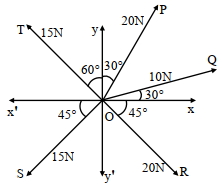
- (A) \(9.25 \hat{{i}}+5 \hat{{j}}\)
- (B) \(3 \hat{{i}}+15 \hat{{j}}\)
- (C) \(2.5 \hat{i}-14.5 \hat{{j}}\)
- (D) \(-1.5 \hat{{i}}-15.5 \hat{{j}}\)
Show answer and solution
Correct Answer: (A)
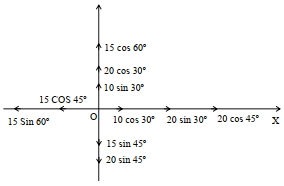
\(\hat{F}_{x}=\left(10 \times \frac{\sqrt{3}}{2}+20\left(\frac{1}{2}\right)+20\left(\frac{1}{\sqrt{2}}\right)-15\left(\frac{1}{\sqrt{2}}\right)-15\left(\frac{\sqrt{3}}{2}\right)\right) \hat{i}\)\(=9.25 \hat{i}\)
\(\vec{F}_{y}=\left(15\left(\frac{1}{2}\right)+20\left(\frac{\sqrt{3}}{2}\right)+10\left(\frac{1}{2}\right)-15\left(\frac{1}{\sqrt{2}}\right)-20\left(\frac{1}{\sqrt{2}}\right)\right) \hat{j}\)
\(=5 \hat{j}\)
-
- (A) \(11\)
- (B) \(47\)
- (C) \(5\)
- (D) \(3\)
Show answer and solution
Correct Answer: (D)
Direction of \(P=\hat{v}_{1}=\pm \frac{\vec{A} \times \vec{B}}{|\vec{A} \times \vec{B}|}=\pm \frac{\hat{i}-\hat{j}+\hat{k}}{\sqrt{3}}\)Direction of \(Q=\hat{v}_{2}=\pm \frac{\vec{A} \times \vec{C}}{|\vec{A} \times \vec{C}|}=\pm \frac{2 \hat{k}}{2}=\pm \hat{k}\)
Angle between \(\hat{v}_{1}\) and \(\hat{v}_{2}\)
\(\cos \theta = \frac{\hat{v}_{1}, \hat{v}_{2}}{\left|\hat{v}_{1}\right|\left|\hat{v}_{2}\right|}=\frac{\pm 1 / \sqrt{3}}{(1)(1)}=\pm \frac{1}{\sqrt{3}}\)
\(\Rightarrow x=3\)
-
- (A) \({\cos ^{ - 1}}\left[ {\frac{{{n^2} - 1}}{{{n^2} + 1}}} \right]\)
- (B) \({\cos ^{ - 1}}\left[ {\frac{{n - 1}}{{n + 1}}} \right]\)
- (C) \({\sin ^{ - 1}}\left[ {\frac{{{n^2} - 1}}{{{n^2} + 1}}} \right]\)
- (D) \({\sin ^{ - 1}}\left[ {\frac{{n - 1}}{{n + 1}}} \right]\)
Show answer and solution
Correct Answer: (A)
\(\begin{array}{*{20}{l}} {\left| {\vec A + \vec B} \right| = n\left| {\vec A - \vec B} \right|} \\ { \Rightarrow \,{A^2} + {B^2} + 2AB\,\cos \,\theta } \\ {\,\,\,\,\,\,\, = {n^2}\left( {{A^2} + {B^2} - 2AB\,\cos \,\theta } \right)} \\ { \Rightarrow \,\cos \,\theta \,\left( {1 + {n^2}} \right) = \frac{{2{a^2}\left( {{n^2} - 1} \right)}}{{2{a^2}}}\,\,} \\ {[A = B = c]} \\ {\cos \,\theta = \frac{{{n^2} - 1}}{{{n^2} + 1}}} \end{array}\) -
- (A) \(\cos ^{-1}\left(\frac{n^{2}+1}{n^{2}-1}\right)\)
- (B) \(\cos ^{-1}\left(\frac{{n}^{2}-1}{-{n}^{2}-1}\right)\)
- (C) \(\cos ^{-1}\left(\frac{-n^{2}-1}{n^{2}-1}\right)\)
- (D) \(\cos ^{-1}\left(\frac{n^{2}+1}{n^{2}-1}\right)\)
Show answer and solution
Correct Answer: (B)
Given \(X=Y\)\(\sqrt{ X ^{2}+ Y ^{2}-2 \times Y \cos \theta}\)
\(= n \sqrt{ X ^{2}+ Y ^{2}+2 \times Y \cos \theta}\)
Square both sides
\(2 X ^{2}(1-\cos \theta)= n ^{2} \cdot 2 X ^{2}(1+\cos \theta)\)
\(1-\cos \theta= n ^{2}+ n ^{2} \cos \theta\)
\(\cos \theta=\frac{1- n ^{2}}{1+ n ^{2}}\)
\(\theta=\cos ^{-1}\left[\frac{ n ^{2}-1}{- n ^{2}-1}\right]\)
- 685. What will be the projection of vector \(A=\hat{i}+\hat{j}+\hat{k}\) on vector \(\vec{B}=\hat{i}+\hat{j}\). 2021 Medium
- (A) \(\sqrt{2}(\hat{i}+\hat{j})\)
- (B) \((\hat{i}+\hat{j})\)
- (C) \(\sqrt{2}(\hat{i}+\hat{j}+\hat{k})\)
- (D) \(2(\hat{i}+\hat{j}+\hat{k})\)
Show answer and solution
Correct Answer: (B)
Projection of vector \(A\) on vector \(B\)\((A \cos \theta) \hat{B}=A\left(\frac{\bar{A} \cdot \bar{B}}{A B}\right) \hat{B}=\frac{\bar{A} \cdot \bar{B}}{B} \hat{B}\)
\(=\frac{2}{\sqrt{2}}\left(\frac{\hat{i}+\hat{j}}{\sqrt{2}}\right)=\hat{i}+\hat{j}\)

No questions on this page match these filters.