


પ્રશ્નો
12 પ્રશ્નો12 માંથી 1–12 પ્રશ્નો
-
- (A) \(\sqrt{\frac{7}{5}}: \sqrt{\frac{5}{3}}: \sqrt{\frac{4}{3}}\)
- (B) \(\sqrt{\frac{5}{3}}: \sqrt{\frac{4}{3}}: \sqrt{\frac{7}{5}}\)
- (C) \(\sqrt{\frac{5}{3}}: \sqrt{\frac{4}{3}}: \sqrt{\frac{4}{3}}\)
- (D) \(\sqrt{\frac{4}{3}}: \sqrt{\frac{5}{3}}: \sqrt{\frac{7}{5}}\)
જવાબ અને ઉકેલ જુઓ
સાચો જવાબ: (C)
\(\mathrm{v}_{\text {sound }}=\sqrt{\frac{\gamma \mathrm{p}}{\rho}} \\ \gamma=1+\frac{2}{\mathrm{f}} \\ \gamma_{\mathrm{He}}=\frac{5}{3} \\ \gamma_{\mathrm{CH}_4}=\gamma_{\mathrm{CO}_2} \approx 1.33=\frac{4}{3}\) (Experimental data) -
- (A) \(335 \mathrm{~m} / \mathrm{s}\)
- (B) \(370 \mathrm{~m} / \mathrm{s}\)
- (C) \(340 \mathrm{~m} / \mathrm{s}\)
- (D) \(360 \mathrm{~m} / \mathrm{s}\)
જવાબ અને ઉકેલ જુઓ
સાચો જવાબ: (D)
બંધ ઓર્ગન પાઇપમાં મૂળભૂત આવૃત્તિ
\(\begin{aligned} & (\mathrm{f})=\frac{\mathrm{v}}{4 \ell} \\ & \mathrm{f}_1=\frac{\mathrm{v}}{4 \ell_1} \& \mathrm{f}_2=\frac{\mathrm{v}}{4 \ell_2}\end{aligned}\)
Beat \(=\left(\mathrm{f}_1-\mathrm{f}_2\right)=\frac{\mathrm{v}}{4}\left(\frac{1}{\ell_1}-\frac{1}{\ell_2}\right)\)
\(\begin{aligned} & 15=\frac{\mathrm{v}}{4}\left(\frac{1}{1}-\frac{1}{1.2}\right) \\ & \mathrm{v}=\left(\frac{15 \times 4 \times 1.2}{0.2}\right)=60 \times 6=360 \mathrm{~m} / \mathrm{s}\end{aligned}\) -
- (A) \(\left[6, \frac{2 \pi}{3}\right]\)
- (B) \(\left[6, \frac{\pi}{3}\right]\)
- (C) \(\left[\sqrt{3}, \frac{\pi}{6}\right]\)
- (D) \(\left[2 \sqrt{3}, \frac{\pi}{6}\right]\)
જવાબ અને ઉકેલ જુઓ
સાચો જવાબ: (D)
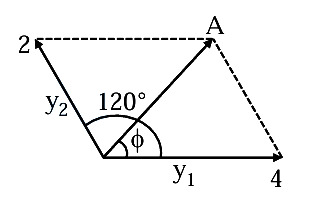
\(\begin{aligned} & \begin{array}{l}\mathrm{A}=\sqrt{2^2+4^2+2 \times 2 \times 4 \times \cos 120^{\circ}} \\ \quad=\sqrt{12}=2 \sqrt{3} \\ \tan \phi=\frac{2 \sin 120^{\circ}}{4+2 \cos 120^{\circ}}=\frac{\sqrt{3}}{3}=\frac{1}{\sqrt{3}} \\ \phi=\frac{\pi}{6}\end{array}\end{aligned}\) -
- (A) 6 s
- (B) 4 s
- (C) 1 s
- (D) 2 s
જવાબ અને ઉકેલ જુઓ
સાચો જવાબ: (D)
આપેલ સમીકરણને આ રીતે લખી શકાય છે
\(\mathrm{x}=\frac{\mathrm{a}}{2} \cos [1.5+50.5] \mathrm{t}+\frac{\mathrm{a}}{2} \cos [50.5-1.5]\)
\(x=\frac{a}{2} \cos [52 t]+\frac{a}{2} \cos [49 t]\)
અહીં, \(2 \pi \mathrm{f}_1 \& 2 \pi \mathrm{f}_2=49\)
\(\mathrm{f}_1=\frac{52}{2 \pi}, \mathrm{f}_2=\frac{49}{2 \pi}\)
\(\therefore \mathrm{f}_{\text {Beat }}=\mathrm{f}_1-\mathrm{f}_2=\frac{3}{2 \pi} \mathrm{~Hz}\)
\(\therefore \mathrm{T}_{\text {Beat }}=\frac{1}{\mathrm{f}_{\text {Beat }}}=\frac{2 \pi}{3} \mathrm{sec}\)
\(=2.09 \mathrm{sec} \approx 2 \mathrm{sec}\) -
- (A) \(25 \%\)
- (B) \(20 \%\)
- (C) \(-20 \%\)
- (D) \(-25 \%\)
જવાબ અને ઉકેલ જુઓ
સાચો જવાબ: (A)
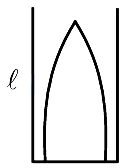
\(\lambda_1=4 \ell\)
\(\mathrm{f}_1=\frac{\mathrm{v}}{4 \ell}\)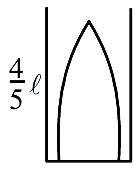
\(\begin{aligned} & \lambda_2=\frac{16 \ell}{5} \\ & \mathrm{f}_2=\frac{5 \mathrm{~V}}{16 \ell} \\ & \frac{\Delta \mathrm{f}}{\mathrm{f}}=\frac{\frac{\mathrm{V}}{\ell}\left(\frac{1}{16}\right)}{\frac{\mathrm{V}}{4 \ell}} \times 100=25 \%\end{aligned}\) -
- (A) 5.0 cm
- (B) 20 cm
- (C) 10 cm
- (D) 2.5 cm
જવાબ અને ઉકેલ જુઓ
સાચો જવાબ: (A)
સમાન ગતિ ધરાવતા 2 બિંદુઓ વચ્ચેનું લઘુત્તમ અંતર \(\frac{\lambda}{2}\) છે.
\(\lambda=\frac{2 \pi}{\mathrm{k}}=\frac{1}{10} \mathrm{~m}=10 \mathrm{~cm}\)
\(\text { Distance }=\frac{\lambda}{2}=5 \mathrm{~cm}\) -
- (A) \(-60 \mathrm{~m} / \mathrm{s}\)
- (B) \(-30 \mathrm{~m} / \mathrm{s}\)
- (C) \(+30 \mathrm{~m} / \mathrm{s}\)
- (D) \(+60 \mathrm{~m} / \mathrm{s}\)
જવાબ અને ઉકેલ જુઓ
સાચો જવાબ: (B)
\(\begin{aligned}
& k=20 \times 10^{-3} \mathrm{~mm}^{-1}=20 \mathrm{~m}^{-1} \\
& w=600 \mathrm{~s}^{-1} \\
& v=\frac{W}{k}=\frac{600}{20}=30 \mathrm{~m} / \mathrm{s}
\end{aligned}\)
અને \(x\) તથા \(t\) સમાન ચિહ્ન ધરાવે છે.
તેથી \(\mathrm{v}=-30 \mathrm{~m} / \mathrm{s}\) -
- (A) \(\frac{15}{7} \mathrm{~cm}\)
- (B) \(\frac{20}{7} \mathrm{~cm}\)
- (C) \(\frac{15}{9} \mathrm{~cm}\)
- (D) \(\frac{20}{9} \mathrm{~cm}\)
જવાબ અને ઉકેલ જુઓ
સાચો જવાબ: (D)
\(\begin{aligned} & 9^{\text {th }} \text { harmonic of closed pipe }=\frac{9 \mathrm{~V}_1}{4 \ell_1} \\ & 4^{\text {th }} \text { harmonic of open pipe }=\frac{2 \mathrm{~V}_2}{\ell_2} \\ & \therefore \frac{9 \mathrm{~V}_1}{4 \ell_1}=\frac{2 \mathrm{~V}_2}{\ell_2} \\ & \therefore \frac{9}{4 \ell_1} \sqrt{\frac{\mathrm{~B}}{\rho_1}}=\frac{2}{\ell_2} \sqrt{\frac{\mathrm{~B}}{\rho_2}} \Rightarrow \frac{\ell_2}{\ell_1}=\frac{8}{9} \sqrt{\frac{\rho_1}{\rho_2}} \\ & \ell_2=\ell_1 \times \frac{8}{9} \times \frac{1}{4}=\frac{20}{9} \mathrm{~cm}\end{aligned}\) -
- (A) \(y=2 \cos (0.83 x-3.35 t) \mathrm{cm}\)
- (B) \(y=2 \sin (0.83 x-3.5 t) \mathrm{cm}\)
- (C) \(y=2 \cos (3.35 x-0.83 t) \mathrm{cm}\)
- (D) \(y=2 \cos (0.13 x-0.5 t) \mathrm{cm}\)
જવાબ અને ઉકેલ જુઓ
સાચો જવાબ: (A)
\(\begin{aligned}
& \mathrm{v}=\frac{\text { distance }}{\text { time }} \\
& \mathrm{v}=\frac{12}{0.3}=4 \mathrm{~cm} / \mathrm{s} \\
& \mathrm{k}=\frac{2 \pi}{\lambda}=\frac{2 \pi}{7.5}=\frac{4 \pi}{15}=0.83 \\
& \mathrm{v}=\frac{\omega}{\mathrm{k}} \Rightarrow \omega=\mathrm{vk}=4 \times \frac{4 \pi}{15}=3.35
\end{aligned}\)
આથી \(y=A \cos (k x-\omega t)\) -
- (A) \(\mathbf{A}\) અને \(\mathbf{R}\) બંને સાચાં છે, પરંતુ \(\mathbf{R}\) એ \(\mathbf{A}\) ની સાચી સમજૂતી નથી.
- (B) \(\mathbf{A}\) સાચું છે, પરંતુ \(\mathbf{R}\) ખોટું છે.
- (C) \(\mathbf{A}\) ખોટું છે, પરંતુ \(\mathbf{R}\) સાચું છે.
- (D) \(\mathbf{A}\) અને \(\mathbf{R}\) બંને સાચાં છે અને \(\mathbf{R}\) એ \(\mathbf{A}\) ની સાચી સમજૂતી છે.
જવાબ અને ઉકેલ જુઓ
સાચો જવાબ: (B)
માધ્યમમાં ધ્વનિની ઝડપ જડત્વીય અને સ્થિતિસ્થાપક ગુણધર્મો પર આધાર રાખે છે જેમ કે વાયુઓ માટે \(v=\sqrt{\frac{B}{P}}\) અને ઘન પદાર્થો માટે \(v=\sqrt{\frac{Y}{P}}\). કારણ કે ઘન પદાર્થોનો સ્થિતિસ્થાપક ગુણધર્મ વાયુઓ કરતાં અનેક ગણો વધારે હોય છે, તેથી ઘન પદાર્થોમાં ધ્વનિની ઝડપ વાયુઓ કરતાં વધુ હોય છે.
ઉપરાંત, વાયુઓનો કદ સ્થિતિસ્થાપકતા ગુણાંક 0 અને \(\infty\left(B=-v \frac{d P}{d v}\right)\) ની વચ્ચે બદલાય છે, તેથી કારણ ખોટું છે. -
- (A) 5 m
- (B) 3 m
- (C) 0.5 m
- (D) 0.33 m
જવાબ અને ઉકેલ જુઓ
સાચો જવાબ: (B)
\(\begin{aligned} & \mathrm{x}(\mathrm{t})=5 \cos \left[628 \mathrm{t}+\frac{\pi}{2}\right] \mathrm{m} \\ & \text { velocity }\left(\mathrm{v}_\omega\right)=300 \mathrm{~m} / \mathrm{s} \\ & \mathrm{v}_{\mathrm{w}}=\frac{\omega}{\mathrm{K}} \\ & 300=\frac{628}{\mathrm{~K}} \Rightarrow \mathrm{~K}=\frac{628}{300} \\ & \frac{2 \pi}{\lambda}=\frac{628}{300} \Rightarrow \lambda=\frac{2 \times 3.14 \times 300}{628} \\ & \lambda=2 \mathrm{~m}\end{aligned}\) -
- (A) \(\sqrt{2}\)
- (B) 2
- (C) 8
- (D) 4
જવાબ અને ઉકેલ જુઓ
સાચો જવાબ: (B)
\(\begin{aligned} & v=\sqrt{\frac{T}{\mu}}=\sqrt{\frac{T}{f \pi R^2}} \\ & \frac{v_2}{v_1}=\frac{R_1}{R_2}=2\end{aligned}\)
આ પેજ પર આ ફિલ્ટર મુજબ કોઈ પ્રશ્ન નથી.