


Questions
12 questionsShowing 1–12 of 12 questions
-
- (A) \(\frac{15}{7} \mathrm{~cm}\)
- (B) \(\frac{20}{7} \mathrm{~cm}\)
- (C) \(\frac{15}{9} \mathrm{~cm}\)
- (D) \(\frac{20}{9} \mathrm{~cm}\)
Show answer and solution
Correct Answer: (D)
\(\begin{aligned} & 9^{\text {th }} \text { harmonic of closed pipe }=\frac{9 \mathrm{~V}_1}{4 \ell_1} \\ & 4^{\text {th }} \text { harmonic of open pipe }=\frac{2 \mathrm{~V}_2}{\ell_2} \\ & \therefore \frac{9 \mathrm{~V}_1}{4 \ell_1}=\frac{2 \mathrm{~V}_2}{\ell_2} \\ & \therefore \frac{9}{4 \ell_1} \sqrt{\frac{\mathrm{~B}}{\rho_1}}=\frac{2}{\ell_2} \sqrt{\frac{\mathrm{~B}}{\rho_2}} \Rightarrow \frac{\ell_2}{\ell_1}=\frac{8}{9} \sqrt{\frac{\rho_1}{\rho_2}} \\ & \ell_2=\ell_1 \times \frac{8}{9} \times \frac{1}{4}=\frac{20}{9} \mathrm{~cm}\end{aligned}\) -
- (A) \(y=2 \cos (0.83 x-3.35 t) \mathrm{cm}\)
- (B) \(y=2 \sin (0.83 x-3.5 t) \mathrm{cm}\)
- (C) \(y=2 \cos (3.35 x-0.83 t) \mathrm{cm}\)
- (D) \(y=2 \cos (0.13 x-0.5 t) \mathrm{cm}\)
Show answer and solution
Correct Answer: (A)
\(\begin{aligned}
& \mathrm{v}=\frac{\text { distance }}{\text { time }} \\
& \mathrm{v}=\frac{12}{0.3}=4 \mathrm{~cm} / \mathrm{s} \\
& \mathrm{k}=\frac{2 \pi}{\lambda}=\frac{2 \pi}{7.5}=\frac{4 \pi}{15}=0.83 \\
& \mathrm{v}=\frac{\omega}{\mathrm{k}} \Rightarrow \omega=\mathrm{vk}=4 \times \frac{4 \pi}{15}=3.35
\end{aligned}\)
So \(y=A \cos (k x-\omega t)\) -
- (A) \(\sqrt{\frac{7}{5}}: \sqrt{\frac{5}{3}}: \sqrt{\frac{4}{3}}\)
- (B) \(\sqrt{\frac{5}{3}}: \sqrt{\frac{4}{3}}: \sqrt{\frac{7}{5}}\)
- (C) \(\sqrt{\frac{5}{3}}: \sqrt{\frac{4}{3}}: \sqrt{\frac{4}{3}}\)
- (D) \(\sqrt{\frac{4}{3}}: \sqrt{\frac{5}{3}}: \sqrt{\frac{7}{5}}\)
Show answer and solution
Correct Answer: (C)
\(\mathrm{v}_{\text {sound }}=\sqrt{\frac{\gamma \mathrm{p}}{\rho}} \\ \gamma=1+\frac{2}{\mathrm{f}} \\ \gamma_{\mathrm{He}}=\frac{5}{3} \\ \gamma_{\mathrm{CH}_4}=\gamma_{\mathrm{CO}_2} \approx 1.33=\frac{4}{3}\) (Experimental data) -
- (A) 5 m
- (B) 3 m
- (C) 0.5 m
- (D) 0.33 m
Show answer and solution
Correct Answer: (B)
\(\begin{aligned} & \mathrm{x}(\mathrm{t})=5 \cos \left[628 \mathrm{t}+\frac{\pi}{2}\right] \mathrm{m} \\ & \text { velocity }\left(\mathrm{v}_\omega\right)=300 \mathrm{~m} / \mathrm{s} \\ & \mathrm{v}_{\mathrm{w}}=\frac{\omega}{\mathrm{K}} \\ & 300=\frac{628}{\mathrm{~K}} \Rightarrow \mathrm{~K}=\frac{628}{300} \\ & \frac{2 \pi}{\lambda}=\frac{628}{300} \Rightarrow \lambda=\frac{2 \times 3.14 \times 300}{628} \\ & \lambda=2 \mathrm{~m}\end{aligned}\) -
- (A) Both \(\mathbf{A}\) and \(\mathbf{R}\) are true but \(\mathbf{R}\) is NOT the correct explanation of \(\mathbf{A}\)
- (B) \(\mathbf{A}\) is true but \(\mathbf{R}\) is false
- (C) \(\mathbf{A}\) is false but \(\mathbf{R}\) is true
- (D) Both \(\mathbf{A}\) and \(\mathbf{R}\) are true and \(\mathbf{R}\) is the correct explanation of \(\mathbf{A}\)
Show answer and solution
Correct Answer: (B)
Speed of sound in a medium depends on inertial and elastic properties as \(v=\sqrt{\frac{B}{P}}\) for gases and \(v=\sqrt{\frac{Y}{P}}\) for solids. Since the elastic property of solid happens to be many folds greater than that of gases, the speed of sound in solids i5 higher than in gases.
Also, bulk modulus of gases varies between 0 and \(\infty\left(B=-v \frac{d P}{d v}\right)\) hence reason is false. -
- (A) \(25 \%\)
- (B) \(20 \%\)
- (C) \(-20 \%\)
- (D) \(-25 \%\)
Show answer and solution
Correct Answer: (A)
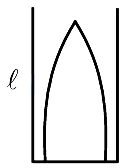
\(\lambda_1=4 \ell\)
\(\mathrm{f}_1=\frac{\mathrm{v}}{4 \ell}\)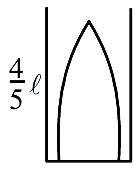
\(\begin{aligned} & \lambda_2=\frac{16 \ell}{5} \\ & \mathrm{f}_2=\frac{5 \mathrm{~V}}{16 \ell} \\ & \frac{\Delta \mathrm{f}}{\mathrm{f}}=\frac{\frac{\mathrm{V}}{\ell}\left(\frac{1}{16}\right)}{\frac{\mathrm{V}}{4 \ell}} \times 100=25 \%\end{aligned}\) -
- (A) \(335 \mathrm{~m} / \mathrm{s}\)
- (B) \(370 \mathrm{~m} / \mathrm{s}\)
- (C) \(340 \mathrm{~m} / \mathrm{s}\)
- (D) \(360 \mathrm{~m} / \mathrm{s}\)
Show answer and solution
Correct Answer: (D)
Fundamental frequency in close/organ pipe
\(\begin{aligned} & (\mathrm{f})=\frac{\mathrm{v}}{4 \ell} \\ & \mathrm{f}_1=\frac{\mathrm{v}}{4 \ell_1} \& \mathrm{f}_2=\frac{\mathrm{v}}{4 \ell_2}\end{aligned}\)
Beat \(=\left(\mathrm{f}_1-\mathrm{f}_2\right)=\frac{\mathrm{v}}{4}\left(\frac{1}{\ell_1}-\frac{1}{\ell_2}\right)\)
\(\begin{aligned} & 15=\frac{\mathrm{v}}{4}\left(\frac{1}{1}-\frac{1}{1.2}\right) \\ & \mathrm{v}=\left(\frac{15 \times 4 \times 1.2}{0.2}\right)=60 \times 6=360 \mathrm{~m} / \mathrm{s}\end{aligned}\) -
- (A) \(\left[6, \frac{2 \pi}{3}\right]\)
- (B) \(\left[6, \frac{\pi}{3}\right]\)
- (C) \(\left[\sqrt{3}, \frac{\pi}{6}\right]\)
- (D) \(\left[2 \sqrt{3}, \frac{\pi}{6}\right]\)
Show answer and solution
Correct Answer: (D)
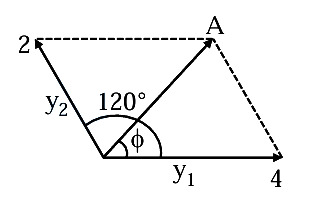
\(\begin{aligned} & \begin{array}{l}\mathrm{A}=\sqrt{2^2+4^2+2 \times 2 \times 4 \times \cos 120^{\circ}} \\ \quad=\sqrt{12}=2 \sqrt{3} \\ \tan \phi=\frac{2 \sin 120^{\circ}}{4+2 \cos 120^{\circ}}=\frac{\sqrt{3}}{3}=\frac{1}{\sqrt{3}} \\ \phi=\frac{\pi}{6}\end{array}\end{aligned}\) -
- (A) \(-60 \mathrm{~m} / \mathrm{s}\)
- (B) \(-30 \mathrm{~m} / \mathrm{s}\)
- (C) \(+30 \mathrm{~m} / \mathrm{s}\)
- (D) \(+60 \mathrm{~m} / \mathrm{s}\)
Show answer and solution
Correct Answer: (B)
\(\begin{aligned}
& k=20 \times 10^{-3} \mathrm{~mm}^{-1}=20 \mathrm{~m}^{-1} \\
& w=600 \mathrm{~s}^{-1} \\
& v=\frac{W}{k}=\frac{600}{20}=30 \mathrm{~m} / \mathrm{s}
\end{aligned}\)
and \(x \& t\) carry same sign
Therefore \(\mathrm{v}=-30 \mathrm{~m} / \mathrm{s}\) -
- (A) 5.0 cm
- (B) 20 cm
- (C) 10 cm
- (D) 2.5 cm
Show answer and solution
Correct Answer: (A)
Minimum distance between 2 points having same speed is \(\frac{\lambda}{2}\).
\(\lambda=\frac{2 \pi}{\mathrm{k}}=\frac{1}{10} \mathrm{~m}=10 \mathrm{~cm}\)
\(\text { Distance }=\frac{\lambda}{2}=5 \mathrm{~cm}\) -
- (A) 6 s
- (B) 4 s
- (C) 1 s
- (D) 2 s
Show answer and solution
Correct Answer: (D)
The given equation can be written as
\(\mathrm{x}=\frac{\mathrm{a}}{2} \cos [1.5+50.5] \mathrm{t}+\frac{\mathrm{a}}{2} \cos [50.5-1.5]\)
\(x=\frac{a}{2} \cos [52 t]+\frac{a}{2} \cos [49 t]\)
Here, \(2 \pi \mathrm{f}_1 \& 2 \pi \mathrm{f}_2=49\)
\(\mathrm{f}_1=\frac{52}{2 \pi}, \mathrm{f}_2=\frac{49}{2 \pi}\)
\(\therefore \mathrm{f}_{\text {Bat }}=\mathrm{f}_1-\mathrm{f}_2=\frac{3}{2 \pi} \mathrm{~Hz}\)
\(\therefore \mathrm{T}_{\text {Beat }}=\frac{1}{\mathrm{f}_{\text {Beat }}}=\frac{2 \pi}{3} \mathrm{sec}\)
\(=2.09 \mathrm{sec} \approx 2 \mathrm{sec}\) -
- (A) \(\sqrt{2}\)
- (B) 2
- (C) 8
- (D) 4
Show answer and solution
Correct Answer: (B)
\(\begin{aligned} & v=\sqrt{\frac{T}{\mu}}=\sqrt{\frac{T}{f \pi R^2}} \\ & \frac{v_2}{v_1}=\frac{R_1}{R_2}=2\end{aligned}\)
No questions on this page match these filters.