


પ્રશ્નો
નવા પહેલા61 માંથી 51–61 પ્રશ્નો
-
- (A) \(4\)
- (B) \(8\)
- (C) \(16\)
- (D) \(2\)
જવાબ અને ઉકેલ જુઓ
સાચો જવાબ: (D)
For \(n=4\)\(\ell=0,1,2,3\)
\(\therefore 4 d \& 4 f\) subshell associated with \(n =4, m =-2\)

- 52. \(n=5,\;m_s=+\frac 12\) ક્વોન્ટમ સંખ્યા સાથે સંકળાયેલ ભ્રમણકક્ષાની સંખ્યા ........ થાય. 2020 મધ્યમ
- (A) \(11\)
- (B) \(25\)
- (C) \(15\)
- (D) \(50\)
જવાબ અને ઉકેલ જુઓ
સાચો જવાબ: (B)
No. of orbitals \(=n^{2}=5^{2}=25\)For \(n=5,\) no. of orbitals \(=n^{2}=25\)
Total number of orbitals is equal to no. of electrons having \(\mathrm{m}_{\mathrm{s}}=\frac{1}{2}\)
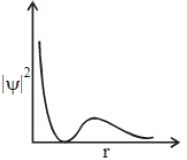
- 53. \({\left| \psi \right|^2}\) અને \(r\)(radial distance) વચ્ચેનો આલેખ નીચે દર્શાવ્યો છે . તે .. . રજૂ કરે છે .
 2019 મધ્યમ
- (A) \(1s\) કક્ષક
- (B) \(3s\) કક્ષક
- (C) \(2s\) કક્ષક
- (D) \(2p\) કક્ષક
જવાબ અને ઉકેલ જુઓ
સાચો જવાબ: (C)
As we know that for \(s-\) orbital graph start from top and no. of radial node \(= n-l-1\) For \(2s\) orbital it will \(= 2-0-1=1\)\(\therefore \) The graph is of \(2s\)
-
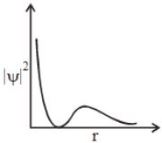
- (A) \(I < III < II < IV\)
- (B) \(I < II < III < IV\)
- (C) \(IV < II < III < I\)
- (D) \(IV < III < II < I\)
જવાબ અને ઉકેલ જુઓ
સાચો જવાબ: (C)
According to Aufbau principle, the energy sequence is \(3p < 3d < 4p < 4d\) -
- (A) ઇલેક્ટ્રોન કેન્દ્ર થી \(2a_0\) અંતરે મળી શકે છે .
- (B) ન્યુક્લિઅસ પર ઇલેક્ટ્રોન મળવાની સંભાવના વધુ છે.
- (C) સરેરાશપણે તેની ગતિજ ઊર્જા કરતાં સ્થિતિજ ઊર્જાની માત્ર બમણી છે .
- (D) જ્યારે ઇલેક્ટ્રોન કેન્દ્ર થી \(a_0\) અંતરે હોય તેની કુલ ઊર્જા મહતમ હોય છે .
જવાબ અને ઉકેલ જુઓ
સાચો જવાબ: (D)
\(T.E = - K.E = \frac{{PE}}{2}\) The energy of electrons increases as they are away from the nucleus. The probability of finding the \(1s\) electron may be higher at \(a_0\) but the energy is not. The probability density of finding the electron is not zero at any place in the atom. So, the energy may be higher when it is far from \(a_0\) -
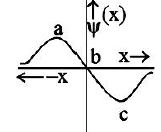
- (A) \(a\) અને \(b\) વિસ્તાર માં
- (B) \(a\) અને \(c\) વિસ્તાર માં
- (C) ફક્ત \(a\) વિસ્તારમાં
- (D) ફક્ત \(c\) વિસ્તારમાં
જવાબ અને ઉકેલ જુઓ
સાચો જવાબ: (B)
At \(a\) & \(c\), probability of finding electron is maximum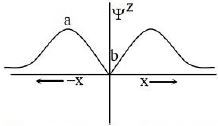
-
- (A) \(K\)
- (B) \(Na\)
- (C) \(H\)
- (D) \(Li\)
જવાબ અને ઉકેલ જુઓ
સાચો જવાબ: (A)
Greater the nuclear charge, stronger will be the attraction, hence lower will be energy of \(2s\) -
- (A) \(20\)
- (B) \(25\)
- (C) \(10\)
- (D) \(5\)
જવાબ અને ઉકેલ જુઓ
સાચો જવાબ: (B)
Number of orbitals in a shell \(= n^2 = (5)^2 = 25.\) -
- (A) \(ns \to (n - 2)f \to np \to (n - 1 )d\)
- (B) \(ns \to (n - 2)f\to (n -1 )d\to np\)
- (C) \(ns \to np \to (n - 1 )d \to (n-2)f\)
- (D) \(ns \to (n-1 )d \to (n-2)f \to np\)
જવાબ અને ઉકેલ જુઓ
સાચો જવાબ: (B)
The sequence of filling electrons in sixth period \(6s -4f- 5d -6p \,\,i.e., (ns) \to (n-2)f\to (n- 1 )d \to np\) -
- (A) \(25\) અને \(1\)
- (B) \(8\) અને \(1\)
- (C) \(2\) અને \(4\)
- (D) \(4\) અને \(1\)
જવાબ અને ઉકેલ જુઓ
સાચો જવાબ: (B)
\((i)\) \(n=5\) means \(l=0,1,2,3,4\)since \(m= +1\)
hence total no. of electrons will be \(= 0\) (from \(s\)) \(+ 2\) (from \(p\)) \(+ 2\) (fron \(d\)) \(+ 2\) (from \(f\)) \(+ 2\) (from \(g\))
\(=0+2+2+2+2=8\)
\((ii)\) \(n=2,\,l=1,\,m_l=-1,\,m_s=-1/2\) represent \(2p\) orbital with one electron
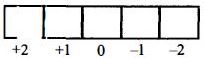
- 61. કોઈ એક પરમાણુમા કેટલી કક્ષકો, ક્વોન્ટમ આંક \(n = 3, l = 2\) અને \(m_l = + 2\) ધરાવે છે ? 2013 મધ્યમ
- (A) \(5\)
- (B) \(3\)
- (C) \(1\)
- (D) \(7\)
જવાબ અને ઉકેલ જુઓ
સાચો જવાબ: (C)
\(n=3,\,l=2\) means \(3d\) orbitali.e. in an atom only one orbital can have the value \(m_l = +2\)
આ પેજ પર આ ફિલ્ટર મુજબ કોઈ પ્રશ્ન નથી.