


प्रश्न
नए पहले58 में से 51–58 प्रश्न
-
- (A) \(13\) के अर्द्धपूरित संयोजकता उपकोश होते है।
- (B) \(9\) प्रथम क्षारीय धातु है।
- (C) \(8\) प्रथम उत्कृष्ट गैस है।
- (D) \(6\) की एक \(2 p\)-संयोजकता उपकोश है।
उत्तर और हल देखें
सही उत्तर: (A)
\(l=0\) to \(( n +1)\)\(n =1 \quad n =2\)
\(l=0,1,2 \quad l=0,1,2,3\)
\((n+l) \Rightarrow \frac{1 s}{1} \frac{1 p}{2} \frac{1 d}{3} \quad \frac{2 s}{2} \frac{2 p}{3} \frac{2 d}{4} \frac{2 f}{5}\)
\(n=3\)
\(l=0,1,2,3,4\)
\(\frac{3 s }{3} \frac{3 p }{4} \frac{3 d }{5} \frac{3 f }{6} \frac{3 g }{7}\)
Now, in order to write electronic configuration, we need to apply \(( n +l)\) rule
Energy order : \(1 s <1 p <2 s <1 d <2 p <3 s <2 d\)
Option 1) \(13: 1 s^{2} 1 p^{6} 2 s^{2} 1 d^{3}\) is not half filled
Option 2) \(9: \quad 1 s^{2} 1 p^{6} 2 s^{1}\) is the first alkali metal because after losing one electron, it will achieve first noble gas configuration
Option \(3)\) \(8: \quad 1 s^{2} 1 p^{6}\) is the first noble gas because after \(1 p ^{6} e ^{-}\) will
Option \(4)\) \(6: \quad 1 s ^{2} 1 p ^{4}\) has \(1 p\) valence subshell.
-
- (A) \(1s\) कक्षक
- (B) \(3s\) कक्षक
- (C) \(2s\) कक्षक
- (D) \(2p\) कक्षक
उत्तर और हल देखें
सही उत्तर: (C)
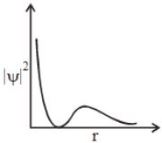
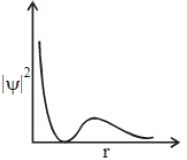
As we know that for \(s-\) orbital graph start from top and no. of radial node \(= n-l-1\) For \(2s\) orbital it will \(= 2-0-1=1\)\(\therefore \) The graph is of \(2s\)
-
- (A) \(I < III < II < IV\)
- (B) \(I < II < III < IV\)
- (C) \(IV < II < III < I\)
- (D) \(IV < III < II < I\)
उत्तर और हल देखें
सही उत्तर: (C)
According to Aufbau principle, the energy sequence is
\(3p < 3d < 4p < 4d\) -
- (A) इलेक्ट्रॉन, नाभिक से \(2 a _{0}\) की दूरी पर पाया जा सकता है।
- (B) इलेक्ट्रॉन के पाये जाने का प्रायिकता घनत्व नाभिक पर सर्वाधिक है।
- (C) औसतन, स्थितिज ऊर्जा का मान इसके गतिज ऊर्जा के मान का दुगुना है।
- (D) इलेक्ट्रॉन की कुल ऊर्जा उच्चतम तब होगी जब वह नाभिक से \(a_{0}\) दूरी पर है।
उत्तर और हल देखें
सही उत्तर: (D)
\(T.E = - K.E = \frac{{PE}}{2}\)The energy of electrons increases as they are away from the nucleus. The probability of finding the \(1s\) electron may be higher at \(a_0\) but the energy is not. The probability density of finding the electron is not zero at any place in the atom. So, the energy may be higher when it is far from \(a_0\)
-
- (A) \(a\) तथा \(b\) क्षेत्र में
- (B) \(a\) तथा \(c\) क्षेत्र में
- (C) मात्र \(a\) क्षेत्र में
- (D) मात्र \(c\) क्षेत्र में
उत्तर और हल देखें
सही उत्तर: (B)
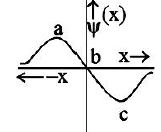
At \(a\) & \(c\), probability of finding electron is maximum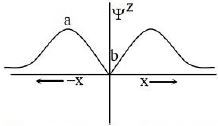
-
- (A) \(K\)
- (B) \(Na\)
- (C) \(H\)
- (D) \(Li\)
उत्तर और हल देखें
सही उत्तर: (A)
Greater the nuclear charge, stronger will be the attraction, hence lower will be energy of \(2s\) -
- (A) \(20\)
- (B) \(25\)
- (C) \(10\)
- (D) \(5\)
उत्तर और हल देखें
सही उत्तर: (B)
Number of orbitals in a shell \(= n^2 = (5)^2 = 25.\) -
- (A) \(ns \to (n - 2)f \to np \to (n - 1 )d\)
- (B) \(ns \to (n - 2)f\to (n -1 )d\to np\)
- (C) \(ns \to np \to (n - 1 )d \to (n-2)f\)
- (D) \(ns \to (n-1 )d \to (n-2)f \to np\)
उत्तर और हल देखें
सही उत्तर: (B)
The sequence of filling electrons in sixth period\(6s -4f- 5d -6p \,\,i.e., (ns) \to (n-2)f\to (n- 1 )d \to np\)
इस पेज पर इन फ़िल्टर से कोई प्रश्न नहीं मिला।