


પ્રશ્નો
6 પ્રશ્નો6 માંથી 1–6 પ્રશ્નો
-
- (A) \(A\,<\,2.0\,cm\)
- (B) \(A\,=\,2.0\,cm\)
- (C) \(A\,>\,2.0\,cm\)
- (D) \(A\,=\,1.5\,cm\)
જવાબ અને ઉકેલ જુઓ
સાચો જવાબ: (C)
As \(F = -kx\)\(mg=-kx\)
\(1\times 10=500\;A\)
\(A=2\;cm\)
for not gettingdistorted \(A > 2\;cm\)
-
- (A) \(0.6\)
- (B) \(0.7\)
- (C) \(0.81\)
- (D) \(0.73\)
જવાબ અને ઉકેલ જુઓ
સાચો જવાબ: (D)
\(\because A=A_{0} e^{-\frac{b t}{2 m}}\left(\text { where }, A_{0}=\text { maximum amplitude }\right)\)\( According \,to \,the\, questions,\, after\, 5\, second, \)
\(0.9 \mathrm{A}_{0}=\mathrm{A}_{0} \mathrm{e}^{-\frac{\mathrm{b}(5)}{2 \mathrm{m}}}\) \(...(i)\)
\(After\, 10 \,more\, second,\)
\(A=A_{0} \mathrm{e}^{-\frac{\mathrm{b}(15)}{2 \mathrm{m}}}\) \(...(ii)\)
From eq"s \((i)\) and \((ii)\)
\(A=0.729 A_{0} \therefore \alpha=0.729\)
-
- (A) \(\frac{4}{3}\)
- (B) \(\frac{16}{9}\)
- (C) \(\frac{3}{4}\)
- (D) \(\frac{9}{16}\)
જવાબ અને ઉકેલ જુઓ
સાચો જવાબ: (A)
\(\mathrm{k}_{\mathrm{A}}=300 \mathrm{N} / \mathrm{m}, \quad \mathrm{k}_{\mathrm{B}}=400 \mathrm{N} / \mathrm{m}\)Let when the combination of springs is compressed by force \(\mathrm{F}\). Spring \(A\) is compressed by \(x\). Therefore compression in spring \(\mathrm{B}\)
\(x_{B}=(8.75-x) c m\)
\(\mathrm{F}=300 \times x=400(8.75-x)\)
Solving we get, \(x=5 \mathrm{cm}\)
\(x_{B}=8.75-5=3.75 \mathrm{cm}\)
\(\frac{E_{A}}{E_{B}}=\frac{\frac{1}{2} k_{A}\left(x_{A}\right)^{2}}{\frac{1}{2} k_{B}\left(x_{B}\right)^{2}}=\frac{300 \times(5)^{2}}{400 \times(3.75)^{2}}=\frac{4}{3}\)
-
- (A) \(2\)
- (B) \(7\)
- (C) \(5\)
- (D) \(3\)
જવાબ અને ઉકેલ જુઓ
સાચો જવાબ: (A)
Let \(\mathrm{T}_{1}\) and \(\mathrm{T}_{2}\) be the time period of the twopendulums \(T_{1}=2 \pi \sqrt{\frac{1}{g}}\) and \(T_{2}=2 \pi \sqrt{\frac{4}{g}}\)
As \(\ell_{1}<\ell_{2}\) therefore \(\mathrm{T}_{1}<\mathrm{T}_{2}\)
Let at \(t=0\) they start swinging together. since their time periods are different, the swinging will not be in unison always. Only when number of completed oscillations
differ by an integer, the two pendulums will again begin to swing together
Let longer length pendulum complete \(n\) oscillation and shorter length pendulum complete \((\mathrm{n}+1)\) oscillation. For unison swinging
\((n+1) T_{1}=n T_{2}\)
\((n+1) \times 2 \pi \sqrt{\frac{1}{g}}=(n) \times 2 \pi \sqrt{\frac{4}{g}}\)
\(\Rightarrow n=1\)
\(\therefore n+1=1+1=2\)
-
- (A) \(2\pi {\left[ {\frac{M}{{\left( {k + A\sigma g} \right)}}} \right]^{1/2}}\) કરતાં નાનો
- (B) \(2\pi \sqrt {\frac{M}{k}} \)
- (C) \(2\pi {\left[ {\frac{M}{{\left( {k + A\sigma g} \right)}}} \right]^{1/2}}\) કરતાં મોટો
- (D) \(2\pi {\left[ {\frac{M}{{\left( {k + A\sigma g} \right)}}} \right]^{1/2}}\)
જવાબ અને ઉકેલ જુઓ
સાચો જવાબ: (A)
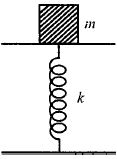
If \(x\) is the displacement then,\(M{\omega ^2}x = \left[ {\rho Ag + k} \right]x\)
\( \Rightarrow \omega = {\left[ {\frac{{\rho Ag + k}}{m}} \right]^{1/2}}\)
\( \Rightarrow T=2\pi {\left[ {\frac{M}{{\left( {k + A\sigma g} \right)}}} \right]^{1/2}}\)
It Should be less than \(2\pi {\left[ {\frac{M}{{\left( {k + A\sigma g} \right)}}} \right]^{1/2}}\)
-
- (A) \(\frac{1}{{2\pi }}\sqrt {\frac{{M{V_0}}}{{A\gamma {P_o}}}} \;\;\;\;\;\;\;\;\;\;\;\;\;\;\;\)
- (B) \(\;\frac{1}{{2\pi }}\sqrt {\frac{{A\gamma {P_o}}}{{{V_0}M}}} \)
- (C) \(\;\frac{1}{{2\pi }}\sqrt {\frac{{{A^2}\gamma {P_o}}}{{M{V_0}}}} \)
- (D) \(\;\frac{1}{{2\pi }}\frac{{{V_o}M{P_o}}}{{{A^2}\gamma }}\)
જવાબ અને ઉકેલ જુઓ
સાચો જવાબ: (C)
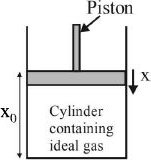
\({\frac{M g}{A}=P_{0}}\) \( {P_{0} V_{0}^{\gamma}=P V^{\gamma}}\)\({\mathrm{Mg}=\mathrm{P}_{0} \mathrm{A}}{\ldots(1)}\) \( {P_{0} A x_{0}^{\gamma}=P A\left(x_{0}-x\right)^{\gamma}}\)
\(P=\frac{P_{0} x_{0}^{\gamma}}{\left(x_{0}-x\right)^{\gamma}}\)
Let piston is displaced by distance \(x\)
\(M g-\left(\frac{P_{0} x_{0}^{\gamma}}{\left(x_{0}-x\right)^{\gamma}}\right) A=F_{\text {restoring }}\)
\(P_{0} A\left(1-\frac{x_{0}^{\gamma}}{\left(x_{0}-x\right)^{\gamma}}\right)=F_{\text {restoring }} \quad\left[x_{0}-x \approx x_{0}\right]\)
\(F=-\frac{\gamma P_{0} A x}{x_{0}}\)
Frequency with which piston executes \(SHM.\)
\(f=\frac{1}{2 \pi} \sqrt{\frac{\gamma P_{0} A}{x_{0} M}}=\frac{1}{2 \pi} \sqrt{\frac{\gamma P_{0} A^{2}}{M V_{0}}}\)
આ પેજ પર આ ફિલ્ટર મુજબ કોઈ પ્રશ્ન નથી.