


હાઇડ્રોકાર્બન ના બધા પ્રશ્નો
નવા પહેલા63 માંથી 51–63 પ્રશ્નો
- 51. નીચેના પૈકી ક્યા આલ્કીનની જ્યારે \(HCI\) સાથે પ્રક્રિયા કરવામાં આવે ત્યારે મુખ્યત્વે પ્રતિમાર્કોવનિકોવ નીપજ આપે છે? 2019 અઘરું
- (A) \(H_2N -CH = CH_2\)
- (B) \(F_3C -CH = CH_2\)
- (C) \(CH_3 O -CH = CH_2\)
- (D) \(Cl -CH = CH_2\)
જવાબ અને ઉકેલ જુઓ
સાચો જવાબ: (B)
In this case antimarkonikov product will be formed as major product because carbocation formed at a double bonded carbon having lesser number of \(H\) atom will be unstable due to presence of an electron with drawing group \((CF_3)\) attached to it.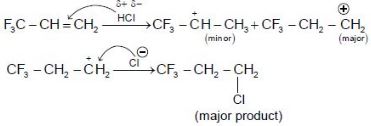
- 52. નીચેની પ્રક્રિયાની મુખ્ય નીપજ જણાવો. \(C{H_3}C \equiv CH\xrightarrow[{(ii)\,Dl}]{{(i)\,DCl\,\,(1\,equiv)}}\) 2019 અઘરું
- (A) \(CH_3CD(I)CHD(Cl)\)
- (B) \(CH_3C(I)(Cl)CHD_2\)
- (C) \(CH_3CD_2CH(Cl)(I)\)
- (D) \(CH_3CD(Cl)CHD(I)\)
જવાબ અને ઉકેલ જુઓ
સાચો જવાબ: (B)
\(C{{H}_{3}}C\equiv CH\xrightarrow{DCl}\begin{matrix}
Cl\,\,\, \\
|\,\,\, \\
C{{H}_{3}}-C=CHD \\
\end{matrix}\) \(\xrightarrow{DI}\begin{matrix}
Cl\,\, \\
|\,\,\, \\
C{{H}_{3}}-C-CH{{D}_{2}} \\
\,|\,\,\,\, \\
I\,\,\, \\
\end{matrix}\) -
- (A) \(\alpha - \) હાઈડ્રોજન
- (B) \(\gamma - \) હાઈડ્રોજન
- (C) \(\delta - \) હાઈડ્રોજન
- (D) \(\beta - \) હાઈડ્રોજન
જવાબ અને ઉકેલ જુઓ
સાચો જવાબ: (B)
Allylic radical will form in presence of sunlight -
- (A) \(X\) કરતાં \(Y\) વધારે દ્વિધ્રુવીય ચાકમાત્રા અને ઊંચું ઉત્કલન બિંદુ ધરાવશે.
- (B) \(X\) કરતાં \(Y\) વધારે દ્વિધ્રુવીય ચાકમાત્રા અને નીચું ઉત્કલન બિંદુ ધરાવશે.
- (C) \(Y\) કરતાં \(X\) ઓછી દ્વિધ્રુવીય ચાકમાત્રા અને નીચું ઉત્કલન બિંદુ ધરાવશે.
- (D) \(Y\) કરતાં \(X\) ઊંચી દ્વિધ્રુવીય ચાકમાત્રા અને ઊચું ઉત્કલન બિંદુ ધરાવશે.
જવાબ અને ઉકેલ જુઓ
સાચો જવાબ: (D)
When \(2-\) butyne is treated with \(H_2/\) Lindlar's catalyst, compound \(X\) (cis \(-2-\) butene) is produced as the major product; and when treated with \(Na/liq\,NH_3\) it produces \(Y\) (trans \(-2-\) butene) as the major product. Cisisomer \((X)\) will have higher dipole moment and higher boiling point than trans \((Y)\). -
- (A) \(6\)
- (B) \(0\)
- (C) \(2\)
- (D) \(4\)
જવાબ અને ઉકેલ જુઓ
સાચો જવાબ: (D)
When alkenes are treated with \(HBr\) in the presence of peroxides, an anti-Markovnikov addition occurs in the sense that the hydrogen atom becomes attached to the carbon atom with the fewer hydrogen atoms.The product formed has two chirality centres, therefore, four stereoisomers \(\left(2^{2}\right)\) will exist.
\(\begin{array}{*{20}{c}}
{\,\,\,\,\,C{H_3}} \\
| \\
{C{H_3} - C{H_2} - C = CH - C{H_3}}
\end{array}\) \(\xrightarrow[{Peroxide}]{{HBr}}\) \(\mathop {\begin{array}{*{20}{c}}
{\,\begin{array}{*{20}{c}}
{\,\,\,\,\,\,C{H_3}} \\
|
\end{array}} \\
{C{H_3} - C{H_2} - {}_*CH - \mathop {CH}\limits^{*\,} - C{H_3}} \\
{\,\,\,\,\,\,\,\,\,\,\,\,\,\,\,\,\,\,\,\,\,\,\,\,\,\,\,\,\,\,\,\,\,\,\,|} \\
{\,\,\,\,\,\,\,\,\,\,\,\,\,\,\,\,\,\,\,\,\,\,\,\,\,\,\,\,\,\,\,\,\,\,\,\,\,Br}
\end{array}}\limits_{Major\,\,product} \) -
- (A) \(C_4H_8\)
- (B) \(C_4H_{10}\)
- (C) \(C_3H_6\)
- (D) \(C_3H_8\)
જવાબ અને ઉકેલ જુઓ
સાચો જવાબ: (D)
\(C_{x} H_{y(g)}+\left(\frac{4 x+y}{4}\right) O_{2(g)} \rightarrow x C O_{2(g)}+\frac{y}{2} H_{2} O(l)\)Volume of \(O_{2}\) used
\(=375 \times \frac{20}{100}=75 m l\)
From the reaction of combination
\(m l C_{x} H_{y}\) requires \(=\frac{4 x+y}{4} m l O_{2}\)
\(15\left(\frac{4 x+y}{4}\right)=75\)
So, \(4 x+y=20\)
\(x=3\)
\(y=8\)
\(\therefore C_{3} H_{8}\)
-
- (A) આઇસોક્યુટેન
- (B) ઇથેન
- (C) બ્યુટેન
- (D) પ્રોપેન
જવાબ અને ઉકેલ જુઓ
સાચો જવાબ: (D)
Since the compound undergoing combustion is an alkane. Hence the combustion reaction can be written as\(\underset{5L}{\mathop{{{C}_{n}}{{H}_{2n+2}}}}\,+\underset{25L}{\mathop{\left( \frac{3n+1}{2} \right){{O}_{2}}}}\,\to \) \(nC{{O}_{2}}+(n+1){{H}_{2}}O\)
since volumes are measured at constant \(T\) & \(P\). Hence according to Avogadro's law
Volume \(\propto \) mole
\(\therefore \,{{n}_{alkane}}=\left( \frac{2}{3n+1} \right)\times {{n}_{{{O}_{2}}}}\)
\(5 = \frac{2}{{3n + 1}} \times 25\)
\(\therefore \,n = 3\)
Hence alkane is propane \((C_3H_8)\)
- 58. પ્રોપિનની \(HOCl (Cl_2 + H_2O)\) સાથેની પ્રક્રિયા ક્યા ક્રિયાશીલ મધ્યસ્થી દ્વારા આગળ વધે છે ? 2016 અઘરું
- (A) \(CH_3 -CH(OH)-CH_2^+\)
- (B) \(CH_3 -CHCl-CH_2^+\)
- (C) \(CH_3 -CH^+ -CH_2 -OH\)
- (D) \(CH_3 -CH^+ -CH_2 -Cl\)
જવાબ અને ઉકેલ જુઓ
સાચો જવાબ: (D)
\(C{{H}_{3}}-CH=C{{H}_{2}}\xrightarrow[(electrophilic\,addition)]{\overset{\delta -}{\mathop{HO}}\,-\overset{\delta +}{\mathop{Cl}}\,}\) \(\underset{(\operatorname{int}ermediate)}{\mathop{C{{H}_{3}}-\overset{+}{\mathop{C}}\,H-C{{H}_{2}}-Cl}}\,\) \(\xrightarrow{O{{H}^{-}}}C{{H}_{3}}-CH(OH)-C{{H}_{2}}-Cl\) -
- (A) \(1-\) બ્રોમો\(-2-\) મિથાઇલબ્યુટેન
- (B) \(1-\) બ્રોમો\(-3-\) મિથાઇલબ્યુટેન
- (C) \(2-\) બ્રોમો\(-3-\) મિથાઇલબ્યુટેન
- (D) \(2-\) બ્રોમો\(-2-\) મિથાઇલબ્યુટેન
જવાબ અને ઉકેલ જુઓ
સાચો જવાબ: (D)
The order of substituion in different alkanes is\(3^o > 2^o > 1^o\)
Thus the bromination of \(2-\) methyl butane mainly gives \(2-\) Bromo \(-2-\) methyl butane
\(\mathop {\begin{array}{*{20}{c}}
{\,\,\,\,\,\,\,\,\,\,\,\,\,\,\,C{H_3}} \\
{\,\,\,\,\,\,\,\,\,\,\,\,\,\,|\,\,\,\,} \\
{C{H_3} - C{H_2} - CH - C{H_3}}
\end{array}}\limits_{2 - methyl\,bu\tan e} \xrightarrow{{B{r_2}}}\)\(\mathop {\mathop {\begin{array}{*{20}{c}}
{\,\,\,\,\,\,\,\,\,\,C{H_3}} \\
{\,\,\,\,\,|} \\
{C{H_3} - C{H_2} - CH - C{H_2}Br}
\end{array}}\limits_{1 - Bromo - 2\,methyl\,bu\tan e} }\limits_{(\min or)} \) \(+\) \(\underset{\begin{smallmatrix}
2-Bromo-2-methyl\,bu\tan e \\
\,\,\,\,\,\,\,\,\,\,\,\,\,\,\,\,\,\,\,\,\,\,\,\,\,\,\,(major)
\end{smallmatrix}}{\mathop{\begin{matrix}
\,\,\,\,\,\,\,\,\,\,\,\,\,\,\,\,\,\,\,C{{H}_{3}} \\
\,\,\,\,\,\,\,\,\,\,\,\,\,\,\,| \\
C{{H}_{3}}-C{{H}_{2}}-C-C{{H}_{3}} \\
\,\,\,\,\,\,\,\,\,\,\,\,\,\,\,| \\
\,\,\,\,\,\,\,\,\,\,\,\,\,\,\,\,Br \\
\end{matrix}}}\,\) -
- (A) પોલી-આઇન
- (B) પોલી-ઇન
- (C) પોલી-એસ્ટર
- (D) પોલી-એમાઇન
જવાબ અને ઉકેલ જુઓ
સાચો જવાબ: (B)
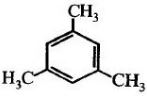
Poly-ene. e.g\(\mathop {3CH \equiv CH}\limits_{acetylene} \to \mathop {{C_6}{H_6}}\limits_{Benzene} \)
\(\mathop {3C{H_3} - C \equiv CH}\limits_{\Pr opyne} \to \) (figure)
- 61. પેરોક્સાઇડની હાજરીમાં, \(HCl\) અને \(HI\) એ આલ્કીન સાથે પ્રતિમાર્કોનિકોવ નિયમ મુજબ યોગશીલ પ્રક્રિયા આપતા તથી, કારણ કે ......... 2014 અઘરું
- (A) \(HCl\) અને \(HI\) માં એક તબક્કો ઉષ્માશોષક છે
- (B) \(HCl\) અને \(HI\) બંને પ્રબળ એસિડ છે
- (C) \(HCl\) ઓક્સિડેશનકર્તા છે અને \(HI\) રીડકશનકર્તા છે
- (D) \(HCl\) અને \(HI\) માં બધા તબકકા ઉમાક્ષેપક છે.
જવાબ અને ઉકેલ જુઓ
સાચો જવાબ: (A)
Anti-Markownikoff addition is possible only in case of \(HBr\) and not in \(HCl\) and \(HI\) . In \(HBr\) both the chain initiation and propagation steps are exothermic, while in \(HCl,\) first step is exothermic, and second step is endothermic and in \(HI,\) no step is exothermic. Hence \(HCl\) and \(HI\) do not undergo anti-Markownikoff's addition. -
- (A) ઉદ્દીપકીય હાઇડ્રોજીનેશન
- (B) \(H_2/\) લિન્ડલરનો ઉદ્દીપક
- (C) \(Li/NH_3\)
- (D) \(LiAlH_4\)
જવાબ અને ઉકેલ જુઓ
સાચો જવાબ: (C)
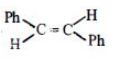
With Lithium in liquid ammonia, trans-alkene is almost an exclusive product.\(Ph-C\equiv C-Ph\xrightarrow[Brich\,reduction]{Li\,in\,liq.N{{H}_{3}}}\begin{matrix}
^{Ph} \\
_{H} \\
\end{matrix}\begin{matrix}
\text{ }\!\!\backslash\!\!\text{ } \\
/ \\
\end{matrix}C=C\begin{matrix}
/ \\
\text{ }\!\!\backslash\!\!\text{ } \\
\end{matrix}_{Ph}^{H}\) - 63. \(HI\) નો ઉમેરો પેરોક્સાઇડ ઉદીપકની હાજરીમાં પ્રતિ-માર્કોવનિકોવ નિયમનું પાલન કરતું નથી કારણ કે.... 2013 અઘરું
- (A) \(HI\) એ પ્રબળ રીડકક્ષનકર્તા છે
- (B) \(H-I\)બંધ સમવિભાજન દ્વારા તોડવા માટે વધારે પ્રબળ(મજબૂત) છે.
- (C) \(I\) પરમાણુ \(H\) પરમાણુ સાથે જોડાઈને \(HI\) આપે છે
- (D) આયોડિન અણુ દ્વિ બંધમાં ઉમેરવા માટે પૂરતી પ્રતિક્રિયાશીલ નથી
જવાબ અને ઉકેલ જુઓ
સાચો જવાબ: (D)
\(HI\) does not exhibit peroxide effect. \(HI\) bond although dissociates easily into iodine radicals, they being bigger in size are not much reactive but recombine together to form iodine molecule
આ પેજ પર આ ફિલ્ટર મુજબ કોઈ પ્રશ્ન નથી.