


All Hydricarbon questions
Newest firstShowing 51–63 of 63 questions
- 51. The major product of the following reaction is \(C{H_3}C \equiv CH\xrightarrow[{(ii)\,Dl}]{{(i)\,DCl\,\,(1\,equiv)}}\) 2019 Hard
- (A) \(CH_3CD(I)CHD(Cl)\)
- (B) \(CH_3C(I)(Cl)CHD_2\)
- (C) \(CH_3CD_2CH(Cl)(I)\)
- (D) \(CH_3CD(Cl)CHD(I)\)
Show answer and solution
Correct Answer: (B)
\(C{{H}_{3}}C\equiv CH\xrightarrow{DCl}\begin{matrix}
Cl\,\,\, \\
|\,\,\, \\
C{{H}_{3}}-C=CHD \\
\end{matrix}\) \(\xrightarrow{DI}\begin{matrix}
Cl\,\, \\
|\,\,\, \\
C{{H}_{3}}-C-CH{{D}_{2}} \\
\,|\,\,\,\, \\
I\,\,\, \\
\end{matrix}\) -
- (A) \(\alpha - \) hydrogen
- (B) \(\gamma - \) hydrogen
- (C) \(\delta - \) hydrogen
- (D) \(\beta - \) hydrogen
Show answer and solution
Correct Answer: (B)
Allylic radical will form in presence of sunlight - 53. Which one of the following alkenes when treated with \(HCl\) yields majorly an anti Markovnikov product? 2019 Hard
- (A) \(H_2N -CH = CH_2\)
- (B) \(F_3C -CH = CH_2\)
- (C) \(CH_3 O -CH = CH_2\)
- (D) \(Cl -CH = CH_2\)
Show answer and solution
Correct Answer: (B)
In this case antimarkonikov product will be formed as major product because carbocation formed at a double bonded carbon having lesser number of \(H\) atom will be unstable due to presence of an electron with drawing group \((CF_3)\) attached to it.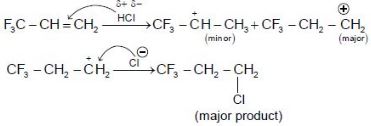
-
- (A) \(Y\) will have higher dipole moment and higher boiling point than \(X\)
- (B) \(Y\) will have higher dipole moment and lower boiling point than \(X\)
- (C) \(X\) will have lower dipole moment and lower boiling point than \(Y\)
- (D) \(X\) will have higher dipole moment and higher boiling point than \(Y\)
Show answer and solution
Correct Answer: (D)
When \(2-\) butyne is treated with \(H_2/\) Lindlar's catalyst, compound \(X\) (cis \(-2-\) butene) is produced as the major product; and when treated with \(Na/liq\,NH_3\) it produces \(Y\) (trans \(-2-\) butene) as the major product. Cisisomer \((X)\) will have higher dipole moment and higher boiling point than trans \((Y)\). -
- (A) \(6\)
- (B) \(0\)
- (C) \(2\)
- (D) \(4\)
Show answer and solution
Correct Answer: (D)
When alkenes are treated with \(HBr\) in the presence of peroxides, an anti-Markovnikov addition occurs in the sense that the hydrogen atom becomes attached to the carbon atom with the fewer hydrogen atoms.The product formed has two chirality centres, therefore, four stereoisomers \(\left(2^{2}\right)\) will exist.
\(\begin{array}{*{20}{c}}
{\,\,\,\,\,C{H_3}} \\
| \\
{C{H_3} - C{H_2} - C = CH - C{H_3}}
\end{array}\) \(\xrightarrow[{Peroxide}]{{HBr}}\) \(\mathop {\begin{array}{*{20}{c}}
{\,\begin{array}{*{20}{c}}
{\,\,\,\,\,\,C{H_3}} \\
|
\end{array}} \\
{C{H_3} - C{H_2} - {}_*CH - \mathop {CH}\limits^{*\,} - C{H_3}} \\
{\,\,\,\,\,\,\,\,\,\,\,\,\,\,\,\,\,\,\,\,\,\,\,\,\,\,\,\,\,\,\,\,\,\,\,|} \\
{\,\,\,\,\,\,\,\,\,\,\,\,\,\,\,\,\,\,\,\,\,\,\,\,\,\,\,\,\,\,\,\,\,\,\,\,\,Br}
\end{array}}\limits_{Major\,\,product} \) -
- (A) Isobutane
- (B) Ethane
- (C) Butane
- (D) Propane
Show answer and solution
Correct Answer: (D)
Since the compound undergoing combustion is an alkane. Hence the combustion reaction can be written as\(\underset{5L}{\mathop{{{C}_{n}}{{H}_{2n+2}}}}\,+\underset{25L}{\mathop{\left( \frac{3n+1}{2} \right){{O}_{2}}}}\,\to \) \(nC{{O}_{2}}+(n+1){{H}_{2}}O\)
since volumes are measured at constant \(T\) & \(P\). Hence according to Avogadro's law
Volume \(\propto \) mole
\(\therefore \,{{n}_{alkane}}=\left( \frac{2}{3n+1} \right)\times {{n}_{{{O}_{2}}}}\)
\(5 = \frac{2}{{3n + 1}} \times 25\)
\(\therefore \,n = 3\)
Hence alkane is propane \((C_3H_8)\)
-
- (A) \(C_4H_8\)
- (B) \(C_4H_{10}\)
- (C) \(C_3H_6\)
- (D) \(C_3H_8\)
Show answer and solution
Correct Answer: (D)
\(C_{x} H_{y(g)}+\left(\frac{4 x+y}{4}\right) O_{2(g)} \rightarrow x C O_{2(g)}+\frac{y}{2} H_{2} O(l)\)Volume of \(O_{2}\) used
\(=375 \times \frac{20}{100}=75 m l\)
From the reaction of combination
\(m l C_{x} H_{y}\) requires \(=\frac{4 x+y}{4} m l O_{2}\)
\(15\left(\frac{4 x+y}{4}\right)=75\)
So, \(4 x+y=20\)
\(x=3\)
\(y=8\)
\(\therefore C_{3} H_{8}\)
- 58. The reaction of propene with \(HOCl (Cl_2 + H_2O)\) proceeds through the intermediate : 2016 Hard
- (A) \(CH_3 -CH(OH)-CH_2^+\)
- (B) \(CH_3 -CHCl-CH_2^+\)
- (C) \(CH_3 -CH^+ -CH_2 -OH\)
- (D) \(CH_3 -CH^+ -CH_2 -Cl\)
Show answer and solution
Correct Answer: (D)
\(C{{H}_{3}}-CH=C{{H}_{2}}\xrightarrow[(electrophilic\,addition)]{\overset{\delta -}{\mathop{HO}}\,-\overset{\delta +}{\mathop{Cl}}\,}\) \(\underset{(\operatorname{int}ermediate)}{\mathop{C{{H}_{3}}-\overset{+}{\mathop{C}}\,H-C{{H}_{2}}-Cl}}\,\) \(\xrightarrow{O{{H}^{-}}}C{{H}_{3}}-CH(OH)-C{{H}_{2}}-Cl\) - 59. In the presence of peroxide, \(HCl\) and \(HI\) do not give anti-Markownikoff's addition of alkenes because 2014 Hard
- (A) One of the steps is endothermic in \(HCl\) and \(HI\)
- (B) Both \(HCl\) and \(HI\) are strong acids
- (C) \(HCl\) is oxidizing and the \(HI\) is reducing
- (D) All the steps are exothermic is \(HCl\) and \(HI\)
Show answer and solution
Correct Answer: (A)
Anti-Markownikoff addition is possible only in case of \(HBr\) and not in \(HCl\) and \(HI\). In \(HBr\) both the chain initiation and propagation steps are exothermic, while in \(HCl,\) first step is Exothermic, and second step is endothermic and in \(HI,\) no step is exothermic. Hence \(HCl\) and \(HI\) do not undergo anti-Markownikoff's addition. - 60. The major product obtained in the photo catalysed bromination of \(2-\) methylbutane is 2014 Hard
- (A) \(1-\) bromo \(-2-\) methylbutane
- (B) \(1-\) bromo \(-3-\) methylbutane
- (C) \(2-\) bromo \(-3-\) methylbutane
- (D) \(2-\) bromo \(-2-\) methylbutane
Show answer and solution
Correct Answer: (D)
The order of substituion in different alkanes is\(3^o > 2^o > 1^o\)
Thus the bromination of \(2-\) methyl butane mainly gives \(2-\) Bromo \(-2-\) methyl butane
\(\mathop {\begin{array}{*{20}{c}}
{\,\,\,\,\,\,\,\,\,\,\,\,\,\,\,C{H_3}} \\
{\,\,\,\,\,\,\,\,\,\,\,\,\,\,|\,\,\,\,} \\
{C{H_3} - C{H_2} - CH - C{H_3}}
\end{array}}\limits_{2 - methyl\,bu\tan e} \xrightarrow{{B{r_2}}}\)\(\mathop {\mathop {\begin{array}{*{20}{c}}
{\,\,\,\,\,\,\,\,\,\,C{H_3}} \\
{\,\,\,\,\,|} \\
{C{H_3} - C{H_2} - CH - C{H_2}Br}
\end{array}}\limits_{1 - Bromo - 2\,methyl\,bu\tan e} }\limits_{(\min or)} \) \(+\) \(\underset{\begin{smallmatrix}
2-Bromo-2-methyl\,bu\tan e \\
\,\,\,\,\,\,\,\,\,\,\,\,\,\,\,\,\,\,\,\,\,\,\,\,\,\,\,(major)
\end{smallmatrix}}{\mathop{\begin{matrix}
\,\,\,\,\,\,\,\,\,\,\,\,\,\,\,\,\,\,\,C{{H}_{3}} \\
\,\,\,\,\,\,\,\,\,\,\,\,\,\,\,| \\
C{{H}_{3}}-C{{H}_{2}}-C-C{{H}_{3}} \\
\,\,\,\,\,\,\,\,\,\,\,\,\,\,\,| \\
\,\,\,\,\,\,\,\,\,\,\,\,\,\,\,\,Br \\
\end{matrix}}}\,\) -
- (A) Cat. Hydrogenation
- (B) \(H_2/\) Lindlar Cat.
- (C) \(Li/NH_3\)
- (D) \(LiAlH_4\)
Show answer and solution
Correct Answer: (C)
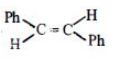
With Lithium in liquid ammonia, trans-alkene is almost an exclusive product.\(Ph-C\equiv C-Ph\xrightarrow[Brich\,reduction]{Li\,in\,liq.N{{H}_{3}}}\begin{matrix}
^{Ph} \\
_{H} \\
\end{matrix}\begin{matrix}
\text{ }\!\!\backslash\!\!\text{ } \\
/ \\
\end{matrix}C=C\begin{matrix}
/ \\
\text{ }\!\!\backslash\!\!\text{ } \\
\end{matrix}_{Ph}^{H}\) - 62. Which one of the following class of compounds is obtained by polymerization of acetylene? 2014 Hard
- (A) Poly-yne
- (B) Poly-ene
- (C) Poly-ester
- (D) Poly-amine
Show answer and solution
Correct Answer: (B)
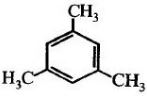
Poly-ene. e.g\(\mathop {3CH \equiv CH}\limits_{acetylene} \to \mathop {{C_6}{H_6}}\limits_{Benzene} \)
\(\mathop {3C{H_3} - C \equiv CH}\limits_{\Pr opyne} \to \) (figure)
- 63. The addition of \(HI\) in the presence of peroxide catalyst does not follow anti-Markovnikov's rule because 2013 Hard
- (A) \(HI\) is a strong reducing agent
- (B) \(H-I\) bond is too strong to be broken homolytically
- (C) \(I\) atom combines with \(H\) atom to give back \(HI\)
- (D) Iodine atom is not reactive enough to add across a double bond
Show answer and solution
Correct Answer: (D)
\(HI\) does not exhibit peroxide effect. \(HI\) bond although dissociates easily into iodine radicals, they being bigger in size are not much reactive but recombine together to form iodine molecule
No questions on this page match these filters.