


हाइड्रोकार्बन के सभी प्रश्न
नए पहले61 में से 51–61 प्रश्न
- 51. निम्नलिखित अभिक्रिया का प्रमुख उत्पाद है - \(C{H_3}C \equiv CH\xrightarrow[{(ii)\,Dl}]{{(i)\,DCl\,\,(1\,equiv)}}\) 2019 कठिन
- (A) \(CH_3CD(I)CHD(Cl)\)
- (B) \(CH_3C(I)(Cl)CHD_2\)
- (C) \(CH_3CD_2CH(Cl)(I)\)
- (D) \(CH_3CD(Cl)CHD(I)\)
उत्तर और हल देखें
सही उत्तर: (B)
\(C{{H}_{3}}C\equiv CH\xrightarrow{DCl}\begin{matrix}
Cl\,\,\, \\
|\,\,\, \\
C{{H}_{3}}-C=CHD \\
\end{matrix}\) \(\xrightarrow{DI}\begin{matrix}
Cl\,\, \\
|\,\,\, \\
C{{H}_{3}}-C-CH{{D}_{2}} \\
\,|\,\,\,\, \\
I\,\,\, \\
\end{matrix}\) - 52. निम्नलिखित ऐल्कीनों में से कौन-सा एक \(HCl\) के साथ अभिक्रिया करके मुख्यतः एक प्रति मार्कोनीकॉफ उत्पाद देता है ? 2019 कठिन
- (A) \(H_2N -CH = CH_2\)
- (B) \(F_3C -CH = CH_2\)
- (C) \(CH_3 O -CH = CH_2\)
- (D) \(Cl -CH = CH_2\)
उत्तर और हल देखें
सही उत्तर: (B)
In this case antimarkonikov product will be formed as major product because carbocation formed at a double bonded carbon having lesser number of \(H\) atom will be unstable due to presence of an electron with drawing group \((CF_3)\) attached to it.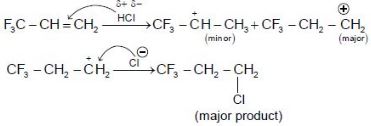
-
- (A) \(\alpha - \) हाइड्रोजन
- (B) \(\gamma - \) हाइड्रोजन
- (C) \(\delta - \) हाइड्रोजन
- (D) \(\beta - \) हाइड्रोजन
उत्तर और हल देखें
सही उत्तर: (B)
Allylic radical will form in presence of sunlight -
- (A) \(6\)
- (B) \(0\)
- (C) \(2\)
- (D) \(4\)
उत्तर और हल देखें
सही उत्तर: (D)
When alkenes are treated with \(HBr\) in the presence of peroxides, an anti-Markovnikov addition occurs in the sense that the hydrogen atom becomes attached to the carbon atom with the fewer hydrogen atoms.The product formed has two chirality centres, therefore, four stereoisomers \(\left(2^{2}\right)\) will exist.
\(\begin{array}{*{20}{c}}
{\,\,\,\,\,C{H_3}} \\
| \\
{C{H_3} - C{H_2} - C = CH - C{H_3}}
\end{array}\) \(\xrightarrow[{Peroxide}]{{HBr}}\) \(\mathop {\begin{array}{*{20}{c}}
{\,\begin{array}{*{20}{c}}
{\,\,\,\,\,\,C{H_3}} \\
|
\end{array}} \\
{C{H_3} - C{H_2} - {}_*CH - \mathop {CH}\limits^{*\,} - C{H_3}} \\
{\,\,\,\,\,\,\,\,\,\,\,\,\,\,\,\,\,\,\,\,\,\,\,\,\,\,\,\,\,\,\,\,\,\,\,|} \\
{\,\,\,\,\,\,\,\,\,\,\,\,\,\,\,\,\,\,\,\,\,\,\,\,\,\,\,\,\,\,\,\,\,\,\,\,\,Br}
\end{array}}\limits_{Major\,\,product} \) -
- (A) \(C_4H_8\)
- (B) \(C_4H_{10}\)
- (C) \(C_3H_6\)
- (D) \(C_3H_8\)
उत्तर और हल देखें
सही उत्तर: (D)
\(C_{x} H_{y(g)}+\left(\frac{4 x+y}{4}\right) O_{2(g)} \rightarrow x C O_{2(g)}+\frac{y}{2} H_{2} O(l)\)Volume of \(O_{2}\) used
\(=375 \times \frac{20}{100}=75 m l\)
From the reaction of combination
\(m l C_{x} H_{y}\) requires \(=\frac{4 x+y}{4} m l O_{2}\)
\(15\left(\frac{4 x+y}{4}\right)=75\)
So, \(4 x+y=20\)
\(x=3\)
\(y=8\)
\(\therefore C_{3} H_{8}\)
-
- (A) आइसोब्यूटेन
- (B) ऐथेन
- (C) ब्यूटेन
- (D) प्रोपेन
उत्तर और हल देखें
सही उत्तर: (D)
Since the compound undergoing combustion is an alkane. Hence the combustion reaction can be written as\(\underset{5L}{\mathop{{{C}_{n}}{{H}_{2n+2}}}}\,+\underset{25L}{\mathop{\left( \frac{3n+1}{2} \right){{O}_{2}}}}\,\to \) \(nC{{O}_{2}}+(n+1){{H}_{2}}O\)
since volumes are measured at constant \(T\) & \(P\). Hence according to Avogadro's law
Volume \(\propto \) mole
\(\therefore \,{{n}_{alkane}}=\left( \frac{2}{3n+1} \right)\times {{n}_{{{O}_{2}}}}\)
\(5 = \frac{2}{{3n + 1}} \times 25\)
\(\therefore \,n = 3\)
Hence alkane is propane \((C_3H_8)\)
- 57. प्रोपीन की \(HOCl \left( Cl _{2}+ H _{2} O \right)\) के साथ अभिक्रिया जिस मध्यवर्तीं से होकर सम्पन्न होती है, वह है: 2016 कठिन
- (A) \(CH_3 -CH(OH)-CH_2^+\)
- (B) \(CH_3 -CHCl-CH_2^+\)
- (C) \(CH_3 -CH^+ -CH_2 -OH\)
- (D) \(CH_3 -CH^+ -CH_2 -Cl\)
उत्तर और हल देखें
सही उत्तर: (D)
\(C{{H}_{3}}-CH=C{{H}_{2}}\xrightarrow[(electrophilic\,addition)]{\overset{\delta -}{\mathop{HO}}\,-\overset{\delta +}{\mathop{Cl}}\,}\) \(\underset{(\operatorname{int}ermediate)}{\mathop{C{{H}_{3}}-\overset{+}{\mathop{C}}\,H-C{{H}_{2}}-Cl}}\,\) \(\xrightarrow{O{{H}^{-}}}C{{H}_{3}}-CH(OH)-C{{H}_{2}}-Cl\) -
- (A) \(1-\) ब्रोमो \(-2-\) मेथिलब्युटेन
- (B) \(1-\) ब्रोमो \(-3-\) मेथिलब्युटेन
- (C) \(2-\) ब्रोमो \(-3-\) मेथिलब्युटेन
- (D) \(2-\) ब्रोमो \(-2-\) मेथिलब्युटेन
उत्तर और हल देखें
सही उत्तर: (D)
The order of substituion in different alkanes is\(3^o > 2^o > 1^o\)
Thus the bromination of \(2-\) methyl butane mainly gives \(2-\) Bromo \(-2-\) methyl butane
\(\mathop {\begin{array}{*{20}{c}}
{\,\,\,\,\,\,\,\,\,\,\,\,\,\,\,C{H_3}} \\
{\,\,\,\,\,\,\,\,\,\,\,\,\,\,|\,\,\,\,} \\
{C{H_3} - C{H_2} - CH - C{H_3}}
\end{array}}\limits_{2 - methyl\,bu\tan e} \xrightarrow{{B{r_2}}}\)\(\mathop {\mathop {\begin{array}{*{20}{c}}
{\,\,\,\,\,\,\,\,\,\,C{H_3}} \\
{\,\,\,\,\,|} \\
{C{H_3} - C{H_2} - CH - C{H_2}Br}
\end{array}}\limits_{1 - Bromo - 2\,methyl\,bu\tan e} }\limits_{(\min or)} \) \(+\) \(\underset{\begin{smallmatrix}
2-Bromo-2-methyl\,bu\tan e \\
\,\,\,\,\,\,\,\,\,\,\,\,\,\,\,\,\,\,\,\,\,\,\,\,\,\,\,(major)
\end{smallmatrix}}{\mathop{\begin{matrix}
\,\,\,\,\,\,\,\,\,\,\,\,\,\,\,\,\,\,\,C{{H}_{3}} \\
\,\,\,\,\,\,\,\,\,\,\,\,\,\,\,| \\
C{{H}_{3}}-C{{H}_{2}}-C-C{{H}_{3}} \\
\,\,\,\,\,\,\,\,\,\,\,\,\,\,\,| \\
\,\,\,\,\,\,\,\,\,\,\,\,\,\,\,\,Br \\
\end{matrix}}}\,\) -
- (A) पॉली-आइन
- (B) पॉली-ईन
- (C) पॉली-ऐस्टर
- (D) पॉली-एमाइड
उत्तर और हल देखें
सही उत्तर: (B)
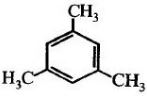
Poly-ene. e.g\(\mathop {3CH \equiv CH}\limits_{acetylene} \to \mathop {{C_6}{H_6}}\limits_{Benzene} \)
\(\mathop {3C{H_3} - C \equiv CH}\limits_{\Pr opyne} \to \) (figure)
-
- (A) कैट. हाइड्रोजिनेशन
- (B) \(H_2/\) लिंडलर कैट.
- (C) \(Li/NH_3\)
- (D) \(LiAlH_4\)
उत्तर और हल देखें
सही उत्तर: (C)
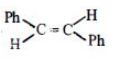
With Lithium in liquid ammonia, trans-alkene is almost an exclusive product.\(Ph-C\equiv C-Ph\xrightarrow[Brich\,reduction]{Li\,in\,liq.N{{H}_{3}}}\begin{matrix}
^{Ph} \\
_{H} \\
\end{matrix}\begin{matrix}
\text{ }\!\!\backslash\!\!\text{ } \\
/ \\
\end{matrix}C=C\begin{matrix}
/ \\
\text{ }\!\!\backslash\!\!\text{ } \\
\end{matrix}_{Ph}^{H}\) - 61. परऑक्साइड की उपस्थिति में ऐल्कीनों को \(HCl\) और \(HI\) ऐन्टीमारकोनीकाफ योग नहीं देते क्यों कि। 2014 कठिन
- (A) \(HCl\) और \(HI\) के सम्बन्ध में एक चरण ऊष्माशोषी है।
- (B) \(HCl\) और \(HI\) दोनों, प्रबल अम्ल हैं।
- (C) \(HCl\) उपचायक और \(HI\) अपचायक है।
- (D) \(HCl\) और \(HI\) के सम्बन्धों में सभी चरण ऊष्माप्रद हैं।
उत्तर और हल देखें
सही उत्तर: (A)
Anti-Markownikoff addition is possible only in case of \(HBr\) and not in \(HCl\) and \(HI\). In \(HBr\) both the chain initiation and propagation steps are exothermic, while in \(HCl,\) first step is Exothermic, and second step is endothermic and in \(HI,\) no step is exothermic. Hence \(HCl\) and \(HI\) do not undergo anti-Markownikoff's addition.
इस पेज पर इन फ़िल्टर से कोई प्रश्न नहीं मिला।