


પ્રશ્નો
10 પ્રશ્નો10 માંથી 1–10 પ્રશ્નો
- 1. \(0.02\,M\,\,NH_4Cl\) ના દ્રાવણની \(pH\) કેટલી થશે ? [અહીં \(K_b\,(NH_4OH) = 10^{-5}\) અને \(log\,2 = 0.301\) ] 2019 અઘરું
- (A) \(2.65\)
- (B) \(5.35\)
- (C) \(4.35\)
- (D) \(4.65\)
જવાબ અને ઉકેલ જુઓ
સાચો જવાબ: (B)
For the salt of strong acid and weak base\({H^ + } = \sqrt {\frac{{{K_w} \times C}}{{{K_b}}}} \)
\([{H^ + }] = \sqrt {\frac{{{{10}^{ - 14}} \times 2 \times {{10}^{ - 2}}}}{{{{10}^{ - 5}}}}} \)
\( - \log [{H^ + }] = 6 - \frac{1}{2}\log \,20\)
\(\therefore \,pH = 5.35\)
-
- (A) \(3 \times {10^{ - 19}}\)
- (B) \(12 \times {10^{ - 21}}\)
- (C) \(12 \times {10^{ - 23}}\)
- (D) \(3 \times {10^{ - 22}}\)
જવાબ અને ઉકેલ જુઓ
સાચો જવાબ: (D)
\(Al(O{H_3}) \rightleftharpoons \mathop {A{l^{3 + }}}\limits_s + \mathop {3O{H^ - }}\limits_{(3s + 0.2)} \)\(2.4 \times {10^{ - 24}} = s{(3s + 0.2)^3}\)
-
- (A) \(1.9\, g, 0.28\, mol\, L^{-1}\)
- (B) \(13.6\, g, 0.28\, mol\, L^{-1}\)
- (C) \(1.9\, g, 0.14\, mol\, L^{-1}\)
- (D) \(13.6\, g, 0.14\, mol\, L^{-1}\)
જવાબ અને ઉકેલ જુઓ
સાચો જવાબ: (A)
\(\mathop {\mathop {Ca{{(OH)}_2}}\limits_{100\,m\,mol} }\limits_ - + \mathop {\mathop {N{a_2}S{O_4}}\limits_{14\,m\,mol} }\limits_ - \to \mathop {\mathop {CaS{O_4}}\limits_ - }\limits_{14\,m\,mol} + \mathop {\mathop {2NaOH}\limits_ - }\limits_{28\,m\,mol} \)\({w_{CaS{O_4}}} = 14 \times {10^{ - 3}} \times 136 = 1.9\,gm\)
\([O{H^ - }] = \frac{{28}}{{100}} = 0.28\,M\)
-
- (A) \(5.2\)
- (B) \(9\)
- (C) \(5\)
- (D) \(9.4\)
જવાબ અને ઉકેલ જુઓ
સાચો જવાબ: (B)
\(\mathop {\mathop {{H_2}S{O_4}}\limits_{2\,m.m} }\limits_ - + \mathop {\mathop {2N{H_4}OH}\limits_{6\,m.m} }\limits_{2\,m.m} \to \mathop {{{(N{H_4})}_2}S{O_4}}\limits_{2\,m.m} + 2{H_2}O\)\(pOH = 4.7 + \log \frac{4}{2} = 5\)
\(pH = 14 - 5 = 9\)
-
- (A) \(6.23\times10^{-11}\, M\)
- (B) \(1.84\times10^{-9}\, M\)
- (C) \(\frac{{2.49}}{{1.84}} \times {10^{ - 9}}\,M\)
- (D) \(2.49\times10^{-10}\, M\)
જવાબ અને ઉકેલ જુઓ
સાચો જવાબ: (D)
\({K_{sp}}\) of \(Cd{(OH)_2} = 4{s^3} = 4 \times {(1.84 \times {10^{ - 5}})^3}\)If \(pH = 12\)
\(pOH = 2\)
\([O{H^ - }] = {10^{ - 2}}\,M\)
\({K_{sp}} = [C{d^{2 + }}]{[O{H^ - }]^2}\)
\(4 \times {(1.84 \times {10^{ - 5}})^3} = [C{d^{2 + }}]{[O{H^ - }]^2}\)
\([C{d^{2 + }}] = \frac{{4 \times {{(1.84)}^3} \times {{10}^{ - 15}}}}{{{{10}^{ - 4}}}}\)
\(C{d^{2 + }} = 4 \times 6.22 \times {10^{ - 11}} = 2.49 \times {10^{ - 10}}\,M\)
-
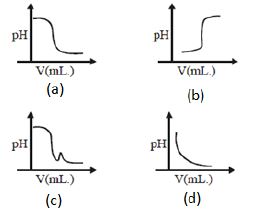
- (A) \((a)\)
- (B) \((c)\)
- (C) \((d)\)
- (D) \((b)\)
જવાબ અને ઉકેલ જુઓ
સાચો જવાબ: (A)
The nature of the curve is such that the \(pH\) change of the reaction becomes larger for very small change in volume of titrant. - 7. જે \(Ag_2CO_3\) નો \(K_{sp}=8 \times10^{-12}\) છે, તો \(0.1\, M\,AgNO_3\) માં \(Ag_2CO_3\) ની મોલર દ્રાવ્યતા કેટલી થાય? 2019 મધ્યમ
- (A) \(8\times 10^{-12}\,M\)
- (B) \(8\times 10^{-11}\,M\)
- (C) \(8\times 10^{-10}\,M\)
- (D) \(8\times 10^{-13}\,M\)
જવાબ અને ઉકેલ જુઓ
સાચો જવાબ: (C)
\(8 \times {10^{ - 12}} = {(2S' + 0.1)^2}S'\) Or \(S' = 8\times 10^{-10}\,M\) -
- (A) \(S = {\left( {\frac{{{K_{SP}}}}{{6912}}} \right)^{1/7}}\)
- (B) \(S = {\left( {\frac{{{K_{SP}}}}{{144}}} \right)^{1/6}}\)
- (C) \(S = {\left( {\frac{{{K_{SP}}}}{{929}}} \right)^{1/9}}\)
- (D) \(S = {\left( {\frac{{{K_{SP}}}}{{216}}} \right)^{1/7}}\)
જવાબ અને ઉકેલ જુઓ
સાચો જવાબ: (A)
\(Z{r_4}{(P{O_4})_4}(s) \rightleftharpoons \mathop {3Z{r^{4 + }}(aq.)}\limits_{3S\,M} + \mathop {4PO_4^{3 - }(aq.)}\limits_{4S\,M} \)\({K_{sp}} = {[Z{r^{4 + }}]^3}{[P{O_4}^{3 - }]^4} = {(3S)^3}.{(4S)^4} = 6912\,{S^7}\)
\(\therefore S = {\left( {\frac{{{K_{sp}}}}{{6912}}} \right)^{1/7}}\)
-
- (A) \((a)\) અને \((b)\)
- (B) \((a), (b)\) અને \((c)\)
- (C) \((b)\) અને \((c)\)
- (D) \((a), (b)\) અને \((d)\)
જવાબ અને ઉકેલ જુઓ
સાચો જવાબ: (B)
\((a)\,\mathop {\mathop {{H_2}S{O_4}}\limits_{400 \times 1 = 40} }\limits_{20} + \mathop {\mathop {2NaOH}\limits_{400 \times 1 = 40} }\limits_0 \to N{a_2}S{O_4} + 2{H_2}O\)\(\therefore [{H^ + }] = \frac{{20 \times 2}}{{800}} = \frac{1}{{20}} \Rightarrow pH = - log\left( {\frac{1}{{20}}} \right)\)
\(\therefore \,pH = 1.3\,\) so \((a)\) is correct
\((b)\,\log \,\left( {\frac{{{K_{{w_2}}}}}{{{K_{{w_1}}}}}} \right) = \frac{{\Delta H}}{{2.303\,R}}\left[ {\frac{1}{{{T_1}}} - \frac{1}{{{T_2}}}} \right]\)
so ionic product of water is temp. dependent hence \((b)\) is correct.
\((c)\,{K_a} = {10^{ - 5}},\,pH = 5 \Rightarrow [{H^ + }] = {10^{ - 5}}\)
\({K_a} = \frac{{c{\alpha ^2}}}{{(1 - \alpha )}} \Rightarrow {K_a} = \frac{{{{[H]}^ + }.\alpha }}{{(1 - \alpha )}}\)
\(\therefore \,{10^{ - 5}} = \frac{{{{10}^{ - 5}}.\alpha }}{{(1 - \alpha )}} \Rightarrow 1 - \alpha = \alpha = \frac{1}{2} = 50\% \)
so \((c)\) is correct
\((d)\) Le-chatelier's principle is applicable to cpmmon-Ion effect so option \((d)\) is wrong
-
- (A) \(a > c > b\)
- (B) \(c > a > b\)
- (C) \(c > b > a\)
- (D) \(a > b > c\)
જવાબ અને ઉકેલ જુઓ
સાચો જવાબ: (A)
Stronger the acidic strength greater will be its electrical conductivity. \(K_a\) value of formic acid \(>\) benzoic acid \(>\) acetic acid
આ પેજ પર આ ફિલ્ટર મુજબ કોઈ પ્રશ્ન નથી.