


Questions
Newest firstShowing 1–10 of 10 questions
-
- (A) 7
- (B) 4
- (C) 6
- (D) 5
Show answer and solution
Correct Answer: (D)
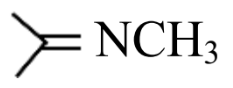
Total five nucleophiles are present
\(\mathrm{NH}_3, \mathrm{PhSH},\left(\mathrm{H}_3 \mathrm{C}\right)_2 \mathrm{~S}, \mathrm{CH}_2=\mathrm{CH}_2, \stackrel{\ominus}{\mathrm{O}} \mathrm{H}\) -
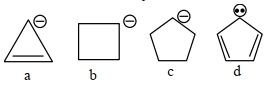
- (A) \(c>b>d>a\)
- (B) \(a>b>c>d\)
- (C) \(d>a>c>b\)
- (D) \(d>c>b>a\)
Show answer and solution
Correct Answer: (D)
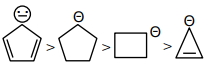
As we know compound (\(d\)) is aromatic and the compound (\(a\)) is anti-aromatic. Hence compound(\(d\))is most stable and compound (\(a\)) is least stable among these in compound (\(b\)) and (\(c\)) carbon atom of that positive charge is \(\mathrm{sp}^3\) hybridised they on the basis of angle strain theory compound (\(c\)) is more stable than compound (\(b\)).
-
- (A) \((A)\) only
- (B) \((C)\) only
- (C) \((B)\) only
- (D) \((D)\) and \((E)\) only
Show answer and solution
Correct Answer: (C)
Heterolytic cleavage of Bond lead to formation of ions. - 4. The correct order of reactivity in electrophilic substitution reaction of the following compounds is _______.
 2024 Hard
- (A) \(\mathrm{B}>\mathrm{C}>\mathrm{A}>\mathrm{D}\)
- (B) \(\mathrm{D}>\mathrm{C}>\mathrm{B}>\mathrm{A}\)
- (C) \(\mathrm{A}>\mathrm{B}>\mathrm{C}>\mathrm{D}\)
- (D) \(B>A>C>D\)
Show answer and solution
Correct Answer: (D)
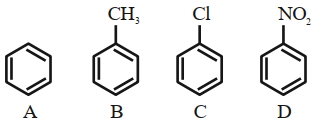
\(-\mathrm{CH}_3\) shows \(+\mathrm{M}\) and \(+\mathrm{I}\).\(-\mathrm{Cl}\) shows \(+\mathrm{M}\) and \(-\mathrm{I}\) but inductive effect dominates.
\(-\mathrm{NO}_2\) shows \(-\mathrm{M}\) and \(-\mathrm{I}\).
Electrophilic substitution \(\alpha \frac{1}{-\mathrm{M} \text { and }-\mathrm{I}}\)
\(\alpha+\mathrm{M} \text { and }+\mathrm{I}\)
Hence, order is \(\mathrm{B}>\mathrm{A}>\mathrm{C}>\mathrm{D}\).
- 5. Arrange the following compounds in increasing order of rate of aromatic electrophilic substitution reaction
 2023 Hard
- (A) \(d, b, c, a\)
- (B) \(b, c, a, d\)
- (C) \(c, a, b, d\)
- (D) \(d, b, a, c\)
Show answer and solution
Correct Answer: (C)
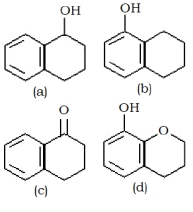
Benzene becomes more reactive towards EAS when any substituent raises the electron density.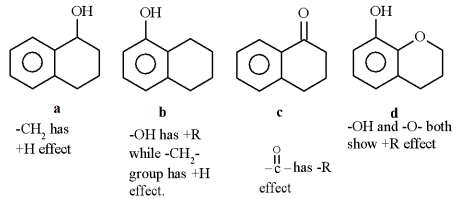
- 6. Decreasing order of reactivity towards electrophilie substitution for the following compounds is:
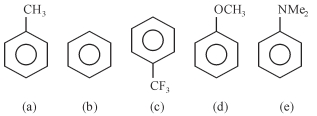 2023 Medium
- (A) \(c > b > a > d > e\)
- (B) \(e > d > a > b > c\)
- (C) \(a > d > e > b > c\)
- (D) \(d > a > e > c > b\)
Show answer and solution
Correct Answer: (B)
Higher the electron density on Benzene Ring, Higher its Reactivity towards electrophilic substitution Reaction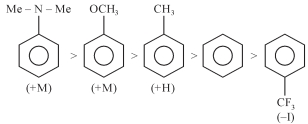
-
- (A) \(F ^{-}> OH ^{-}\)
- (B) \({{H}_{2}}\underset{\scriptscriptstyle\centerdot\centerdot}{\ddot{O}} > OH ^{-}\)
- (C) \(R \underset{\scriptscriptstyle\centerdot\centerdot}{\ddot{O}} H> RO ^{-}\)
- (D) \(NH _{2}^{-}> NH _{3}\)
Show answer and solution
Correct Answer: (D)
Nucleophilicity \(\propto\) electro density on donor atom\(\propto\) size of donor atom (in gas)
\(\propto \frac{1}{\text { EN of atom }}\) (for period)
-
- (A) \((B)\) and \((C)\) only
- (B) \((A)\) only
- (C) \((A)\) and \((C)\) only
- (D) \((B)\) only
Show answer and solution
Correct Answer: (C)
Ambident nucleophile\((A)\) \(KCN\) And \(AgCN\)
\((C)\) \(AgNO _{2}\) And \(KNO _{2}\)
-
- (A) \((b) < (c) < (a) < (d)\)
- (B) \((a) < (d) < (c) < (b)\)
- (C) \((d) < (a) < (c) < (b)\)
- (D) \((b) < (c) < (d) < (a)\)
Show answer and solution
Correct Answer: (A)
\(\underset{Ch\arg ed\,ion}{\mathop{\underset{\_\_\_\_\_\_\_\_\_\_\_\_\_\_\_\_\_\_\_\_\_\_\_\_\_\_\_\_\_\_\_\_\_\_\_\_\_\_\_\_\_\_\_\_\_\_\_\_\_\_\_\_\_\_\_\_\_}{\mathop{O{{H}^{-}}>\begin{matrix}
C{{H}_{3}}-C-{{O}^{-}} \\
\,\,\,|| \\
\,\,\,O \\
\end{matrix}>\begin{matrix}
\,\,\,\,O \\
\,\,\,\,|| \\
C{{H}_{3}}-S-{{O}^{-}} \\
\,\,\,\,|| \\
\,\,\,\,O \\
\end{matrix}>}}\,}}\,\) \(\underset{\begin{smallmatrix}
neutral \\
system
\end{smallmatrix}}{\mathop{\underset{\_\_\_\_\_\_\_}{\mathop{{{H}_{2}}O}}\,}}\,\)ione pair donating tendency on oxygen is reduced, nucleophilicity reduced \(b < c < a < d\)
- 10. In the above compounds correct order of reactivity in electrophilic substitution reactions will be
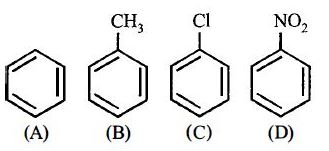 2013 Hard
- (A) \(B >A> C > D\)
- (B) \(D > C > B > A\)
- (C) \(A > B > C > D\)
- (D) \(B > C > A > D\)
Show answer and solution
Correct Answer: (A)
\(- Cl\) and \(-CH_3\) groups are \(o\) and \(p\) directing. They are electron releasing due to \(+ E\) and \(+ M\) effects. Further since such groups increase electron density in the nucleus, they facilitate further electrophilic substitution and hence known as activating group. The activating effect of these groups is in order of \(- CH_3 > -X\) but chlorine exceptionally deactive the ring due to strong \(- I\) effect. Hence, it is difticult to carry out substitution in chlorobenzene than in benzene . Further \(- NO_2\) is a deactivating group hence deactivates the benzene nucleus, i.e. hinder the further substitution. Thus nitrobenzene undergo electrophilic substitution with a great difficulty hence the correct order will be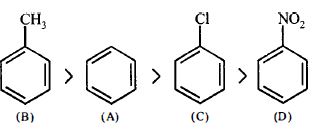
No questions on this page match these filters.
Other STD 11 - Organic chemistry reaction mechanism topics
Frequently asked
How many Attacking reagents questions came in JEE Mains?
10 questions from 2013–2025, each with the correct answer and a full solution.
How difficult are Attacking reagents questions?
10% are easy, 40% medium and 50% hard.