


પ્રશ્નો
4 પ્રશ્નો4 માંથી 1–4 પ્રશ્નો
- 1. \(CH_3Cl, CH_3Br, CH_3I\) અને \(CH_3F\) સંયોજનો માટે \(C-\)હેલોજન બંધલંબાઇનો સાચો વધતો ક્રમ જણાવો. 2014 મધ્યમ
- (A) \(CH_3F < CH_3Cl < CH_3Br < CH_3I\)
- (B) \(CH_3F < CH_3Br < CH_3Cl < CH_3I\)
- (C) \(CH_3F < CH_3I < CH_3Br < CH_3Cl\)
- (D) \(CH_3Cl< CH_3Br < CH_3F < CH_3I\)
જવાબ અને ઉકેલ જુઓ
સાચો જવાબ: (A)
The correct order of increasing bond length is \(CH_3F < CH_3Cl < CH_3Br < CH_3I\) -
- (A) \(C_6H_5CHC_6H_5Br\)
- (B) \(C_6H_5CH_2Br\)
- (C) \(C_6H_5CHCH_3Br\)
- (D) \(C_6H_5CCH_3C_6H_5Br\)
જવાબ અને ઉકેલ જુઓ
સાચો જવાબ: (C)
\(C_6H_5CHCH_3Br\) being an optically active secondary alkyl bromide undergoes \(S_N2\) nucleophilic substitution reaction. Hence it undergoes complete inversion of configuration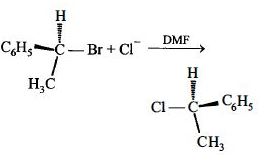
- 3. \({S_{{N^2}}}\) પ્રકિયા માં નીચેના સંયોજનો માટે પ્રતિક્રિયાશીલતાનો યોગ્ય ક્રમ કયો હશે ? 2014 મધ્યમ
- (A) \(CH_3Cl > (CH_3)_2CHCl > CH_3CH_2Cl > ( CH_3)_3CCl\)
- (B) \(CH_3Cl > CH_3CH_2 Cl > (CH_3)_2CHCl > (CH_3)_3CCl\)
- (C) \(CH_3CH_2 Cl > CH_3Cl > (CH_3)_2CHCl > (CH_3)_3CCl\)
- (D) \((CH_3 )_2CHCl > CH_3CH_2Cl > CH_3Cl > (CH_3)_3CCl\)
જવાબ અને ઉકેલ જુઓ
સાચો જવાબ: (B)
Rate of \({S_{{N^2}}} \propto \frac{1}{\text { Steric crowding of }^{\prime} C^{\prime}}\)As steric hindrance (crowding) increases, the rate of \({S_{{N^2}}}\) reaction decreases.
The order of reactivity towards \({S_{{N^2}}}\) reaction for alkyl halides is
Primary halides \(>\) Secondary halides \(>\) Tertiary halides
- 4. સિલ્વર પાવડર સાથે ટ્રાઈક્લોરોઇથેન \(1, 1, 1-\) ની પ્રક્રિયા દ્વારા રચાયેલ મુખ્ય કાર્બનિક નીપજ કઈ છે ?: 2014 અઘરું
- (A) એસીટીલીન
- (B) ઇથિન
- (C) \(2 -\) બ્યુટીન
- (D) \(2 -\) બ્યુટીન
જવાબ અને ઉકેલ જુઓ
સાચો જવાબ: (C)
\(2 \mathrm{CH}_{3}-\mathrm{CCl}_{3} \stackrel{6 \mathrm{Ag}}{\longrightarrow} \mathrm{CH}_{3}-\mathrm{C} \equiv \mathrm{C}-\mathrm{CH}_{3}+6 \mathrm{AgCl}\)
આ પેજ પર આ ફિલ્ટર મુજબ કોઈ પ્રશ્ન નથી.