


પ્રશ્નો
5 પ્રશ્નો5 માંથી 1–5 પ્રશ્નો
-
- (A) \(0.1\)
- (B) \(3\)
- (C) \(0.01\)
- (D) \(2 \)
જવાબ અને ઉકેલ જુઓ
સાચો જવાબ: (C)
\(\lg \mathrm{G}=(\mathrm{I}-\mathrm{Ig}) \mathrm{s}\)\(\therefore 10^{-3} \times 100=\left(10-10^{-3}\right) \times \mathrm{S}\)
\(\therefore \mathrm{S} \approx 0.01 \,\Omega\)
-
- (A) \(r_s = 0.5\, \Omega \) ગેલ્વેનોમીટર સાથે શ્રેણીમાં
- (B) \(r_s = 1\, \Omega \) ગેલ્વેનોમીટર સાથે શ્રેણીમાં
- (C) \(r_s = 1\, \Omega \) ગેલ્વેનોમીટર સાથે સમાંતરમાં
- (D) \(r_s = 0.5\, \Omega \) ગેલ્વેનોમીટર સાથે સમાંતરમાં
જવાબ અને ઉકેલ જુઓ
સાચો જવાબ: (D)
As we know, \(\mathrm{I}=\frac{\mathrm{V}}{\mathrm{R}}=\frac{5}{50}=0.1\)\(I' = 0.099\)
When Galvanometer is connected
\(R_{e q}=50+\frac{100 S}{100+S}=\frac{V}{I}\)
\(\Rightarrow \frac{100 \mathrm{S}}{100+\mathrm{S}}=\frac{5}{0.099}-50\)
\(\Rightarrow \frac{100 \mathrm{S}}{100+\mathrm{S}}=50.50-50 \Rightarrow \frac{100 \mathrm{S}}{100+\mathrm{S}}=0.5\)
\(\Rightarrow 100 \mathrm{S}=50+0.55 \Rightarrow 99.5 \mathrm{S}=50\)
\(S=\frac{50}{99.05}=0.5 \,\Omega\)
So, shunt of resistance \(=0.5 \,\Omega\) is onnected in parallel with the galvanometer.
-
- (A) \(S (R+ G) = RG\)
- (B) \(2S (R+G)=RG\)
- (C) \(2G = S\)
- (D) \(2S=G\)
જવાબ અને ઉકેલ જુઓ
સાચો જવાબ: (A)
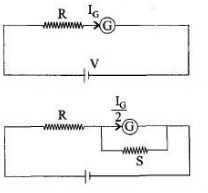
According to Ohm's Law, \(I\) \(=\frac{V}{R}\)\(\mathrm{I}_{\mathrm{g}}=\frac{\mathrm{V}}{\mathrm{R}+\mathrm{G}}\)
where, \(I \)\(_{g}\) - Galvanometer current, \(G-\)Galvonometer resistance
When shunt of resistance \(S\) is connected parallel to the Galvanometer then
\(\mathrm{G}=\frac{\mathrm{GS}}{\mathrm{G}+\mathrm{S}}\)
\(\therefore I=\frac{V}{R+\frac{G S}{G+S}}\)
Equal potential difference is given by
\(\mathrm{I}_{\mathrm{g}}^{\prime} \mathrm{G}=\left(\mathrm{I}-\mathrm{I}_{\mathrm{B}}^{\prime}\right) \mathrm{S}\)
\(\mathrm{I}_{\mathrm{g}}^{\prime}(\mathrm{G}+\mathrm{S})=\mathrm{IS}\)
\(\Rightarrow \frac{\mathrm{I}_{\mathrm{g}}}{2}=\frac{\mathrm{IS}}{\mathrm{G}+\mathrm{S}}\)
\(\Rightarrow \frac{\mathrm{v}}{2(\mathrm{R}+\mathrm{G})}=\frac{\mathrm{v}}{\mathrm{R}+\frac{\mathrm{GS}}{\mathrm{G}+\mathrm{S}}} \times \frac{\mathrm{S}}{\mathrm{G}+\mathrm{S}}\)
\( \Rightarrow \frac{1}{{2(R + G)}} = \frac{S}{{R(G + S) + GS}}\)
\(\Rightarrow R(G+S)+G S=2 S(R+G)\)
\(\Rightarrow \mathrm{RG}+\mathrm{RS}+\mathrm{GS}=2 \mathrm{S}(\mathrm{R}+\mathrm{G})\)
\(\Rightarrow \mathrm{RG}=2 \mathrm{S}(\mathrm{R}+\mathrm{G})-\mathrm{S}(\mathrm{R}+\mathrm{G})\)
\(\therefore \mathrm{RG}=\mathrm{S}(\mathrm{R}+\mathrm{G})\)
-
- (A) પૂર્ણ આવર્તન સમયે ગેલ્વેનોમીટર \(2\, mA\) નો પ્રવાહ દર્શાવે
- (B) ગેલ્વેનોમીટરનો અવરોધ \(200\,\Omega \) હશે
- (C) \(10\) કાંપા આવર્તન માટે \(R=9800\,\Omega\) અવરોધની જરૂર પડે.
- (D) ગેલ્વેનોમીટરની પ્રવાહ સંવેદિતા \(20\,\mu A\) /કાંપા મળે
જવાબ અને ઉકેલ જુઓ
સાચો જવાબ: (D)
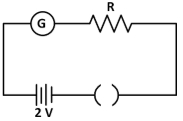
Let full scale deflection of current \(=1\)In case \(1,\) when \(\mathrm{R}=2400 \Omega\) and deflection of 40 divisions present.
\(\therefore \quad \frac{40}{50} \mathrm{I}=\frac{V}{G+R}\)
\(\Rightarrow \quad \frac{4}{5} \mathrm{I}=\frac{2}{G+2400}\dots (1)\)
In case \(2,\) when \(\mathrm{R}=4900 \Omega\) and deflection of 20 divisions present
\(\therefore \quad \frac{20}{50} \mathrm{I}=\frac{V}{G+R}\)
\(\Rightarrow \quad \frac{2}{5} \mathrm{I}=\frac{2}{G+4900}\dots (2)\)
From \((1)\) and \((2)\) we get,
\(\frac{4}{2}=\frac{G+4900}{G+2400}\)
\(\Rightarrow 2 G+4800=G+4900\)
\(\Rightarrow \mathrm{G}=100 \Omega\)
Putting value of G in equation (1), we get.
\(\frac{4}{5} \mathrm{I}=\frac{2}{100+2400}\)
\(\Rightarrow \mathrm{I}=1 \mathrm{mA}\)
Current sensitivity \(=\frac{\mathrm{I}}{\text { number of divisions }}\)
\(=\frac{1}{50}\)
\(=0.02 \mathrm{mA} /\) division
\(=20 \mu \mathrm{A} /\) division
Resistance required for deflection of 10 divisions
\(\frac{10}{50} \mathrm{I}=\frac{V}{G+R}\)
\(\Rightarrow \frac{1}{5} \times 1 \times 10^{-3}=\frac{2}{100+R}\)
\(\Rightarrow \mathrm{R}=9900 \Omega\)
-
- (A) \({\sigma _1} = \frac{{ - { \in _0}\,vB}}{2}\,,\,{\sigma _2} = \frac{{{ \in _0}\,vB}}{2}\)
- (B) \({\sigma _1} = { \in _0}\,vB\,,\,{\sigma _2} = - { \in _0}\,vB\)
- (C) \({\sigma _1} = \frac{{{ \in _0}\,vB}}{2}\,,\,{\sigma _2} = \frac{{ - { \in _0}\,vB}}{2}\)
- (D) \({\sigma _1} = {\sigma _2} = { \in _0}\,vB\)
જવાબ અને ઉકેલ જુઓ
સાચો જવાબ: (B)
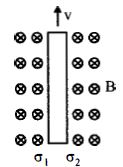
\(\because F=q E\) and \(F=q v B\)\(\therefore \mathrm{E}=\mathrm{vB}\)
And Gauss's law in Electrostatics \(\mathrm{E}=\frac{\sigma}{\varepsilon_{0}}\)
\(\mathrm{E}=\frac{\sigma}{\varepsilon_{0}}=\mathrm{vB} \Rightarrow \sigma=\varepsilon_{0} \mathrm{vB}\)
\(\sigma_{1}=-\sigma_{2}\)
આ પેજ પર આ ફિલ્ટર મુજબ કોઈ પ્રશ્ન નથી.