


enEnglishguગુજરાતી
JEE Mains · Physics · STD 12 -6. Electromagnetic induction
\(R\) જેટલી મોટી ત્રિજ્યા ધરાવતા વર્તુળાકાર ગૂચળાના કેન્દ્ર આગળ એક ખૂબ નાની ત્રિજ્યા \(r\) ધરાવતું ગુચળું મૂકેલું છે. બંને ગુચળા સમકેન્દ્રિય અને એક જ સમતલમાં છે. મોટા ગુચળામાંથી \(I\) જેટલો પ્રવાહ વહે છે. નાનું ગુચળાને તેના સામાન્ય(common) વ્યાસની અક્ષને અનુલક્ષીને અચળ કોણીય વેગ \(\omega \) થી ભ્રમણ કરવવામાં આવે છે. તો ભ્રમણના \(t\) સમય પછી નાના ગુચળામાં કેટલું \(emf\) પ્રેરિત થશે?
- A \(\frac{{{\mu _0}I}}{{2R}}\,\omega {r^2}\,\sin \,\omega t\)
- B \(\frac{{{\mu _0}I}}{{4R}}\,\omega \pi {r^2}\,\sin \,\omega t\)
- C \(\frac{{{\mu _0}I}}{{2R}}\,\omega \pi {r^2}\,\sin \,\omega t\)
- D \(\frac{{{\mu _0}I}}{{4R}}\,\omega {r^2}\,\sin \,\omega t\)
Answer & Solution
Correct Answer
(C) \(\frac{{{\mu _0}I}}{{2R}}\,\omega \pi {r^2}\,\sin \,\omega t\)
Step-by-step Solution
Detailed explanation
According to Faraday's law of electromagnetic induction, \(e=-\frac{d \phi}{d t} \text { and } \phi=B A \cos \omega t=B \pi r^{2} \cos \omega t\) \(\Rightarrow \quad e=-\frac{d}{d t}\left(\pi r^{2} B \cos \omega t\right)=\pi r^{2} B \sin \omega t(\omega)\)…
See the Complete Solution
Get step-by-step explanations for this and 2.5 Lakh+ more JEE, NEET & CET questions.
- Unlock all solutions
- Practice the full chapter
- Track accuracy across PYQs
4.8 rated on Google Play · 14,000+ reviews
More questions from Physics
- \(T = 10^3\, K\) તાપમાને રહેલ એક ઊષ્મા સ્ત્રોતને બીજા \(T = 10^2\, K\) તાપમાને રહેલા ઊષ્મા સંગ્રાહક સાથે \(1\,m\) જાડા કોપરના ચોસલા વડે જોડવામાં આવે છે. કોપરની ઊષ્પીય વાહક્તા \(0.1\, W K^{-1}m^{-1}\) હોય તો સ્થિત સ્થિતિમાં તેમાંથી પસાર થતું ઊર્જા ફલ્કસ ........ \(Wm^{-2}\) હશે.JEE Mains 2019 Hard
- ધારો કે ખરબચડી સમક્ષિતિજ સપાટી પર સ્થિર રહેલ \(M\) દળનું નળાકાર તેના અક્ષને લંબ પ્રવેગ \('a'\) થી બહાર તરફ ખેંચવામાં આવે છે. તો બિંદુ \(P\) આગળ \(F_{friction}\) શું હશે? નળાકાર સરક્યાં વગર ગતિ કરે છે તેમ ધારો.
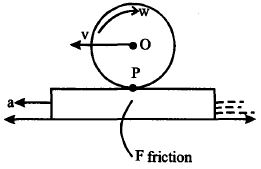 JEE Mains 2014 Hard
 - એક સિલિન્ડરમાં રાખેલ એક મોલ હિલિયમને કુલ \(48 \mathrm{~J}\) ઉષ્મા આપવામાં આવે છે. હિલિયમનું તાપમાન \(2^{\circ} \mathrm{C}\) વધે છે. વાયુ દ્વારા થયેલું કાર્ય _______ છે. (આપેલ છે, \(\mathrm{R}=8.3 \mathrm{~J} \mathrm{~K}^{-1} \mathrm{~mol}^{-1}\).)JEE Mains 2024 Hard
- આકૃતિમાં એક ખૂબ મોટું ધન વિદ્યુતભારિત સમતલ પૃષ્ઠ દર્શાવેલ છે. \(P _{1}\) અને \(P _{2}\) એ વિદ્યુતભાર વિતરણથી \(l\) અને \(2 l\) જેટલા લઘુત્તમ અંતરે બે બિંદુુઓ છે. જે પૃષ્ઠ વીજભાર ઘનતા \(\sigma\) હોય, તો \(P_{1}\) અને \(P_{2}\) આગળ વિદ્યુતક્ષેત્ર \(E_{1}\) અને \(E_{2}\) માટે સાચો વિકલ્પ પસંદ કરો
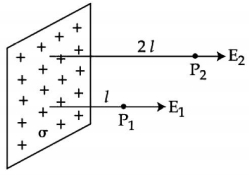 JEE Mains 2022 Medium
 - ધટ્ટ અને પાતળા માધ્યમ વચ્ચેની સપાટી માટે ક્રાંતીકોણ \(45^{\circ}\) છે. પાતળા માધ્યમમાં પ્રકાશની ઝડપ \(3 \times 10^8\,m / s\) છે. ઘટ્ટ માધ્યમમાં પ્રકાશની ઝડપ ......... હશે.JEE Mains 2023 Medium
- \(h\) ઊંચાઈ અને \(R\) બેજની ત્રિજ્યા ધરાવતા શંકુને \(\vec E\) વિદ્યુતક્ષેત્રમાં એવી રીતે મૂકવામાં આવે છે કે જેથી વિદ્યુતક્ષેત્ર બેજને સમાંતર રહે.તો શંકુમાં દાખલ થતું વિદ્યુત ફ્લક્સ કેટલું હશે?JEE Mains 2014 Medium
More PYQs from JEE Mains
- \(G\) જેટલો અવરોધ અને \(S\) જેટલો શંટ જોડી રૂપાંતરીત કરેલા ગેલ્વેનોમીટરમાં વાસ્તવમાં થતા કોણાવર્તનો \(n\) છે. જ્યારે તેનો ગુણવત્તા અંક (figure of merit) \(K\) હોય તો કુલ પ્રવાહ \(I\)....... થશે.JEE Mains 2022 Medium
- \(6\,m\) ત્રિજ્યા ધરાવતા ગોળાની કદ વિદ્યુતભાર ઘનતા \(2\,\mu\,C / cm ^3\) છે. ગોળાની સપાટીમાંથી બહાર આવતી પ્રતિ એકમ પૃષ્ઠ ક્ષેત્રફળ દીઠ બળ રેખાઓની સંખ્યા \(..........\times 10^{10} NC ^{-1}\) હશે. [Given : Permittivity of vacuum \(\left.\epsilon_{0}=8.85 \times 10^{-12} C ^{2} N ^{-1}- m ^{-2}\right]\)JEE Mains 2022 Medium
- \(\rho(r)=\left\{\begin{array}{ll}\rho_{0}\left(\frac{3}{4}-\frac{r}{R}\right) & \text { for } r \leq R \\ \text { Zero } & \text { for } r>R\end{array}\right.\) અનુસાર બદલાતી ગોલીય સંમિત વિદ્યુતભાર વહેંચણી વિચારો,જ્યાં \(r ( r < R )\) એ કેન્દ્રથી અંતર છે (આકૃતિ જુઓ) \(P\) બિંદુ આગળ વિદ્યુતક્ષેત્ર \(......\) હશે.
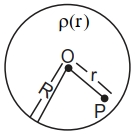 JEE Mains 2022 Hard
 - \(\tan \left(2 \tan ^{-1}\left(\frac{3}{5}\right)+\sin ^{-1}\left(\frac{5}{13}\right)\right)\) ની કિમંત મેળવો.JEE Mains 2021 Medium
- એક પાત્રમાં \(14\,g\) નાઈટ્રોજન \(27^{\circ}\,C\) તાપમાને ભરેલ છે. તેના અણુઓની \(r.m.s.\) ઝડપ બમણી કરવા માટે વાયુને આપવી પડતી ઉષ્મા \(........\,J\) હશે. \(R =8.32\,J \,mol ^{-1} k ^{-1}\) લો.JEE Mains 2022 Medium
- જો \(\left(1+\frac{1}{x}\right)^6\left(1+x^2\right)^7\left(1-x^3\right)^8 ; x \neq 0\) ના વિસ્તરણમાં \(x^{30}\) નો સહગુણક \(\alpha\) હોય, તો \(|\alpha| =\) ...........JEE Mains 2024 Hard