


प्रश्न
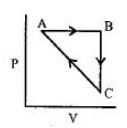
3 प्रश्न3 में से 1–3 प्रश्न
-
- (A) \( - 5\)
- (B) \( + 5\)
- (C) \( 18\)
- (D) \( -18\)
उत्तर और हल देखें
सही उत्तर: (B)
\(\Delta {U_{AB}} = {q_{AB}} + {W_{AB}} = 2 + ( - 5) = - 3\,kJ/mol\)\(\Delta {U_{BC}} = - 5\,kJ/mol\)
For cyclic procrss, \(\Delta U=0\)
\(\Delta {U_{AB}} + \Delta {U_{BC}} + \Delta {U_{CA}} = 0\)
\(\Delta {U_{CA}} = - \Delta {U_{AB}} - \Delta {U_{BC}}\)
\(\Delta {U_{CA}} = - ( - 3) - ( - 5) = 8\,kJ/mol\)
\(\Delta {U_{CA}} = {q_{CA}} + {W_{CA}}\)
\(8 = {q_{CA}} + 3\)
\({q_{CA}} = + 5\,kJ/mol\)
Heat absorbed has positive sign.
-
- (A) \({N_2}(g) + 3{H_2}(g) \to 2N{H_3}(g)\)
- (B) \(2HI(g) \to H_2(g) + I_2(g)\)
- (C) \(2SO_2 (g) + O_2 (g) \to 2SO_3 (g)\)
- (D) \(2NO_2 (g) \to N_2O_4 (g)\)
उत्तर और हल देखें
सही उत्तर: (B)
\(\Delta H = \Delta U + \Delta {n_g}RT\)\(2HI(g) \to {H_2}(g) + {I_2}(g);\Delta {n_g} = (1 + 1) - 2 = 0\)
\(\therefore \,\Delta H = \Delta U + 0\)
-
- (A) \(C\) (हीरा) \(\to\) \(C\) (ग्रेफाइट)
- (B) \(N_2(g,\,1\,atm) \to N_2(g,\,5\,atm)\)
- (C) \(N_2(g,\,273\,K) \to N_2(g,\,300\,K)\)
- (D) \(H_2(g) \to 2H(g)\)
उत्तर और हल देखें
सही उत्तर: (B)
\((a)\) When diamond is converted into graphite when it is heated to \(1500\,^oC\) and entropy is increased so \(\Delta S > 0\)
\((b)\) When pressure increases then molecules of gas will come closer and intermolecular distance decreases so entropy will also decrease and \(\Delta S < 0\)
\((c)\) When we increase the temperature of a gas then random ness is increased due to kinetic energy gained by molecules. So, \(\Delta S > 0\)
\((d)\) \(H_2\) molecule is converted into atoms, the no. of particles increases . Thus entropy will increase. So, \(\Delta S > 0\)
इस पेज पर इन फ़िल्टर से कोई प्रश्न नहीं मिला।