


Questions
Newest firstShowing 1–10 of 10 questions
-
- (A) CoS
- (B) ZnS
- (C) NiS
- (D) MnS
Show answer and solution
Correct Answer: (A)
Compound \((A)\) in the given reaction sequence is likely to be CoS.
\(\begin{aligned} \mathrm{CoS}+\mathrm{HNO}_3+3 \mathrm{HCl} \rightarrow \mathrm{Co}^{2+} & +\mathrm{S} \downarrow+\mathrm{NOCl} \uparrow \\ & +2 \mathrm{Cl}^{-}+2 \mathrm{H}_2 \mathrm{O}\end{aligned}\)
The above solution is neutralised with \(\mathrm{NH}_4 \mathrm{OH}\).
To a neutral solution of \(\mathrm{Co}^{2+}\), acetic acid and saturated solution of \(\mathrm{KNO}_2\) are added which results in the formation of yellow precipitate of \(\mathrm{K}_3\left[\mathrm{Co}\left(\mathrm{NO}_2\right)_6\right]\)
\(\mathrm{Co}^{2+}+7 \mathrm{NO}_2^{-}+2 \mathrm{H}^{+}+3 \mathrm{~K}^{+} \rightarrow \mathrm{K}_3\left[\mathrm{Co}\left(\mathrm{NO}_2\right)_6\right]+\mathrm{NO} \uparrow+\mathrm{H}_2 \mathrm{O}\) -
- (A) (A), (D) and (E) only
- (B) (D) and (E) only
- (C) (A) and (B) only
- (D) (A) and (C) only
Show answer and solution
Correct Answer: (B)
\(\mathrm{As}_2 \mathrm{~S}_3\) and \(\mathrm{As}_2 \mathrm{~S}_5\) are yellow colour sulphides, \(\left(\mathrm{NH}_4\right)_2 \mathrm{~S}\) is colourless, PbS is black, CuS is black in colour -
- (A) Both Statement I and Statement II are correct
- (B) Statement I is correct but Statement II is incorrect
- (C) Statement I is incorrect but Statement II is correct
- (D) Both Statement I and Statement II are incorrect
Show answer and solution
Correct Answer: (A)
Potassium hydrogen phthalate is used to standardize NaOH solutions.
Phenolphthalein is used as an indicator to detect completion of titrations -
- (A) Statement \(I\) is correct but Statement \(II\) is incorrect.
- (B) Statement \(I\) is incorrect but statement \(II\) is correct.
- (C) Both Statement \(I\) and Statement \(II\) are incorrect.
- (D) Both statement \(I\) and Statement \(II\) are correct.
Show answer and solution
Correct Answer: (C)
Methyl orange is weak base .Benzenoid structure (Yellow Coloured) \(\rightleftharpoons\) Quinonoid structure (Red Coloured)
Statement \(I\) - FALSE
Statement \(II\) - FALSE
-
- (A) Methyl orange may be used for a weak acid vs weak base titration.
- (B) Methyl orange is a suitable indicator for a strong acid vs weak base titration
- (C) Phenolphthalein is a suitable indicator for a weak acid vs strong base titration
- (D) Phenolphthalein may be used for a strong acid vs strong base titration.
Show answer and solution
Correct Answer: (A)
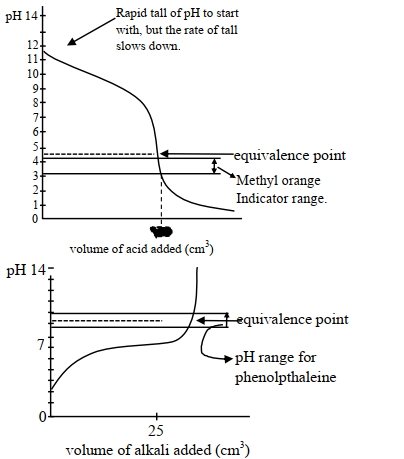
Indicator \(pH\) range Methyl orange \(3.2-4.5\) Phenolpthalein \(8.3-10.5\) Methyl orange may be used for a strong acid vs strong base and strong acid vs weak base titration. Phenolpthalein may be used for a strong acid vs strong base and weak acid vs strong base titration.
-
- (A) \(1\)
- (B) \(2\)
- (C) \(3\)
- (D) \(4\)
Show answer and solution
Correct Answer: (B)
\((B)\) \(pk _{ In }=-\log \left(4 \times 10^{-10}\right)=9.4\)Indicator range
\(\Rightarrow pk _{\text {In }} \pm 1\)
i.e. \(8.4\) to \(10.4\)
\((D)\) In acidic medium, phenolphthalein is in unionized form and is colourless.
-
- (A) methyl orange
- (B) methyl red
- (C) phenolphthalein
- (D) erichrome Black \(T\)
Show answer and solution
Correct Answer: (C)
Phenolphthalein is weak acid give colour in basic medium. -
- (A) Both \(A\) and \(R\) are true and \(R\) is the correct explanation of \(A\)
- (B) Both \(A\) and \(R\) are true but \(R\) is NOT the correct explanation of \(A\).
- (C) \(A\) is false but \(R\) is true
- (D) \(A\) is true but \(R\) is false
Show answer and solution
Correct Answer: (D)
Phenolphthalein dissociate in basic medium\(HPh ( aq ) \rightleftharpoons H ^{+}+ Ph ^{-}\)
-
- (A) Statement \(I\) is false but Statement \(II\) is true
- (B) Statement \(I\) is true but Statement \(II\) is false
- (C) Both Statement \(I\) and Statement \(II\) are true
- (D) Both Statement \(I\) and Statement \(II\) are false
Show answer and solution
Correct Answer: (B)
Titration curve for strong acid and weak base initially a buffer of weak base and conjugate acid is:Formed, thus \(\mathrm{pH}\) falls slowly and after equivalence point, so the \(\mathrm{pH}\) falls sharply so methyl arrange, having \(\mathrm{pH}\) range of \(3.2\) to \(4.4\) will weak as indicator. So statement\(-I\) is correct.
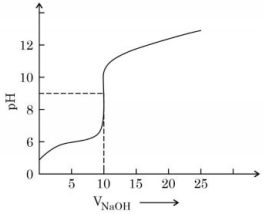
Titration curve for weak acid and strong base \((\mathrm{NaOH})\) Initially weak acid will form a buffer so \(\mathrm{pH}\) increases slowly but after equivalence point. it rises sharply covering range of phenolphthalein so it will be suitable indicator so statement\(-II\) is false.
-
- (A) \((a)\)
- (B) \((c)\)
- (C) \((d)\)
- (D) \((b)\)
Show answer and solution
Correct Answer: (A)
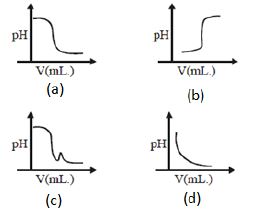
The nature of the curve is such that the \(pH\) change of the reaction becomes larger for very small change in volume of titrant.
No questions on this page match these filters.
Other STD 11 - Equilibrium - II (icon Equilibrium) topics
Frequently asked
How many Acid and base indicators questions came in JEE Mains?
10 questions from 2019–2025, each with the correct answer and a full solution.
How difficult are Acid and base indicators questions?
0% are easy, 50% medium and 50% hard.