


પ્રશ્નો
6 પ્રશ્નો6 માંથી 1–6 પ્રશ્નો
-
- (A) \(9.2 \times 10^{-3} J\)
- (B) \(11.7 \times 10^{-3} J\)
- (C) \(6.4 \times 10^{-2} J\)
- (D) \(7.2 \times 10^{-2} J\)
જવાબ અને ઉકેલ જુઓ
સાચો જવાબ: (D)
Torque on a bar magnet: \(I = MB\) sin \(\theta\)Here, \(\theta=30^{\circ}, I =0.018\, N-m , B =0.06 T\)
\(\Rightarrow 0.018= M \times 0.06 \times \sin 30^{\circ}\)
\(\Rightarrow 0.018=M \times 0.06 \times \frac{1}{2}\)
\(\Rightarrow M =0.6 A - m ^{2}\)
Now \(v=-M B \cos \theta\)
Position of stable equilibrium \(\left(\theta=0^{\circ}\right)\)
\(u _{ i }=- MB\)
Position of unstable equilibrium \(\left(\theta=180^{\circ}\right)\) :
\(u _{ f }= MB\)
\(\Rightarrow\) work done : \(\Delta U\)
\(\Rightarrow W =2 MB\)
\(\Rightarrow W =2 \times 0.6 \times 0.06\)
\(\Rightarrow W =7.2 \times 10^{-2} J\)
-
- (A) \(0.5 \times 10^{2}\)
- (B) \(50 \times 10^{2}\)
- (C) \(500 \times 10^{2}\)
- (D) \(5 \times 10^{2}\)
જવાબ અને ઉકેલ જુઓ
સાચો જવાબ: (D)
\(M =\mu_{ r } Ni A\)Here
\(\mu_{ r }=\) Relative permeability
\(N =\) No. of turns
\(i =\) Current
\(A =\) Aea of cross section
\(M=\mu_{r} N i A=\mu_{r} n\ell i A\)
\(M=\mu_{r} n i V=1000(1000) 0.5\left(10^{-3}\right)\)
\(=500=5 \times 10^{2} Am ^{2}\)
- 3. કાયમી ચુંબક \((p)\) અને ટ્રાન્સફોર્મર \((T)\) માં વપરાતુ ચુબકીય દ્રવ્ય ના ગુણધર્મ કયો છે. 2020 મધ્યમ
- (A) \(T\) : વધારે રિટેન્ટીવિટી, ઓછી કોઅર્સીવિટી
- (B) \(P\) : ઓછી રિટેન્ટીવિટી વધારે કોઅર્સીવિટી
- (C) \(T\) : ઓછી રિટેન્ટીવિટી વધારે કોઅર્સીવિટી
- (D) \(P :\) વધારે રિટેન્ટીવિટી વધારે કોઅર્સીવિટી
જવાબ અને ઉકેલ જુઓ
સાચો જવાબ: (D)
As for permanent magnet large retentivity and large coercivity required -
- (A) \(4\)
- (B) \(0.75\)
- (C) \(2.25\)
- (D) \(1\)
જવાબ અને ઉકેલ જુઓ
સાચો જવાબ: (B)
For paramagnetic material According to curies law\(x \propto \frac{1}{ T }\)
\(\chi \propto \frac{1}{ T } \Rightarrow \chi_{1} T _{1}=\chi_{2} T _{2}\)
\(\Rightarrow \frac{6}{0.4} \times 4=\frac{ I }{0.3} \times 24\)
\(I =\frac{0.3}{0.4}=0.75 A / m\)
-
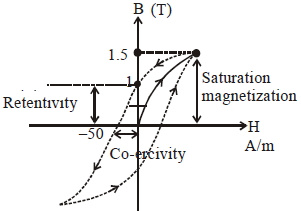
- (A) \(150 \;\mathrm{A} / \mathrm{m}, 1.0\; \mathrm{T}\) and \(1.5\; \mathrm{T}\)
- (B) \(1.0 \;\mathrm{T}, 50\; \mathrm{A} / \mathrm{m}\) and \(1.5\; \mathrm{T}\)
- (C) \(1.5\; \mathrm{T}, 50\; \mathrm{A} / \mathrm{m}\) and \(1.0 \;\mathrm{T}\)
- (D) \(1.5\; \mathrm{T}, 50 \;\mathrm{A} / \mathrm{m}\) and \(1.0 \;\mathrm{T}\)
જવાબ અને ઉકેલ જુઓ
સાચો જવાબ: (B)
Retentivity \(=1.0 \mathrm{T}\)Co-ercivity \(=50 \mathrm{A} / \mathrm{m}\)
Saturation \(=1.5 \mathrm{T}\)
-
- (A) શૂન્ય
- (B) \(\overrightarrow{ B }\)
- (C) \(\overrightarrow{ B }\) કરતા વધારે પરંતુ વિરૂદ્ધ દિશામાં
- (D) \(\overrightarrow{ B }\) કરતા વધારે પરંતુ સમાન દિશામાં
જવાબ અને ઉકેલ જુઓ
સાચો જવાબ: (A)
A perfect diamagnetic substance will completely expel the magnetic field. Therefore, there will be no magnetic field inside the cavity of sphere. Hence the paramagnetic substance kept inside the cavity will experience no force.

આ પેજ પર આ ફિલ્ટર મુજબ કોઈ પ્રશ્ન નથી.