


Questions
6 questionsShowing 1–6 of 6 questions
-
- (A) \(4\)
- (B) \(0.75\)
- (C) \(2.25\)
- (D) \(1\)
Show answer and solution
Correct Answer: (B)
For paramagnetic material According to curies law\(x \propto \frac{1}{ T }\)
\(\chi \propto \frac{1}{ T } \Rightarrow \chi_{1} T _{1}=\chi_{2} T _{2}\)
\(\Rightarrow \frac{6}{0.4} \times 4=\frac{ I }{0.3} \times 24\)
\(I =\frac{0.3}{0.4}=0.75 A / m\)
-
- (A) \(Zero\)
- (B) \(\overrightarrow{ B }\)
- (C) much large than \(|\overrightarrow{ B }|\) but opposite to \(\overrightarrow{ B }\)
- (D) much large than \(|\overrightarrow{ B }|\) and parallel to \(\overrightarrow{ B }\)
Show answer and solution
Correct Answer: (A)
A perfect diamagnetic substance will completely expel the magnetic field. Therefore, there will be no magnetic field inside the cavity of sphere. Hence the paramagnetic substance kept inside the cavity will experience no force. -
- (A) \(9.2 \times 10^{-3} J\)
- (B) \(11.7 \times 10^{-3} J\)
- (C) \(6.4 \times 10^{-2} J\)
- (D) \(7.2 \times 10^{-2} J\)
Show answer and solution
Correct Answer: (D)
Torque on a bar magnet: \(I = MB\) sin \(\theta\)Here, \(\theta=30^{\circ}, I =0.018\, N-m , B =0.06 T\)
\(\Rightarrow 0.018= M \times 0.06 \times \sin 30^{\circ}\)
\(\Rightarrow 0.018=M \times 0.06 \times \frac{1}{2}\)
\(\Rightarrow M =0.6 A - m ^{2}\)
Now \(v=-M B \cos \theta\)
Position of stable equilibrium \(\left(\theta=0^{\circ}\right)\)
\(u _{ i }=- MB\)
Position of unstable equilibrium \(\left(\theta=180^{\circ}\right)\) :
\(u _{ f }= MB\)
\(\Rightarrow\) work done : \(\Delta U\)
\(\Rightarrow W =2 MB\)
\(\Rightarrow W =2 \times 0.6 \times 0.06\)
\(\Rightarrow W =7.2 \times 10^{-2} J\)
-
- (A) \(0.5 \times 10^{2}\)
- (B) \(50 \times 10^{2}\)
- (C) \(500 \times 10^{2}\)
- (D) \(5 \times 10^{2}\)
Show answer and solution
Correct Answer: (D)
\(M =\mu_{ r } Ni A\)Here
\(\mu_{ r }=\) Relative permeability
\(N =\) No. of turns
\(i =\) Current
\(A =\) Aea of cross section
\(M=\mu_{r} N i A=\mu_{r} n\ell i A\)
\(M=\mu_{r} n i V=1000(1000) 0.5\left(10^{-3}\right)\)
\(=500=5 \times 10^{2} Am ^{2}\)
-
- (A) \(T\) : Large retentivity, small coercivity
- (B) \(P\) : Small retentivity, large coercivity
- (C) \(T\) : Large retentivity, large coercivity
- (D) \(P :\) Large retentivity, large coercivity
Show answer and solution
Correct Answer: (D)
As for permanent magnet large retentivity and large coercivity required -
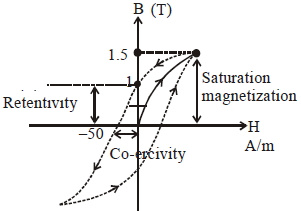
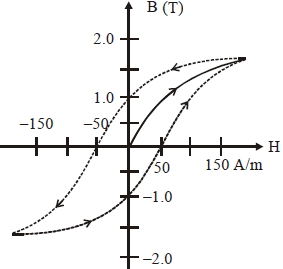
- (A) \(150 \;\mathrm{A} / \mathrm{m}, 1.0\; \mathrm{T}\) and \(1.5\; \mathrm{T}\)
- (B) \(1.0 \;\mathrm{T}, 50\; \mathrm{A} / \mathrm{m}\) and \(1.5\; \mathrm{T}\)
- (C) \(1.5\; \mathrm{T}, 50\; \mathrm{A} / \mathrm{m}\) and \(1.0 \;\mathrm{T}\)
- (D) \(1.5\; \mathrm{T}, 50 \;\mathrm{A} / \mathrm{m}\) and \(1.0 \;\mathrm{T}\)
Show answer and solution
Correct Answer: (B)
Retentivity \(=1.0 \mathrm{T}\)Co-ercivity \(=50 \mathrm{A} / \mathrm{m}\)
Saturation \(=1.5 \mathrm{T}\)

No questions on this page match these filters.