


Questions
2 questionsShowing 1–2 of 2 questions
-
- (A) \(30\)
- (B) \(45\)
- (C) \(60\)
- (D) \(90\)
Show answer and solution
Correct Answer: (C)
\(\mathrm{T}=\mathrm{PE} \sin \theta\) Torque experienced by the dipole in an electric field,\(\quad \vec{T}=\vec{P} \times \vec{E}\)
\(\vec{p}=p \cos \theta \hat{i}+p \sin \theta \hat{j}\)
\(\vec{E}_{1}=\overrightarrow{E i}\)
\(\vec{T}_{1}=\vec{p} \times \vec{E}_{1}=(p \cos \theta \hat{i}+p \sin \theta \hat{j}) \times E(\hat{i})\)
\(\tau \hat{k}=p E \sin \theta(-\hat{k}).........(i)\)
\(\vec{E}_{2}=\sqrt{3} E_{1} \hat{j}\)
\(\left.\vec{T}_{2}=p \cos \theta \hat{i}+p \sin \theta \hat{j}\right) \times \sqrt{3} E_{1} \hat{j}\)
\(\tau \hat{k}=\sqrt{3} p E_{1} \cos \theta \hat{k}.........(ii)\)
From eqns. ( \(i\) ) and \((ii )\)
\(p E \sin \theta=\sqrt{3} p E \cos \theta\)
\(\tan \theta=\sqrt{3} \quad \therefore \quad \theta=60^{\circ}\)
-
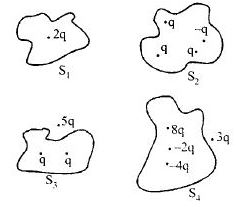
- (A) \({\phi _1} < {\phi _2} = {\phi _3} > {\phi _4}\)
- (B) \({\phi _1} > {\phi _2} > {\phi _3} > {\phi _4}\)
- (C) \({\phi _1} = {\phi _2} = {\phi _3} = {\phi _4}\)
- (D) \({\phi _1} > {\phi _3} ; {\phi _2} < {\phi _4}\)
Show answer and solution
Correct Answer: (C)
The net fluw linked with closed surfaces \(S_{1}\), \(\mathrm{S}_{2}, \mathrm{S}_{3} \& \mathrm{S}_{4}\) areFor surface \(S_{1}, \phi_{1}=\frac{1}{\varepsilon_{0}}(2 q)\)
For surface
\(\mathrm{S}_{2}, \phi_{2}=\frac{1}{\varepsilon_{0}}(\mathrm{q}+\mathrm{q}+\mathrm{q}-\mathrm{q})=\frac{1}{\varepsilon_{0}} 2 \mathrm{q}\)
For surface \(S_{3}, \phi_{3}=\frac{1}{\varepsilon_{0}}(q+q)=\frac{1}{\varepsilon_{0}}(2 q)\)
For surface
\(S_{4}, \phi_{4}=\frac{1}{\varepsilon_{0}}(8 q-2 q-4 q)=\frac{1}{\varepsilon_{0}}(2 q)\)
Hence, \(\phi_{1}=\phi_{2}=\phi_{3}=\phi_{4}\) i.e. netelectric flux is same for all surfaces.
Keep in mind, the electric field due to a charge outside \(\left(\mathrm{S}_{3} \text { and } \mathrm{S}_{4}\right),\) the Gaussian surface contributes zero net flux through the surface, because as many lines due to that charge enter the surface as leave it.
No questions on this page match these filters.