


પ્રશ્નો
9 પ્રશ્નો9 માંથી 1–9 પ્રશ્નો
-
- (A) \(\frac{82}{5}\)
- (B) \(\frac{57}{2}\)
- (C) \(\frac{71}{5}\)
- (D) \(\frac{68}{5}\)
જવાબ અને ઉકેલ જુઓ
સાચો જવાબ: (A)
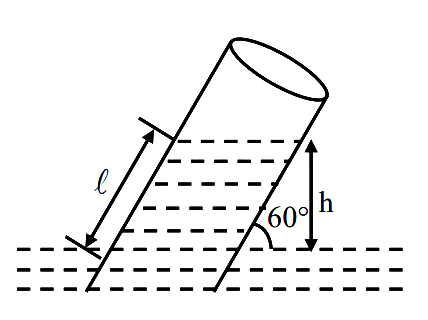
\(\begin{aligned} & \mathrm{h}=\frac{2 \mathrm{~T} \cos \theta}{\rho \mathrm{gr}}=\frac{2 \times 70 \times 1}{1 \times 980 \times 10^{-2}} \\ & \mathrm{~h}=\frac{100}{7} \mathrm{~cm} \\ & \sin 60^{\circ}=\frac{\mathrm{h}}{\ell} \\ & \ell=\frac{\mathrm{h} \times 2}{\sqrt{3}} \\ & \ell=\frac{100}{7} \times \frac{2}{\sqrt{3}} \\ & =\frac{200}{7 \times \sqrt{3}} \\ & =16.49 \mathrm{~cm}\end{aligned}\) -
- (A) 2190
- (B) 2000
- (C) 1540
- (D) 1325
જવાબ અને ઉકેલ જુઓ
સાચો જવાબ: (A)
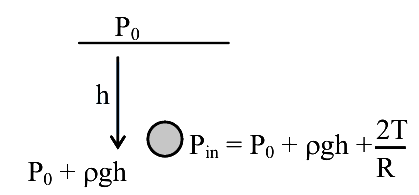
\(\Delta \mathrm{P}=\mathrm{P}_{\mathrm{in}}-\mathrm{P}_0\)
\(\begin{aligned} & =\rho \mathrm{gh}+\frac{2 \mathrm{~T}}{\mathrm{R}}=\frac{1000 \times 10 \times 20}{100}+\frac{2 \times 0.095}{10^{-3}} \\ & =2000+190 \\ & =2190\end{aligned}\) -
- (A) \(0.1\)
- (B) \(0.05\)
- (C) \(0.02\)
- (D) \(0.25\)
જવાબ અને ઉકેલ જુઓ
સાચો જવાબ: (B)
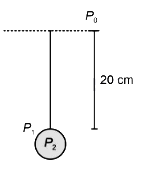
\(\begin{aligned}
& P_1=P_0+\rho g h=P_0+1000 \times 10 \times \frac{20}{100} \\
& \Rightarrow P_1=P_0+2000
\end{aligned}\)
આથી, \(P_2-P_1=\frac{2 S}{R}=\left(\frac{2 S}{1 \times 10^{-3}}\right)\)
\(\Rightarrow P_2=P_0+2100\)
(આપેલ છે)
\(\begin{aligned}
& \text { So, } P_0+2100-P_0-2000=2 S \times 10^3 \\
& \Rightarrow 100=2 S \times 10^3 \\
& \Rightarrow s=\left(\frac{1}{20}\right)=0.05
\end{aligned}\) -
- (A) \(K\) ઋણ હોય, તો પ્રવાહી \(A\) અને પ્રવાહી \(B\) બહિર્ગોળ મેનિસ્કસ ધરાવે છે.
- (B) \(K\) ઋણ હોય, તો પ્રવાહી \(A\) અને પ્રવાહી \(B\) અંતર્ગોળ મેનિસ્કસ ધરાવે છે.
- (C) K ઋણ હોય, તો પ્રવાહી A અંતર્ગોળ મેનિસ્કસ ધરાવે છે અને પ્રવાહી \(B\) બહિર્ગોળ મેનિસ્કસ ધરાવે છે.
- (D) K શૂન્ય હોય, તો પ્રવાહી A બહિર્ગોળ મેનિસ્કસ ધરાવે છે અને પ્રવાહી B અંતર્ગોળ મેનિસ્કસ ધરાવે છે.
જવાબ અને ઉકેલ જુઓ
સાચો જવાબ: (C)
\(\mathrm{k}=\frac{\cos \theta_{\mathrm{A}}}{\cos \theta_{\mathrm{B}}}\)
તે ઋણ હોય છે જ્યારે \(\cos \theta_A \) અને \(\cos \theta_B\) વિરુદ્ધ ચિહ્નના હોય. તેથી વિકલ્પ (3) -
- (A) 10
- (B) 8
- (C) 4
- (D) 6
જવાબ અને ઉકેલ જુઓ
સાચો જવાબ: (C)
\(R=\frac{R_2 R_1}{R_2-R_1}=\frac{4 \times 2}{2}=4 \mathrm{~cm}\) -
- (A) 10
- (B) 8
- (C) 6
- (D) 7
જવાબ અને ઉકેલ જુઓ
સાચો જવાબ: (B)
\(\begin{aligned} & \Delta \mathrm{P}=\frac{4 \mathrm{~T}}{\mathrm{R}} \\ & \frac{\mathrm{R}_{\mathrm{A}}}{\mathrm{R}_{\mathrm{B}}}=\frac{\Delta \mathrm{P}_{\mathrm{B}}}{\Delta \mathrm{P}_{\mathrm{A}}}=2 \\ & \frac{\mathrm{~V}_{\mathrm{A}}}{\mathrm{V}_{\mathrm{B}}}=\left(\frac{\mathrm{R}_{\mathrm{A}}}{\mathrm{R}_{\mathrm{B}}}\right)^3=8\end{aligned}\) -
- (A) વિધાન I સાચું છે પરંતુ વિધાન II ખોટું છે
- (B) વિધાન I ખોટું છે પરંતુ વિધાન II સાચું છે
- (C) વિધાન I અને વિધાન II બંને ખોટા છે
- (D) વિધાન I અને વિધાન II બંને સાચા છે
જવાબ અને ઉકેલ જુઓ
સાચો જવાબ: (A)
ગરમ પાણી ઠંડા પાણી કરતાં ઓછું સ્નિગ્ધ હોય છે.
પૃષ્ઠસક્રિયક પૃષ્ઠતાણ ઘટાડે છે. -
- (A) 15 જૂલ
- (B) 5 જૂલ
- (C) 20 જૂલ
- (D) 10 જૂલ
જવાબ અને ઉકેલ જુઓ
સાચો જવાબ: (A)
\(\begin{aligned}
& W_1=s 4 \pi\left(\frac{R}{3}\right)^2 \times 27-4 \pi R^2 \cdot s \\
& \Rightarrow W_1=4 \pi R^2 \cdot s(2)=10 \text { Joule }
\end{aligned}\)
હવે, \(W_2=s 4 \pi R^2(4-1)=4 \pi R^2 s \times 3\)
\(\Rightarrow \quad W_2=3 \times \frac{10}{2}=15 \text { Joule }\) -
- (A) \(4 \pi \mathrm{r}^2 \mathrm{~T}\left[2-2^{\frac{2}{3}}\right]\)
- (B) \(4 \pi r^2 \mathrm{~T}\left[2-2^{\frac{1}{3}}\right]\)
- (C) \(4 \pi r^2 \mathrm{~T}[1+\sqrt{2}]\)
- (D) \(4 \pi r^2 T[\sqrt{2}-1]\)
જવાબ અને ઉકેલ જુઓ
સાચો જવાબ: (A)
\(\begin{aligned} & 2 \times \frac{4}{3} \pi \mathrm{R}^3=\frac{4}{3} \pi \mathrm{r}^3 \Rightarrow \mathrm{r}=2^{1 / 3} \mathrm{R} \\ & \mathrm{U}_{\mathrm{i}}=2 \times 4 \pi \mathrm{R}^2 \mathrm{~T} \\ & \mathrm{U}_{\mathrm{f}}=4 \pi \mathrm{r}^2 \mathrm{~T}=4 \pi \mathrm{R}^2 \mathrm{~T} 2^{2 / 3} \\ & \therefore \text { Heat lost }=\mathrm{u}_{\mathrm{i}}-\mathrm{u}_{\mathrm{f}}=4 \pi \mathrm{R}^2 \mathrm{~T}\left[2-2^{2 / 3}\right]\end{aligned}\)
આ પેજ પર આ ફિલ્ટર મુજબ કોઈ પ્રશ્ન નથી.