


પ્રશ્નો
4 પ્રશ્નો4 માંથી 1–4 પ્રશ્નો
- 1. આપેલ ગોળામાં દર્શાવેલ ભાગ કાપી નાખ્યા પછી વધેલા ભાગનું દૂર રહેલા બિંદુ \(P\) આગળ ગુરુત્વાકર્ષીક્ષેત્ર કેટલું મળશે?
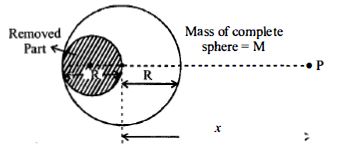 2013 અઘરું
- (A) \(\frac{5}{6}\,\frac{{GM}}{{{x^2}}}\)
- (B) \(\frac{8}{9}\,\frac{{GM}}{{{x^2}}}\)
- (C) \(\frac{7}{8}\,\frac{{GM}}{{{x^2}}}\)
- (D) \(\frac{6}{7}\,\frac{{GM}}{{{x^2}}}\)
જવાબ અને ઉકેલ જુઓ
સાચો જવાબ: (C)
Let mass of smaller sphere (which has to be removed) is m\(Radius = \frac{R}{2}\left( {from\,figure} \right)\)
\(\frac{M}{{\frac{4}{3}\pi {R^3}}} = \frac{m}{{\frac{4}{3}\pi {{\left( {\frac{R}{2}} \right)}^3}}}\)
\( \Rightarrow m = \frac{M}{8}\)
Mass of the left over part of the sphere
\(M' = M - \frac{M}{8} = \frac{7}{8}M\)
Therefore gravitational filed due to the left over part of the sphere
\( = \frac{{GM'}}{{{x^2}}} = \frac{7}{8}\frac{{GM}}{{{x^2}}}\)
-
- (A) \(6.73\times 10^{-5}\,m/s^2\)
- (B) \(6.73\times 10^{-3}\,m/s^2\)
- (C) \(6.73\times 10^{-2}\,m/s^2\)
- (D) \(6.73\times 10^{-4}\,m/s^2\)
જવાબ અને ઉકેલ જુઓ
સાચો જવાબ: (A)
During solar eclipse, the sun and moon will be on the same side of the earth and during lunar eclipse, the moon and the sun will be exactly on the earth’s opposite sides.So the gravitational force acting on earth due to sun will add up with the gravitational force acting on earth due to moon during solar eclipse and the gravitational forces will subtract with each other during lunar eclipse.
Let \(F_S\) be the gravitational force between earth and sun and \(F_L\) be the gravitational force between earth and moon.
Also, the acceleration of earth during solar and lunar eclipse can be derived from Newton’s second law,
\(F=ma\)........(1)
During solar eclipse, eqn (1) will be
\(m.{a_s} = {F_s} + {F_L} \to \left( 2 \right)\)
During lunar ecllpse, eqn \((1)\) will be
\(m.{a_L} = {F_s} - {F_L} \to \left( 3 \right)\)
Here, \(a_s\) and \(a_L\) are the acceleration of earth towards sun during solar and lunar ecllpse respectlvely and \(m\) is the mass of earth.
So the change in acceleration of earth toward sun from solar to lunar ecllpse perlod, can be found, can be found by subtracting eqn \((2)\) from eqn \((3)\)
\(m\left( {{a_s} - {a_L}} \right) = {F_s} + {F_L} - {F_s} + {F_L}\)
\(\therefore m\left( {{a_s} - {a_L}} \right) = 2{F_L} \to \left( 4 \right)\)
Here,
\({F_L} = G\frac{{m.{M_L}}}{{{D^2}}}\)
Where \(G\) is the gravltational constant, \(m\) is the mass of earth, \(ML\) is the mass of moon, and \(D\) is the distance between moon and earth.
\(D\) is equal to the orbital radlus of moon.
So the eqn \((4)\) becomes,
\(\left( {{a_s} - {a_L}} \right) = 2G\frac{{{M_L}}}{{{D^2}}} \to \left( 5 \right)\)
Now, substitute the glven values in eqn \((5)\),
\({M_L} = 7.36 \times {10^{22}}\,kg\)
\(D = 3.8 \times {10^8}\,m\)
Gravltational constant value, \(G = 6.67 \times {10^{ - 11}}N.{m^2}.k{g^{ - 2}}\)
\(\left( {{a_s} - {a_L}} \right) = 2 \times 6.67 \times {10^{ - 11}} \times \frac{{7.36 \times {{10}^{22}}}}{{{{\left( {3.8 \times {{10}^8}} \right)}^2}}}\)
\(\left( {{a_s} - {a_L}} \right) = 6.799 \times {10^{ = 11 + 22 - 16}}\)
\(\left( {{a_s} - {a_L}} \right) = 6.799 \times {10^{ - 5}}m/{s^2}\)
-
- (A) શૂન્ય
- (B) \(1\)
- (C) \(\frac{{144}}{{25}}\)
- (D) \(\frac{{25}}{{144}}\)
જવાબ અને ઉકેલ જુઓ
સાચો જવાબ: (B)
From question,\({E_x} = 5\,N/kg\,and\,{E_y} = 12\,N/kg\)
Gravitational potential
\(=Gravitational\, field\times\,distance\)
\(\therefore {V_{\left( {12m,0} \right)}} = {E_x} \times 12\,J/kg\)
\(and\,{V_{\left( {0.5m} \right)}} = {E_y} \times 5\,\,J/kg\)
\(\left( {Give\,:\,potential\,at\,the\,origin\,is\,zero} \right)\)
\(\therefore \frac{{{V_{\left( {12\,m,0} \right)}}}}{{{V_{\left( {0,5m} \right)}}}} = \frac{{{E_x} \times 12}}{{{E_y} \times 5}} = \frac{{5 \times 12}}{{12 \times 5}} = 1\)
-
- (A) \(\frac{{GmM}}{{3R}}\;\;\;\;\;\;\;\;\;\;\;\;\;\;\;\;\;\;\;\;\;\;\;\;\)
- (B) \(\;\frac{{5GmM}}{{6R}}\)
- (C) \(\;\frac{{2GmM}}{{3R}}\)
- (D) \(\;\frac{{GmM}}{{2R}}\)
જવાબ અને ઉકેલ જુઓ
સાચો જવાબ: (B)
Applying energy conservation\(k + \left( { - \frac{{GMm}}{R}} \right) = \frac{1}{2}mv_0^2 + \left( { - \frac{{GMm}}{{R + h}}} \right)\)
\(k - \frac{{GMm}}{R} = \frac{1}{2}m\left( {\frac{{Gm}}{{R + 2R}}} \right) - \frac{{GMm}}{{R + 2R}}\)
\(\therefore k = \frac{{5GMm}}{{6R}}\)
આ પેજ પર આ ફિલ્ટર મુજબ કોઈ પ્રશ્ન નથી.