


પ્રશ્નો
4 પ્રશ્નો4 માંથી 1–4 પ્રશ્નો
-
- (A) \(Co^{2+}\)
- (B) \(Cu^{2+}\)
- (C) \(Zn^{2+}\)
- (D) \(Fe^{2+}\)
જવાબ અને ઉકેલ જુઓ
સાચો જવાબ: (A)
\(Zn^{2+}\) salts are white. Usually \(Fe^{2+}\) salts are rarely pink. \(Cu^{2+}\) salts are usually blue in hydrated form. \(Co^{2+}\) is pink in aqueous solution -
- (A) \(L\to M\) સંક્રાંતિ ભાર નું સ્થળાંતર
- (B) \(\sigma - \sigma ^*\) સંક્રાંતિ
- (C) \(M\to L\) સંક્રાંતિ ભાર નું સ્થળાંતર
- (D) \(d - d\) સંક્રાંતિ
જવાબ અને ઉકેલ જુઓ
સાચો જવાબ: (A)
\(K M n O_{4} \rightarrow K^{+}+M n O_{4}^{-}\)\(\therefore \ln M n O_{4}^{-},\) Mn has \(+7\) oxidation state having no electron in d-orbitals. It ts considered that higher the oxidation state of metal, greater is the tendency to occur \(L \rightarrow M\) charge transfer,
because ligand is able to donate the electron into the vacant ( - orbital of metal.
since, charge transfer is laporate as well as spin allowed, therefore, it shows colour
-
- (A) \(K_2Cr_2O_7\) કરતા \(Na_2Cr_2O_7\) ઓછો દ્રાવ્ય છે
- (B) \(Na_2Cr_2O_7\) એ કદમાપક પૃથ્થકરણમાં પ્રાથમિક માપદંડ છે
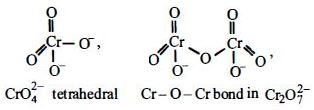
- (C) \(CrO_4^{2-}\) સમચતુષ્કલકીય આકારનો છે
- (D) \(CrO_7^{2-}\) માં \(Cr- O- Cr\) બંધ હોય છે.
જવાબ અને ઉકેલ જુઓ
સાચો જવાબ: (A)
\(Na_2Cr_2O_7\) is used as primary standard in volumetryHydration energy of \(Na^+\) is greater then \(K^+\). Because of smaller size of \(Na^+\) , \(Na_2Cr_2O_7\) is more soluble than \(K_2Cr_2O_7\).
-
- (A) \((NH_4)_3 [As (Mo_3O_{10})_4]\)
- (B) \(BaCrO_4\)
- (C) \(Zn_2[Fe(CN)_6]\)
- (D) \(K_3[Co(NO_2)_6]\)
જવાબ અને ઉકેલ જુઓ
સાચો જવાબ: (C)
\(Z n_{2}\left[F e(C N)_{6}\right], K_{3}\left[C o\left(N O_{2}\right)_{6}\right] \) and \(\left(N H_{4}\right)_{3} A s\left[M o_{3} O_{l 0}\right]_{4}\) show color due to d-d transition while \(B a C r O_{4}\) is coloured due to charge transfer phenomenon.Further according to spectrochemical series the strong ligand possessing complex has higher energy and hence lower wavelength. Therefore, complexes containing \(N O_{2}, N H_{4}^{+}, O^{2-}\) etc., ligands show yellow colour while \(\mathrm{CN}^{-}\) forces the complex to impart white colour.
Spectrochemical series \(I^{-} < B r^{-} < S^{2-} < S C N^{-} < C I^{-} < N O_{3}^{-} < N_{3}^{-} < F^{-} < O H^{-}\)
\( < C_{2} O_{4}^{2-}=H_{2} O < N C S^{-} < C H_{3} C N < p y < N H_{3} < e n\)
\( < b i p y < phen < N o_{2}^{-} < p p h_{3} < C N^{-}=C O\)
આ પેજ પર આ ફિલ્ટર મુજબ કોઈ પ્રશ્ન નથી.