


Chapters asked in 2023
32 chapters- 24Qs STD 11 Units, dimensions and measurement
- 16Qs STD 12 Semicondutor electronics
- 25Qs STD 12 Nuclei
- 22Qs STD 12 Atoms
- 25Qs STD 12 Dual nature of radiation and matter
- 21Qs STD 12 Electromagnetic waves
- 17Qs STD 12 Wave optics
- 33Qs STD 12 Ray optics and optical instruments Most asked
- 20Qs STD 12 Alternating current
- 23Qs STD 11 System of particles and rotational motion
- 31Qs STD 12 Moving charges and magnetism
- 29Qs STD 12 Electromagnetic induction
- 7Qs STD 12 Magnetism and matter
- 46Qs STD 12 Current electricity Most asked
- 22Qs STD 12 Electric potential and capacitance
- 19Qs STD 12 Electric charges and fields
- 17Qs STD 11 Waves and sound
- 21Qs STD 11 Oscillations
- 20Qs STD 11 Kinetic theory of gases
- 20Qs STD 11 Thermodynamics
- 8Qs STD 11 10.1, thermonetry, thermal expansion and calorimetry
- 15Qs STD 11 Mechanical properties of solids
- 7Qs STD 11 Surface tension
- 14Qs STD 11 Fluid mechanics
- 18Qs STD 11 Newtons laws of motion
- 34Qs STD 11 Gravitation Most asked
- 28Qs STD 11 Work, energy, power and collision
- 11Qs STD 11 Friction
- 20Qs STD 11 Motion in plane
- 20Qs STD 11 Motion in straight line
- 5Qs STD 11 Transmission of heat
- 6Qs STD 11 Vectors
All JEE Mains 2023 Physics questions
32 chaptersShowing 1–50 of 644 questions
- 1. A body of mass \((5 \pm 0.5) kg\) is moving with a velocity of \((20 \pm 0.4) m / s\). Its kinetic energy will be 2023 Medium
- (A) \((1000 \pm 140)\,J\)
- (B) \((1000 \pm 0.14)\,J\)
- (C) \((500 \pm 0.14)\,J\)
- (D) \((500 \pm 140)\,J\)
Show answer and solution
Correct Answer: (A)
\(k =\frac{1}{2} mv ^2\)\(k =\frac{1}{2} \times 5 \times 400=5 \times 200=1000\,J\)
\(\frac{\Delta k }{2 k }=\frac{\Delta m }{ m }+\frac{2 \Delta v }{ v }=\frac{0.5}{5}+\frac{2 \times 0.4}{20}\)
\(\Delta k =1000\left(\frac{1}{10}+\frac{4}{100}\right)=1000\left(\frac{10+4}{100}\right)=140\,J\)
-
- (A) 1
- (B) 3.5
- (C) 4
- (D) 5
Show answer and solution
Correct Answer: (C)
\(\rho=\frac{ m }{\pi r ^2 l} \Rightarrow\left|\frac{ d \rho}{\rho}\right|_{\max }=\left|\frac{ dm }{ m }\right|+2\left|\frac{ dr }{ r }\right|+\left|\frac{ d l}{l}\right|\)\(=\frac{0.01}{0.4}+\frac{2(0.03)}{6}+\frac{0.04}{8}\)
\(\Rightarrow \% \text { error in density }=\left(\frac{ d \rho}{\rho}\right) \times 100 \%\)
\(=(2.5+1+0.5) \%=4 \%\)
-
- (A) \(13\)
- (B) \(14\)
- (C) \(12\)
- (D) \(16\)
Show answer and solution
Correct Answer: (A)
\(\frac{\Delta P }{ P } \times 100 \%=\left(2 \frac{\Delta a }{ a }+3 \frac{\Delta b }{ b }+\frac{\Delta c }{ c }+\frac{1}{2} \frac{\Delta d }{ d }\right) \times 100 \%\)\(=2(1 \%)+3(2 \%)+3 \%+\frac{1}{2} \times 4 \%=13 \%\)
-
- (A) \(T ^2 / L ^2\)
- (B) \(L / T\)
- (C) \(L ^2 / T ^2\)
- (D) \(T / L\)
Show answer and solution
Correct Answer: (C)
\(\frac{1}{\mu_0 \epsilon_0}=c^2 \Rightarrow\left[\frac{1}{\mu_0 \in_0}\right]=\left[ c ^2\right]=\left[ L ^2 T ^{-2}\right]\) -
- (A) \(Nm ^3\,C ^{-1} ; Nm ^2 \,C ^{-1}\)
- (B) \(Nm ^2\, C ^{-1} ; Nm ^3 \,C ^{-1}\)
- (C) \(Nm ^3 \,C ; Nm ^2 \,C\)
- (D) \(Nm ^2 \,C ; Nm ^3\, C\)
Show answer and solution
Correct Answer: (B)
\(\overrightarrow{ E }=\frac{ A }{ x ^2} \hat{ i }+\frac{ B }{ y ^3} \hat{ j }\)\({\left[\frac{ A }{ x ^2}\right]= NC ^{-1} \Rightarrow[ A ]= Nm ^2 C ^{-1}}\)
\({\left[\frac{ B }{ y ^3}\right]= NC ^{-1} \Rightarrow[ B ]= Nm ^3 C ^{-1}}\)
-
- (A) Both \(A\) and \(R\) are true but \(R\) is NOT the correct explanation of \(A\)
- (B) Both \(A\) and \(R\) are true and \(R\) is the correct explanation of \(A\)
- (C) \(A\) is false but \(R\) is true
- (D) \(A\) is true but \(R\) is false
Show answer and solution
Correct Answer: (D)
Terminal velocity of a spherical body in liquid\(\Rightarrow V _{ t } \propto r ^2\)
\(\Rightarrow \frac{\Delta V _{ t }}{ V _{ t }}=2 \cdot \frac{\Delta r }{ r }\)
\(\Rightarrow \frac{\Delta V _{ t }}{ V _{ t }} \times 100 \%=2 \frac{(0.1)}{5} \times 100=4\,\%\)
Also \(V_t \propto r^2\)
Reason \(R\) is false
-
- (A) Both Statements \(I\) and Statements \(II\) are correct.
- (B) Statements \(I\) is correct but Statements \(II\) is incorrect.
- (C) Both Statements \(I\) and Statements \(II\) are incorrect.
- (D) Statements \(I\) is incorrect but statements \(II\) is correct.
Show answer and solution
Correct Answer: (B)
\(1 AU =1.496 \times 10^{11}\,m\)\(1 \text { par sec }=3.08 \times 10^{16}\,m\)
\(1 \text { light year }=9.46 \times 10^{15}\,m\)
So, \(Au < ly < Per\,sec\)
-
- (A) \(RX _{ L } X _{ C }\)
- (B) \(\frac{ R }{\sqrt{ X _{ L } X _{ C }}}\)
- (C) \(\frac{R}{X_L X_C}\)
- (D) \(R \frac{X_L}{X_C}\)
Show answer and solution
Correct Answer: (B)
All three have same dimension therefore \(\frac{ R }{\sqrt{X_L X_C}}\) is dimensionless. -
- (A) \({V^{ - 2}}{A^2}{F^{ - 2}}\)
- (B) \({V^{ - 2}}{A^2}{F^2}\)
- (C) \({V^{ - 4}}{A^{ - 2}}F\)
- (D) \({V^{ - 4}}{A^{2}}F\)
Show answer and solution
Correct Answer: (D)
\(\begin{array}{l}
\frac{F}{A} = y \cdot \frac{{\Delta \ell }}{\ell }\,\,;\,\,\left[ Y \right] = \frac{F}{A}\\
Now\,from\,\dim ension\\
\,\,\,\,\,\,\,\,\,\,\,\,\,\,\,F = \frac{{ML}}{{{T^2}}}\,\,;\,\,L = \frac{F}{M} \cdot {T^2}\\
\,\,\,\,\,\,\,\,\,\,\,\,\,\,\,{L^2} = \frac{{{F^2}}}{{{M^2}}}{\left( {\frac{V}{A}} \right)^4}\,\,\,\,\,\,T = \frac{V}{A}\\
\,\,\,\,\,\,\,\,\,\,\,\,\,\,\,{L^2} = \frac{{{F^2}}}{{{M^2}{A^2}}}\frac{{{V^4}}}{{{A^2}}}\,\,\,\,\,\,F = MA\\
\,\,\,\,\,\,\,\,\,\,\,\,\,\,{L^2} = \frac{{{V^4}}}{{{A^2}}}\\
\left[ Y \right] = \frac{{\left[ F \right]}}{{\left[ A \right]}} = {F^1}{V^{ - 4}}{A^2}
\end{array}\) -
- (A) \(\left[h^{\frac{1}{2}} c^{-\frac{1}{2}} G^1\right]\)
- (B) \(\left[ h ^1 c ^1 G ^{-1}\right]\)
- (C) \(\left[ h ^{-\frac{1}{2}} c ^{\frac{1}{2}} G ^{\frac{1}{2}}\right]\)
- (D) \(\left[h^{\frac{1}{2}} c^{\frac{1}{2}} G ^{-\frac{1}{2}}\right]\)
Show answer and solution
Correct Answer: (D)
Say dimensional formale of mass is \(H ^{ x } C ^{ y } G ^z\)\(M ^1=\left( ML ^2 T ^{-1}\right)^{ x }\left( LT ^{-1}\right)\left( M ^{-1} L ^3 T ^{-2}\right)^Z\)
\(M ^1 L ^0 T ^0= M ^{ x - z } L ^{2 x + y +3 z} T ^{- x - y -2 z}\)
on comparing both side
\(x-z=1\)
\(2 x+y+3 z=0\)
\(-x-y-2 z=0\)
On solving above equations we get
\(x=\frac{1}{2} \quad y=\frac{1}{2} \quad z=\frac{-1}{2}\)
-
- (A) \(23\)
- (B) \(20\)
- (C) \(21\)
- (D) \(22\)
Show answer and solution
Correct Answer: (D)
\(\text { Least count }=\frac{\text { Pitch }}{\text { No. of circular divisions }}\)\(=\frac{0.5\,mm }{100}\)
\(\text { Least count }=5 \times 10^{-3}\,mm\)
\(\text { Positive Error }= MSR + CSR ( LC )\)
\(=0\,mm +6\left(5 \times 10^{-3}\,mm \right)\)
\(\text { Reading of Diameter }= MSR + CSR ( LC )-\)
\(\text { Positive zero error }\)
\(=4 \times 0.5\,mm +\left(46\left(5 \times 10^{-3}\right)\right)-6\left(5 \times 10^{-3}\right)\,mm\)
\(=2\,mm +40 \times 5 \times 10^{-3}\,mm =2.2\,mm\)
-
- (A) \(3.18\)
- (B) \(3.25\)
- (C) \(3.26\)
- (D) \(3.22\)
Show answer and solution
Correct Answer: (A)
\(LC =0.1\,mm\)\(\text { Zero Error }=6 \times LC =0.6\,mm\)
\(\text { Reading }= MSR + VSR \times LC -\text { Zero Error }\)
\(=[32\,mm +(0.1) 4\,mm ]-0.6\,mm\)
\(=31.8\,mm\)\(=3.18\,cm\)
-
- (A) Energy
- (B) Impulse
- (C) Pressure gradient
- (D) Coefficient of viscosity
Show answer and solution
Correct Answer: (A)
\(X\) and \(\frac{a}{Y^2}\) have same dimensions\(Y\) and \(b\) have same dimensions
\(\therefore[a] =\left[ ML ^5 T ^{-2}\right]\)
\({[b] } =\left[ L ^3\right]\)
\(\frac{[a]}{[b]} =\left[ ML ^2 T ^{-2}\right] \text { has dimensions of energy }\)
-
- (A) \((A)-(IV), (B)-(III), (C)-( II), (D)-(I)\)
- (B) \((A)-(IV), (B)-(III), (C)-(I), (D)-(II)\)
- (C) \((A)-(III), (B)-(IV), (C)-(I), (D)-(II)\)
- (D) \((A)-(II), (B)-(I), (C)-(III), (D)-(IV)\)
Show answer and solution
Correct Answer: (B)
\((A)\) Surface Tension \(=\frac{ F }{\ell}=\frac{ MLT ^{-2}}{ L }= ML ^{-1} T ^{-2}\)\(= Kgs ^{-2}( IV )\)
\((B)\) Pressure \(=\frac{ F }{ A }=\frac{ MLT ^{-2}}{ L ^2}\)
\(= kg m ^{-1} s ^{-2}\) (III)
\((C)\) Viscosity \(==\frac{ F }{ A \left(\frac{ dV }{ dz }\right)}=\frac{ MLT ^{-2}}{ L ^2\left(\frac{ LT ^{-1}}{ L }\right)}\)
\(= ML ^{-1} T ^{-1}= kg m ^{-1} s ^{-1}\) (I)
\((D)\) Impulse \(=\int Fdt = MLT ^{-2} \times T\)
\(= MLT ^{-1}= Kgms ^{-1}( II )\)
-
- (A) \((A)-(II), (B)-(III), (C)-(IV), (D)-(I)\)
- (B) \((A)-(III), (B)-(I), (C)-(II), (D)-(IV)\)
- (C) \((A)-(I), (B)-(III), (C)-(IV), (D)-(II)\)
- (D) \((A)-(I), (B)-(II), (C)-(III), (D)-(IV)\)
Show answer and solution
Correct Answer: (B)
\(Y =\frac{\text { Stress }}{\text { Strain }}=\frac{ F / A }{\Delta \ell / \ell}=\frac{\left[ MLT ^{-2}\right]}{\left[ L ^2\right]}=\left[ ML ^{-1} T ^{-2}\right]\)\(F =6 \pi \eta rv \Rightarrow \eta=\frac{ F }{6 \pi rv }\)
\({[\eta]=\frac{\left[ MLT ^{-2}\right]}{[ L ]\left[ LT ^{-1}\right]}=\left[ ML ^{-1} T ^{-1}\right]}\)
\(E = h v \Rightarrow h =\frac{ E }{v}=\frac{\left[ ML ^2 T ^{-2}\right]}{\left[ T ^{-1}\right]}=\left[ ML ^2 T ^{-1}\right]\)
Work function has same dimension as that of energy, so \([\phi]=\left[ ML ^2 T ^{-2}\right]\)
-
- (A) \((A)-(I), (B)-(IV), (C)-(III), (D)-(II)\)
- (B) \((A)-(III), (B)-(I), (C)-(IV), (D)-(II)\)
- (C) \((A)-(II), (B)-(III), (C)-(IV), (D)-(I)\)
- (D) \((A)-(IV), (B)-(II), (C)-(I), (D)-(III)\)
Show answer and solution
Correct Answer: (B)
Explanation:
Let us derive the dimensional formula for each physical quantity step-by-step to find the correct match:
1. Angular Momentum (A):
The formula for angular momentum is \( L = mvr \), where \( m \) is mass, \( v \) is velocity, and \( r \) is radius.
Dimensions: \( [M] \times [LT^{-1}] \times [L] = [ML^2T^{-1}] \)
This matches with item (III).
2. Torque (B):
The formula for torque is \( \tau = \text{Force} \times \text{perpendicular distance} \).
Dimensions: \( [MLT^{-2}] \times [L] = [ML^2T^{-2}] \)
This matches with item (I).
3. Stress (C):
The formula for stress is \( \text{Stress} = \frac{\text{Force}}{\text{Area}} \).
Dimensions: \( \frac{[MLT^{-2}]}{[L^2]} = [ML^{-1}T^{-2}] \)
This matches with item (IV).
4. Pressure Gradient (D):
The formula for pressure gradient is \( \text{Pressure gradient} = \frac{\text{Pressure}}{\text{Distance}} \).
Dimensions: \( \frac{[ML^{-1}T^{-2}]}{[L]} = [ML^{-2}T^{-2}] \)
This matches with item (II).
Combining these results, the correct matching sequence is: (A) – (III), (B) – (I), (C) – (IV), (D) – (II).
Hence, Option B is the correct choice. -
- (A) \((A)-(III), (B)-(IV), (C)-(I), (D)-(II)\)
- (B) \((A)-(IV), (B)-(II), (C)-(III), (D)-(I)\)
- (C) \((A)-(II), (B)-(IV), (C)-(I), (D)-(III)\)
- (D) \((A)-(II), (B)-(I), (C)-(IV), (D)-(III)\)
Show answer and solution
Correct Answer: (C)
A. Torque \(\Rightarrow \vec{\tau}=\overrightarrow{ r } \times \overrightarrow{ F }\)\({[\tau]=[ L ]\left[ MLT ^{-2}\right] }\)
\(\Rightarrow ML ^2 T ^{-2}\)
B. Stress \(=\frac{F}{A} \Rightarrow \frac{M L T^{-2}}{ L ^2}\)
\([\text { stress }]= ML ^{-1} T ^{-2}\)
C.\(\text { Pressure gradient }=\frac{\Delta P }{\Delta X }\)
\(\Rightarrow \frac{[ F / A ]}{[ L ]} \Rightarrow \frac{ ML T ^{-2}}{ L ^3}\)
\(\Rightarrow ML ^{-2} T ^{-2}\)
D. Coefficient of viscosity \(\Rightarrow F=6 \pi \eta rV\)
\(MLT ^{-2}=[\eta] L ^2 T ^{-1}\)
\({[\eta]= ML ^{-1} T ^{-1}}\)
-
- (A) \((A)-(II), (B)-(I), (C)-(IV), (D)-(III)\)
- (B) \((A)-(IV), (B)-(I), (C)-(III), (D)-(II)\)
- (C) \((A)-(II), (B)-(III), (C)-(I), (D)-(IV)\)
- (D) \((A)-(I), (B)-(III), (C)-(II), (D)-(IV)\)
Show answer and solution
Correct Answer: (A)
Spring Constant\({[ K ]=\frac{[ F ]}{[ x ]}=\frac{ MLT ^{-2}}{ L }= MT ^{-2}}\)
\({[\omega]=\frac{[\theta]}{[ t ]}=\frac{1}{ T }= T ^{-1}}\)
-
- (A) \((A)-(III), (B)-(II), (C)-(I), (D)-(IV)\)
- (B) \((A)-(II), (B)-(III), (C)-(IV), (D)-(I)\)
- (C) \((A)-(III), (B)-(II), (C)-(IV), (D)-(I)\)
- (D) \((A)-(II), (B)-(III), (C)-(I), (D)-(IV)\)
Show answer and solution
Correct Answer: (C)
Pressure gradient\(=\frac{ dp }{ dx }=\frac{\left[ ML ^{-1} T ^{-2}\right]}{[ L ]}\)\(=\left[ M ^1 L ^{-2} T ^{-2}\right]\)
Energy density \(=\frac{\text { energy }}{\text { volume }}=\frac{\left[ ML ^2 T ^{-2}\right]}{\left[ L ^3\right]}\)
\(=\left[ M ^1 L ^{-1} T ^{-2}\right]\)
\(\text { Electric field }=\frac{\text { Force }}{\text { ch arge }}=\frac{\left\lfloor MLT ^{-2}\right\rfloor}{[ A . T ]}\)
\(=\left[ M ^1 L ^1 T ^{-3} A ^{-1}\right]\)
\(\text { Latent heat }=\frac{\text { heat }}{\text { mass }}=\frac{\left[ ML ^2 T ^{-2}\right]}{[ M ]}\)
\(=\left[ M ^0 L ^2 T ^{-2}\right]\)
-
- (A) Bulk modulus
- (B) Modulus of rigidity
- (C) Compressibility
- (D) Energy density
Show answer and solution
Correct Answer: (C)
\({[b]=[V]}\)\(\left[\frac{a}{b^2}\right]=[P] \quad \therefore \quad\left[\frac{b^2}{a}\right]=\frac{1}{[P]}=\frac{1}{[B]}=[K]\)
-
- (A) \(A =\left[ L ^{-1} T \right], B =\left[ LT ^{-1}\right]\)
- (B) \(A =[ LT ], B =\left[ L ^{-1} T ^{-1}\right]\)
- (C) \(A =\left[ L ^{-1} T ^{-1}\right], B =\left[ LT ^{-1}\right]\)
- (D) \(A =\left[ L ^{-1} T ^{-1}\right], B =[ LT ]\)
Show answer and solution
Correct Answer: (B)
\(( x - At )^2+\left( y -\frac{ t }{ B }\right)^2= a ^2\)\({[ At ]= A \times \frac{1}{ T }= L }\)
\(\therefore \quad[ A ]= T ^1 L ^1\)
\(\quad \frac{ t }{ B } \text { is in meters }\)
\(\therefore \quad \frac{1}{ T [ B ]}= L\)
\(\therefore \quad[ B ]= T ^{-1} L ^{-1}\)
-
- (A) \(\left(-\frac{3}{2},-\frac{1}{2}, \frac{1}{2}\right)\)
- (B) \(\left(\frac{3}{2},-\frac{1}{2}, \frac{1}{2}\right)\)
- (C) \(\left(\frac{3}{2}, \frac{1}{2},-\frac{1}{2}\right)\)
- (D) \(\left(-\frac{3}{2}, \frac{1}{2}, \frac{1}{2}\right)\)
Show answer and solution
Correct Answer: (A)
\({\left[ T ^{-1}\right]=\left[ L ^1\right]^{ a }\left[ M ^{ 1 } L ^{-3}\right]^{ b }\left[\frac{ MLT ^{-2}}{ L }\right]^{ c }}\)\(\Rightarrow T ^{-1}= M ^{ b + c } \cdot L ^{ a -3 b } \cdot T ^{-2 c}\)
\(c =\frac{1}{2}, b =-\frac{1}{2}, \quad a -3 b =0\)
\(a +\frac{3}{2}=0 \Rightarrow a =-\frac{3}{2}\)
-
- (A) \(\frac{1}{2}, \frac{1}{2}, 0\)
- (B) \(1,1,0\)
- (C) \(1,-1,0\)
- (D) \(\frac{1}{2}, 0, \frac{1}{2}\)
Show answer and solution
Correct Answer: (A)
\(v=\lambda^a g^b \rho^c\)using dimension formula
\(\Rightarrow\left[ M ^0 L ^1 T ^{-1}\right]=\left[ L ^1\right]^{ a }\left[ L ^1 T ^{-2}\right]^{ b }\left[ M ^1 L ^{-3}\right]^{ c }\)
\(\Rightarrow\left[ M ^0 L ^1 T ^{-1}\right]=\left[ M ^{ c } L ^{ a + b -3 c } T ^{-2 b}\right]\)
\(\therefore c =0, a + b -3 c =1,-2 b =-1 \Rightarrow b =\frac{1}{2}\)
Now \(a+b-3 c=1\)
\(\Rightarrow a+\frac{1}{2}-0=1\)
\(\Rightarrow a=\frac{1}{2}\)
\(\therefore a=\frac{1}{2}, b=\frac{1}{2}, c=0\)
-
- (A) \(6.33\)
- (B) \(2.33\)
- (C) \(4.33\)
- (D) \(5.33\)
Show answer and solution
Correct Answer: (C)
\(\frac{1}{ R }=\frac{1}{ R _1}+\frac{1}{ R _2}\)Differentiating both sides, we get
\(\frac{\Delta R }{ R ^2}=\frac{\Delta R _1}{ R _1^2}+\frac{\Delta R _2}{ R _2^2}\left[ R =\frac{ R _1 R _2}{ R _1+ R _2}=\frac{10 \times 15}{10+15}=6\right]\)
\(\Rightarrow \frac{\Delta R }{ R }=\left(\frac{\Delta R _1}{ R _1^2}+\frac{\Delta R _2}{ R _2^2}\right) R\)
\(=\left(\frac{0.5}{100}+\frac{0.5}{225}\right) 6\)
\(=\left(\frac{6 \times 0.5}{25}\right)\left(\frac{1}{4}+\frac{1}{9}\right)=\frac{13}{300}\)
\(\frac{\Delta R }{ R } \times 100=\frac{13}{3}=4.33 \%\)
-
- (A) \(13.3\)
- (B) \(12\)
- (C) \(10\)
- (D) \(13\)
Show answer and solution
Correct Answer: (C)
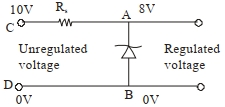
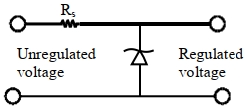
\(V_b=8 \text { volt }\)\(V_A-V_B=8 \text { volt }\)
Current through zener diode,
\(i =\frac{ P }{ V }=\frac{1.6 W }{8 V }=0.2\,A\)
\(V _{ C }- V _{ A }=10-8 \text { volt }\)
\(\therefore R =\frac{ V _{ C }- V _{ A }}{ i }=\frac{2 V }{0.2 A }=10\,\Omega\)
[Note : A zener diode can regulate only if input voltage is \(\geq\) zener breakdown voltage the range of input voltage should be \(8\) to \(10\,V\) so that output voltage remains constant \(=8\,V\) ]
-
- (A) \(I _b=1.0\,\mu A\)
- (B) \(I _{ b }=0.10\,\mu A\)
- (C) \(I_b=100\,\mu A\)
- (D) \(I _{ b }=10\,\mu A\)
Show answer and solution
Correct Answer: (D)
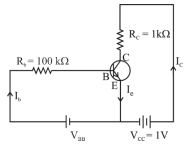
Considering the transistor in saturation mode\(V _{ CE }=0\)
Using KVL
\(-I_c R_c+V_{c c}=0\)
\(I_c=\frac{V_{ cC }}{R_c}=\frac{1}{1 \times 10^3}\)
\(I_c=10^{-3}\,A\)
\(\beta=\frac{I_c}{I_b}\)
\(I_b=\frac{10^{-3}}{100} \Rightarrow 10^{-5}\,A \Rightarrow I_b=10\,\mu A\)
-
- (A) \(6\)
- (B) \(9\)
- (C) \(3\)
- (D) \(12\)
Show answer and solution
Correct Answer: (C)
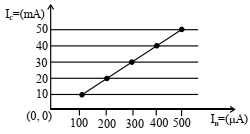
Power gain\(\Rightarrow A _{ V } \cdot A _1= B \frac{ R _{ C }}{ R _{ B }} \cdot B = B ^2 \frac{ R _{ C }}{ R _{ B }}\)
\(=\left(\frac{(20-10) \times 10^{-3}}{(200-100) \times 10^{-6}}\right) \times \frac{1 \times 10^3}{10 \times 10^3}=10^3\)
Hence \(x =3\)
-
- (A) Both \(A\) and \(R\) are true and \(R\) is correct explanation \(A\)
- (B) Both \(A\) and \(R\) are true but \(R\) is \(NOT\) the correct explanation \(A\)
- (C) \(A\) is false but \(R\) is true
- (D) \(A\) is true but \(R\) is false
Show answer and solution
Correct Answer: (C)
Theory based Photodiodes are operated in reverse bias condition. For \(P - N\) junction current in forward bias (for \(\left.V \geq V_0\right)\) is always greater than current in reverse bias \(\left(\right.\) for \(V \leq V _{ z }\) ) Hence Assertion if false but Reason is true -
- (A) \(A\) is false but \(R\) is true
- (B) Both \(A\) and \(R\) are true but \(R\) is NOT the correct explanation of \(A\)
- (C) \(A\) is true but \(R\) is false
- (D) Both \(A\) and \(R\) are true and \(R\) is the correct explanation of \(A\)
Show answer and solution
Correct Answer: (B)
Photodiodes are operated in reverse bias as fractional change in current due to light is more easy to detect in reverse bias. -
- (A) Both \(A\) and \(R\) are correct and \(R\) is the correct explanation of \(A\)
- (B) Both \(A\) and \(R\) are correct but \(R\) is NOT the correct explanation of \(A\)
- (C) \(A\) is correct but \(R\) is not correct
- (D) \(A\) is not correct but \(R\) is correct
Show answer and solution
Correct Answer: (C)
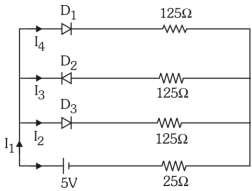
In forward biased condition, diffusion of majority charge carriers takes place from \(p\)-side to \(n\)-side which constitute the diffusion current. - 31. If each diode has a forward bias resistance of \(25\,\Omega\) in the below circuit,Which of the following options is correct:
 2023 Medium
- (A) \(\frac{ I _3}{ I _4}=1\)
- (B) \(\frac{ I _2}{ I _3}=1\)
- (C) \(\frac{I_1}{I_2}=1\)
- (D) \(\frac{I_1}{I_2}=2\)
Show answer and solution
Correct Answer: (D)
\(R _{ eq }=\frac{150 \times 150}{300}+25=100 \Omega\)\(I _1=\frac{5}{10}=0.05\,A\)
\(I _2= I _4=\frac{0.05}{2}=0.025\,A\)
\(\frac{ I _1}{ I _2}=2\)
-
- (A) \(110\)
- (B) \(0.9\)
- (C) \(210\)
- (D) \(9\)
Show answer and solution
Correct Answer: (A)
Current gain in common emitter transistor\(\beta=\frac{\Delta I _{ C }}{\Delta I _{ B }}=\frac{16 mA -5 mA }{200 \mu A -100 \mu A }=\frac{11 mA }{100 \mu A }=110\)
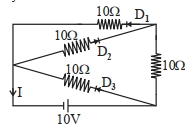
- 33. In the given circuit, the current \((I)\) through the battery will be \(..........\,A\)
 2023 Medium
- (A) \(1.5\)
- (B) \(1\)
- (C) \(2.5\)
- (D) \(2\)
Show answer and solution
Correct Answer: (A)
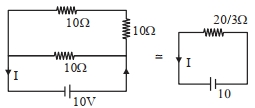
In the circuit \(D_1\) and \(D_3\) are forward biased and \(D_2\) is reverse biased.\(\therefore I =\frac{10}{20 / 3}=\frac{3}{2}\,A =1.5\,A\)
-
- (A) \((A) \rightarrow I, (B) \rightarrow II, (C) \rightarrow III, (D) \rightarrow IV\)
- (B) \((A) \rightarrow II, (B) \rightarrow I, (C) \rightarrow III, (D) \rightarrow IV\)
- (C) \((A) \rightarrow II, (B) \rightarrow III, (C) \rightarrow I, (D) \rightarrow IV\)
- (D) \((A) \rightarrow III, (B) \rightarrow I, (C) \rightarrow II, (D) \rightarrow IV\)
Show answer and solution
Correct Answer: (B)
Based on theory. -
- (A) \(OR\)
- (B) \(NOR\)
- (C) \(NAND\)
- (D) \(AND\)
Show answer and solution
Correct Answer: (B)
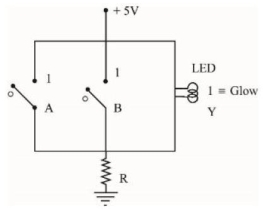
Circuit is closed when neither \(A\) nor \(B\) is closed \(\Rightarrow\) current flows for \(A=0 B=0\) when either or both of \(A\) and \(B\) is closed we get current bypass from switchHence it is "\(NOR\)" gate
-
- (A) Both Statement \(I\) and statement \(II\) are incorrect
- (B) Statement \(I\) is incorrect but statement \(II\) is correct
- (C) Both Statement \(I\) and statement \(II\) are correct
- (D) Statement \(I\) is correct but statement \(II\) is incorrect
Show answer and solution
Correct Answer: (D)
Statement\(-I\) is correctWhen \(P-N\) junction is formed an electric field is generated form \(N\)-side to \(P\)-side due to which barrier potential arises \& majority charge carrier can not flow through the junction due to barrier potential so current is \(zero\) unless we apply forward bias voltage.
-
- (A) Both \(n_e\) and resistance decrease
- (B) Both \(n _{ e }\) and resistance increase
- (C) \(n _{ e }\) increases, resistance decreases
- (D) \(n _{ e }\) decreases, resistance increases
Show answer and solution
Correct Answer: (C)
As temperature increases, more electron excite to conduction band and hence conductivity increases, therefore resistance decreases. -
- (A) \(OR\)
- (B) \(NAND\)
- (C) \(NOR\)
- (D) \(AND\)
Show answer and solution
Correct Answer: (B)
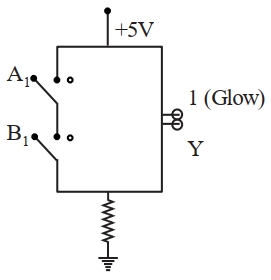
\(Y =\overline{ A _1 \odot B _1}\,\,\,\,NAND\)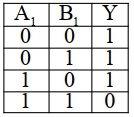
-
- (A) \(AND\)
- (B) \(NOR\)
- (C) \(OR\)
- (D) \(NAND\)
Show answer and solution
Correct Answer: (A)
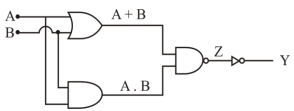
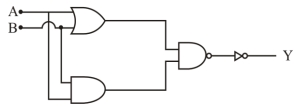
\(Z =\overline{(A+B) \cdot(A \cdot B)}\)\(Y =\bar{Z}=(A+B) \cdot(A \cdot B)\)
\(Y =A \cdot B\)
\(\therefore\) It is an \(AND\) Gate
-
- (A) \(C\) and \(D\)
- (B) \(A\)
- (C) \(C\)
- (D) \(B\)
Show answer and solution
Correct Answer: (C)
\(LED\) works in forward biasing and light energy maybe slightly less or equal to band gap. -
- (A) \(3.82\)
- (B) \(5.9\)
- (C) \(2.12\)
- (D) \(4.25\)
Show answer and solution
Correct Answer: (D)
\(=\left(m_A-m_B-m_D\right) \times 931.5\,MeV\)\(=(238.05079-234.04363-4.00260) \times 931.5\)
\(\Rightarrow 4.25\,Mev\)
-
- (A) \(3\)
- (B) \(2\)
- (C) \(1\)
- (D) \(4\)
Show answer and solution
Correct Answer: (D)
Energy released \(=(\Delta m )_{ amu } \times 931.5\,MeV\)\(=\left( m _{ u }- m _{ Th }- m _{ He }\right)_{ amu } \times 931.5\,MeV\)
\(=0.0044 \times 931.5\,MeV =4.0986\,MeV\)
- 43. A free neutron decays into a proton but a free proton does not decay into neutron. This is because 2023 Medium
- (A) neutron is an uncharged particle
- (B) proton is a charged particle
- (C) neutron is a composite particle made of a proton and an electron
- (D) neutron has larger rest mass than proton
Show answer and solution
Correct Answer: (D)
As neutron has more rest mass than proton it will require energy to decay proton into neutron. -
- (A) \(2\)
- (B) \(4\)
- (C) \(6\)
- (D) \(8\)
Show answer and solution
Correct Answer: (A)
\(\frac{ v _1}{ v _2}=\frac{ m _2}{ m _1}=\frac{ A _2}{ A _1}=\frac{2}{1}\) -
- (A) \(1\)
- (B) \(2\)
- (C) \(3\)
- (D) \(4\)
Show answer and solution
Correct Answer: (B)
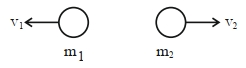
\(\frac{ v _1}{ v _2}=\frac{3}{2}\)\(m _1 v _1= m _2 v _2 \Rightarrow \frac{ m _1}{ m _2}=\frac{2}{3}\)
Since, Nuclear mass density is constant
\(\frac{ m _1}{\frac{4}{3} \pi r _1^3}=\frac{ m _2}{\frac{4}{3} \pi r _2^3}\)
\(\left(\frac{ r _1}{ r _2}\right)^3=\frac{ m _1}{ m _2}\)
\(\frac{ r _1}{ r _2}=\left(\frac{2}{3}\right)^{\frac{1}{3}}\)
\(\text { So, } x =2\)
-
- (A) \(120\)
- (B) \(121\)
- (C) \(122\)
- (D) \(159\)
Show answer and solution
Correct Answer: (B)
Initial binding energy \(=242 \times 7.6\,MeV\)Final binding energy
\(=121 \times 8.1\,MeV +121 \times 8.1\,MeV\)
\(=242 \times 8.1\,MeV\)
Total gain in binding energy
\(=242(8.1-7.6)=121\,MeV\)
-
- (A) \(64\)
- (B) \(40\)
- (C) \(32\)
- (D) \(256\)
Show answer and solution
Correct Answer: (D)
\(N = N _0\left(\frac{1}{2}\right)^{ n }\)\(\frac{ N _0}{8}= N _0\left(\frac{1}{2}\right)^{ n }\)
\(n =3\)
\(3 \text { half lives }=3 \text { days }\)
\(1 \text { half life }=1 \text { day }\)
\(5 \text { days }=5 \text { half life }\)
\(N = N _0\left(\frac{1}{2}\right)^{ n }\)
\(8 \times 10^{-3}= N _0\left(\frac{1}{2}\right)^5\)
\(N _0=256 \times 10^{-3}\,kg\)
\(N _0=256\,g\)
-
- (A) \(87\)
- (B) \(88\)
- (C) \(80\)
- (D) \(86\)
Show answer and solution
Correct Answer: (A)
\(P =92-2-2+1-1-1\)\(P =92-5\)
\(P=87\)
-
- (A) \(301\)
- (B) \(302\)
- (C) \(300\)
- (D) \(303\)
Show answer and solution
Correct Answer: (C)
\(\frac{ dN _1}{ dt }=-\lambda_1 N \quad \frac{ dN _2}{ dt }=-\lambda_2 N\)\(\frac{ dN }{ dt }=-\left(\lambda_1+\lambda_2\right) N\)
\(\Rightarrow \lambda_{\text {eq }}=\lambda_1+\lambda_2\)
\(\Rightarrow \frac{1}{t_{1 / 2}}=\frac{1}{300}+\frac{1}{30}=\frac{11}{300}\)
\(\Rightarrow t _{1 / 2}=\frac{300}{11}\)
-
- (A) \(11\)
- (B) \(12\)
- (C) \(14\)
- (D) \(16\)
Show answer and solution
Correct Answer: (A)
\(\text { density of nuclei }=\frac{\text { mass of nuclei }}{\text { volume of nuclei }}\)\(\rho=\frac{1.6 \times 10^{-27} A }{\frac{4}{3} \pi\left(1.5 \times 10^{-15}\right)^3 A } \)
\(=\frac{1.6 \times 10^{-27}}{14.14 \times 10^{-45}}=0.113 \times 10^{18}\)
\(\rho_{ W }=10^3\)
\(\text { Hence } \frac{\rho}{\rho_w}=11.31 \times 10^{13}\)
No questions on this page match these filters.
Other years
Frequently asked
How many JEE Mains 2023 Physics questions are on ExamBro?
644 questions, each with the correct answer and a full solution.
Which JEE Mains 2023 Physics chapter is asked the most?
Current electricity, with 46 questions, followed by Gravitation with 34.
How difficult are JEE Mains 2023 Physics questions?
14% are easy, 72% medium and 14% hard.