


Questions
Newest firstShowing 1–17 of 17 questions
-
- (A) 1
- (B) 2
- (C) 4
- (D) 0.5
Show answer and solution
Correct Answer: (B)
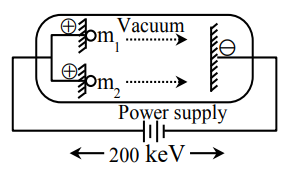
\(\lambda_{ d }=\frac{ h }{\sqrt{2 mK.E.}}\)
Here KE is same i.e. 200 k eV
So \(\lambda_{ d } \propto \frac{1}{\sqrt{m}}\)
\(\frac{\left(\lambda_{ d }\right)_{ m _1}}{\left(\lambda_{ d }\right)_{ m _2}}=\sqrt{\frac{ m _2}{m_1}}=\sqrt{4}=2\)
\(\left(\lambda_{ d }\right)_{ m _1}=2\left(\lambda_{ d }\right)_{ m _2}\)
So \(x =2\). -
- (A) Statement I is false but Statement II is true
- (B) Both Statement I and Statement II are false
- (C) Both Statement I and Statement II are true
- (D) Statement I is true but Statement II is false
Show answer and solution
Correct Answer: (C)
According to Heisenberg's uncertainty principle, it is impossible to determine simultaneously the exact position and momentum of particle like electron.
If
\(\begin{aligned} & \Delta p=\Delta x \\ & \Delta p \cdot \Delta x \geq \frac{h}{4 \pi} \\ &(\Delta p)^2 \geq \frac{h}{4 \pi} \\ & \Delta p \geq \sqrt{\frac{h}{\pi}} \times \frac{1}{2} \\ & m \Delta v \geq \sqrt{\frac{h}{\pi}} \times \frac{1}{2} \\ & \Delta v \geq \sqrt{\frac{h}{\pi}} \times \frac{1}{2 m}\end{aligned}\) -
- (A) \(600\)
- (B) \(657\)
- (C) \(661\)
- (D) \(668\)
Show answer and solution
Correct Answer: (C)
\(\lambda=\frac{\mathrm{h}}{\mathrm{mv}}\)\(\lambda=\frac{\mathrm{hv}}{\mathrm{mv}^2}\)
\(\frac{\mathrm{mv}^2}{\mathrm{~h}}=\frac{\mathrm{v}}{\lambda}=\mathrm{v} \text { (frequency) }\)
\(\text { Given } \frac{1}{2} \mathrm{mv}^2=2.18 \times 10^{-18} \mathrm{~J}\)
\(\mathrm{~h}=6.6 \times 10^{-34}\)
\(\mathrm{v}=\frac{4.36 \times 10^{-18}}{6.6 \times 10^{-34}}=660.60 \times 10^{13} \mathrm{~Hz}\)
\(\approx 661 \times 10^{13} \mathrm{~Hz}\)
- 4. The de-Broglie's wavelength of an electron in the \(4^{\text {th }}\) orbit is _______. \(\pi a_0 .\left(a_0=\right.\) Bohr's radius) 2024 Medium
- (A) \(5\)
- (B) \(4\)
- (C) \(7\)
- (D) \(8\)
Show answer and solution
Correct Answer: (D)
\(2 \pi \mathrm{r}_{\mathrm{u}}=\mathrm{n} \lambda_{\mathrm{d}}\)\(2 \pi \mathrm{a}_0 \frac{\mathrm{n}^2}{\mathrm{z}}=\mathrm{n} \lambda_{\mathrm{d}}\)
\(2 \pi \mathrm{a}_0 \frac{4^2}{1}=4 \lambda_{\mathrm{d}}\)
\(\lambda_{\mathrm{d}}=8 \pi \mathrm{a}_0\)
-
- (A) \(6\)
- (B) \(5\)
- (C) \(4\)
- (D) \(7\)
Show answer and solution
Correct Answer: (D)
\(\lambda_{ d }=\frac{ h }{ mv }=\frac{ h }{\sqrt{2 mKE }}=\frac{6.6 \times 10^{-34}}{\sqrt{2 \times 9 \times 10^{-31} \times 4.5 \times 10^{-29}}}\)\(=\frac{6.6 \times 10^{-34}}{\sqrt{9^2 \times 10^{-60}}}\)
\(=\frac{6.6 \times 10^{-34}}{9 \times 10^{-30}}=\frac{6.6}{9} \times 10^{-4}\)
\(=7.3 \times 10^{-5}\,m\)
\(\text { Therefore Ans }=7\)
-
- (A) \(1757\)
- (B) \(1758\)
- (C) \(1756\)
- (D) \(1755\)
Show answer and solution
Correct Answer: (B)
\(v_{e}=x v_{N}\)\(\lambda_{ e }=\lambda_{ N }\)
\(\Rightarrow \frac{ h }{ m _{ e } v _{ c }}=\frac{ h }{ m _{ N } v_{ N }}\)
\(v_{ e }=\frac{ m _{ N }}{ m _{ e }} \cdot v _{ N }\)
\(=\frac{1.6 \times 10^{-27}}{9.1 \times 10^{-31}} v_{ N }\)
\(v_{ e }=1758.24 \times v_{ N }\)
-
- (A) \(1\)
- (B) \(2\)
- (C) \(3\)
- (D) \(4\)
Show answer and solution
Correct Answer: (B)
\(\lambda=\frac{ h }{\sqrt{2 mqV }}\)\(\frac{\lambda_{ Li }}{\lambda_{ p }}=\sqrt{\frac{ m _{ p }( e ) V }{ m _{ Li }(3 e )( V )}} \quad m _{ Li }=8.3 m _{ p }\)
\(\frac{\lambda_{ Li }}{\lambda_{ p }}=\sqrt{\frac{1}{8.3 \times 3}}=\frac{1}{5}=0.2=2 \times 10^{-1}\)
-
- (A) \(9\)
- (B) \(4\)
- (C) \(5\)
- (D) \(6\)
Show answer and solution
Correct Answer: (D)
De-broglie-wave length of electron:\(\lambda_{c}=\frac{h}{\sqrt{2 m(\mathrm{KE})}}\)
\(\because \mathrm{e}^{-}\,{\text {is accelerated }}{\text { from rest }}{\Rightarrow \mathrm{KE}=\mathrm{q} \times \mathrm{V}}\)
\(\lambda=\frac{\mathrm{h}}{\sqrt{2 \mathrm{mqv}}}\)
\(=\frac{6.63 \times 10^{-34}}{\sqrt{2 \times 1.6 \times 10^{-19} \times 9.1 \times 10^{-31} \times 40 \times 10^{3}}}\)
\(=0.614 \times 10^{-11} \,\mathrm{~m}\)
\(=6.16 \times 10^{-12} \,\mathrm{~m}\)
Nearest integer \(=6\)
OR
\(=\frac{12.3}{\sqrt{V}} \,\mathring A\)
\(=\frac{12.3}{200}=6.15 \times 10^{-12}\, \mathrm{~m}\)
-
- (A) \(7\)
- (B) \(9\)
- (C) \(12\)
- (D) \(18\)
Show answer and solution
Correct Answer: (B)
Energy incident \(=\frac{ hc }{\lambda}\)\(=\frac{6.63 \times 10^{-34} \times 3.0 \times 10^{8}}{248 \times 10^{-9} \times 1.6 \times 10^{-19}} eV\)
\(=\frac{6.63 \times 3 \times 100}{248 \times 1.6}\)
\(=0.05 eV \times 100=5 eV\)
Now using \(E =\phi+ K . E\)
\(5=3+ K . E\)
\(K . E .=2 eV =3.2 \times 10^{-19} J\)
for debroglie wavelength \(\lambda=\frac{ h }{ mv }\)
\(K . E =\frac{1}{2} mv ^{2}\)
so \(v =\sqrt{\frac{2 KE }{ m }}\)
hence \(\lambda=\frac{ h }{\sqrt{2 KE \times m }}\)
\(=\frac{6.63 \times 10^{-34}}{\sqrt{2 \times 3.2 \times 10^{-19} \times 9.1 \times 10^{-31}}}\)
\(=\frac{6.63}{7.6} \times \frac{10^{-34}}{10^{-25}}=\frac{66.3 \times 10^{-10} m }{7.6}\)
\(=8.72 \times 10^{-10} m\)
\(\approx 9 \times 10^{-10} m\)
\(=9 ^o\)
-
- (A) \(8 \pi a_{0}\)
- (B) \(2 \pi a_{0}\)
- (C) \(4 \pi a_{0}\)
- (D) \(6 \pi a_{0}\)
Show answer and solution
Correct Answer: (A)
\(2 \pi r=n \lambda\)for \(\quad \mathrm{n}=1, \mathrm{r}=\mathrm{a}_{0}\)
\(\mathrm{n}=4, \mathrm{r}=16 \mathrm{a}_{0}\)
So, \(\quad 2 \pi \times 16 \mathrm{a}_{0}=4 \times \lambda\)
\(\lambda=8 \pi \mathrm{a}_{0}\)
-
- (A) \(0.40\)
- (B) \(1.50\)
- (C) \(1.0\)
- (D) \(0.75\)
Show answer and solution
Correct Answer: (D)
\(2\pi r = n\lambda \)\(\lambda = \frac{{2\pi r}}{n} = \frac{{2\pi {n^2}{a_0}}}{{n \times Z}} = 2\pi \frac{n}{Z}{a_0}\)
\(\lambda = 1.5\pi {a_0}\)
\(\therefore \,2\pi \frac{n}{Z}{a_0} = 1.5\pi {a_0}\)
\(\therefore \frac{n}{Z} = \frac{{1.5}}{2} = 0.75\)
-
- (A) \(\lambda \propto \frac{1}{{\left( {v - {v_0}} \right)}}\)
- (B) \(\lambda \propto \frac{1}{{{{\left( {v - {v_0}} \right)}^{\frac{1}{4}}}}}\)
- (C) \(\lambda \propto \frac{1}{{{{\left( {v - {v_0}} \right)}^{\frac{3}{2}}}}}\)
- (D) \(\lambda \propto \frac{1}{{{{\left( {v - {v_0}} \right)}^{\frac{1}{2}}}}}\)
Show answer and solution
Correct Answer: (D)
\(\lambda = \frac{h}{{mv}}\)According to Einstein's theory of photoelectric effect:
\(hv = h{v_0} + KE\)
\(hv = h{v_0} + \frac{1}{2}m{v^2}\)
\(2h(v - {v_0}) = m{v^2}\)
\(\frac{{2h(v - {v_0})}}{m} = {v^2}\)
\(v \propto {(v - {v_0})^{\frac{1}{2}}}\)
\(\lambda \propto \frac{h}{{m{{(v - {v_0})}^{\frac{1}{2}}}}}\)
\(\lambda \propto \frac{1}{{{{(v - {v_0})}^{\frac{1}{2}}}}}\)
- 13. The de-Broglie's wavelength of electron present in first Bohr orbit of \('H'\) atom is 2018 Hard
- (A) \(4 \times 0.529\,\mathop A\limits^o \)
- (B) \(2\pi \times 0.529\,\mathop A\limits^o \)
- (C) \(\frac{{0.529}}{{2\pi }}\mathop A\limits^o \)
- (D) \(0.529\,\mathop A\limits^o \)
Show answer and solution
Correct Answer: (B)
First Bohr orbit of \(H\) atom has radius\(r = 0.529\,\mathop A\limits^o \)
Also, the angular momentum is quantised.
\(mvr = \frac{h}{{2\pi }}\)
\(2\pi r = \frac{h}{{mv}} = \lambda \)
\(\lambda = 2\pi \times 0.529\,\mathop A\limits^o \)
-
- (A) \(\sqrt {meV}\)
- (B) \(\sqrt {2meV}\)
- (C) \(meV\)
- (D) \(2meV\)
Show answer and solution
Correct Answer: (B)
Kinetic energy \(=e V=\frac{1}{2} m u^{2}\)\(u=\sqrt{\frac{2 e V}{m}}\)
Here, u is the velocity of the electron.
The de broglie wavelength is \(\lambda=\frac{h}{m u}\)
\(\frac{h}{\lambda}=m u\)
Substitute equation (1) in equation (2)
\(\frac{h}{\lambda}=m \sqrt{\frac{2 e V}{m}}=\sqrt{2 m e V}\)
-
- (A) Visible photon \(>\) Thermal neutron \(>\) Thermal electron
- (B) Thermal proton \(>\) Thermal electron \(>\) Visible photon
- (C) Thermal proton \(>\) Visible photon \(>\) Thermal electron
- (D) Visible photon \(>\) Thermal electron \(>\) Thermal neutron
Show answer and solution
Correct Answer: (D)
Kinetic energy of any particle \( = \frac{3}{2}\,KT\)Also \(K.E. = \frac{1}{2}\,m{v^2}\)
\(\frac{1}{2}m{v^2} = \frac{3}{2}KT \Rightarrow {v^2} = \frac{{3KT}}{m}\)
\(v = \sqrt {\frac{{3KT}}{m}} \)
De-broglie wavelength
\( = \lambda = \frac{h}{{mv}} = \frac{h}{{m\sqrt {\frac{{3KT}}{m}} }}\)
\(\lambda = \frac{h}{{\sqrt {3KTm} }}\,\lambda \propto \frac{1}{{\sqrt m }}\)
Mass of electron \(<\) mass of neutron
\(\lambda \) (electron) \(>\) \(\lambda \) (neutron)
- 16. The de-Broglie wavelength of a particle of mass \(6.63\,g\) moving with a velocity of \(100\,ms^{-1}\) is 2014 Medium
- (A) \(10^{-33}\,m\)
- (B) \(10^{-35}\,m\)
- (C) \(10^{-31}\,m\)
- (D) \(10^{-25}\,m\)
Show answer and solution
Correct Answer: (A)
De Broglie wavelength \(\left( \lambda \right) = \frac{h}{{mv}}\)\(\frac{{6.63 \times {{10}^{ - 34}}}}{{6.63 \times {{10}^{ - 3}} \times 100}} = {10^{ - 33}}\,m\)
- 17. The de Broglie wavelength of a car of mass \(1000\, kg\) and velocity \(36\, km/hr\) is 2013 Medium
- (A) \(6.626\times10^{-34}\, m\)
- (B) \(6.626\times10^{-38}\, m\)
- (C) \(6.626\times10^{-31}\, m\)
- (D) \(6.626\times10^{-30}\, m\)
Show answer and solution
Correct Answer: (B)
\(\lambda = \frac{h}{{mv}}\)\(h = 6.6 \times {10^{ - 34}}\,J - s\)
\(m = 1000\,kg\)
\(v = 36\,km/hr = \frac{{36 \times {{10}^3}}}{{60 \times 60}}\,m/\sec = 10\,m/\sec \)
\(\lambda = \frac{{6.6 \times {{10}^{ - 34}}}}{{{{10}^3} \times 10}} = 6.6 \times {10^{ - 38}}\,m\)
No questions on this page match these filters.
Other STD 11 - Structure of atom topics
Frequently asked
How many De Broglie's principle questions came in JEE Mains?
17 questions from 2013–2026, each with the correct answer and a full solution.
How difficult are De Broglie's principle questions?
6% are easy, 53% medium and 41% hard.