


Questions
Newest firstShowing 1–50 of 58 questions
-
- (A) A, B, C, D & E
- (B) B & C only
- (C) B, C & D only
- (D) A, C & D only
Show answer and solution
Correct Answer: (B)
(A) Dipole moment: \( NF_{3} < NH_{3} \)
(B) \( BeH_{2} \) is '\( sp \)' hybridized, linear molecule with zero dipole moment.
(C) \( O_{2}^{-2} \Rightarrow \) bond order = 1;
\( F_{2} \Rightarrow \) bond order = 1
(D) Formal charge on central oxygen atom in \( O_{3} \) is +1.
(E) In \( NO_{2} \); nitrogen does not follow octet rule. -
- (A) Both Statement I and Statement II are true
- (B) Both Statement I and Statement II are false
- (C) Statement I is true but Statement II is false
- (D) Statement I is false but Statement II is true
Show answer and solution
Correct Answer: (C)
The bond order of the given oxygen species can be calculated using molecular orbital theory:
For \(O_2\) (16 electrons), the configuration is Sigma 1s2, Sigma* 1s2, Sigma 2s2, Sigma* 2s2, Sigma 2pz2, (Pi 2px2, Pi 2py2), (Pi* 2px1, Pi* 2py1 .
Bond order = \(\dfrac{10 - 6}{2} = 2\). Number of unpaired electrons = \(2\).
For \(O_2^+\) (15 electrons), one electron is removed from a \(\pi^{*}\) orbital.
Bond order = \(\dfrac{10 - 5}{2} = 2.5\). Number of unpaired electrons = \(1\).
For \(O_2^-\) (17 electrons), one electron is added to a \(\pi^{*}\) orbital.
Bond order = \(\dfrac{10 - 7}{2} = 1.5\). Number of unpaired electrons = \(1\).
For \(O_2^{2-}\) (18 electrons), two electrons are added to the \(\pi^{*}\) orbitals.
Bond order = \(\dfrac{10 - 8}{2} = 1\). Number of unpaired electrons = \(0\).
Since bond length is inversely proportional to bond order, the correct sequence of bond lengths is \(O_2^+ < O_2 < O_2^- < O_2^{2-}\). Thus, Statement I is true.
The number of unpaired electrons for the species are \(2, 1, 1,\) and \(0\) respectively. The correct sequence is \(O_2 > O_2^+ = O_2^- > O_2^{2-}\). Thus, Statement II is false.
Answer: Statement I is true but Statement II is false -
- (A) Both Statement I and Statement II are false
- (B) Both Statement I and Statement II are true
- (C) Statement I is true but Statement II is false
- (D) Statement I is false but Statement II is true
Show answer and solution
Correct Answer: (A)
In \(BF _4^{-}, SiF _4\) and \(XeF _4\) all bond lengths are identicalMolecules B.O. \(O _2^{+}\) → 2.5 \(O_2^{-}\) → 1.5 \(O _2^{2-}\) → 1 \(F_2\) → 1 - 4. Pair of species among the following having same bond order as well as paramagnetic character will be - 2026 Hard
- (A) \(O_{2}^{+}, N_{2}^{2-}\)
- (B) \(O_{2}^{-}, N_{2}^{+}\)
- (C) \(O_{2}^{+}, N_{2}^{-}\)
- (D) \(O_{2}^{-}, N_{2}\)
Show answer and solution
Correct Answer: (C)
Species Bond order Magnetic Nature \(O _2^{+}\) 2.5 Paramagnetic \(O _2^{-}\) 1.5 Paramagnetic \(O _2^{+}\) 2.5 Paramagnetic \(N _2^{-}\) 2.5 Paramagnetic \(N _2^{2-}\) 2 Paramagnetic -
- (A) (A) \(-(\mathrm{IV}),(\mathrm{B})-(\mathrm{II}),(\mathrm{C})-(\mathrm{I}),(\mathrm{D})-(\mathrm{III})\)
- (B) \((\mathrm{A})-(\mathrm{III}),(\mathrm{B})-(\mathrm{I}),(\mathrm{C})-(\mathrm{II}),(\mathrm{D})-(\mathrm{IV})\)
- (C) (A) \(-(\mathrm{IV}),(\mathrm{B})-(\mathrm{I}),(\mathrm{C})-(\mathrm{II}),(\mathrm{D})-(\mathrm{III})\)
- (D) \((\mathrm{A})-(\mathrm{III}),(\mathrm{B})-(\mathrm{II}),(\mathrm{C})-(\mathrm{I}),(\mathrm{D})-(\mathrm{IV})\)
Show answer and solution
Correct Answer: (A)
\(\begin{aligned}
& \text { (A) }\left[\mathbf{M n B r}_4\right]^{2-} \\
& \mathrm{Mn}^{+2} \Rightarrow[\mathrm{Ar}] 3 \mathrm{~d}^5
\end{aligned}\)
In presence of ligand field
\(\Rightarrow \mathrm{sp}^3\) hybridization, paramagnetic in nature
(B) \(\left[\mathrm{FeF}_6\right]^{3-}\)
\(\mathrm{Fe}^{+3} \Rightarrow[\mathrm{Ar}] 3 \mathrm{~d}^5\)
In presence of ligand field
\(\Rightarrow \mathrm{sp}^3 \mathrm{~d}^2\) hybridization, paramagnetic in nature
(C) \(\left[\mathrm{Co}\left(\mathrm{C}_2 \mathrm{O}_4\right)_3\right]^{3-}\)
\(\mathrm{Co}^{+3} \Rightarrow[\mathrm{Ar}] 3 \mathrm{~d}^6\)
In presence of ligand field
\(\Rightarrow d^2 \mathrm{sp}^3\) hybridization, diamagnetic in nature
(D) \(\left[\mathrm{Ni}(\mathrm{CO})_4\right]\)
\(\mathrm{Ni}^0 \Rightarrow[\mathrm{Ar}] 3 \mathrm{~d}^8 4 \mathrm{~s}^2\)
In presence of ligand field
\(\Rightarrow \mathrm{sp}^3\) hybridization, diamagnetic in nature -
- (A) 10
- (B) 8
- (C) 6
- (D) 12
Show answer and solution
Correct Answer: (C)
\(\mathrm{O}_2 \rightarrow 2\) unpaired electrons according to MOT
\(\mathrm{O}_2^{+} \rightarrow 1\) unpaired electrons according to MOT
\(\mathrm{O}_2^{-} \rightarrow 1\) unpaired electrons according to MOT
\(\mathrm{NO} \rightarrow\) odd electron species
\(\mathrm{NO}_2 \rightarrow\) odd electron species
\(\mathrm{K}_2\left[\mathrm{NiCl}_4\right] \rightarrow \mathrm{Ni}^{2+} \Rightarrow 3 \mathrm{~d}^8\) weak Ligand, C.N. \(=4\)
\(\Rightarrow\) Tetrahedral, Paramagnetic with 2 unpaired electrons -
- (A) B only
- (B) A & C only
- (C) A & E only
- (D) A & D only
Show answer and solution
Correct Answer: (D)
\(\begin{array}{lcc}
& & \text { No. of unpaired } \mathrm{e}^{-} \\
\text {(A) } & \mathrm{O}_2 & 2 \\
\text { (B) } & \mathrm{N}_2 & 0 \\
\text { (C) } & \mathrm{F}_2 & 0 \\
\text { (D) } & \mathrm{S}_2 & 2 \\
\text { (E) } & \mathrm{Cl}_2 & 0
\end{array}\)
If species contain unpaired electron than it is paramagnetic.
So A \& D are paramagnetic. -
- (A) Both Statement \(I\) and Statement \(II\) are false
- (B) Both Statement \(I\) and Statement \(II\) are true
- (C) Statement \(I\) is false but Statement \(II\) is true
- (D) Statement \(I\) is true but Statement \(II\) is false
Show answer and solution
Correct Answer: (C)
A \(\pi\) bonding molecular orbital has higher electron density above and below inter nuclear axis.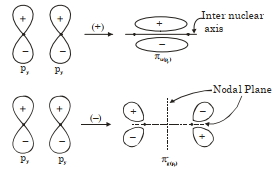
-
- (A) \(1\)
- (B) \(2\)
- (C) \(5\)
- (D) \(8\)
Show answer and solution
Correct Answer: (B)
\(\left(12 \mathrm{e}^{-}\right): \sigma 1 \mathrm{~s}^2, \sigma^* 1 \mathrm{~s}^2, \sigma 2 \mathrm{~s}^2, \sigma^* 2 \mathrm{~s}^2\left[\pi 2 \mathrm{p}_{\mathrm{x}}^2=\pi 2 \mathrm{p}_{\mathrm{y}}^2\right]\)\(\text { B.O. }=\frac{8-4}{2}=2\)
\(\mathrm{O}_2\)
\(\left(16 \mathrm{e}^{-}\right): \sigma 1 \mathrm{~s}^2, \sigma^* 1 \mathrm{~s}^2, \sigma 2 \mathrm{~s}^2, \sigma^* 2 \mathrm{~s}^2, \sigma 2 \mathrm{pz}^2\)
\({\left[\pi 2 \mathrm{p}_{\mathrm{x}}^2=\pi 2 \mathrm{p}_{\mathrm{y}}^2\right]\left[\pi^* 2 \mathrm{p}_{\mathrm{x}}^1=\pi^* 2 \mathrm{p}_{\mathrm{y}}^1\right]}\)
\(\text { B.O. }=\frac{10-6}{2}=2\)
\(\mathrm{Be}_2\)
\(\left(8 \mathrm{e}^{-}\right): \sigma 1 \mathrm{~s}^2, \sigma^* 1 \mathrm{~s}^2, \sigma 2 \mathrm{~s}^2, \sigma^* 2 \mathrm{~s}^2\)
\(\text { B.O. }=\frac{4-4}{2}=0\)
\(\text {Li}_2\)
\(\left(6 \mathrm{e}^{-}\right): \sigma 1 \mathrm{~s}^2, \sigma^* 1 \mathrm{~s}^2, \sigma 2 \mathrm{~s}^2\)
-
- (A) \(1\)
- (B) \(2\)
- (C) \(3\)
- (D) \(4\)
Show answer and solution
Correct Answer: (B)
According to \(M.O.T.\)\(\mathrm{O}_2 \rightarrow\) no. of unpaired electrons \(=2\)
\(\mathrm{O}_2^{-} \rightarrow\) no. of unpaired electron \(=1\)
NO \(\rightarrow\) no. of unparred electron \(=1\)
\(\mathrm{CN}^{-} \rightarrow\) no. of unparred electron \(=0\)
\(\mathrm{O}_2^{2-} \rightarrow\) no. of unpaired electron \(=0\)
-
- (A) \(6\)
- (B) \(7\)
- (C) \(5\)
- (D) \(96\)
Show answer and solution
Correct Answer: (A)
\(\mathrm{CO} \Rightarrow\ \ \overline{\mathrm{C}} \equiv \stackrel{+}{\mathrm{O}} \ \ : \mathrm{BO}=3 \)\(\mathrm{NO}^{+} \Rightarrow\ \ \mathrm{N} \equiv \mathrm{O}^{+} \ \ : \mathrm{BO}=3\)
-
- (A) \(A, B, C\) only
- (B) \(A\) and \(C\) only
- (C) \(B, C, D\) only
- (D) \(B\) and \(D\) only
Show answer and solution
Correct Answer: (B)
* Molecular orbital should have maximum overlap.* Symmetry about the molecular axis should be similar.
-
- (A) \(3\)
- (B) \(7\)
- (C) \(6\)
- (D) \(1\)
Show answer and solution
Correct Answer: (D)
Magnetic behaviour Bond order \(\mathrm{H}_2\) Diamagnetic \(2\) \(\mathrm{He}\) Paramagnetic \(0.5\) \(\mathrm{O}_2^{+}\) Paramagnetic \(0.5\) \(\mathrm{N}_2^{2-}\) Paramagnetic \(2.5\) \(\mathrm{O}_2^{2-}\) Diamagnetic \(2\) \(\mathrm{F}_2\) Diamagnetic \(1\) \(\mathrm{Ne}_2^{+}\) Paramagnetic \(1\) \(\mathrm{B}_2\) Paramagnetic \(0.5\) -
- (A) \(4\)
- (B) \(12\)
- (C) \(6\)
- (D) \(7\)
Show answer and solution
Correct Answer: (A)
Antibonding molecular orbital from \(2 \mathrm{s}=1\)Antibonding molecular orbital from \(2 p=3\)
Total \(=4\)
-
- (A) \(08\)
- (B) \(07\)
- (C) \(06\)
- (D) \(09\)
Show answer and solution
Correct Answer: (A)
Two molecular orbitals \(\sigma 2 \mathrm{~s}\) and \(\sigma * 2 \mathrm{~s}\).Six molecular orbitals \(\sigma 2 \mathrm{p}_\iota\) and \(\sigma * 2 \mathrm{p}_\iota\). \(\pi 2 \mathrm{p}_{\mathrm{x}}, \pi 2 \mathrm{p}_{\mathrm{y}}\)
\(\pi * 2 \mathrm{p}_{\mathrm{x}}, \pi^* 2 \mathrm{p}_{\mathrm{y}}\)
-
- (A) \(2\)
- (B) \(3\)
- (C) \(4\)
- (D) \(8\)
Show answer and solution
Correct Answer: (C)
One unpaired \(\mathrm{e}^{-}\)is present in : \(\mathrm{C}_2^{-} ; \mathrm{O}_2^{-} ; \mathrm{H}_2^{+} ; \mathrm{He}_2^{+}\) -
- (A) \(6\)
- (B) \(7\)
- (C) \(9\)
- (D) \(10\)
Show answer and solution
Correct Answer: (A)
\( \mathrm{O}_2(16 \mathrm{e}):\left(\sigma_{1 \mathrm{~s}}\right)^2\left(\sigma_{1 \mathrm{~s}}^*\right)^2\left(\sigma_{2 \mathrm{~s}}\right)^2\left(\sigma_{2 \mathrm{~s}}^*\right)^2 \)\( \left(\sigma_{2 \mathrm{p}}\right)^2\left[\left(\pi_{2 \mathrm{p}}\right)^2=\left(\pi_{2 \mathrm{p}}\right)^2\right],\left[\left(\pi_{2 \mathrm{p}}^*\right)^1=\left(\pi_{2 \mathrm{p}}^*\right)^1\right]\)
Number of \(\mathrm{e}^{-}\)present in \(\left(\pi^*\right)\) of \(\mathrm{O}_2=2\)
Number of \(\mathrm{e}^{-}\)present in \(\left(\pi^*\right)\) of \(\mathrm{O}_2^{+}=1\)
Number of \(\mathrm{e}^{-}\)present in \(\left(\pi^*\right)\) of \(\mathrm{O}_2^{-}=3\)
So total \(\mathrm{e}^{-}\)in \(\left(\pi^*\right)=2+1+3=6\)
- 18. When \(\psi_{\mathrm{A}}\) and \(\psi_{\mathrm{B}}\) are the wave functions of atomic orbitals, then \(\sigma^*\) is represented by _______. 2024 Medium
- (A) \(\psi_A-2 \psi_B\)
- (B) \(\psi_A-\psi_B\)
- (C) \(\psi_A+2 \psi_B\)
- (D) \(\psi_A+\psi_B\)
Show answer and solution
Correct Answer: (B)
Antibonding molecular orbitals are formed by destructive interference of wave functions.\((\mathrm{ABMO}) \sigma^*=\psi_{\mathrm{A}}-\psi_{\mathrm{B}}\)
- 19. According to \(MO\) theory the bond orders for \(O _2{ }^{2-}\), \(CO\) and \(NO ^{+}\)respectively, are 2023 Medium
- (A) \(1,3\) and \(3\)
- (B) \(1, 3\) and \(2\)
- (C) \(1,2\) and \(3\)
- (D) \(2,3\) and \(3\)
Show answer and solution
Correct Answer: (A)
Theory based. - 20. In which of the following processes, the bond order increases and paramagnetic character changes to diamagnetic one? 2023 Medium
- (A) \(O _2 \rightarrow O _2^{2-}\)
- (B) \(NO \rightarrow NO ^{+}\)
- (C) \(N _2 \rightarrow N _2^{+}\)
- (D) \(O _2 \rightarrow O _2^{+}\)
Show answer and solution
Correct Answer: (B)
\(NO\) is paramagnetic with \(BO =2.5, NO ^{+}\)is diamagnetic with \(BO =3\) - 21. The bond order and magnetic property of acetylide ion are same as that of \(........\). 2023 Medium
- (A) \(NO ^{+}\)
- (B) \(O _2^{+}\)
- (C) \(O _2^{-}\)
- (D) \(N _2^{+}\)
Show answer and solution
Correct Answer: (A)
Acetylide ion \(\rightarrow C _2^{2-}(\overline{ C } \equiv \overline{ C })\)Bond order \(=3\) and Diamagnetic
\(NO ^{+} 14 e ^{-} \rightarrow\) Bond order \(=3\) and Diamagnetic
-
- (A) \(0,1,2,1\)
- (B) \(2,1,2,1\)
- (C) \(0,1,0,1\)
- (D) \(2,1,0,1\)
Show answer and solution
Correct Answer: (A)
\(N _2\)\(\sigma 1 s ^2 \sigma^* 1 s ^2 \sigma 2 s ^2 \sigma^* 2 s ^2 \pi 2 p _{ x }^2=\pi 2 p _y^2 \frac{\sigma 2 p _z^2}{\text { HOMO }}\)
\(N _2^{+}-\sigma 1 s ^2 \sigma^* 1 s ^2 \sigma^* 2 s ^2 \sigma^* 2 s ^2 \pi 2 p _{ x }^2=\pi 2 p _{ y }^2 \frac{\sigma 2 p _z^1}{\text { HOMO }}\)
\(O _2-\sigma 1 s ^2 \sigma^* 1 s ^2 \sigma 2 s ^2 \sigma^* 2 s ^2 \sigma 2 p _z^2\)
\(\pi 2 p _{ x }^2=\pi 2 p _{ y }^2\)
\(\pi^* 2 p _{ x }^1=\pi^* 2 p _{ y }^1( HOMO )\)
\(O _2^{+}-\sigma 1 s ^2 \sigma * 1 s ^2 \sigma 2 s ^2 \sigma * 2 s ^2 \sigma 2 p _z^2 \pi 2 p _{ x }^2=\pi 2 p _y^2\)
\(\pi^* 2 p _{ x }^1=\pi^* 2 p _{ y }^0( HOMO )\)
\(N _2 \Rightarrow 0 \text { unpaired } e ^{-} \text {in HOMO }\)
\(N _2^{+} \Rightarrow 1 \text { unpaired } e ^{-} \text {in HOMO }\)
\(O _2 \Rightarrow 2 \text { unpaired } e ^{-} \text {in HOMO }\)
\(O _2^{+} \Rightarrow 1 \text { unpaired } e ^{-} \text {in HOMO }\)
-
- (A) \(2\)
- (B) \(3\)
- (C) \(4\)
- (D) \(5\)
Show answer and solution
Correct Answer: (B)
\(CN ^{-}, NO ^{+}, O _{2}^{2+}\) have bond order \(=3\) -
- (A) \(4\)
- (B) \(1\)
- (C) \(2\)
- (D) \(3\)
Show answer and solution
Correct Answer: (C)
Diamagnetic species are: \(N _{2}, O _{2}{ }^{2-}\) -
- (A) \(O _{2}^{2-}< O _{2}^{-}< O _{2}< O _{2}^{+}\)
- (B) \(O _{2}^{-}< O _{2}^{2-}< O _{2}< O _{2}^{+}\)
- (C) \(O _{2}^{-}< O _{2}^{2-}< O _{2}^{+}< O _{2}\)
- (D) \(O _{2}^{-}< O _{2}^{+}< O _{2}^{2-}< O _{2}\)
Show answer and solution
Correct Answer: (A)
Bond order \(O _{2}{ }^{2-}< O _{2}{ }^{-}< O _{2}< O _{2}{ }^{+}\)ion/molecule Number of \(e^{-}\) BMO Number of \(e^{-}\) in ABMO Bond order \(O _{2}{ }^{+}\) \(10\) \(5\) \(2.5\) \(O _{2}{ }\) \(10\) \(6\) \(2\) \(O _{2}{ }^{-}\) \(10\) \(7\) \(1.5\) \(O _{2}{ }^{-2}\) \(10\) \(8\) \(1\) - 26. Consider the species \(CH _{4}, NH _{4}^{+}\)and \(BH _{4}^{-}\). Choose the correct option with respect to the there species .... . 2022 Medium
- (A) They are isoelectronic and only two have tetrahedral structures
- (B) They are isoelectronic and all have tetrahedral structures
- (C) Only two are isoelectronic and all have tetrahedral structures
- (D) Only two are isoelectronic and only two have tetrahedral structures
Show answer and solution
Correct Answer: (B)
All are tetrahedral and each have \(10\) electrons.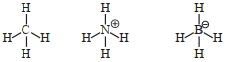
-
- (A) \((A)-(II), (B)-(I), (C)-(IV), (D)-(III)\)
- (B) \((A)-(III), (B)-(IV), (C)-(I), (D)-(II)\)
- (C) \((A)-(III), (B)-(I), (C)-(IV), (D)-(II)\)
- (D) \((A)-(III), (B)-(IV), (C)-(II), (D)-(I)\)
Show answer and solution
Correct Answer: (C)
\((A)\) \(\psi_{M O}=\psi_{A}-\psi_{B}\) \((III)\,ABMO\)\((B)\) \(\mu= Q \times r\) \((I)\) Dipole moment
\((C)\) \(\frac{ N _{b}- N _{2}}{2}\) \((IV)\) Bond order
\((D)\) \(\psi_{M O}=\psi_{A}+\psi_{B}\) \((II)\) \(BMO\)
- 28. Number of lone pair (s) of electrons on central atom and the shape of \(BrF _{3}\) molecule respectively, are ..... . 2022 Medium
- (A) \(0 ,\) triangular planar
- (B) \(1,\) pyramidal.
- (C) \(2,\) bent \(T-\)shape.
- (D) \(1,\) bent \(T-\)shape
Show answer and solution
Correct Answer: (C)
Steric no. \(=5\left( sp ^{3} d \right)\), lone pair \(=2\)Bent \(T\) shape.

- 29. The correct order of bound orders of \(C _{2}^{2-}, N _{2}^{2-}\) and \(O _{2}^{2-}\) is, respectively. 2022 Medium
- (A) \(C _{2}^{2-}< N _{2}^{2-}< O _{2}^{2-}\)
- (B) \(O _{2}^{2-}< N _{2}^{2-}< C _{2}^{2-}\)
- (C) \(C _{2}^{2-}< O _{2}^{2-}< N _{2}^{2-}\)
- (D) \(N _{2}^{2-}< C _{2}^{2-}< O _{2}^{2-}\)
Show answer and solution
Correct Answer: (B)
Species \(\quad\) Bond order\(C _{2}^{2-} \quad\quad\quad\quad 3\)
\(N _{2}^{2-} \quad\quad\quad\quad 2\)
\(O _{2}^{2-} \quad\quad\quad\quad 1\)
- 30. According to molecular orbital theory, the number of unpaired electron(s) in \(\mathrm{O}_{2}^{2-}\) is : 2021 Medium
- (A) \(1\)
- (B) \(0\)
- (C) \(2\)
- (D) \(3\)
Show answer and solution
Correct Answer: (B)
Molecular orbital configuration of \(\mathrm{O}_{2}^{2-}\) is\(\sigma_{1 \mathrm{~s}}^{2} \sigma_{1 \mathrm{~s}}^{*} \sigma_{2 \mathrm{~s}}^{2} \sigma_{2 \mathrm{~s}}^{*_{2}}\left(\pi 2 \mathrm{p}_{\mathrm{x}}^{2}=\pi 2 \mathrm{p}_{\mathrm{y}}^{2}\right)\left(\pi_{2 \mathrm{px}}^{*}=\pi_{2 \mathrm{py}}^{*}\right)\)
Zero unpaired electron
-
- (A) \(He _{2}^{+}\)
- (B) \(He _{2}^{-}\)
- (C) \(Be _{2}\)
- (D) \(O _{2}^{2-}\)
Show answer and solution
Correct Answer: (C)
Chemical Species Bond Order \(He _{2}^{+}\) \(0.5\) \(He _{2}^{-}\) \(0.5\) \(Be _{2}\) \(0\) \(O _{2}^{2-}\) \(1\) According to \(M.O.T.\) If bond order of chemical species is zero then that chemical species does not exist.
-
- (A) \(30\)
- (B) \(25\)
- (C) \(20\)
- (D) \(15\)
Show answer and solution
Correct Answer: (D)
\(AX\) is a covalent diatomic molecule.The molecule is \(NO\).
Total no. of electrons is \(15\).
-
- (A) \(\mathrm{O}_{2}^{+}>\mathrm{O}_{2}>\mathrm{O}_{2}^{-}>\mathrm{O}_{2}^{2-}\)
- (B) \(\mathrm{O}_{2}>\mathrm{O}_{2}^{-}>\mathrm{O}_{2}^{2-}>\mathrm{O}_{2}^{+}\)
- (C) \(\mathrm{O}_{2}^{2-}>\mathrm{O}_{2}^{+}>\mathrm{O}_{2}^{-}>\mathrm{O}_{2}\)
- (D) \(\mathrm{O}_{2}^{+}>\mathrm{O}_{2}^{-}>\mathrm{O}_{2}^{2-}>\mathrm{O}_{2}\)
Show answer and solution
Correct Answer: (A)
\(\sigma_{1 s}^{2}, \sigma_{1 s}^{* 2}, \sigma_{2 s}^{2}, \sigma_{2 s}^{*}, \sigma_{2 p_{2}}^{2}\)\(\pi_{2 p_{x}}^{2}=\pi_{2 p_{y}}^{2}, \pi_{2 p_{x}}^{*_{1}}=\pi_{2 p_{y}}^{*_{1}}, \sigma_{2 p_{2}}^{*}\)
Bond order of \(\mathrm{O}_{2} \Rightarrow 2\)
Bond order of \(\mathrm{O}_{2}^{-} \Rightarrow 1.5\)
Bond order of \(\mathrm{O}_{2}^{2-} \Rightarrow 1\)
Bond order of \(\mathrm{O}_{2}^{+} \Rightarrow 2.5\)
-
- (A) \(( a ) \rightarrow( iii ),( b ) \rightarrow( iv ),( c ) \rightarrow( i ),( d ) \rightarrow( ii )\)
- (B) \(( a ) \rightarrow( i ),( b ) \rightarrow( ii ),( c ) \rightarrow( iii ),( d ) \rightarrow( iv )\)
- (C) \(( a ) \rightarrow( ii ),( b ) \rightarrow( i ),( c ) \rightarrow( iv ),( d ) \rightarrow( iii )\)
- (D) \(( a ) \rightarrow( iv ),( b ) \rightarrow( iii ),( c ) \rightarrow( ii ),( d ) \rightarrow( i )\)
Show answer and solution
Correct Answer: (A)
\((a)\) \(\quad Ne _{2}=\operatorname{Total} e ^{\Theta}=20\)B.O. \(=\frac{10-10}{2}=0\)
\((b)\) \(\quad N _{2}=\) Total \(e ^{\Theta}=14\)
B.O. \(=\frac{10-4}{2}=3\)
\((c)\) \(\quad F _{2}=\) Total \(e ^{\Theta}=18\)
B.O. \(=\frac{10-8}{2}=1\)
(d) \(O _{2}=\operatorname{Total} e ^{\theta}=16\)
B.O. \(=\frac{10-6}{2}=2\)
-
- (A) \(1\)
- (B) \(2\)
- (C) \(3\)
- (D) \(0\)
Show answer and solution
Correct Answer: (A)
\(\mathrm{Li}_{2} \mathrm{O} \quad \Rightarrow 2 \mathrm{Li}^{+}\quad\mathrm{O}^{2-}\)\(\mathrm{MgO} \Rightarrow \mathrm{Mg}^{2+}\quad \mathrm{O}^{2-}\)
\(\mathrm{CaO} \quad \Rightarrow \mathrm{Ca}^{2+} \quad \mathrm{O}^{2-}\)
\(\mathrm{K}_{2} \mathrm{O} \Rightarrow 2 \mathrm{~K}^{+} \quad\mathrm{O}^{2-}\)
\(\mathrm{Na}_{2} \mathrm{O}_{2} \Rightarrow 2 \mathrm{Na}^{+} \quad \mathrm{O}_{2}^{2-}\)
\(\mathrm{KO}_{2} \quad \Rightarrow \mathrm{K}^{+} \quad \mathrm{O}_{2}^{-}\)
\(\mathrm{O}_{2}^{-} \Rightarrow\) Complete octet, diamagnetic
\(\mathrm{O}^{2} \Rightarrow \sigma_{1 \mathrm{~s}}^{2} \sigma_{1 \mathrm{~s}}^{* 2} \sigma_{2 \mathrm{~s}}^{2} \sigma_{2 \mathrm{~s}}^{*_{2}} \sigma_{2 \mathrm{px}}^{2} \pi_{2 \mathrm{py}}^{2} \simeq \pi_{2 \mathrm{pz}}^{2} \pi_{2 \mathrm{py}}^{*_{2}} \simeq \pi_{2 \mathrm{pz}}^{*_{2}}(\mathrm{dia})\)
\(\mathrm{O}_{2}^{-} \Rightarrow \sigma_{1 \mathrm{~s}}^{2} \sigma_{1 \mathrm{~s}}^{*_{2}} \sigma_{2 \mathrm{~s}}^{2} \sigma_{2 \mathrm{~s}}^{* 2} \sigma_{2 \mathrm{px}}^{2} \pi_{2 \mathrm{py}}^{2} \simeq \pi_{2 \mathrm{p} z}^{2} \pi_{2 \mathrm{py}}^{*} \simeq \pi_{2 \mathrm{pz}}^{* 1}(\mathrm{para})\)
-
- (A) \(5\)
- (B) \(10\)
- (C) \(15\)
- (D) \(20\)
Show answer and solution
Correct Answer: (B)
\(\sigma 1 \mathrm{~s}^{2} \sigma 1^* \mathrm{~s}^{2} \sigma 2 \mathrm{~s}^{2} \sigma 2^* \mathrm{~s}^{2} \sigma 2 \mathrm{p}_{z}^{2} \pi 2 \mathrm{p}_{\mathrm{x}}^{2}=\pi 2 \mathrm{p}_{\mathrm{y}}^{2}\)\(\pi 2^* \mathrm{p}_{\mathrm{x}}^{2}=\pi 2^* \mathrm{p}_{\mathrm{y}}^{2}\)
-
- (A) \(\mathrm{O}_{2}^{-}\) or \(\mathrm{O}_{2}^{+}\)
- (B) \(\mathrm{O}_{2}\) or \(\mathrm{O}_{2}^{+}\)
- (C) \(\mathrm{O}_{2}\) or \(\mathrm{O}_{2}^{-}\)
- (D) \(\mathrm{O}_{2}, \mathrm{O}_{2}^{-}\) or \(\mathrm{O}_{2}^{+}\)
Show answer and solution
Correct Answer: (A)
\(\begin{array}{|c|c|c|} \hline & \text { unpaired electron } & \text { magnetic moment } \\ \hline O _{2}^{\oplus} & 1 & 1.73 B . M \\ \hline O _{2}^{\ominus} & 1 & 1.73 B . M \\ \hline O _{2} & 2 & 2.83 B.M \\ \hline \end{array}\) - 38. Of the species, \(NO , NO ^{+}, NO ^{2+}, NO ^{-},\) the one with minimum bond strength is : 2020 Hard
- (A) \(NO ^{2+}\)
- (B) \(NO ^{+}\)
- (C) \(NO\)
- (D) \(NO ^{-}\)
Show answer and solution
Correct Answer: (D)
Bond order of \(NO ^{2+}=2.5\)Bond order of \(NO ^{+}=3\)
Bond order of \(NO =2.5\)
Bond order of \(NO ^{-}=2\)
Bond order \(\alpha\) bond strength.
- 39. The molecule in which hybrid \(MOs\) involve only one \(d-\)orbital of the central atom is 2020 Hard
- (A) \(\left[ Ni ( CN )_{4}\right]^{2-}\)
- (B) \(\left[ CrF _{6}\right]^{3-}\)
- (C) \(BrF _{5}\)
- (D) \(XeF _{4}\)
Show answer and solution
Correct Answer: (A)
\(\left[ Ni ( CN )_{4}\right]^{2-}\)\(dsp\)\(^{2}\) hybridisation.
- 40. According to molecular orbital theory, which of the following is true with respect to \(Li_2^ + \) and \(Li_2^ - \) ? 2019 Medium
- (A) \(Li_2^ + \) is unstable and \(Li_2^ - \) is stable
- (B) \(Li_2^ + \) is stable and \(Li_2^ - \) is unstable
- (C) Both are stable
- (D) Both are unstable
Show answer and solution
Correct Answer: (C)
\(Li_2^+\): Electrons = 5
MO Config: \((\sigma_{1s})^2 (\sigma_{1s}^*)^2 (\sigma_{2s})^1\)
Bond Order = \(\frac{1}{2} (N_b - N_a) = \frac{1}{2} (3 - 2) = 0.5\)
\(Li_2^-\): Electrons = 7
MO Config: \((\sigma_{1s})^2 (\sigma_{1s}^*)^2 (\sigma_{2s})^2 (\sigma_{2s}^*)^1\)
Bond Order = \(\frac{1}{2} (N_b - N_a) = \frac{1}{2} (4 - 3) = 0.5\)
Both are stable.
-
- (A) \(O_2^{2-}\)
- (B) \(C_2^{2-}\)
- (C) \(O_2\)
- (D) \(N_2^{2-}\)
Show answer and solution
Correct Answer: (B)
\(C_2^{2 - } - {\sigma _{1s}}2{\sigma ^*}_{1s}2{\sigma _{2s}}2{\sigma ^*}_{2{s^2}}[{\pi _{2p_x^2}} = {\pi _2}p_y^2]{\sigma _{2p_z^2}}\)\(B.O = \frac{{10 - 4}}{2} = 3\) (diamagnetic)
\(N_2^{2 - } - {\sigma _{1s}}2{\sigma ^*}_{1s}2{\sigma _{2s}}2{\sigma ^*}_{2{s^2}}[{\pi _{2p_x^2}} = {\pi _2}p_y^2]{\sigma _{2p_z^2}}[{\pi _{2p_x^1}} = {\pi ^*}_{2p_y^1}]\)
\(B.O = \frac{{10 - 6}}{2} = 2\) (paramagnetic)
\(O_2^{2 - } - {\sigma _{1s}}2{\sigma ^*}_{1s}2{\sigma _{2s}}2{\sigma ^*}_{2s}2{\sigma _{2p_z^2}}[{\pi _{2p_x^2}} = {\pi _2}p_y^2]\,[{\pi _{2p_x^2}} = {\pi ^*}_2p_y^2]\)
\(B.O = \frac{{10 - 8}}{2} = 1\) (diamagnetic)
\({O_2} - {\sigma _{1s}}2{\sigma ^*}_{1s}2{\sigma _{2s}}2{\sigma ^*}_{2s}2{\sigma _{2p_z^2}}\,[{\pi _{2p_x^2}} = {\pi _2}p_y^2]\,[{\pi _{2p_x^2}} = {\pi ^*}_2p_y^2]\)
\(B.O = \frac{{10 - 6}}{2} = 2\) (paramagnetic)
-
- (A) \(O_2\)
- (B) \(NO\)
- (C) \(B_2\)
- (D) \(CO\)
Show answer and solution
Correct Answer: (D)
\(CO\) is diamagnetic in nature due to absence of any unpaired electron. -
- (A) \(F_2\)
- (B) \(C_2\)
- (C) \(O_2\)
- (D) \(NO\)
Show answer and solution
Correct Answer: (B)
\(C_2\) configuration\(\sigma 1{s^2}{\sigma ^*}1{s^2}\sigma 2{s^2}{\sigma ^*}2{s^2}_{\pi 2{p_z}^2}^{\pi 2{p_y}^2}\sigma 2Px\)
\(C_2^-\) configuration
\(\sigma 1{s^2}{\sigma ^*}1{s^2}\sigma 2{s^2}{\sigma ^*}2{s^2}_{\pi 2{p_z}^2}^{\pi 2{p_y}^2}\sigma 2P_x^1\)
- 44. In which of the following processes, the bond order has increased and paramagnetic character has changed to diamagnetic? 2019 Hard
- (A) \(NO\,\to \,NO^+\)
- (B) \(N_2\,\to \,N_2^+\)
- (C) \(O_2\,\to \,O_2^+\)
- (D) \(O_2\,\to \,O_2^{2-}\)
Show answer and solution
Correct Answer: (A)
\(B.O\) \(\mathop {\mathop {NO}\limits_{0.5} }\limits_{Para} \to \mathop {\mathop {N{O^ + }}\limits_3 }\limits_{Dia} \) \(B.O\) \(\mathop {\mathop {{N_2}}\limits_3 }\limits_{Dia} \to \mathop {\mathop {N_2^ + }\limits_{2.5} }\limits_{Para} \)\(B.O\) \(\mathop {\mathop {{O_2}}\limits_2 }\limits_{Para} \to \mathop {\mathop {O_2^ + }\limits_{2.5} }\limits_{Para} \) \(B.O\) \(\mathop {\mathop {{O_2}}\limits_2 }\limits_{Para} \to \mathop {\mathop {O_2^{2 - }}\limits_1 }\limits_{Dia} \)
-
- (A) \(O_2^ + \)
- (B) \(N_2\)
- (C) \(O_2\)
- (D) \(N_2^ + \)
Show answer and solution
Correct Answer: (D)
\({N_{{2^ \oplus }}} \Rightarrow BO = 2.5 \Rightarrow [\pi = Bond = 2\,\& \sigma - Bond = \frac{1}{2}]\)\({N_2} \Rightarrow B.O. = 3.0 \Rightarrow [\pi - Bond = 2\,\& \sigma - Bond = 1]\)
\({O_{{2^ \oplus }}} = B.O. \Rightarrow 2.5 \Rightarrow [\pi - Bond = 1.5\,\& \sigma - Bond = 1]\)
\({O_2} \Rightarrow B.O. \Rightarrow 2 \Rightarrow [\pi - Bond \Rightarrow 1\,\& \sigma - Bond = 1]\)
- 46. In the molecular orbital diagram for the molecular ion, \(N_2^ + \) , the number of electrons in the \({\sigma _{2p}}\) molecular orbital is 2018 Medium
- (A) \(0\)
- (B) \(2\)
- (C) \(3\)
- (D) \(1\)
Show answer and solution
Correct Answer: (D)
Total electrons in \(N_2^ + = (7 \times 2) - 1 = 13\)\(N_2^ + \to {\sigma _{1{s^2}}},\sigma _{1{s^2}}^*,{\sigma _{2{s^2}}},\sigma _{2{s^2}}^*,[\pi _{2{p_x}}^2 = \pi _{2{p_y}}^2]\sigma _{2{p_z}}^1\)
Number of electron in \({\sigma _2}_{{p_z}}\) is \(1\)
-
- (A) A bonding \(\pi \) orbital
- (B) A non - bonding orbital
- (C) An antibonding \(\sigma \) orbital
- (D) An antibonding \(\pi \) orbital
Show answer and solution
Correct Answer: (D)
An antibonding \(\pi \) orbital best describes the diagram of a molecular orbital. Two orbitals laterally overlap to form pi bond. Out of phase combination, of these two \(p-\) orbitals, give \(\pi ^*\, MO\). -
- (A) \(N{O^ + }\)
- (B) \(CO\)
- (C) \(O_2^{2 - }\)
- (D) \(B_2\)
Show answer and solution
Correct Answer: (D)
Total electron\(NO^+\) \(14\)
\(CO\) \(14\)
\(O_2^{2-}\) \(18\)
\(B_2\) \(10\)
\(N{O^ + } \Rightarrow KK.\sigma {(2s)^2}{\sigma ^*}{(2s)^2}.{(\pi 2{p_x})^2}\)
\( = {(\pi 2{p_y})^2}.{(\sigma 2{p_z})^2}\) diamagnetic
\(CO \Rightarrow KK.\sigma {(2s)^2}{\sigma ^*}{(2s)^2}.{(\pi 2{p_x})^2}\)
\( = {(\pi 2{p_y})^2}.{(\sigma 2{p_z})^2}\) diamagnetic
\(O_2^{2 - } \Rightarrow KK.\sigma {(2s)^2}{\sigma ^*}{(2s)^2}.\sigma {(2{p_z})^2}{(\pi 2{p_x})^2}\)
\( = {(\pi 2{p_y})^2}.{\pi ^*}{(2{p_x})^2} = {\pi ^*}{(2{p_y})^2}\) diamagnetic
\({B_2} \Rightarrow KK.\sigma {(2s)^2}{\sigma ^*}{(2s)^2}.\pi {(2{p_x})^1} = \pi {(2{p_y})^1}\) paramagnetic
-
- (A) Assertion is incorrect, reason is correct.
- (B) Assertion is correct, reason is incorrect
- (C) Assertion and reason are correct and reason is the correct explanation for the assertion
- (D) Assertion and reason are correct, but reason is not the correct explanation for the assertion
Show answer and solution
Correct Answer: (B)
Assertion is correct but reason is incorrect. Bonding \(MO\) shows constructive interference of the combining electron oxide waves. - 50. The correct order of bond dissociation energy among \(N_2, O_2, O_2^-\) is shown in which of the following arrangements? 2014 Medium
- (A) \(N_2 > O_2^- > O_2\)
- (B) \(O_2^- > O_2 > N_2\)
- (C) \(N_2 > O_2 > O_2^-\)
- (D) \(O_2 > O_2^- > N_2\)
Show answer and solution
Correct Answer: (C)
The bond order of \(N_2,\) \(O_2,\) and \(O_2^-\) are respectively \(3,2\) and \(1.5\)Since higher bond order implies higher bond dissociation energy hence the correct orde will be
\(N_2 > O_2 > O_2^-\)

No questions on this page match these filters.
Other STD 11 - Chemical bonding and molecular structure topics
Frequently asked
How many Molecular orbital theory questions came in JEE Mains?
58 questions from 2013–2026, each with the correct answer and a full solution.
How difficult are Molecular orbital theory questions?
7% are easy, 57% medium and 36% hard.