


JEE Mains · Physics · STD 11 - Units,dimensions and measurement
- JEE Mains 2023
- Medium
- MCQ
Match List\(-I\) with List\(-II\).
| List\(-I\) | List\(-II\) |
| \((A)\) Angular momentum | \((I)\) \(\left[ ML ^2 T ^{-2}\right]\) |
| \((B)\) Torque | \((II)\) \(\left[ ML ^{-2} T ^{-2}\right]\) |
| \((C)\) Stress | \((III)\) \(\left[ ML ^2 T ^{-1}\right]\) |
| \((D)\) Pressure gradient | \((IV)\) \(\left[ ML ^{-1} T ^{-2}\right]\) |
Pick an option to check your answer.
Answer & Solution
Correct Answer
(B) \((A)-(III), (B)-(I), (C)-(IV), (D)-(II)\)
Step-by-step Solution
Detailed explanation
Explanation:
Let us derive the dimensional formula for each physical quantity step-by-step to find the correct match:
1. Angular Momentum (A):
The formula for angular momentum is \( L = mvr \), where \( m \) is mass, \( v \) is velocity, and \( r \) is radius.
Dimensions: \( [M] \times [LT^{-1}] \times [L] = [ML^2T^{-1}] \)
This matches with item (III).
2. Torque (B):
The formula for torque is \( \tau = \text{Force} \times \text{perpendicular distance} \).
Dimensions: \( [MLT^{-2}] \times [L] = [ML^2T^{-2}] \)
This matches with item (I).
3. Stress (C):
The formula for stress is \( \text{Stress} = \frac{\text{Force}}{\text{Area}} \).
Dimensions: \( \frac{[MLT^{-2}]}{[L^2]} = [ML^{-1}T^{-2}] \)
This matches with item (IV).
4. Pressure Gradient (D):
The formula for pressure gradient is \( \text{Pressure gradient} = \frac{\text{Pressure}}{\text{Distance}} \).
Dimensions: \( \frac{[ML^{-1}T^{-2}]}{[L]} = [ML^{-2}T^{-2}] \)
This matches with item (II).
Combining these results, the correct matching sequence is: (A) – (III), (B) – (I), (C) – (IV), (D) – (II).
Hence, Option B is the correct choice.
More questions from Physics
- Two wires A and B are made of same material having ratio of lengths \(\frac{L_A}{L_B}=\frac{1}{3}\) and their diameters ratio \(\frac{d_A}{d_B}=2\). If both the wires are stretched using same force, what would be the ratio of their respective elongations?JEE Mains 2025 Easy
- In photoelectric effect, the stopping potential \(\left(\mathrm{V}_0\right) \mathrm{v} / \mathrm{s}\) frequency \((\nu)\) curve is plotted.
( h is the Planck's constant and \(\phi_0\) is work function of metal )
(A) \(\mathrm{V}_0 \mathrm{v} / \mathrm{s} \nu\) is linear.
(B) The slope of \(\mathrm{V}_0 \mathrm{v} / \mathrm{s} \nu\) curve \(=\frac{\phi_0}{\mathrm{~h}}\)
(C) h constant is related to the slope of \(\mathrm{V}_0 \mathrm{v} / \mathrm{s} \nu\) line.
(D) The value of electric charge of electron is not required to determine \(h\) using the \(V_0 \mathrm{v} / \mathrm{s} \nu\) curve.
(E) The work function can be estimated without knowing the value of \(h\).
Choose the correct answer from the options given below :JEE Mains 2025 Easy - The position, velocity and acceleration of a particle executing simple harmonic motion are found to have magnitudes of \(4 \mathrm{~m}, 2 \mathrm{~ms}^{-1}\) and \(16 \mathrm{~ms}^{-2}\) at a certain instant. The amplitude of the motion is \(\sqrt{\mathrm{x}} \mathrm{m}\) where \(\mathrm{x}\) is _______.JEE Mains 2024 Hard
- For a periodic motion represented by the equation \(Y=\sin \omega t+\cos \omega t\) The amplitude of the motion isJEE Mains 2023 Easy
- In a perfectly inelastic collision, two spheres made of the same material with masses 15 kg and 25 kg , moving in opposite directions with speeds of \(10 m / s\) and \(30 m / s\), respectively, strike each other and stick together. The rise in temperature (in \({ }^{\circ} C\) ), if all the heat produced during the collision is retained by these spheres, is :
(specific heat of sphere material \(31 cal / kg .{ }^{\circ} C\) and \(1 cal =4.2 J)\)JEE Mains 2026 Easy - The ratio of vapour densities of two gases at the same temperature is \(\frac{4}{25}\), then the ratio of r.m.s. velocities will be:JEE Mains 2025 Easy
More PYQs from JEE Mains
- Five charges \(+q,+5 q,-2 q,+3 q\) and \(-4 q\) are situated as shown in the figure. The electric flux due to this configuration through the surface \(S\) is _______.
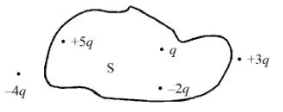 JEE Mains 2024 Hard
- A steel rail of length \(5\,m\) and area of cross-section \(40\,cm^2\) is prevented from expanding along its length while the temperature rises by \(10\,^oC\). If coefficient of linear expansion and Young's modulus of steel are \(1.2\times10^{-5}\, K^{-1}\) and \(2\times10^{11}\, Nm^{-2}\) respectively, the force developed in the rail is approximatelyJEE Mains 2017 Hard
- A parallel plate capacitor having a separation between the plates \(d\) , plate area \(A\) and material with dielectric constant \(K\) has capacitance \(C_0\). Now one-third of the material is replaced by another material with dielectric constant \(2K\), so that effectively there are two capacitors one with area \(\frac{1}{3}\,A\) , dielectric constant \(2K\) and another with area \(\frac{2}{3}\,A\) and dielectric constant \(K\). If the capacitance of this new capacitor is \(C\) then \(\frac{C}{{{C_0}}}\) isJEE Mains 2013 Hard
- A particle executes simple harmonic motion with an amplitude of \(4 \mathrm{~cm}\). At the mean position, velocity of the particle is \(10 \mathrm{~cm} / \mathrm{s}\). The distance of the particle from the mean position when its speed becomes \(5 \mathrm{~cm} / \mathrm{s}\) is \(\sqrt{\alpha} \mathrm{cm}\), where \(\alpha=\)____________.JEE Mains 2024 Hard
- Find the ratio of energies of photons produced due to transition of an election of hydrogen atom from its \((i)\) second permitted energy level to the first level, and \((ii)\) the highest permitted energy level to the first permitted level.JEE Mains 2022 Medium