


Questions
Newest firstShowing 1–17 of 17 questions
-
- (A) A and D only
- (B) B and C only
- (C) A and C only
- (D) B and D only
Show answer and solution
Correct Answer: (B)
In the given Friedel-Crafts alkylation reaction, \(1\)-chloropropane reacts with anhydrous \(\text{AlCl}_3\) to initially form a primary carbocation, the \(n\)-propyl carbocation (\(\text{CH}_3-\text{CH}_2-\text{CH}_2^+\)).
This primary carbocation is less stable and undergoes a \(1,2\)-hydride shift to form a more stable secondary carbocation, the iso-propyl carbocation (\(\text{CH}_3-\text{CH}^+-\text{CH}_3\)). Therefore, statement B is correct.
The iso-propyl carbocation then acts as an electrophile and attacks the benzene ring, yielding iso-propylbenzene (cumene) as the major product. Thus, statement A is incorrect.
Once an alkyl group is introduced to the benzene ring, it acts as an electron-donating group (via hyperconjugation and inductive effect), which activates the ring. This makes the newly formed alkylbenzene more reactive towards electrophilic aromatic substitution than the original benzene molecule, leading to polyalkylation. Hence, multiple substitution is a common and inevitable drawback. Therefore, statement C is correct.
Introducing an electron-donating substituent on benzene generally activates the ring and facilitates Friedel-Crafts alkylation (except for strong Lewis bases like \(-\text{NH}_2\) which complex with \(\text{AlCl}_3\)). Thus, statement D is incorrect.
Therefore, only statements B and C are correct.
Answer: B and C only -
- (A) Statement I is correct but Statement II is incorrect.
- (B) Both Statement I and Statement II are correct.
- (C) Statement I is incorrect but Statement II is correct.
- (D) Both Statement I and Statement II are incorrect.
Show answer and solution
Correct Answer: (C)
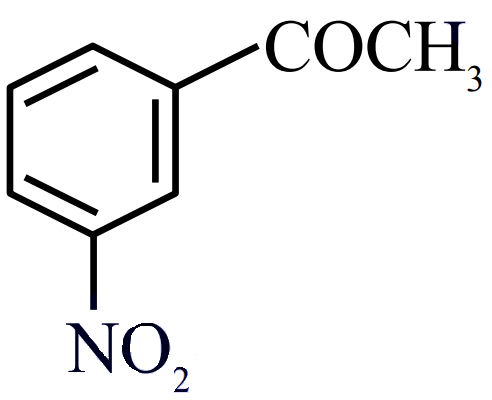
Nitrobenzene does not give Friedel-Craft acylation since it is a highly deactivated ring. -
- (A) (A) only
- (B) (A), (B) and (E) only
- (C) (A) and (C) only
- (D) (A), (C) and (D) only
Show answer and solution
Correct Answer: (D)
Explanation:
Let us analyze each statement for electrophilic aromatic substitution on a benzene ring:
1. Statement (A) is correct: Both \(-\text{OCH}_3\) and \(-\text{NHCOCH}_3\) have lone pairs on the heteroatom directly attached to the benzene ring. They donate electron density via the resonance effect (\(+R\)), which outweighs their inductive withdrawal (\(-I\)), making them ring-activating.
2. Statement (B) is incorrect: While \(-\text{CN}\) is meta-directing, the \(-\text{OH}\) group is a powerful ortho/para-directing group due to strong resonance electron donation.
3. Statement (C) is correct: Both \(-\text{CN}\) and \(-\text{SO}_3\text{H}\) are electron-withdrawing groups due to the combined \(-R\) and \(-I\) effects, which deactivates the ring and directs incoming electrophiles to the meta position.
4. Statement (D) is correct: Activating groups increase electron density specifically at the ortho and para positions via resonance, making them ortho- and para-directing.
5. Statement (E) is incorrect: Halides (\(-\text{Cl}\), \(-\text{Br}\), etc.) possess lone pairs and display a \(+R\) effect, but they are also highly electronegative, causing a very dominant inductive electron-withdrawing effect (\(-I\)). For halogens, the \(-I\) effect outweighs the \(+R\) effect. Consequently, they act as net deactivating groups, even though they direct incoming groups to the ortho/para positions.
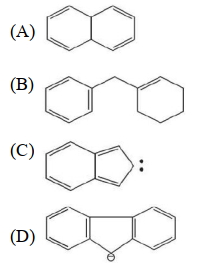
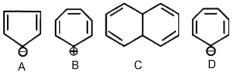
Hence, statements (A), (C), and (D) are correct, making Option D the right choice. - 4. Among the given organic compounds, the total number of aromatic compounds is___________
 2024 Hard
- (A) \(1\)
- (B) \(3\)
- (C) \(4\)
- (D) \(2\)
Show answer and solution
Correct Answer: (B)
\(B\),\(C\) and \(D\) are Aromatic -
- (A) Both Statement \(I\) and Statement \(II\) are incorrect
- (B) Statement \(I\) is correct but Statement \(II\) is incorrect
- (C) Both Statement \(I\) and Statement \(II\) are correct
- (D) Statement \(I\) is incorrect but Statement \(II\) is correct
Show answer and solution
Correct Answer: (B)
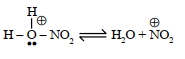
In nitration of benzene concentrated \(\mathrm{H}_2 \mathrm{SO}_4\) and \(\mathrm{HNO}_3\) is used as reagent which generates electrophile \(\mathrm{NO}_2\) in following steps: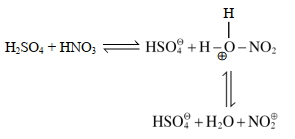
Lewis acids can promote the formation of electrophiles not Lewis base -
- (A) \(A\) is true but \(R\) is false.
- (B) \(A\) is false but \(R\) is true.
- (C) Both \(A\) and \(R\) are correct and \(R\) is the correct explanation of \(A\).
- (D) Both \(A\) and \(R\) are correct but \(R\) is NOT the correct explanation of \(A\).
Show answer and solution
Correct Answer: (C)
Assertion \(- A\) : Benzene is more stable than cyclohexatriene (True)Reason \(- R :\) Delocalised \(\pi-\) e cloud lies \(B.M.O\) so more attracted by nuclei of carbon atom.
(True and Correct Explanation)
-
- (A) Both Statement \(I\) and Statement \(II\) are true
- (B) Statement \(I\) is true but Statement \(II\) is false
- (C) Statement \(I\) is false but Statement \(II\) is true
- (D) Both Statement \(I\) and Statement \(II\) are false
Show answer and solution
Correct Answer: (B)
Tropolone is an aromatic compound and has \(8 \pi\) electrons \(\left(6 \pi e ^{-}\right.\)are endocyclic and \(2 \pi e^{-}\) are exocyclic) and \(\pi\) electrons of \( > C = O\) group in tropolone is not involved in aromaticity.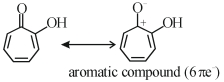
-
- (A) Both \(A\) and \(R\) are correct and \(R\) is the correct explanation of \(A\).
- (B) Both \(A\) and \(R\) are correct but \(R\) is NOT the correct explanation of \(A\).
- (C) \(A\) is correct but \(R\) is not correct.
- (D) \(A\) is not correct but \(R\) is correct.
Show answer and solution
Correct Answer: (D)
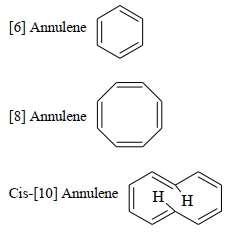
If this annulene with five cis double bonds were planar, each internal angle would be \(144^{\circ}\). Since a normal double bond has bond angle of \(120^{\circ}\), this would be from ideal. This compound can be made but it does not adopt a planar conformation and therefore is not aromatic even though it has ten \(\pi\) electrons.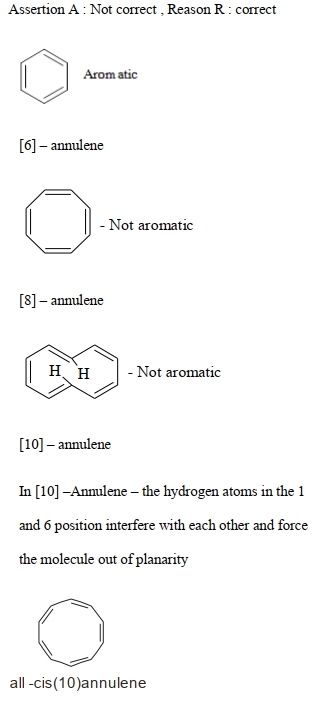
-
- (A) \(31\)
- (B) \(32\)
- (C) \(33\)
- (D) \(30\)
Show answer and solution
Correct Answer: (D)
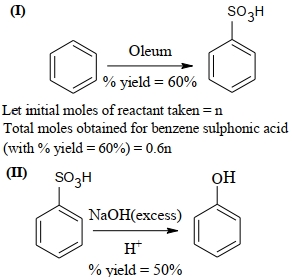
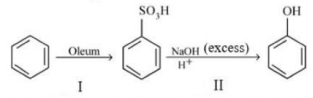
Moles of benzene sulphonic acid before reaction \(II =0.6\,n\)Moles obtained for phenol (with \(\%\) yield \(=50 \%\) ) = \(0.6 \times 0.5\,n=0.3\,n\)
So over all \(\%\) yield of complete reaction \(=\frac{0.3\,n }{ n } \times 100=30\)
-
- (A) \(A, B, C\) and \(D\)
- (B) Only \(A\) and \(B\)
- (C) Only \(A\) and \(C\)
- (D) Only \(B, C\) and \(D\)
Show answer and solution
Correct Answer: (B)
\(A , B\) aromatic\(C , D\) is nonaromatic
-
- (A) \(\mathrm{HNO}_{3}\) acts as an acid and \(\mathrm{H}_{2} \mathrm{SO}_{4}\) acts as a base
- (B) both \(\mathrm{H}_{2} \mathrm{SO}_{4}\) and \(\mathrm{HNO}_{3}\) act as a bases
- (C) \(\mathrm{HNO}_{3}\) acts as a base and \(\mathrm{H}_{2} \mathrm{SO}_{4}\) acts as an acid
- (D) both \(\mathrm{H}_{2} \mathrm{SO}_{4}\) and \(\mathrm{HNO}_{3}\) act as an acids
Show answer and solution
Correct Answer: (C)
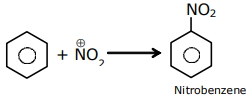
Reagent for nitration of Benzene\(\underset{(\text { Acid })}{{H}_{2} \mathrm{SO}_{4}}+\underset{(\text { Base })} {HNO} \rightleftarrows {HSO}_{4}^{-}+\mathrm{H}_{2} \stackrel{\oplus} {NO}_{2}\)
\(\mathrm{H}_{2} \stackrel{\oplus}N \mathrm{O}_{3} \rightleftarrows \mathrm{H}_{2} \mathrm{O}+\stackrel{\oplus}N \mathrm{O}_{2}\)
-
- (A) \(78\)
- (B) \(70\)
- (C) \(78\)
- (D) \(52\)
Show answer and solution
Correct Answer: (C)
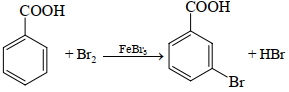
Moles of Benzoic acid \(=\frac{6.1}{122}\)\(=\) moles of m-bromobenzoic acid
So, weight of m-bromobenzoic acid
\(=\frac{6.1}{122} \times 201\, gm\)
\(=10.05\, gm\)
\(\%\) yield \(=\frac{\text { Actual weight }}{\text { Theoretical weight }} \times 100\)
\(=\frac{7.8}{10.05} \times 100\)
\(=77.61 \,\%\)
-
- (A) \(3\)
- (B) \(9\)
- (C) \(4\)
- (D) \(7\)
Show answer and solution
Correct Answer: (D)
In benzaldehyde total number of \(sp ^{2}{ }^{\prime} C ^{\prime}\) are 7 .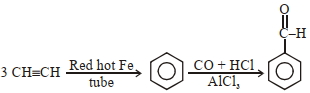
-
- (A) \((D)>(C)>(B)>(A)\)
- (B) \((C)>(B)>(A)>(D)\)
- (C) \((C)>(D)>(A)>(B)\)
- (D) \((A)>(B)>(C)>(D)\)
Show answer and solution
Correct Answer: (A)
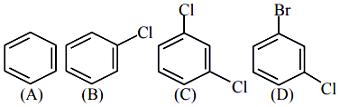
The density order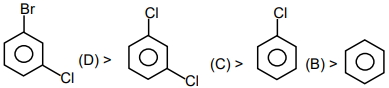
-
- (A) \(\mathrm{CH}_{3} \mathrm{CH}_{2} \mathrm{CH}_{2} \mathrm{CONH}_{2}\)
- (C) \(\mathrm{CH}_{3} \mathrm{CH}_{2} \mathrm{OCH}=\mathrm{CH}_{2}\)
- (D) \(\mathrm{CH}_{3} \mathrm{CH}_{2} \mathrm{CH}=\mathrm{CHCH}_{2} \mathrm{NH}_{2}\)
Show answer and solution
Correct Answer: (D)
\(\mathrm{CH}_{3}-\mathrm{CH}_{2}-\mathrm{CH}=\mathrm{CH}-\mathrm{CH}_{2}-\mathrm{NH}_{2}\)This is non conjugated compound.
-
- (A) \(13\)
- (B) \(15\)
- (C) \(11\)
- (D) \(9\)
Show answer and solution
Correct Answer: (A)
Total \(13\) atom are present in same plane (\(7\) carbon and \(6\) hydrogen atoms.)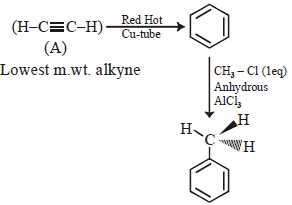
-
- (A) Friedel Craft’s alkylation
- (B) Reimer Tiemann reaction
- (C) Acetylation of aniline
- (D) Friedel Craft’s acylation
Show answer and solution
Correct Answer: (A)
Polysubstitution is a major drawback of Friedal craft’s alkylation. It is so because activating behaviour of benzene ring increases with increase in number of alkyl group on benzene ring

No questions on this page match these filters.
Other STD 11 - Hydricarbon topics
Frequently asked
How many Aromatic hydrocarbon questions came in JEE Mains?
17 questions from 2019–2026, each with the correct answer and a full solution.
How difficult are Aromatic hydrocarbon questions?
12% are easy, 41% medium and 47% hard.