


Chapters asked in 2024
31 chapters- 34Qs STD 11 Units, dimensions and measurement Most asked
- 18Qs STD 12 Semicondutor electronics
- 19Qs STD 12 Nuclei
- 22Qs STD 12 Atoms
- 24Qs STD 12 Dual nature of radiation and matter
- 16Qs STD 12 Electromagnetic waves
- 23Qs STD 12 Wave optics
- 22Qs STD 12 Ray optics and optical instruments
- 21Qs STD 12 Alternating current
- 25Qs STD 11 System of particles and rotational motion
- 39Qs STD 12 Moving charges and magnetism Most asked
- 20Qs STD 12 Electromagnetic induction
- 4Qs STD 12 Magnetism and matter
- 45Qs STD 12 Current electricity Most asked
- 21Qs STD 12 Electric potential and capacitance
- 21Qs STD 12 Electric charges and fields
- 9Qs STD 11 Waves and sound
- 18Qs STD 11 Oscillations
- 23Qs STD 11 Kinetic theory of gases
- 16Qs STD 11 Thermodynamics
- 1Qs STD 11 10.1, thermonetry, thermal expansion and calorimetry
- 15Qs STD 11 Mechanical properties of solids
- 12Qs STD 11 Surface tension
- 13Qs STD 11 Fluid mechanics
- 19Qs STD 11 Newtons laws of motion
- 21Qs STD 11 Gravitation
- 20Qs STD 11 Work, energy, power and collision
- 12Qs STD 11 Friction
- 13Qs STD 11 Motion in plane
- 19Qs STD 11 Motion in straight line
- 8Qs STD 11 Vectors
All JEE Mains 2024 Physics questions
31 chaptersShowing 1–50 of 593 questions
-
- (A) \(\frac{1}{2}\)
- (B) \(\frac{10}{11}\)
- (C) \(\frac{50}{11}\)
- (D) \(\frac{5}{11}\)
Show answer and solution
Correct Answer: (D)
\(10 \mathrm{MSD}=11 \mathrm{VSD}\)\(1 \mathrm{VSD}=\frac{10}{11} \mathrm{MSD}\)
\(\mathrm{LC}=1 \mathrm{MSD}-1 \mathrm{VSD}\)
\(=1 \mathrm{MSD}-\frac{10}{11} \mathrm{MSD}\)
\(=\frac{1 \mathrm{MSD}}{11}\)
\(-\frac{5}{11} \text { units }\)
-
- (A) \(\left[\mathrm{ML}^3 \mathrm{~T}^{-3}\right]\)
- (B) \(\left[\mathrm{MLT}^{-2}\right]\)
- (C) \(\left[\mathrm{ML}^{-1} \mathrm{~T}^{-1}\right]\)
- (D) \(\left[\mathrm{ML}^2 \mathrm{~T}^{-3}\right]\)
Show answer and solution
Correct Answer: (A)
\(\mathrm{F}=\mathrm{ax}^2+\mathrm{bt}^{1 / 2}\)\({[\mathrm{a}]=\frac{[\mathrm{F}]}{\left[\mathrm{x}^2\right]}=\left[\mathrm{M}^1 \mathrm{~L}^{-1} \mathrm{~T}^{-2}\right]}\)
\({[\mathrm{b}]=\frac{[\mathrm{F}]}{\left[\mathrm{t}^{1 / 2}\right]}=\left[\mathrm{M}^1 \mathrm{~L}^1 \mathrm{~T}^{-5 / 2}\right]}\)
\({\left[\frac{\mathrm{b}^2}{\mathrm{a}}\right]=\frac{\left[\mathrm{M}^2 \mathrm{~L}^2 \mathrm{~T}^{-5}\right]}{\left[\mathrm{M}^1 \mathrm{~L}^{-1} \mathrm{~T}^{-2}\right]}=\left[\mathrm{M}^1 \mathrm{~L}^3 \mathrm{~T}^{-3}\right]}\)
-
- (A) \(66 \%\)
- (B) \(43 \%\)
- (C) \(34 \%\)
- (D) \(14 \%\)
Show answer and solution
Correct Answer: (C)
\( \mathrm{Q}=\frac{\mathrm{a}^4 \mathrm{~b}^3}{\mathrm{c}^2} \)\( \frac{\Delta \mathrm{Q}}{\mathrm{Q}}=4 \frac{\Delta \mathrm{a}}{\mathrm{a}}+3 \frac{\Delta \mathrm{b}}{\mathrm{b}}+2 \frac{\Delta \mathrm{c}}{\mathrm{c}} \)
\( \frac{\Delta \mathrm{Q}}{\mathrm{Q}} \times 100=4\left(\frac{\Delta \mathrm{a}}{\mathrm{a}} \times 100\right)+3\left(\frac{\Delta \mathrm{b}}{\mathrm{b}} \times 100\right)+2\left(\frac{\Delta \mathrm{c}}{\mathrm{c}} \times 100\right) \)
\( \% \text { error in } \mathrm{Q}=4 \times 3 \%+3 \times 4 \%+2 \times 5 \% \)
\(=12 \%+12 \%+10 \% \)
\(=34 \%\)
-
- (A) \(1\)
- (B) \(0.5\)
- (C) \(2\)
- (D) \(5\)
Show answer and solution
Correct Answer: (C)
\(20 \mathrm{VSD}=19 \mathrm{MSD}\)\(1 \mathrm{VSD}=\frac{19}{20} \mathrm{MSD}\)
\(\text { L.C. }=1 \mathrm{MSD}-1 \mathrm{VSD}\)
\(0.1 \mathrm{~mm}=1 \mathrm{MSD}-\frac{19}{20} \mathrm{MSD}\)
\(0.1=\frac{1}{20} \mathrm{MSD}\)
\(1 \mathrm{MSD}=2 \mathrm{~mm}\)
-
- (A) \(\mathrm{T}^2=\frac{4 \pi^2 \mathrm{r}}{\mathrm{GM}^2}\)
- (B) \(\mathrm{T}^2=4 \pi^2 \mathrm{r}^3\)
- (C) \(\mathrm{T}^2=\frac{4 \pi^2 \mathrm{r}^3}{G M}\)
- (D) \(\mathrm{T}^2=\frac{4 \pi^2 \mathrm{r}^2}{G M}\)
Show answer and solution
Correct Answer: (C)
According to principle of homogeneity dimension of \(LHS\) should be equal to dimensions of RHS so option \((3)\) is correct.\(\mathrm{T}^2=\frac{4 \pi^2 \mathrm{r}^3}{\mathrm{GM}}\)
\({\left[\mathrm{T}^2\right]=\frac{\left[\mathrm{L}^3\right]}{\left[\mathrm{M}^{-1} \mathrm{~L}^3 \mathrm{~T}^{-2}\right][\mathrm{M}]}}\)
(Dimension of G is \(\left[\mathrm{M}^{-1} \mathrm{~L}^3 \mathrm{~T}^{-2}\right]\) )
\(\left[\mathrm{T}^2\right]=\frac{\left[\mathrm{L}^3\right]}{\left[\mathrm{L}^3 \mathrm{~T}^{-2}\right]}=\left[\mathrm{T}^2\right]\)
-
- (A) \(\mathrm{L}^{-2} \mathrm{M}^1 \mathrm{~T}^0\)
- (B) \(\mathrm{L}^2 \mathrm{M}^{-1} \mathrm{~T}^1\)
- (C) \(\mathrm{L}^{-2} \mathrm{M}^{-1} \mathrm{~T}^1\)
- (D) \(\mathrm{L}^0 \mathrm{M}^{-1} \mathrm{~T}^1\)
Show answer and solution
Correct Answer: (B)
\({[B]=L^2}\)\(A=\frac{x^2}{t E}=\frac{L^2}{T^2 T^{-2}}=\frac{1}{M^{-1}}\)
\({[A]=M^{-1} T}\)
\({[A B]=\left[L^2 M^{-1} T^1\right]}\)
-
- (A) Statement \((I)\) is incorrect but statement \((II)\) is correct
- (B) Both statement \((I)\) and statement \((II)\) are incorrect
- (C) Statement \((I)\) is correct but statement \((II)\) is incorrect
- (D) Both statement \((I)\) and statement \((II)\) are correct
Show answer and solution
Correct Answer: (C)
\(\Delta \mathrm{Q}=\mathrm{mS} \Delta \mathrm{T}\)\(\mathrm{s}=\frac{\Delta \mathrm{Q}}{\mathrm{m} \Delta \mathrm{T}}\)
\({[\mathrm{s}]=\left[\frac{\mathrm{ML}^2 \mathrm{~T}^{-2}}{\mathrm{MK}}\right]}\)
\({[\mathrm{s}]=\left[\mathrm{L}^2 \mathrm{~T}^{-2} \mathrm{~K}^{-1}\right]}\)
Statement-\((I)\) is correct
\(\mathrm{PV}=\mathrm{nRT} \Rightarrow \mathrm{R}=\frac{\mathrm{PV}}{\mathrm{nT}}\)
\({[\mathrm{R}]=\frac{\left[\mathrm{ML}^{-1} \mathrm{~T}^{-2}\right]\left[\mathrm{L}^3\right]}{[\mathrm{mol}][\mathrm{K}]}}\)
\({[\mathrm{R}]=\left[\mathrm{ML}^{-2} \mathrm{~T}^{-2} \mathrm{~mol}^{-1} \mathrm{~K}^{-1}\right]}\)
Statement\(-II\) is incorrect
-
- (A) Statement \(I\) is true but Statement \(II\) is false
- (B) Both Statement \(I\) and Statement \(II\) are false
- (C) Both Statement \(I\) and Statement \(II\) are true
- (D) Statement \(I\) is false but Statement \(II\) is true
Show answer and solution
Correct Answer: (A)
\( {[\mathrm{h}]=\mathrm{ML}^2 \mathrm{~T}^{-1}} \)\( {[\mathrm{~L}]=\mathrm{ML}^2 \mathrm{~T}^{-1}} \)
\( {[\mathrm{P}]=\mathrm{MLT}^{-1}} \)
\( {[\tau]=\mathrm{ML}^2 \mathrm{~T}^{-2}}\)
(Here \(\mathrm{h}\) is Planck's constant, \(\mathrm{L}\) is angular momentum, \(\mathrm{P}\) is linear momentum and \(\tau\) is moment of force)
-
- (A) \(\left[\mathrm{M}^0 \mathrm{~L}^{-2} \mathrm{TA}\right]\)
- (B) \(\left[\mathrm{ML}^{-1} \mathrm{~T}^{-2}\right]\)
- (C) \(\left[\mathrm{M}^{-1} \mathrm{~L}^{-3} \mathrm{~T}^4 \mathrm{~A}^2\right]\)
- (D) \(\left[\mathrm{M} \mathrm{L}^2 \mathrm{~T}^{-2}\right]\)
Show answer and solution
Correct Answer: (B)
\(\mathrm{E}=\frac{\mathrm{K}}{\mathrm{R}^2}\)\(\mathrm{E}=\frac{\mathrm{Q}}{4 \pi \varepsilon_0 \mathrm{R}^2}\)
\(\varepsilon_0=\frac{\mathrm{Q}}{4 \pi \mathrm{R}^2 \mathrm{E}}\)
\(\text { Now, } \varepsilon_0 \mathrm{E}^2=\frac{\mathrm{Q}}{4 \pi \mathrm{R}^2\mathrm{E}} \cdot \mathrm{E}^2=\frac{\mathrm{Q}}{4 \pi \mathrm{R}^2} \cdot \mathrm{E}\)
\({\left[\varepsilon_0 \mathrm{E}^2\right]=\left[\frac{\mathrm{QE}}{\mathrm{R}^2}\right]=\frac{[\mathrm{Q}][\mathrm{E}]}{\left[\mathrm{R}^2\right]}=\frac{[\mathrm{Q}]}{\left[\mathrm{R}{ }^2\right][\mathrm{Q}][\mathrm{R}]}}\)
\(=\frac{[\mathrm{W}]}{\left[\mathrm{R}^3\right]}=\frac{\mathrm{ML}^2 \mathrm{~T}^{-2}}{\mathrm{~L}^3}=\mathrm{ML}^{-1} \mathrm{~T}^{-2}\)
-
- (A) \(0.1 \mathrm{~mm}\)
- (B) \(0.1 \mathrm{~cm}\)
- (C) \(0.01 \mathrm{~cm}\)
- (D) \(0.01 \mathrm{~mm}\)
Show answer and solution
Correct Answer: (D)
\(50 \mathrm{~V}+\mathrm{S}=49 \mathrm{~S}+\mathrm{S}\)\(\mathrm{S}=50(\mathrm{~S}-\mathrm{V})\)
\(5=50(\mathrm{~S}-\mathrm{V})\)
\(\mathrm{S}-\mathrm{V}=\frac{0.5}{50}=\frac{1}{100}=0.01 \mathrm{~mm}\)
-
- (A) Pressure gradient per unit mass
- (B) Force per unit mass
- (C) Gravitational potential
- (D) Energy per unit mass
Show answer and solution
Correct Answer: (B)
\({[\mathrm{uG}]=\left[\left(\mathrm{M}^1 \mathrm{~L}^{-1} \mathrm{~T}^{-2}\right)\left(\mathrm{M}^{-1} \mathrm{~L}^3 \mathrm{~T}^{-2}\right)\right]}\)\({[\mathrm{uG}]=\left[\mathrm{M}^0 \mathrm{~L}^2 \mathrm{~T}^{-4}\right]}\)
\({[\sqrt{\mathrm{uG}}]=\left[\mathrm{L}^1 \mathrm{~T}^{-2}\right]}\)
Option \((2)\) is correct
-
- (A) \(1 / 2\)
- (B) \(1 / 3\)
- (C) \(2\)
- (D) \(-1 / 3\)
Show answer and solution
Correct Answer: (A)
\(\mathrm{m}=\mathrm{kc}^{\mathrm{P}} \mathrm{G}^{-1 / 2} \mathrm{~h}^{1 / 2}\)\(\mathrm{M}^1 \mathrm{~L}^0 \mathrm{~T}^0=\left[\mathrm{LT}^{-1}\right]^{\mathrm{P}}\left[\mathrm{M}^{-1} \mathrm{~L}^3 \mathrm{~T}^{-2}\right]^{-1 / 2}\left[\mathrm{ML}^2 \mathrm{~T}^{-1}\right]^{1 / 2}\)
\(\text { By comparing } P=1 / 2\)
-
- (A) \(0.2 \%\)
- (B) \(0.3 \%\)
- (C) \(0.1 \%\)
- (D) \(0.144 \%\)
Show answer and solution
Correct Answer: (B)
\(\mathrm{R}=\frac{\rho \mathrm{L}}{\pi \frac{\mathrm{d}^2}{4}}\)\(\frac{\Delta \mathrm{R}}{\mathrm{R}}=\frac{\Delta \mathrm{L}}{\mathrm{L}}+\frac{2 \Delta \mathrm{d}}{\mathrm{d}}\)
\(\frac{\Delta \mathrm{L}}{\mathrm{L}}=0.1 \% \text { and } \frac{\Delta \mathrm{d}}{\mathrm{d}}=0.1 \%\)
\(\frac{\Delta \mathrm{R}}{\mathrm{R}}=0.3 \%\)
-
- (A) \(40\)
- (B) \(5\)
- (C) \(20\)
- (D) \(10\)
Show answer and solution
Correct Answer: (C)
\(4^{\text {th }}\) division coincides with \(3^{\text {rd }}\) division then\( 0.004 \mathrm{~cm}=4 \mathrm{VSD}-3 \mathrm{MSD}\)
\(49 \mathrm{MSD}=50 \mathrm{VSD}\)
\(1 \mathrm{MSD}=\frac{1}{\mathrm{~N}} \mathrm{~cm}\)
\(0.004=4\left\{\frac{49}{50} \mathrm{MSD}\right\}-3 \mathrm{MSD}\)
\(0.004=\left(\frac{196}{50}-3\right)\left(\frac{1}{\mathrm{~N}}\right)\)
\(\mathrm{N}=\frac{46}{50} \times \frac{1000}{4}=\frac{46 \times 1000}{200}=230\)
-
- (A) \(b\) is order of magnitude for \(a \leq 5\)
- (B) \(a\) is order of magnitude for \(b \leq 5\)
- (C) \(b\) is order of magnitude for \(5 < a \leq 10\)
- (D) \(b\) is order of magnitude for \(a \geq 5\)
Show answer and solution
Correct Answer: (A)
\(a \times 10^b\)\(\text { if } a \leq 5 \text { order is } b\)
\(a>5 \text { order } 1 s b+1\)
-
- (A) \(1.42\)
- (B) \(1.52\)
- (C) \(1.24\)
- (D) \(1.35\)
Show answer and solution
Correct Answer: (A)
\(1 \mathrm{MSD}=\frac{1 \mathrm{~cm}}{20}=0.05 \mathrm{~cm}\)\(1 \mathrm{VSD}=\frac{49}{50} \mathrm{MSD}=\frac{49}{50} \times 0.05 \mathrm{~cm}=0.049 \mathrm{~cm}\)
\(\mathrm{LC}=1 \mathrm{MSD}-1 \mathrm{VSD}=0.001 \mathrm{~cm}\)
\(\text { For mark on paper, } \mathrm{L}_1=8.45 \mathrm{~cm}+26 \times 0.001 \mathrm{~cm} \)
\(=84.76 \mathrm{~mm}\)
\(\text { For mark on paper through slab, } \mathrm{L} 2=7.12 \mathrm{~cm}+\)
\(41 \times 0.001 \mathrm{~cm}=71.61 \mathrm{~mm}\)
\(\text { For powder particle on top surface, } \mathrm{ZE}=4.05 \mathrm{~cm}\)
\(+1 \times 0.001 \mathrm{~cm}=40.51 \mathrm{~mm}\)
\(\therefore \text { actual } \mathrm{L}_1=84.76-40.51=44.25 \mathrm{~mm}\)
\(\quad \text { actual } \mathrm{L} 2=71.61-40.51=31.10 \mathrm{~mm}\)
\(\quad \mathrm{~L}_2=\frac{\mathrm{L}_1}{\mu}\)
\(\Rightarrow \mu=\frac{\mathrm{L}_1}{\mathrm{~L}_2}=\frac{44.25}{31.10}=1.42\)
-
- (A) \(\left(\frac{2 \mathrm{~N}-1}{20 \mathrm{~N}}\right)\)
- (B) \(\left(\frac{2 \mathrm{~N}-1}{2}\right)\)
- (C) \((2 \mathrm{~N}-1)\)
- (D) \(\left(\frac{2 \mathrm{~N}-1}{2 \mathrm{~N}}\right)\)
Show answer and solution
Correct Answer: (B)
Least count of vernier calipers \(=\frac{1}{20 \mathrm{~N}} \mathrm{~cm}\)\(\because\) Least count\(=1 \mathrm{MSD}-1 \mathrm{VSD}\)
let \(\mathrm{x}\) no. of divisions of main scale coincides with \(\mathrm{N}\) division of vernier scale, then
\(1 \mathrm{VSD}=\frac{\mathrm{x} \times 1 \mathrm{~mm}}{\mathrm{~N}}\)
\(\therefore \frac{1}{20 \mathrm{~N}} \mathrm{~cm}=1 \mathrm{~mm}-\frac{\mathrm{x} \times 1 \mathrm{~mm}}{\mathrm{~N}}\)
\(\frac{1}{2 \mathrm{~N}} \mathrm{~mm}=1 \mathrm{~mm}-\frac{\mathrm{x}}{\mathrm{N}} \mathrm{mm}\)
\(\mathrm{x}=\left(1-\frac{1}{2 \mathrm{~N}}\right) \mathrm{N}\)
\(\mathrm{x}=\frac{2 \mathrm{~N}-1}{2}\)
-
- (A) \( A-II, B-I, C-IV, D-III\)
- (B) \( A-I, B-II, C-III, D-IV\)
- (C) \( A-III, B-IV, C-II, D-I\)
- (D) \(A-IV, B-III, C-II, D-I\)
Show answer and solution
Correct Answer: (C)
\( F=\eta A \frac{d v}{d y} \)\( {\left[M L T^{-2}\right]=\eta\left[L^2\right]\left[T^{-1}\right]} \)
\( \eta=\left[M L^{-1} T^{-1}\right] \)
\( S . T=\frac{F}{\ell}=\frac{\left[M L T^{-2}\right]}{[L]}=\left[M L^0 T^{-2}\right] \)
\( L=m v r=\left[M L^2 T^{-1}\right] \)
\( K . E=\frac{1}{2} I \omega^2=\left[M L^2 T^{-2}\right]\)
-
- (A) \(A-I, B-III, C-II, D-IV\)
- (B) \(A-IV, B-III, C-II, D-I\)
- (C) \(A-III, B-I, C-II, D-IV\)
- (D) \(A-IV, B-II, C-III, D-I\)
Show answer and solution
Correct Answer: (B)
\({[\tilde{\tau}]=[\overrightarrow{\mathrm{r}} \times \overrightarrow{\mathrm{F}}]=\left[\mathrm{ML}^2 \mathrm{~T}^{-2}\right]}\)\({[\mathrm{F}]=[\mathrm{qVB}]}\)
\(\Rightarrow \mathrm{B}=\left(\frac{\mathrm{F}}{\mathrm{qV}}\right)=\left[\frac{\mathrm{MLT}^{-2}}{\mathrm{ATLT}^{-1}}\right]=\left[\mathrm{MA}^{-1} \mathrm{~T}^{-2}\right]\)
\({[\mathrm{M}]=[\mathrm{I} \times \mathrm{A}]=\left[\mathrm{AL}^2\right]}\)
\(\mathrm{B}=\frac{\mu_0}{4 \pi} \frac{\mathrm{Idl} \sin \theta}{\mathrm{r}^2}\)
\(\Rightarrow[\mu]=\left[\frac{\mathrm{Br}^2}{\mathrm{Idl}}\right]=\left[\frac{\mathrm{MT}^{-2} \mathrm{~A}^{-1} \times \mathrm{L}^2}{\mathrm{AL}}\right]\)
\(=\left[\mathrm{MLT}^{-2} \mathrm{~A}^{-2}\right]\)
-
- (A) \((A)-(III), (B)-(IV), (C)-(II), (D)-(I)\)
- (B) \((A)-(IV), (B)-(III), (C)-(I), (D)-(II)\)
- (C) \((A)-(II), (B)-(I), (C)-(IV), (D)-(III)\)
- (D) \((A)-(I), (B)-(II), (C)-(III), (D)-(IV)\)
Show answer and solution
Correct Answer: (C)
Theoretical -
- (A) \(\frac{\mathrm{n}}{(\mathrm{n}+1)}\)
- (B) \(\frac{\mathrm{m}}{(\mathrm{n}+1)}\)
- (C) \(\frac{1}{(n+1)}\)
- (D) \(\frac{\mathrm{m}}{\mathrm{n}(\mathrm{n}+1)}\)
Show answer and solution
Correct Answer: (B)
\(n M S D=(n+1) V S D\)\(\Rightarrow 1 V S D=\frac{n}{n+1} M S D\)
\(L \cdot C=1 M S D-1 V S D\)
\(L \cdot C=m-m\left(\frac{n}{n+1}\right)\)
\(L \cdot C=m\left(\frac{n+1-n}{n+1}\right)\)
\(\Rightarrow L \cdot C=\left(\frac{m}{n+1}\right)\)
-
- (A) \(\left[\mathrm{ML}^{-1} \mathrm{~T}^{-2}\right]\)
- (B) \(\left[\mathrm{ML}^2 \mathrm{~T}^{-1}\right]\)
- (C) \(\left[\mathrm{MLT}^{-2}\right]\)
- (D) \(\left[\mathrm{M}^2 \mathrm{~L}^2 \mathrm{~T}^{-2}\right]\)
Show answer and solution
Correct Answer: (B)
\(\lambda=\frac{\mathrm{h}}{\sqrt{2 \mathrm{mE}}} \text { or } \mathrm{E}=\mathrm{h} \nu\)\({\left[\mathrm{ML}^2 \mathrm{~T}^{-2}\right]=\mathrm{h}\left[\mathrm{T}^{-1}\right]}\)
\(\mathrm{h}=\left[\mathrm{ML}^2 \mathrm{~T}^{-1}\right]\)
-
- (A) \(2.5 \mathrm{~g} / \mathrm{cm}^3\)
- (B) \(1.7 \mathrm{~g} / \mathrm{cm}^3\)
- (C) \(2.2 \mathrm{~g} / \mathrm{cm}^3\)
- (D) \(2.0 \mathrm{~g} / \mathrm{cm}^3\)
Show answer and solution
Correct Answer: (D)
\(\text { Given } 9 \mathrm{MSD}=10 \mathrm{VSD}\)\(\text { mass }=8.635 \mathrm{~g}\)
\(\mathrm{LC}=1 \mathrm{MSD}-1 \mathrm{VSD}\)
\(\mathrm{LC}=1 \mathrm{MSD}-\frac{9}{10} \mathrm{MSD}\)
\(\mathrm{LC}=\frac{1}{10} \mathrm{MSD}\)
\(\mathrm{LC}=0.01 \mathrm{~cm}\)
\(\text { Reading of diameter }=\mathrm{MSR}+\mathrm{LC} \times \mathrm{VSR}\)
\(=2 \mathrm{~cm}+(0.01) \times(2)\)
\(=2.02 \mathrm{~cm}\)
\(\text { Volume of sphere }=\frac{4}{3} \pi\left(\frac{d}{2}\right)^3=\frac{4}{3} \pi\left(\frac{2.02}{2}\right)^3\)
\(=4.32 \mathrm{~cm}^3\)
\(\text { Density }=\frac{\text { mass }}{\text { volume }}=\frac{8.635}{4.32}=1.998 \sim 2.00 \mathrm{~g}\)
-
- (A) \(\left[\mathrm{M} \mathrm{L}^2 \mathrm{~T}^1\right]\)
- (B) \(\left[\mathrm{M} \mathrm{L}^2 \mathrm{~T}^2\right]\)
- (C) \(\left[\mathrm{ML} \mathrm{T}{ }^{-1}\right]\)
- (D) \(\left[\mathrm{M} \mathrm{L}^2 \mathrm{~T}^{-1}\right]\)
Show answer and solution
Correct Answer: (D)
Angular impulse \(=\) change in angular momentum.[Angular impulse \(]=[\) Angular momentum \(]=[\mathrm{mvr}]\)
\(=\left[\mathrm{ML}^2 \mathrm{~T}^{-1}\right]\)
-
- (A) \(\left[\mathrm{M}^0 \mathrm{LT}^{-2}\right]\)
- (B) \(\left[\mathrm{MLT}^{-2}\right]\)
- (C) \(\left[M^0 L^2 T^{-2}\right]\)
- (D) \(\left[\mathrm{ML}^2 \mathrm{~T}^{-2}\right]\)
Show answer and solution
Correct Answer: (C)
Latent heat is specific heat\(\Rightarrow \frac{\mathrm{ML}^2 \mathrm{~T}^{-2}}{\mathrm{M}}=\mathrm{M}^0 \mathrm{~L}^2 \mathrm{~T}^{-2}\)
-
- (A) \(PV\)
- (B) \(\mathrm{P}\)
- (C) \(RT\)
- (D) \(\mathrm{R}\)
Show answer and solution
Correct Answer: (B)
\( {[\mathrm{P}]=\left[\frac{\mathrm{a}}{\mathrm{V}^2}\right] \Rightarrow[\mathrm{a}]=\left[\mathrm{PV}^2\right]} \)\( \text { And }[\mathrm{V}]=[\mathrm{b}] \)
\( \frac{[\mathrm{a}]}{\left[\mathrm{b}^2\right]}=\frac{\left[\mathrm{PV}^2\right]}{\left[\mathrm{V}^2\right]}=[\mathrm{P}]\)
-
- (A) The dimensions of nt is \([L]\)
- (B) The dimensions of \(n\) is \(\left[\mathrm{LT}^{-1}\right]\)
- (C) The dimensions of \(n / \lambda\) is \([T]\)
- (D) The dimensions of \(x\) is \([L]\)
Show answer and solution
Correct Answer: (C)
Comparing the given equation with standard equation of standing \(\frac{2 \pi \mathrm{n}}{\lambda}=\omega \& \frac{2 \pi}{\lambda}=\mathrm{k}\)\({\left[\frac{\mathrm{n}}{\lambda}\right]=[\omega]=\mathrm{T}^{-1}}\)
\({[\mathrm{nt}]=[\lambda]=\mathrm{L}}\)
\({[\mathrm{n}]=[\lambda \omega]=\mathrm{LT}^{-1}}\)
\({[\mathrm{x}]=[\lambda]=\mathrm{L}}\)
Hence option \((3)\)
-
- (A) \(4\)
- (B) \(8\)
- (C) \(6\)
- (D) \(5\)
Show answer and solution
Correct Answer: (C)
\( T = 2\pi\sqrt{\frac{l}{g}} \)
\( g = \frac{4\pi^2 l}{T^2} \)
The relative error in \( g \) is given by: \( \frac{\Delta g}{g} = \frac{\Delta l}{l} + 2\frac{\Delta T}{T} \)
Given values:
Length \( l = 20\text{ cm} \)
Error in length \( \Delta l = 2\text{ mm} = 0.2\text{ cm} \)
Total time \( t = 40\text{ s} \)
Error in time \( \Delta t = 1\text{ s} \)
Note: The relative error for the time period \( T \) is the same as the relative error for the total time \( t \),
so \( \frac{\Delta T}{T} = \frac{\Delta t}{t} = \frac{1}{40} \).
Substituting the values into the error equation:
\( \frac{\Delta g}{g} = \frac{0.2}{20} + 2\left(\frac{1}{40}\right) \)
Converting to decimals for clarity:
\( \frac{\Delta g}{g} = 0.01 + \frac{2}{40} \)
\( \frac{\Delta g}{g} = 0.01 + 0.05 \)
\( \frac{\Delta g}{g} = 0.06 \)
Percentage error = \( 0.06 \times 100\% = 6\% \) -
- (A) \(25.6 \%\)
- (B) \(39.9 \%\)
- (C) \(37.3 \%\)
- (D) \(35.6 \%\)
Show answer and solution
Correct Answer: (B)
\(\rho={R} \frac{\rho}{\ell}\)\(\frac{\Delta \rho}{\rho}=\frac{\Delta \mathrm{R}}{\mathrm{R}}+2 \frac{\Delta \mathrm{r}}{\mathrm{r}}+\frac{\Delta \ell}{\ell}\)
\(=\frac{10}{100}+2 \times \frac{0.05}{0.35}+\frac{0.2}{15}\)
\(=\frac{1}{10}+\frac{2}{7}+\frac{1}{75}\)
\(\frac{\Delta \rho}{\rho}=39.9 \%\)
-
- (A) \(3.5 \%\)
- (B) \(7 \%\)
- (C) \(3 \%\)
- (D) \(5.5 \%\)
Show answer and solution
Correct Answer: (A)
\(\mathrm{R}=\frac{\mathrm{V}}{1}\)According to error analysis
\( \frac{\mathrm{dR}}{\mathrm{R}}=\frac{\mathrm{dV}}{\mathrm{V}}+\frac{\mathrm{dI}}{\mathrm{I}} \)
\( \frac{\mathrm{dR}}{\mathrm{R}}=\frac{5}{200}+\frac{0.2}{20} \)
\( \frac{\mathrm{dR}}{\mathrm{R}}=\frac{7}{200} \)
\( \% \text { error } \frac{\mathrm{dR}}{\mathrm{R}} \times 100=\frac{7}{200} \times 100=3.5 \%\)
-
- (A) \(4.65 \mathrm{~mm}\)
- (B) \(4.55 \mathrm{~mm}\)
- (C) \(4.60 \mathrm{~mm}\)
- (D) \(3.35 \mathrm{~mm}\)
Show answer and solution
Correct Answer: (B)
\(\text { Least count }=\frac{1}{100} \mathrm{~mm}=0.01 \mathrm{~mm}\)\(\text { zero error }=+0.05 \mathrm{~mm}\)
\(\text { Reading }=4 \times 1 \mathrm{~mm}+60 \times 0.01 \mathrm{~mm}-0.05 \mathrm{~mm}\)
\(=4.55 \mathrm{~mm}\)
-
- (A) \(4.623 \mathrm{~s}\)
- (B) \(4.62 \mathrm{~s}\)
- (C) \(4.6 \mathrm{~s}\)
- (D) \(5 \mathrm{~s}\)
Show answer and solution
Correct Answer: (C)
Sum of number by considering significant digit sum \(=4.6+4.6+4.6+4.6=18.4\)\(\text { Arithmetic Mean }=\frac{\text { sum }}{4}=\frac{18.4}{4}=4.6\)
-
- (A) \(\left[\mathrm{M}^6 \mathrm{~L}^3 \mathrm{~T}^{-2}\right]\)
- (B) \(\left[\mathrm{ML}^2 \mathrm{~T}^{-2}\right]\)
- (C) \(\left[M^{-1} L^j T^3\right]\)
- (D) \(\left[M^6 L^7 T^4\right]\)
Show answer and solution
Correct Answer: (B)
\(\because[\mathrm{V}]=[\mathrm{b}]\)\(\therefore \text { Dimension of } \mathrm{b}=\left[\mathrm{L}^3\right]\)
\(\&[\mathrm{P}]=\left[\frac{\mathrm{a}}{\mathrm{V}^2}\right]\)
\({[\mathrm{a}]=\left[\mathrm{PV}^2\right]=\left[\mathrm{ML}^{-1} \mathrm{~T}^{-2}\right]\left[\mathrm{L}^6\right]}\)
\(\text { Dimension of } \mathrm{a}=\left[\mathrm{ML}^5 \mathrm{~T}^{-2}\right]\)
\(\therefore \mathrm{ab}^{-1}=\frac{\left[\mathrm{ML}^5 \mathrm{~T}^{-2}\right]}{\left[\mathrm{L}^3\right]}=\left[\mathrm{ML}^2 \mathrm{~T}^{-2}\right]\)
-
- (A) \(142\)
- (B) \(71\)
- (C) \(42\)
- (D) \(21\)
Show answer and solution
Correct Answer: (B)
\(\mathrm{MSR}=1 \mathrm{~mm}, \mathrm{CSR}=42, \text { pitch }=1 \mathrm{~mm}\)\(\mathrm{LC}=\frac{\text { pitch }}{\text { No. of } \mathrm{CSD}}=\left(\frac{1}{100}\right)=0.01 \mathrm{~mm}\)
\(\text { Diameter }=\mathrm{MSR}+\mathrm{LC} \times \mathrm{CSD}\)
\(\text { Diameter }=1+(0.01) \times 42 \mathrm{~mm}\)
\(\text { Diameter }=1.42 \mathrm{~mm}=\frac{\mathrm{x}}{50}\)
\(\therefore \mathrm{x}=71\)
-
- (A) \(650 \mathrm{~nm}\)
- (B) \(1243 \mathrm{~nm}\)
- (C) \(875 \mathrm{~nm}\)
- (D) \(1400 \mathrm{~nm}\)
Show answer and solution
Correct Answer: (C)
\(\lambda=\frac{1240}{1.42}=875 \mathrm{~nm}\) (Approx) -
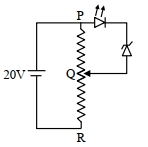
- (A) 2
- (B) 3
- (C) 4
- (D) 5
Show answer and solution
Correct Answer: (D)
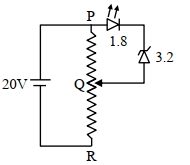
\(PR=20cm\)
\(\mathrm{~V}_{\mathrm{PQ}}=\frac{1}{4} \times \mathrm{R}_{\mathrm{PR}}\)
\(\ell_{\min }(\mathrm{PQ})=\frac{1}{4} \times 20\)
\(=5 \mathrm{~cm}\) -
- (A) \(50 \mathrm{~mA}\)
- (B) \(0\)
- (C) \(30 \mathrm{~mA}\)
- (D) \(20 \mathrm{~mA}\)
Show answer and solution
Correct Answer: (C)
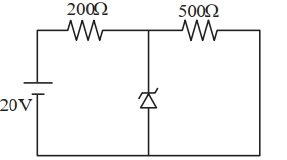
Zener is in breakdown region.
\( I_3=\frac{10}{500}=\frac{1}{50} \)
\( I_1=\frac{10}{200}=\frac{1}{20} \)
\( I_2=I_1-I_3 \)
\( I_2=\left(\frac{1}{20}-\frac{1}{50}\right)=\left(\frac{3}{100}\right)=30 \ m A\)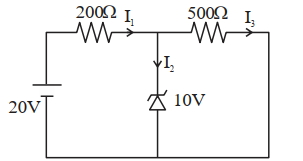
-
- (A) \(15\)
- (B) \(11\)
- (C) \(13\)
- (D) \(21\)
Show answer and solution
Correct Answer: (A)
\(\mathrm{E}_{\mathrm{s}}=\frac{\mathrm{hc}}{\lambda}=\frac{6.6 \times 10^{-34} \times 3 \times 10^8}{660 \times 10^{-9}} \mathrm{~J}\)\(=\frac{6.6 \times 10^{-34} \times 3 \times 10^8}{660 \times 10^{-9} \times 1.6 \times 10^{-19}} \mathrm{eV}\)
\(=\frac{15}{8} \mathrm{eV}\)
So \(x=15\)
-
- (A) \(\mathrm{A}=0, \mathrm{~B}=1, \mathrm{C}=1, \mathrm{D}=1\)
- (B) \(\mathrm{A}=1, \mathrm{~B}=0, \mathrm{C}=0, \mathrm{D}=0\)
- (C) \(\mathrm{A}=0, \mathrm{~B}=0, \mathrm{C}=0, \mathrm{D}=1\)
- (D) \(A=1, B=1, C=1, D=0\)
Show answer and solution
Correct Answer: (B)
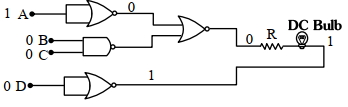
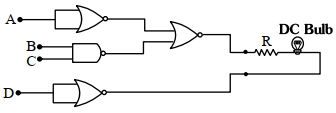
Bulb will glow if bulb have potential drop on it. One end of bulb must be at high \((1)\) and other must be at low \((0)\).Option \((2)\) satisfy this condition
-
- (A) \(NAND\) - gate
- (B) \(OR\) - gate
- (C) \(AND\) gate
- (D) \(NOR\) gate
Show answer and solution
Correct Answer: (B)
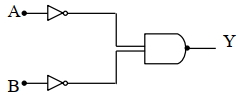
\(\mathrm{Y}=\overline{\overline{\mathrm{A}} \cdot \overline{\mathrm{B}}}\)By De-Morgan Law
\(\mathrm{Y}=\overline{\overline{\mathrm{A}+\mathrm{B}}}\)
\(\mathrm{Y}=\mathrm{A}+\mathrm{B}\)
Hence \(OR\) gate
-
- (A) \(NAND\)
- (B) \(NOR\)
- (C) \(OR\)
- (D) \(AND\)
Show answer and solution
Correct Answer: (C)
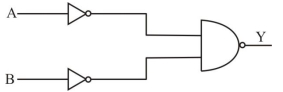
\(\mathrm{Y}=\overline{\overline{\mathrm{A}} \cdot \overline{\mathrm{B}}}=\overline{\overline{\mathrm{A}}}+\overline{\overline{\mathrm{B}}}=\mathrm{A}+\mathrm{B}\)(De-Morgan's law)
-
- (A) reduced by \(\frac{1}{4} \mathrm{~L}\)
- (B) increased by \(2 \mathrm{~L}\)
- (C) reduced by \(\frac{3}{4} \mathrm{~L}\)
- (D) increased to \(4 \mathrm{~L}\)
Show answer and solution
Correct Answer: (C)
\(\omega^{\prime}=\omega\)\(\frac{1}{\sqrt{\mathrm{L}^{\prime} \mathrm{C}^{\prime}}}=\frac{1}{\sqrt{\mathrm{LC}}}\)
\(\therefore \mathrm{L}^{\prime} \mathrm{C}^{\prime}=\mathrm{LC}\)
\(\mathrm{L}^{\prime}(4 \mathrm{C})=\mathrm{LC}\)
\(\mathrm{L}^{\prime}=\frac{\mathrm{L}}{4}\)
\(\because\) Inductance must be decreased by \(\frac{3 L}{4}\)
-
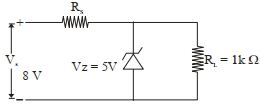
- (A) \(5 \mathrm{k} \Omega\)
- (B) \(10 \Omega\)
- (C) \(1 \mathrm{k} \Omega\)
- (D) \(10 \mathrm{k} \Omega\)
Show answer and solution
Correct Answer: (A)
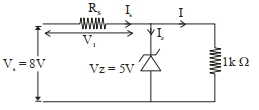
Pd across \(R_{\text {s }}\)\(V_1=8-5=3 \mathrm{~V}\)
Current through the load resistor
\(\mathrm{I}=\frac{5}{1 \times 10^3}=5 \mathrm{~mA}\)
Maximum current through Zener diode
\(I_{z \max .}=\frac{10}{5}=2 \mathrm{~mA}\)
And minimum current through Zener diode
\(\mathrm{I}_{z_{\text {min. }}}=0\)
\(\therefore \mathrm{I}_{5 \text { max. }}=5+2=7 \mathrm{~mA}\)
\(\text { And } \mathrm{R}_{5 \text { min }}=\frac{\mathrm{V}_1}{\mathrm{I}_{5 \max } \cdot}=\frac{3}{7} \mathrm{k} \Omega\)
\(\text { Similarly }\)
\(\mathrm{I}_{5 \text { min. }}=5 \mathrm{~mA}\)
\(\text { And } \mathrm{R}_{5 \text { max. }}=\frac{\mathrm{V}_1}{\mathrm{I}_{\mathrm{s} \text { min. }}}=\frac{3}{5} \mathrm{k} \Omega\)
\(\therefore \frac{3}{7} \mathrm{k} \Omega<\mathrm{R}_5<\frac{3}{5} \mathrm{k} \Omega\)
- 44. In the given circuit, the breakdown voltage of the Zener diode is \(3.0 \mathrm{~V}\). What is the value of \(\mathrm{I}_z\) ?
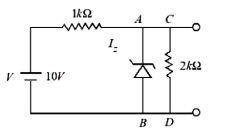 2024 Hard
- (A) \(3.3 \mathrm{~mA}\)
- (B) \(5.5 \mathrm{~mA}\)
- (C) \(10 \mathrm{~mA}\)
- (D) \(7 \mathrm{~mA}\)
Show answer and solution
Correct Answer: (B)
\(\mathrm{V}_z=3 \mathrm{~V}\)Let potential at \(B=0 \mathrm{~V}\)
Potential at \(E\left(V_E\right)=10 \mathrm{~V}\)
\( V_C=V_A=3 \mathrm{~V} \)
\( I_z+I_1=I \)
\( I=\frac{10-3}{1000}=\frac{7}{1000} \mathrm{~A} \)
\( I_1=\frac{3}{2000} \mathrm{~A}\)
Therefore \(I_z=\frac{7-1.5}{1000}=5.5 \mathrm{~mA}\)
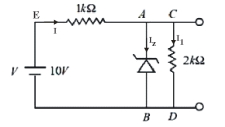
- 45. In the given circuit, the voltage across load resistance \(\left(R_L\right)\) is _______.
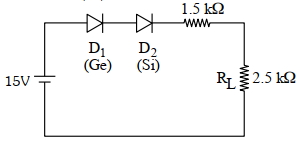 2024 Hard
- (A) \(8.75 \mathrm{~V}\)
- (B) \(9.00 \mathrm{~V}\)
- (C) \(8.50 \mathrm{~V}\)
- (D) \(14.00 \mathrm{~V}\)
Show answer and solution
Correct Answer: (A)
\(\mathrm{i}=\frac{14}{4}=3.5 \mathrm{~mA}\)
\(\mathrm{V}_{\mathrm{L}}=i \mathrm{R}_{\mathrm{L}}=3.5 \times 2.5\) volt
\(=8.75 \mathrm{volt}\)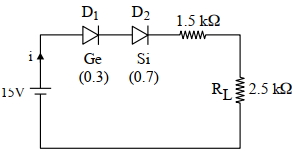
-
- (A) \(407 \mathrm{~nm}\)
- (B) \(414 \mathrm{~nm}\)
- (C) \(207 \mathrm{~nm}\)
- (D) \(103.5 \mathrm{~nm}\)
Show answer and solution
Correct Answer: (C)
\(\text { Energy }=\frac{hc}{\lambda}\)\(E=\frac{1240}{\lambda(\mathrm{nm})} \mathrm{eV}\)
\(6=\frac{1240}{\lambda(\mathrm{nm})}\)
\(\lambda=\frac{1240}{6}=207 \mathrm{~nm}\)
- 47. The \(I-V\) characteristics of an electronic device shown in the figure. The device is _______.
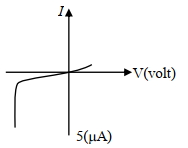 2024 Hard
- (A) a solar cell
- (B) a transistor which can be used as an amplifier
- (C) a zener diode which can be used as voltage regulator
- (D) a diode which can be used as a rectifier
Show answer and solution
Correct Answer: (C)
TheoryZener diode used as voltage regulator
-
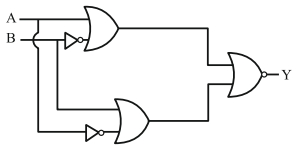
- (A)
\(A\) \(B\) \(Y\) \(0\) \(0\) \(0\) \(1\) \(0\) \(0\) \(0\) \(1\) \(0\) \(1\) \(1\) \(1\) - (B)
\(A\) \(B\) \(Y\) \(0\) \(0\) \(0\) \(1\) \(0\) \(1\) \(0\) \(1\) \(1\) \(1\) \(1\) \(0\) - (C)
\(A\) \(B\) \(Y\) \(0\) \(0\) \(0\) \(1\) \(0\) \(0\) \(0\) \(1\) \(0\) \(1\) \(1\) \(0\) - (D)
\(A\) \(B\) \(Y\) \(0\) \(0\) \(0\) \(1\) \(0\) \(0\) \(0\) \(1\) \(1\) \(1\) \(1\) \(0\)
Show answer and solution
Correct Answer: (C)
\(\text { If } \mathrm{A}=0 ; \overline{\mathrm{A}}=1\)
\(\mathrm{~A}=1 ; \overline{\mathrm{A}}=0\)
\(\mathrm{~B}=0 ; \overline{\mathrm{B}}=1\)
\(\mathrm{~B}=1 ; \overline{\mathrm{B}}=0\)
\(\mathrm{Y}=\overline{(\mathrm{A}+\overline{\mathrm{B}})+(\overline{\mathrm{A}}+\mathrm{B})}=\overline{(1+1)}=0\)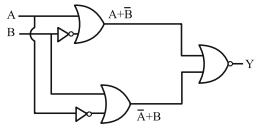
- (A)
-
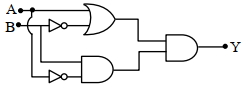
- (A) \(A \cdot B(A+B)\)
- (B) \(A \cdot B\)
- (C) \(0\)
- (D) \(\bar{A} \cdot B\)
Show answer and solution
Correct Answer: (C)
By truth table\(A\) \(B\) \(Y\) \(0\) \(0\) \(0\) \(0\) \(1\) \(0\) \(1\) \(0\) \(0\) \(1\) \(1\) \(0\) -
- (A)
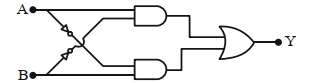
\(A\) \(B\) \(y\) \(0\) \(0\) \(1\) \(0\) \(1\) \(0\) \(1\) \(0\) \(0\) \(1\) \(1\) \(1\) - (B)
\(A\) \(B\) \(y\) \(0\) \(0\) \(0\) \(0\) \(1\) \(1\) \(1\) \(0\) \(1\) \(1\) \(1\) \(0\) - (C)
\(A\) \(B\) \(y\) \(0\) \(0\) \(0\) \(0\) \(1\) \(0\) \(1\) \(0\) \(0\) \(1\) \(1\) \(1\) - (D)
\(A\) \(B\) \(y\) \(0\) \(0\) \(1\) \(0\) \(1\) \(1\) \(1\) \(0\) \(1\) \(1\) \(1\) \(0\)
Show answer and solution
Correct Answer: (B)
\(\mathrm{Y}=\mathrm{A} \cdot \overline{\mathrm{B}}+\overline{\mathrm{A}} \cdot \mathrm{B}\)This is \(XOR\) \(GATE\)
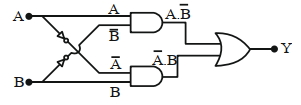
- (A)
No questions on this page match these filters.
Other years
Frequently asked
How many JEE Mains 2024 Physics questions are on ExamBro?
593 questions, each with the correct answer and a full solution.
Which JEE Mains 2024 Physics chapter is asked the most?
Current electricity, with 45 questions, followed by Moving charges and magnetism with 39.
How difficult are JEE Mains 2024 Physics questions?
1% are easy, 4% medium and 95% hard.