


Questions
Newest firstShowing 1–20 of 20 questions
- 1. An unpolarized light of certain intensity passes through a combination of two polarizers whose transmission axes are at \(30°\) and \(90°\), respectively, with respect to the horizontal axis. A third polarizer with its transmission axis at \(60°\) with the horizontal axis is placed between the two existing polarizers. The ratio of the output intensities with and without the third polarizer is ______. 2026 Hard
- 2. An unpolarized light of intensity \(I_o\) passes through polarizer and then through a certain optically active solution and finally it goes to analyser. If the angle between analyser and polariser is \(0°\) and intensity of light emerged from analyser is \(\dfrac{3}{8}I_o\), the angle of rotation of the light by the solution with respect to analyser is _______ degrees. 2026 Medium
- 3. In a Young's double slit experiment, three polarizers are kept as shown in the figure. The transmission axes of \(P_1\) and \(P_2\) are orthogonal to each other. The polarizer \(P_3\) covers both the slits with its transmission axis at \(45^{\circ}\) to those of \(P_1\) and \(P_2\). An unpolarized light of wavelength \(\lambda\) and intensity \(I_0\) is incident on \(P_1\) and \(P_2\). The intensity at a point after \(P_3\) where the path difference between the light waves from \(s_1\) and \(s_2\) is \(\frac{\lambda}{3}\), is _______.
 2025 Hard
- 4. Two polarisers \(P_1\) and \(P_2\) are placed in such a way that the intensity of the transmitted light will be zero. A third polariser \(P_3\) is inserted in between \(P_1\) and \(\mathrm{P}_2\), at the particular angle between \(\mathrm{P}_2\) and \(\mathrm{P}_3\). The transmitted intensity of the light passing the through all three polarisers is maximum. The angle between the polarisers \(\mathrm{P}_2\) and \(\mathrm{P}_3\) is : 2025 Medium
- 5. A beam of unpolarised light of intensity \(I_0\) is passed through a polaroid \(A\) and then through another polaroid \(B\) which is oriented so that its principal plane makes an angle of \(45^o \) relative to that of \(A\). The intensity of the emergent light is _______. 2024 Medium
- 6. Abeam of unpolarised light of intensity \(I_0\) is passed through a polaroid \(A\) and then through another polaroid \(B\) which is oriented so that its principal plane makes an angle of \(45^{\circ}\) relative to that of \(A\). The intensity of emergent light is : 2024 Hard
- 7. As shown in figures, three identical polaroids \(P_1\), \(P _2\) and \(P _3\) are placed one after another. The pass axis of \(P_2\) and \(P_3\) are inclined at angle of \(60^{\circ}\) and \(90^{\circ}\) with respect to axis of \(P _1\). The source \(S\) has an intensity of \(256 \frac{ W }{ m ^2}\). The intensity of light at point \(O\) is \(...........\frac{ W }{ m ^2}\).
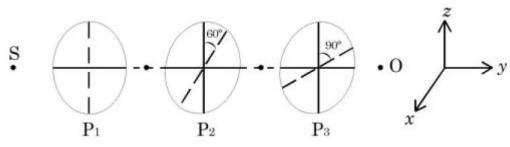 2023 Medium
- 8. \(n\) polarizing sheets are arranged such that each makes an angle \(45^{\circ}\) with the proceeding sheet. An unpolarized light of intensity \(I\) is incident into this arrangement. The output intensity is found to be \(\frac{I}{64}\). The value of \(n\) will be: 2023 Medium
- 9. Two polaroide \(A\) and \(B\) are placed in such a way that the pass-axis of polaroids are perpendicular to each other. Now, another polaroid \(C\) is placed between \(A\) and \(B\) bisecting angle between them. If intensity of unpolarised light is \(I _0\) then intensity of transmitted light after passing through polaroid \(B\) will be : 2023 Medium
- 10. Unpolarised light of intensity \(32\,Wm ^{-2}\) passes through the combination of three polaroids such that the pass axis of the last polaroid is perpendicular to that of the pass axis of first polaroid. If intensity of emerging light is \(3\,Wm ^{-2}\), then the angle between pass axis of first two polaroids is \(............\,^{\circ}\) 2023 Medium
- 11. An unpolarised light beam of intensity \(2 I _{0}\) is passed through a polaroid \(P\) and then through another polaroid \(Q\) which is oriented in such a way that its passing axis makes an angle of \(30^{\circ}\) relative to that of \(P\). The intensity of the emergent light is. 2022 Medium
- 12. A source of light is placed in front of a screen. Intensity of light on the screen is \(I.\) Two Polaroids \({P}_{1}\) and \({P}_{2}\) are so placed in between the source of light and screen that the intensity of light on screen is \({I} / 2 .\) \({P}_{2}\) should be rotated by an angle of ........ (degrees) so that the intensity of light on the screen becomes \(\frac{3 I}{8}.\) 2021 Medium
- 13. An unpolarized light beam is incident on the polarizer of a polarization experiment and the intensity of light beam emerging from the analyzer is measured as \(100\) Lumens. Now, if the analyzer is rotated around the horizontal axis (direction of light) by \(30^{\circ}\) in clockwise direction, the intensity of emerging light will be .......... Lumens. 2021 Hard
- 14. A beam of plane polarised light of large cross sectional area and uniform intensity of \(3.3 \,Wm ^{-2}\) falls normally on a polariser (cross sectional area \(3 \times 10^{-4}\, m ^{2}\) ) which rotates about its axis with an angular speed of \(31.4\, rad/s.\) The energy of light passing through the polariser per revolution, is close to ........ \( \times 10^{-4} \,J\) 2020 Hard
- 15. A polarizer - analyser set is adjusted such that the intensity of light coming out of the analyser is just \(10 \%\) of the original intensity. Assuming that the polarizer - analyser set does not absorb any light, the angle by which the analyser need to be rotated further to reduce the output intensity to be zero, is.....\(^o\) 2020 Medium
- 16. A system of three polarizers \(P_1, P_2, P_3\) is set up such that the pass axis of \(P_3\) is crossed with respect to that of \(P_1\). The pass axis of \(P_2\) is inclined at \(60^o\) to the pass axis of \(P_3\). When a beam of unpolarized light of intensity \(I_0\) is incident on \(P_1\), the intensity of light transmitted by the three polarizers is \(I\). The ratio \((I_0/I)\) equals (nearly) 2019 Hard
- 17. A plane polarized light is incident on a polariser with its pass axis making angle \(\theta\) with \(x-\) axis, as shown in the figure. At four different values of \(\theta\), \(\theta\, = 8^o, 38^o, 188^o\) and \(218^o\), the observed intensities are same. What is the angle between the direction of polarization and \(x-\) axis.....\(^o\)
 2018 Hard
- 18. Unpolarized light of intensity \(I\) is incident on a system of two polarizers, \(A\) followed by \(B.\) The intensity of emergent light is \(I/2.\) If a third polarizer \(C\) is placed between \(A\) and \(B,\) the intensity of emergent light is reduced to \(I/3 .\) The angle between the polarizers \(A\) and \(C\) is \(\theta \) . Then 2018 Medium
- 19. Unpolarized light of intensity \(I\) passes through an ideal polarizer \(A\) Another indentical polarizer \(B\) is placed behind \(A\) The intensity of light beyond \(B\) is found to be \(\frac{I}{2}\) Now another identical polarizer \(C\) is placed between \(A\) and \(B\). The intensity beyond \(B\) is now found to be \(\frac{I}{8}\) The angle between polarizer \(A\) and \(C\) is:......\(^o\) 2018 Medium
- 20. Two beams, \(A\) and \(B\), of plane polarized light with mutually perpendicular planes of polarization are seen through a polaroid. From the position when the beam \(A\) has maximum intensity ( and beam \(B\) has zero intensity), a rotation of polaroid through \(30 ^o \) makes the two beams appear equally bright. If the initial intensities of the two beams are \(I_A\) and \(I_B\) respectively, then \(\frac{{{I_A}}}{{{I_B}}}\)= 2014 Medium
No questions on this page match these filters.
Other STD 12 - Wave optics topics
- 25Qs Single Slit Diffraction of Light
- 57Qs Young's Double Slit Experiment
- 14Qs Resolving power-Human eye, Microscopes and Telescopes
- 10Qs Brewster's Law and Other methods of polarisation
- 23Qs Wave Nature and Interference of Light
- 4Qs Fresnel distance, Diffraction through circular slit, concept of Airy Disc, Rayleigh Criterion of Resolution, Fraunhofer diffraction
- 15Qs Variations in YDSE
- 2Qs Thin film Interference
- 2Qs Huygens' Principle and Wave-fronts
- 1Qs Mix Examples-Wave Optics
- 4Qs Doppler's Effect of Light
Frequently asked
How many Polarisation of Light and Malus' Law questions came in JEE Mains?
20 questions from 2014–2026, each with the correct answer and a full solution.
How difficult are Polarisation of Light and Malus' Law questions?
0% are easy, 65% medium and 35% hard.