


Questions
14 questionsShowing 1–14 of 14 questions
-
- (A) \(16\)
- (B) \(6\)
- (C) \(8\)
- (D) \(10\)
Show answer and solution
Correct Answer: (D)
\(P _2 A - P _1 A =5.4 \times 10^5 \times g\)\(P _2- P _1=\frac{5.4 \times 10^6}{500}=5.4 \times 2 \times 10^2 \times 10\)
\(=10.8 \times 10^3\)
\(P _2+0+\frac{1}{2} \rho V _2^2= P _1+0+\frac{1}{2} \rho V _1^2\)
\(P_2-P_1=\frac{1}{2} \rho\left(V_1^2-V_2^2\right)=\frac{1}{2} \rho\left(V_1-V_2\right)\left(V_1+V_2\right)\)
\(10.8 \times 10^3=\frac{1}{2} \times 1.2\left( V _1- V _2\right) \times 2 \times 3 \times 10^2\)
\(10.8 \times 10=3.6\left( V _1- V _2\right)\)
\(V _1- V _2=30\)
\(\left(\frac{ V _1- V _2}{ V }\right) \times 100=\frac{30}{300} \times 100=10 \%\)
-
- (A) \(200 \times 10^{+6}\,Pa\)
- (B) \(20 \times 10^{+6}\,Pa\)
- (C) \(2 \times 10^{+6}\,Pa\)
- (D) \(2 \times 10^{+5}\,Pa\)
Show answer and solution
Correct Answer: (C)
\(\text { Force }= mg =5000\,g\)\(\text { Area of cross section }=250\,cm ^2=250 \times 10^{-4}\,m ^2\)
\(\text { max imum pressure }=\frac{\text { Force }}{\text { area of cross section }}\)
\(\quad=\frac{5000\,g }{250 \times 10^{-4}}=\frac{20 \times g }{10^{-4}}=2 \times 10^6\,Pa\)
-
- (A) \(12\)
- (B) \(25\)
- (C) \(30\)
- (D) \(40\)
Show answer and solution
Correct Answer: (B)
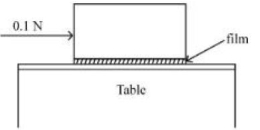
\(| F |=\eta A \frac{\Delta v }{\Delta h }: 0.1=5 \times 10^{-3} \times 0.2 \times \frac{ v }{.25 \times 10^{-3}}\)\(v =0.025\,m / s \text { or } v =25 \times 10^{-3}\,m / s\)
-
- (A) \(F=\mathrm{Mg}\left(1-\frac{\rho_0}{\rho}\right)\)
- (B) \(F=M g\left(1+\frac{\rho}{\rho_0}\right)\)
- (C) \(F=\mathrm{Mg}\left(1+\frac{\rho_0}{\rho}\right)\)
- (D) \(F=\mathrm{Mg}\left(\mathrm{l} \pm \rho \rho_0\right)\)
Show answer and solution
Correct Answer: (A)
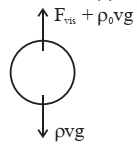
For constant velocity \(F_{\text {net }}=0\)\(\mathrm{F}_{\mathrm{vis}}+\rho_0 \mathrm{vg}=\rho \mathrm{vg}\)
\(\mathrm{F}_{\mathrm{vis}}=\left(\rho-\rho_0\right) \mathrm{vg}\)
\(=\rho \mathrm{vg}\left(1-\frac{\rho_0}{\rho}\right)\)
\(=\mathrm{Mg}\left(1-\frac{\rho_0}{\rho}\right)\)
-
- (A) \(4\)
- (B) \(5\)
- (C) \(7\)
- (D) \(6\)
Show answer and solution
Correct Answer: (C)
When the ball attain terminal velocity\(F _r=\left( mg - F _{ B }\right)(\because a =0)\)
\(= V \sigma_{ b } g - V \rho_{\ell} g\)
\(= Vg \left(\sigma_{ b }-\rho_{\ell}\right)\)
\(=\frac{4}{3} \pi\left(10^{-3}\right)^3 \times 9.8(10.5-1.5) \times 10^3\)
\(=3696 \times 10^{-7}\,N\)
So, \(x=7\)
-
- (A) \(5\)
- (B) \(10\)
- (C) \(8\)
- (D) \(9\)
Show answer and solution
Correct Answer: (B)
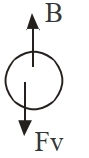
Since the bubble is moving at constant speed the force acting on it is zero.\(B = F _{ V }\)
\(\frac{4}{3} \pi R ^3 \rho g =6 \pi \eta Rv\)
\(\eta=\frac{2 R ^2 \rho g }{9 v }=\frac{2 \times\left(3 \times 10^{-3}\right)^2 \times 1750 \times 10}{9 \times 0.35 \times 10^{-2}}=10\,Pas\)
-
- (A) \(5\mathrm{~cm}^3\)
- (B) \(2\mathrm{~cm}^3\)
- (C) \(4\mathrm{~cm}^3\)
- (D) \(3\mathrm{~cm}^3\)
Show answer and solution
Correct Answer: (A)
\(P = P _0+\rho gh =10^5\,Pa +10^3 \times 10 \times 40=5 \times 10^5\,Pa\)At \(T\) is constant
\(PV = P _0 V _0\)
\(\Rightarrow 5 \times 10^5\,Pa \times 1\,cm ^3=10^5 Pa \times V _0 \Rightarrow V _0=5\,cm ^3\)
-
- (A) \(10\)
- (B) \(40\)
- (C) \(16\)
- (D) \(5\)
Show answer and solution
Correct Answer: (B)
\(v \propto r ^2\)\(\frac{ v _1}{ v _2}=\left(\frac{ r }{ R }\right)^2\)
\(8 \cdot \frac{4}{3} \pi r ^3=\frac{4}{3} \pi R ^3\)
\(R =2 r\)
\(\frac{10}{ v _2}=\left(\frac{1}{2}\right)^2\)
\(v _2=40\,cm / s\)
-
- (A) \(70\)
- (B) \(60\)
- (C) \(80\)
- (D) \(50\)
Show answer and solution
Correct Answer: (C)
By equation of continuity\(A _1 V _1= A _2 V _2\)
\(V _2=\frac{2 \times 4}{10 \times 10^{-2}}=80\,cm / s\)
-
- (A) \(A\) is not correct but \(R\) is correct.
- (B) \(A\) is correct but \(R\) is not correct.
- (C) Both \(A\) and \(R\) are correct and \(R\) is the correct explanation of \(A\).
- (D) Both \(A\) and \(R\) are correct but \(R\) is NOT the correct explanation of \(A\).
Show answer and solution
Correct Answer: (C)
\((R)\) is the statement of Pascal's principle and which explains the assertion \((S)\) -
- (A) Statement \(I\) is false but Statement \(II\) is true
- (B) Both Statement \(I\) and Statement \(II\) are true
- (C) Statement \(I\) is true but Statement \(II\) is false
- (D) Both Statement \(I\) and Statement \(II\) are false
Show answer and solution
Correct Answer: (B)
Pressure in a static liquid will be same at each point on same horizontal level.\(\therefore P=P_{a m}+\rho g h\)
As per Pascal law, same pressure applied to enclosed water is transmitted in all directions equally.
-
- (A) \(2\)
- (B) \(6\)
- (C) \(8\)
- (D) \(4\)
Show answer and solution
Correct Answer: (D)
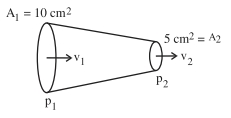
\(\Delta P = P _1- P _2=3 N / m ^2 \text { (given) }\)By continuity \(eq ^{ n }\)
\(A _1 v _1= A _2 v _2\)
\(\therefore \quad v_1=\frac{A_2}{A_1} v_2-(1)\)
By Bernoulli's equation.
\(P _1+\frac{1}{2} \rho v _1{ }^2= P _2+\frac{1}{2} \rho v _2{ }^2\)
\(P _1- P _2=\frac{1}{2} \rho\left( v _2^2- v _1^2\right)\)
\(\Delta P =\frac{1}{2} \rho\left( v _2^2-\frac{ A _2^2}{ A _1^2} v _2^2\right)\)
\(\Delta P =\frac{1}{2} \rho\left[1-\left(\frac{ A _2}{ A _1}\right)^2\right] v _2^2\)
\(3=\frac{1}{2} \times 1.25 \times 10^3\left[1-\left(\frac{5}{10}\right)^2\right] v _2^2\)
\(3=\frac{1}{2} \times 1.25 \times 10^3\left[1-\frac{1}{4}\right] v _2^2\)
\(3=\frac{1}{2} \times 1.25 \times 10^3 \times \frac{3}{4} v_2^2\)
So discharge rate \(= A _2 V _2\)
\(=5 \times 10^{-4} \times 8 \times 10^{-2}\)
\(=4 \times 10^{-5}\,m ^3 / s\)
Correct ans is \(x=4\)
-
- (A) \(175\)
- (B) \(27\)
- (C) \(135\)
- (D) \(36\)
Show answer and solution
Correct Answer: (A)
From continuity theorem \(A_1 V_1=A_2 V_2\)\(1.5 \times V_1=25 \times 10^{-2} \times 60\)
\(V_1=\frac{25 \times 60 \times 10^{-2} \times 10}{1.5}\)
\(V_1=10\,cm / s\)
By Bernoulli's theorem
\(P_1+\frac{1}{2} \times 1000 \times(0.1)^2=P_2+\frac{1}{2} \times 1000 \times(0.6)^2\)
\(P_1+5=P_2+\frac{1}{2} \times 1000 \times 36 \times 10^{-2}\)
\(P_1+5=P_2+180\)
\(P_1-P_2=175\,Pa\)
-
- (A) \(3\)
- (B) \(4\)
- (C) \(6\)
- (D) \(2\)
Show answer and solution
Correct Answer: (D)
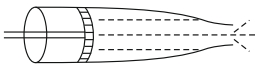
\(A _1 V _1= A _2 V _2\)\(750 \times 10^{-4} V _1=500 \times 10^{-6} \times 0.3\)
\(V _1=\frac{500 \times 3 \times 10^{-3}}{750}\,m / s\)
\(=2 \times 10^{-3}\,m / s\)
\(\frac{ dh }{ dt }=-2 \times 10^{-3}\,m / s\)
No questions on this page match these filters.