


Topics
5 topics- 22Qs Surface Energy Most asked
- 7Qs Surface Tension
- 14Qs Capillary Tube and Capillarity
- 18Qs Excess Pressure
- 1Qs Angle of Contact
All STD 11 - Surface tension questions
Newest firstShowing 1–50 of 62 questions
- 1. A liquid drop of diameter \(2\) mm breaks into \(512\) droplets. The change in surface energy is \(\alpha \times 10^{-6}\) J. The value of \(\alpha\) is _______. (Take surface tension of liquid \(= 0.08\) N/m) 2026 Medium
- 2. A soap bubble of surface tension \(0.04 N / m\) is blown to a diameter of 7 cm . If \((15000- x ) \mu J\) of work is done in blowing it further to make its diameter 14 cm , then the value of x is _________ .\((\pi=22 / 7)\) 2026 Easy
- 3. Eight mercury drops, each of radius \(r\), coalesce to form a bigger drop. The surface energy released in this process is _______. (\(S\) is the surface tension of mercury). 2026 Medium
- 4. Given below are two statements:
Statement I: Pressure of fluid is exerted only on a solid surface in contact as the fluid-pressure does not exist everywhere in a still fluid.
Statement II: Excess potential energy of the molecules on the surface of a liquid, when compared to interior, results in surface tension.
In the light of the above statements, choose the correct answer from the options given below. 2026 Medium - 5. Match List-I with List-II.
Choose the correct answer from the options given below : 2026 HardList-I List-II A. Coefficient of viscosity I. \(\left[ ML ^{-1} T^{-2}\right]\) B. Surface tension II. \(\left[ ML ^2 T^{-2}\right]\) C. Pressure III. \(\left[ ML ^0 T^{-2}\right]\) D. Surface energy IV. \(\left[ ML ^{-1} T^{-1}\right]\) - 6. Surface tension of two liquids (having same densities), \(T_1\) and \(T_2\), are measured using capillary rise method utilizing two tubes with inner radii of \(r_1\) and \(r_2\) where \(r_1>r_2\). The measured liquid heights in these tubes are \(h_1\) and \(h_2\) respectively. [Ignore the weight of the liquid about the lowest point of miniscus]. The heights \(h _1\) and \(h _2\) and surface tensions \(T _1\) and \(T _2\) satisfy the relation : 2026 Easy
- 7. The surface tension of a soap bubble is \(0.03\) N/m. The work done in increasing the diameter of bubble from \(2\) cm to \(6\) cm is \(\alpha \pi \times 10^{-4}\) J. The value of \(\alpha\) is _______. (Take \(\pi = 3.14\)) 2026 Medium
- 8. The surface tension of a soap solution is \(3.5 \times 10^{-2}\) N/m. The work required to increase the radius of a soap bubble from \(1\) cm to \(2\) cm is \(\alpha \times 10^{-6}\) J. The value of \(\alpha\) is _____. (\(\pi = 22/7\)) 2026 Medium
- 9. When a part of a straight capillary tube is placed vertically in a liquid, the liquid raises upto certain height h. If the inner radius of the capillary tube, density of the liquid and surface tension of the liquid decrease by 1% each, then the height of the liquid in the tube will change by __________ %. 2026 Easy
- 10. A capillary tube of radius 0.1 mm is partly dipped in water (surface tension \(70 \mathrm{dyn} / \mathrm{cm}\) and glass water contact angle \(\simeq 0^{\circ}\)) with \(30^{\circ}\) inclined with vertical. The length of water risen in the capillary is ________ cm.
\(\left(\right.\) Take \(\left.\mathrm{g}=9.8 \mathrm{~m} / \mathrm{s}^2\right)\) 2025 Medium - 11. An air bubble of radius 0.1 cm lies at a depth of 20 cm below the free surface of a liquid of density \(1000 \mathrm{~kg} / \mathrm{m}^3\). If the pressure inside the bubble is \(2100 \mathrm{~N} / \mathrm{m}^2\) greater than the atmospheric pressure, then the surface tension of the liquid in SI unit is (use \(\mathrm{g}=10 \mathrm{~m} / \mathrm{s}^2\) ) 2025 Hard
- 12. An air bubble of radius 1.0 mm is observed at a depth of 20 cm below the free surface of a liquid having surface tension \(0.095 \mathrm{~J} / \mathrm{m}^2\) and density \(10^3 \mathrm{~kg} / \mathrm{m}^3\). The difference between pressure inside the bubble and atmospheric pressure is _____ \(\mathrm{N} / \mathrm{m}^2\). (Take \(\mathrm{g}=10 \mathrm{~m} / \mathrm{s}^2\) ) 2025 Medium
- 13. Given below are two statements:
Statement I: The hot water flows faster than cold water.
Statement II: Soap water has higher surface tension as compared to fresh water.
In the light above statements, choose the correct answer from the options given below. 2025 Easy - 14. The amount of work done to break a big water drop of radius ' \(R\) ' into 27 small drops of equal radius is 10 J . The work done required to break the same big drop into 64 small drops of equal radius will be 2025 Medium
- 15. The excess pressure inside a soap bubble A in air is half the excess pressure inside another soap bubble B in air. If the volume of the bubble A is \(n\) times the volume of the bubble \(B\), then, the value of \(n\) is ___. 2025 Easy
- 16. Two liquids A and B have \(\theta_{\mathrm{A}}\) and \(\theta_{\mathrm{B}}\) as contact angles in a capillary tube. If \(K=\cos \theta_A / \cos \theta_B\). then identify the correct statement: 2025 Medium
- 17. Two soap bubbles of radius 2 cm and 4 cm , respectively, are in contact with each other. The radius of curvature of the common surface, in cm , is ______ . 2025 Easy
- 18. Two water drops each of radius 'r' coalesce to from a bigger drop. If ' T ' is the surface tension, the surface energy released in this process is : 2025 Easy
- 19. A big drop is formed by coalescing \(1000\) small droplets of water. The surface energy will become _______. 2024 Hard
- 20. A big drop is formed by coalescing \(1000\) small droplets of water. The ratio of surface energy of \(1000\) droplets to that of energy of big drop is \(\frac{10}{x}\). The value of \(x\) is _______. 2024 Hard
- 21. A big drop is formed by coalescing \(1000\) small identical drops of water. If \(E_1\) be the total surface energy of \(1000\) small drops of water and \(E_2\) be the surface energy of single big drop of water, the \(E_1\) : \(\mathrm{E}_2\) is \(\mathrm{x}: 1\) where \(x\) = _____. 2024 Hard
- 22. A liquid column of height \(0.04 \mathrm{~cm}\) balances excess pressure of soap bubble of certain radius. If density of liquid is \(8 \times 10^3 \mathrm{~kg} \mathrm{~m}^{-3}\) and surface tension of soap solution is \(0.28 \mathrm{Nm}^{-1}\), then diameter of the soap bubble is _______ \(\mathrm{cm}\). \(\text { (if } g=10 \mathrm{~ms}^{-2} \text { ) }\) 2024 Hard
- 23. A small liquid drop of radius \(R\) is divided into \(27\) identical liquid drops. If the surface tension is \(\mathrm{T}\), then the work done in the process will be _______. 2024 Hard
- 24. A soap bubble is blown to a diameter of \(7 \mathrm{~cm}\). \(36960 \mathrm{erg}\) of work is done in blowing it further. If surface tension of soap solution is \(40 \mathrm{dyne} / \mathrm{cm}\) then the new radius is ______ \(\mathrm{cm}\). Take \(:\left(\pi=\frac{22}{7}\right)\). 2024 Hard
- 25. Given below are two statements: \(Statement\) \(I\) : If a capillary tube is immersed first in cold water and then in hot water, the height of capillary rise will be smaller in hot water. \(Statement\) \(II\) : If a capillary tube is immersed first in cold water and then in hot water, the height of capillary rise will be smaller in cold water. In the light of the above statements, choose the most appropriate from the options given below 2024 Hard
- 26. Given below are two statements : Statement \(I\) : The contact angle between a solid and a liquid is a property of the material of the solid and liquid as well. Statement \(II\) : The rise of a liquid in a capillary tube does not depend on the inner radius of the tube. In the light of the above statements, choose the correct answer from the options given below : 2024 Hard
- 27. Given below are two statements : \(Statement\) \((I)\) :Viscosity of gases is greater than that of liquids. \(Statement\) \((II)\) : Surface tension of a liquid decreases due to the presence of insoluble impurities. In the light of the above statements, choose the most appropriate answer from the options given below : 2024 Hard
- 28. Given below are two statements : Statement-I: When a capillary tube is dipped into a liquid, the liquid neither rises nor falls in the capillary. The contact angle may be \(0^{\circ}\). Statement-II: The contact angle between a solid and a liquid is a property of the material of the solid and liquid as well : In the light of above statement, choose the correct answer from the options given below. 2024 Hard
- 29. Pressure inside a soap bubble is greater than the pressure outside by an amount _______. (given : \(\mathrm{R}=\) Radius of bubble, \(\mathrm{S}=\) Surface tension of bubble) 2024 Hard
- 30. The excess pressure inside a soap bubble is thrice the excess pressure inside a second soap bubble. The ratio between the volume of the first and the second bubble is _______. 2024 Hard
- 31. A mercury drop of radius \(10^{-3}\,m\) is broken into \(125\) equal size droplets. Surface tension of mercury is \(0.45\,Nm ^{-1}\). The gain in surface energy is \(......\times 10^{-5}\,J\) 2023 Medium
- 32. A spherical drop of liquid splits into \(1000\) identical spherical drops. If \(u _{ i }\) is the surface energy of the original drop and \(u_f\) is the total surface energy of the resulting drops, the (ignoring evaporation). \(\frac{u_f}{u_i}=\left(\frac{10}{x}\right)\). Then value of \(x\) is \(......\) 2023 Medium
- 33. If \(1000\) droplets of water of surface tension \(0.07\,N / m\). having same radius \(1\,mm\) each, combine to from a single drop. In the process the released surface energy is \(\left(\text { Take } \pi=\frac{22}{7}\right)\) 2023 Medium
- 34. Surface tension of a soap bubble is \(2.0 \times 10^{-2}\; Nm ^{-1}\). Work done to increase the radius of soap bubble from \(3.5\; cm\) to \(7\; cm\) will be \(.........\times 10^{-4}\,J\) [Take \(\pi=\frac{22}{7}\) ] 2023 Medium
- 35. The height of liquid column raised in a capillary tube of certain radius when dipped in liquid A vertically is, \(5 cm\). If the tube is dipped in a similar manner in another liquid \(B\) of surface tension and density double the values of liquid \(A\), the height of liquid column raised in liquid \(B\) would be \(........m\). 2023 Medium
- 36. The surface tension of soap solution is \(3.5 \times 10^{-2}\,Nm ^{-1}\). The amount of work done required to increase the radius of soap bubble from \(10\,cm\) to \(20\,cm\) is \(.....\times 10^{-4}\,J\) 2023 Medium
- 37. There is an air bubble of radius \(1.0\,mm\) in a liquid of surface tension \(0.075\,Nm ^{-1}\) and density \(1000\,kg\) \(m ^{-3}\) at a depth of \(10\,cm\) below the free surface. The amount by which the pressure inside the bubble is greater than the atmospheric pressure is \(....Pa \left( g =10\,ms ^{-2}\right)\) 2023 Hard
- 38. A drop of liquid of density \(\rho\) is floating half immersed in a liquid of density \(\sigma\) and surface tension \(7.5 \times 10^{-4}\,N\,cm ^{-1}\). The radius of drop in \(cm\) will be : (Take : \(g =10\,m / s ^{2}\) ) 2022 Hard
- 39. A spherical soap bubble of radius \(3\,cm\) is formed inside another spherical soap bubble of radius \(6\,cm\). If the internal pressure of the smaller bubble of radius \(3\,cm\) in the above system is equal to the internal pressure of the another single soap bubble of radius \(r\,cm\). The value of \(r\) is....... 2022 Hard
- 40. A water drop of diameter \(cm\) is broken into \(64\) equal droplets. The surface tension of water is \(0.075\,N / m\). In this process the gain in surface energy will be ...........\(J\) 2022 Hard
- 41. A water drop of radius \(1\,cm\) is broken into \(729\) equal droplets. If surface tension of water is \(75\,dyne / cm\), then the gain in surface energy upto first decimal place will be\(...\times 10^{-4}\,J\) 2022 Medium
- 42. A large number of water drops, each of radius \(r\), combine to have a drop of radius \(R\). If the surface tension is \(T\) and mechanical equivalent of heat is \(J ,\) the rise in heat energy per unit volume will be 2021 Hard
- 43. A soap bubble of radius \(3\, {cm}\) is formed inside the another soap bubble of radius \(6\, {cm}\). The radius of an equivalent soap bubble which has the same excess pressure as inside the smaller bubble with respect to the atmospheric pressure is .......... \({cm}\)
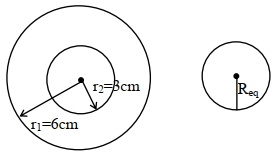 2021 Hard
- 44. The radii of two soap bubbles are \(r_1\) and \(r_2\). In isothermal conditions, two meet together in vaccum. Then the radius of the resultant bubble is given by 2021 Medium
- 45. Two narrow bores of diameter \(5.0\, {mm}\) and \(8.0\, {mm}\) are joined together to form a \(U-\)shaped tube open at both ends. If this \({U}\)-tube contains water, what is the difference in the level of two limbs of the tube. [Take surface tension of water \({T}=7.3 \times 10^{-2} \, {Nm}^{-1}\), angle of contact \(=0, {g}=10\, {ms}^{-2}\) and density of water \(\left.=1.0 \times 10^{3} \,{kg} \,{m}^{-3}\right]\) (in \(mm\)) 2021 Hard
- 46. When two soap bubbles of radii \(a\) and \(b ( b > a )\) coalesce, the radius of curvature of common surface is 2021 Hard
- 47. A capillary tube made of glass of radius \(0.15\, mm\) is dipped vertically in a beaker filled with methylene iodide (surface tension \(=0.05\, Nm ^{-1},\) density \(\left.=667\, kg m ^{-3}\right)\) which rises to height \(h\) in the tube. It is observed that the two tangents drawn from liquid-glass interfaces (from opp. sides of the capillary) make an angle of \(60^{\circ}\) with one another. Then \(h\) is close to \(......m\) \(\left(g=10\, ms ^{-2}\right)\) 2020 Hard
- 48. A small spherical droplet of density \(d\) is floating exactly half immersed in a liquid of density \(\rho\) and surface tension \(\mathrm{T}\). The radius of the droplet is (take note that the surface tension applies an upward force on the droplet) 2020 Hard
- 49. Pressure inside two soap bubbles are \(1.01\) and \(1.02\) atmosphere, respectively. The ratio of their volumes is 2020 Medium
- 50. When a long glass capillary tube of radius \(0.015\;cm\) is dipped in a liquid, the liquid rises to a height of \(15\, cm\) within it. If the contact angle between the liquid and glass to clase to \(0^{\circ},\) the surface tension of the liquid, in \(milli\,Newton \;m ^{-1}\) is \(.....\) \(\left[\rho_{\text {(liquid) }}=900\; kg\,m ^{-3}, g =10\, ms ^{-2}\right]\) (Give answer in closest integer) 2020 Medium
No questions on this page match these filters.
Frequently asked
How many STD 11 - Surface tension questions came in JEE Mains?
62 questions from 2013–2026, each with the correct answer and a full solution.
Which STD 11 - Surface tension topic is asked the most?
Surface Energy, with 22 questions, followed by Excess Pressure with 18.
How difficult are STD 11 - Surface tension questions?
11% are easy, 44% medium and 45% hard.