


Questions
28 questionsShowing 1–28 of 28 questions
-
- (A) \(300\)
- (B) \(30\)
- (C) \(3\)
- (D) \(150\)
Show answer and solution
Correct Answer: (A)
Displacement is \(8^{\text {th }} sec\).\(S _8=0+\frac{1}{2} \times 10 \times(2 \times 8-1)\)
\(S _8=5 \times 15\)
\(\Delta U =0.4 \times 10 \times 5 \times 15\)
\(\Delta U =20 \times 15=300\)
-
- (A) \(120\)
- (B) \(60\)
- (C) \(400\)
- (D) \(360\)
Show answer and solution
Correct Answer: (D)
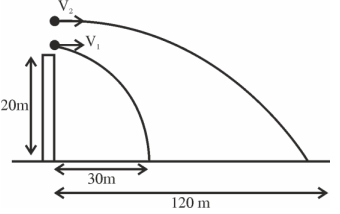
\(v _1=\frac{30}{\sqrt{\frac{2 h }{ g }}}, \quad v _2=\frac{120}{\sqrt{\frac{2 h }{ g }}}\)\((0.01) u =(0.2) \frac{30 \sqrt{ g }}{\sqrt{2 h }}+(0.01) \frac{120 \sqrt{ g }}{\sqrt{2 h }}\)
\(u =300+60=360\,ms ^{-1}\)
-
- (A) \(65\)
- (B) \(66\)
- (C) \(69\)
- (D) \(50\)
Show answer and solution
Correct Answer: (D)
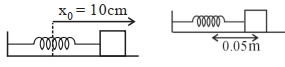
\(U _{ i } =\frac{1}{2} kx _0^2\)\(K _{ i } =0\)
\(U _{ f }=\frac{1}{2} k \left(\frac{ x _0}{2}\right)^2\)
\(K _{ f }=0.25\,J\)
\(\frac{1}{2} kx _0^2+0=\frac{1}{2} k \frac{ x _0^2}{4}+0.25\)
\(\frac{1}{2} k x _0^2 \frac{3}{4}=\frac{1}{4}\)
\(\frac{1}{2} k \frac{3}{100}=1 \Rightarrow k =\frac{200}{3}\,N / m\)
\(=67\,N / m\)
-
- (A) \(30\)
- (B) \(20\)
- (C) \(10\)
- (D) \(50\)
Show answer and solution
Correct Answer: (A)
Work done \(=\int Fdx\)\(\int \limits_2^4 5 x d x=5\left[\frac{ x ^2}{2}\right]_2^4\)
\(=\frac{5}{2}[16-4]\)
\(=30\,J\)
-
- (A) \(300\)
- (B) \(50\)
- (C) \(100\)
- (D) \(200\)
Show answer and solution
Correct Answer: (A)
\(F -5\,g \sin 30^{\circ}=5 a \Rightarrow F =5+25=30\,N\)\(V _{10}= u + at \Rightarrow v _{10}=0+1(10)=10vm / s\)
\(P _{10}= Fv =300\,W\)
-
- (A) \(374\)
- (B) \(373\)
- (C) \(375\)
- (D) \(365\)
Show answer and solution
Correct Answer: (C)
Let \(V_1\) and \(V_2\) are velocity just before and just after hitting the floor.\(\frac{V_1}{V_2}=4 \Rightarrow V_1=4 V_2\)
\(K E_{\text {bygove }}=\frac{1}{2} m V_1^2\)
\(K E_{\text {affor }}=\frac{1}{2} m V_2^2=\frac{1}{2} \frac{m \cdot V_1^2}{16}\)
\(\Delta K E=\frac{1}{2} m V_1^2\left(\frac{1}{16}-1\right)=\frac{-15}{32} m V_1^2\)
\(\% \text { change }=\frac{\Delta K E}{K E_{\text {before }}} \times 100 \%\)
\(=\frac{-15}{16} \times 100=\frac{-375}{4} \%\)
-
- (A) \(1\)
- (B) \(10\)
- (C) \(100\)
- (D) \(0.1\)
Show answer and solution
Correct Answer: (C)
\(\overrightarrow{ F }=t \hat{i}+3 t ^2 \hat{ j }\)\(\frac{ md \overrightarrow{ v }}{ dt }=t \hat{i}+3 t ^2 \hat{ j }\)
\(m =1 kg , \int \limits_0^{\vec{v}} dv =\int \limits_0^{ t } tdt \hat{ i }+\int \limits_0^{ t } 3 t ^2 dt \hat{ j } ~\\ \overrightarrow{ v }=\frac{ t ^2}{2} \hat{ i }+ t ^3 \hat{ j }\)
\(\text { 10.Power }=\overrightarrow{ F } \cdot \overrightarrow{ V }=\frac{ t ^3}{2}+3 t ^5\) \(\text { At } t =2, \text { 10.Power }=\frac{8}{2}+3 \times 32\)
\(=100\)
-
- (A) \(3\)
- (B) \(4\)
- (C) \(2\)
- (D) \(1\)
Show answer and solution
Correct Answer: (B)
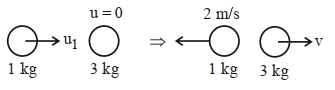
\(1 \times u _1=-2+3 v \Rightarrow u _1=-2+3 v\)\(1=\frac{ v +2}{ u _1} \Rightarrow v +2= u _1\)
Solving \((1)\) and \((2)\)
\(u _1=4\,m / s\)
-
- (A) \(1\)
- (B) \(2\)
- (C) \(4\)
- (D) \(3\)
Show answer and solution
Correct Answer: (C)
\(\frac{1}{2} mV ^2= Pt\)\(V =\sqrt{\frac{2 Pt }{ m }}\)
\(\frac{ dx }{ dt }=\sqrt{\frac{2 Pt }{ m }}\)
\(x =\sqrt{\frac{2 P }{ m } \frac{2}{3}}\left[ t ^{3 / 2}\right]_0^4\)
\(x =\frac{16 \sqrt{ P }}{3}=\frac{1}{3} \times 16 \sqrt{ P }\)
\(\alpha=4\)
-
- (A) \(30\)
- (B) \(29\)
- (C) \(28\)
- (D) \(27\)
Show answer and solution
Correct Answer: (A)
Given\(M =5\,kg\)
\(P _{ i }=10\,kg\,m / s \text { (initial momentum) }\)
\(\text { Impulse }= F \Delta t =\Delta P = P _{ f }- P _{ i }\)
\(2 \times 5= P _{ f }-10\)
\(P _{ f }=20\,kg\,m / s \text { (final momentum) }\)
\(\text { Increase in } KE = KE _{ f }- KE _{ i }\)
\(=\frac{ P _{ f }^2}{2 m }-\frac{ P _{ i }^2}{2\,m }\)
\(=\frac{400}{2 \times 5}-\frac{100}{2 \times 5}=40-10=30\,J\)
-
- (A) \(6\)
- (B) \(3\)
- (C) \(9\)
- (D) \(12\)
Show answer and solution
Correct Answer: (B)
\(E _1=\frac{1}{2} m u^2-0=\frac{1}{2} mu ^2= E\)\(E _2=\frac{1}{2} m (2 u )^2-\frac{1}{2} m u^2=\frac{3}{2} m u^2=3 E\)
-
- (A) \(+564\)
- (B) \(-879\)
- (C) \(-986\)
- (D) \(-245\)
Show answer and solution
Correct Answer: (D)
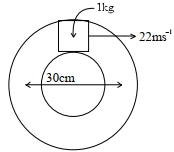
\(r _{\text {avg }}=15\,cm\)\(w _{ f }+ w _{ g }=\Delta KE\)
\(w _{ f }+10 \times 0.3=-\frac{1}{2} \times 484\)
\(w _{ f }=-245\,J\)
-
- (A) \(31\)
- (B) \(32\)
- (C) \(30\)
- (D) \(35\)
Show answer and solution
Correct Answer: (B)
\(W=\int \limits_0^4(2+3 x ) dx\)\(=\left[2 x +\frac{3 x ^2}{2}\right]_0^4\)
\(=8+3 \times 8\)
\(=32\,J\)
-
- (A) \(131\)
- (B) \(134\)
- (C) \(133\)
- (D) \(132\)
Show answer and solution
Correct Answer: (D)
\(F =5+3 y ^2\)\(W =\int \limits_2^5\left(5+3 y ^2\right) d y\)
\(=\left[5 y +\frac{3 y ^3}{3}\right]_2^5\)
\(=132\,J\)
-
- (A) \(7\)
- (B) \(5\)
- (C) \(4\)
- (D) \(3\)
Show answer and solution
Correct Answer: (A)
\(v ^2 = u ^2+2 as\)\(=2^2+2(2)(6)\)
\(=4+24=28\)
\(KE =\frac{1}{2} mv ^2\)
\(=\frac{1}{2}(500) 28\)
\(=7000\,J\)
\(=7\,kJ\)
-
- (A) \(1\)
- (B) \(3\)
- (C) \(4\)
- (D) \(2\)
Show answer and solution
Correct Answer: (D)
Loss of K.E = work done against retarding force .\(=\int \limits _0^{ x } madx =\int \limits_0^{ x } m 2 xdx = mx ^2\)
\(=\left(10^{-2} kg \right) x ^2 J =\left(\frac{10}{ x }\right)^{-2}\,J\)
So \(n=2\)
-
- (A) \(v\)
- (B) \(\frac{v}{2}\)
- (C) \(\frac{v}{3}\)
- (D) \(\frac{v}{4}\)
Show answer and solution
Correct Answer: (C)
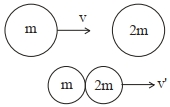
Applying conservation of linear momentum\(\Rightarrow \overrightarrow{ P }_{ i }=\overrightarrow{ P }_{ f }\)
\(mv +2 m \times 0=(3 m ) v ^{\prime}\)
\(\therefore mv =3\,mv\)
\(v ^{\prime}=\frac{ v }{3}\)
-
- (A) \(38\)
- (B) \(40\)
- (C) \(39\)
- (D) \(41\)
Show answer and solution
Correct Answer: (B)
\(W=\vec{F} \cdot\left(\vec{r}_f-\vec{r}_{ i }\right)\)\(=(5 \hat{i}+2 \hat{j}+7 \hat{k}) \cdot((5 \hat{i}-2 \hat{j}+\hat{k})-(2 \hat{i}+3 \hat{j}-4 \hat{k}))\)
\(W=40\,J\)
-
- (A) \(40\)
- (B) \(41\)
- (C) \(42\)
- (D) \(43\)
Show answer and solution
Correct Answer: (A)
\(\frac{1}{2} \times 2 \times v ^2=10000\)\(\Rightarrow v ^2=10000\)
\(\Rightarrow v =100\,m /s\)
\(\Rightarrow v = at = a \times 5=100\)
\(\Rightarrow a =20\,m / s ^2\)
\(F = ma =2 \times 20=40\,N\)
-
- (A) \(1\)
- (B) \(3\)
- (C) \(4\)
- (D) \(2\)
Show answer and solution
Correct Answer: (D)
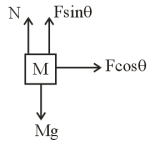
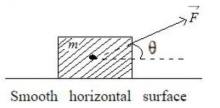
\(F \cos \theta= ma\)\(2 \cos ( kx )=\frac{ mvdv }{ dx }\)
\(\int \limits_0^v v d v=2 \int \limits_0^x \cos (k x) d x\)
\(K . E .=\frac{2}{ k } \sin \theta\)
\(n=2\)
-
- (A) \(0\)
- (B) \(0.25\)
- (C) \(2\)
- (D) \(4\)
Show answer and solution
Correct Answer: (C)
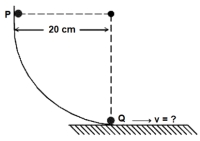
The velocities will be interchanged after collision.Speed of \(P\) just before collision \(=\sqrt{2 gh }\)
\(=\sqrt{2 \times 10 \times 0.2}=2\,m / s\)
- 22. For a body projected at an angle with the horizontal from the ground, choose the correct statement. 2023 Medium
- (A) Gravitational potential energy is maximum at the highest point.
- (B) The horizontal component of velocity is zero at highest point.
- (C) The vertical component of momentum is maximum at the highest point.
- (D) The kinetic energy (K.E.) is zero at the highest point of projectile motion.
Show answer and solution
Correct Answer: (A)
At highest point\(V _{ y }=0\)
\(V _{ x }= u _{ x }= u \cos \theta\)
\(U _{ g }= mgh\), it is maximum at \(H _{\max }\).
-
- (A) Statement \(I\) is correct but Statement \(II\) is incorrect.
- (B) Statement \(I\) is incorrect but Statement \(II\) is correct.
- (C) Both Statement are correct.
- (D) Both Statement are false.
Show answer and solution
Correct Answer: (A)
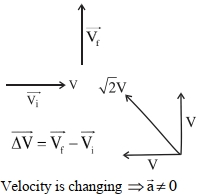
Work done \(=\Delta KE\)Work done \(=- FS =0- K\)
\(S =\frac{ K }{ F }\)
Statement \(1 \rightarrow\) correct
Statement \(2 \rightarrow\) incorrect
-
- (A) \(46\)
- (B) \(44\)
- (C) \(48\)
- (D) \(42\)
Show answer and solution
Correct Answer: (C)
\(P_{\max }=F_{\max } \times V\)\(F_{\max }=1400\,g +\text { friction }\)
\(=14000+2000=16000\)
\(P_{\max }=16000 \times 3=48000\,W =48\,KW\)
- 25. The momentum of a body is increased by \(50 \%\). The percentage increase in the kinetic energy of the body is \(...........\,\%\) 2023 Medium
- (A) \(124\)
- (B) \(125\)
- (C) \(123\)
- (D) \(122\)
Show answer and solution
Correct Answer: (B)
Kinetic energy of body \(=\frac{p^2}{2 m}\)Initial kinetic energy \(=\frac{p_1^2}{2 m }\)
Final kinetic energy \(=\frac{p_f^2}{2 m }=\frac{\left(1.5 p _{ i }\right)^2}{2 m }\)
\(=\frac{2.25 p _{ i }^2}{2 m }\)
\(\%\) increase in \(KE =\frac{2.25 \frac{ p _{ i }^2}{2 m }-\frac{ p _{ i }^2}{2 m }}{\frac{ p _{ i }^2}{2 m }} \times 100=125 \%\)
-
- (A) \(2\)
- (B) \(4\)
- (C) \(2.4\)
- (D) \(16\)
Show answer and solution
Correct Answer: (D)
Average 10.Power \(=\frac{\text { total } \text { work done }}{\text { total time }}\)So,\(P=\frac{m g h}{t}\)
\(\frac{P_1}{P_2}=\frac{\frac{m_1 g h}{t_1}}{\frac{m_2 g h}{t_2}}=\frac{m_1}{t_1} \frac{t_2}{m_2}\)
\(\frac{P_1}{P_2}=\frac{300 \times 2}{5 \times 50}=\frac{12}{5}=\frac{3 \sqrt{x}}{\sqrt{x}+1}\)
\(12 \sqrt{x}+12=15 \sqrt{x}\)
\(3 \sqrt{x}=12\)
\(x=16\)
-
- (A) \(785\)
- (B) \(786\)
- (C) \(777\)
- (D) \(784\)
Show answer and solution
Correct Answer: (D)
For constant speed, WD by engine + WD by friction \(=0 \quad\) [by WET \(]\)\(WD _{\text {engine }}=- WD _{\text {friction }}=-[-\mu mgx ]\)
\(=0.04 \times 500 \times 9.8 \times 4 \times 10^3\)
\(=784\,kJ\)
-
- (A) \(4: 3\)
- (B) \(3: 4\)
- (C) \(16: 9\)
- (D) \(9: 16\)
Show answer and solution
Correct Answer: (D)
\(\frac{ K _1}{ K _2}=\frac{ p _1^2}{2 m _1} \times \frac{2 m _2}{ p _2^2}=\frac{ m _2}{ m _1}=\frac{16}{9}\)\(\frac{ m _1}{ m _2}=\frac{9}{16}\)
No questions on this page match these filters.