


Topics
3 topics- 21Qs Nomenclature of organic compounds Most asked
- 6Qs Classification of organic compounds
- 11Qs Bonding and hybridisation in organic compounds
All Organic chemistry Nomenclature of organic compounds questions
Newest firstShowing 1–38 of 38 questions
-
- (A) Both Statement I and Statement II are true
- (B) Both Statement I and Statement II are false
- (C) Statement I is true but Statement II is false
- (D) Statement I is false but Statement II is true
Show answer and solution
Correct Answer: (C)
In fractional distillation, the temperature of the fractionating column decreases from bottom to top. As the vapours of the mixture rise, they cool and undergo condensation.
The component with the higher boiling point condenses at a higher temperature, meaning it condenses earlier (lower down the column) than the component with the lower boiling point. Thus, Statement I is true.
As the vapours rise up the fractionating column, the higher boiling component continuously condenses and falls back as liquid, while the lower boiling (more volatile) component remains in the vapour phase and continues to rise. Therefore, the vapours rising up the column become richer in the lower boiling component, not the high boiling component. Thus, Statement II is false.
Hence, Statement I is true but Statement II is false.
Answer: Statement I is true but Statement II is false -
- (A) 1,1-Dimethylcyclopropane
- (B) 2,2-Dimethylpropane
- (C) 2-Methylbutane
- (D) n-pentane
Show answer and solution
Correct Answer: (C)
Let the hydrocarbon be an alkane with general formula \(C_nH_{2n+2}\).
Molar mass \(= 14n + 2 = 72 \Rightarrow 14n = 70 \Rightarrow n = 5\)
The molecular formula is \(C_5H_{12}\).
The structural isomers of \(C_5H_{12}\) are:
n-pentane: \(CH_3-CH_2-CH_2-CH_2-CH_3\) (2 primary carbons)
2-methylbutane: \(CH_3-CH(CH_3)-CH_2-CH_3\) (3 primary carbons)
2,2-dimethylpropane: \(C(CH_3)_4\) (4 primary carbons)
The hydrocarbon with exactly three primary carbon atoms is 2-methylbutane.
Answer: 2-Methylbutane - 3. In IUPAC nomenclature, the correct order of decreasing priority of functional group is : 2026 Medium
- (A) \(-CONH_2, >C=O, -CHO, -NH_2, -C\equiv C-\)
- (B) \(-CONH_2, -COOCH_3, -CHO, -NH_2, -OH\)
- (C) \(-CONH_2, -CHO, >C=O, -NH_2, -C\equiv C-\)
- (D) \(-CONH_2, -CHO, -CN, -NH_2, -C\equiv C-\)
Show answer and solution
Correct Answer: (C)
The correct order of decreasing priority for functional groups in IUPAC nomenclature is:
Carboxylic acids (\(-COOH\)) \(>\) Sulphonic acids (\(-SO_3H\)) \(>\) Esters (\(-COOR\)) \(>\) Acid halides (\(-COX\)) \(>\) Amides (\(-CONH_2\)) \(>\) Nitriles (\(-CN\)) \(>\) Aldehydes (\(-CHO\)) \(>\) Ketones (\(>C=O\)) \(>\) Alcohols (\(-OH\)) \(>\) Thiols (\(-SH\)) \(>\) Amines (\(-NH_2\)) \(>\) Alkynes (\(-C\equiv C-\)).
Checking the given options:
Option (A) is incorrect because \(-CHO\) has a higher priority than \(>C=O\).
Option (B) is incorrect because \(-COOCH_3\) has a higher priority than \(-CONH_2\).
Option (C) correctly follows the priority order: \(-CONH_2 > -CHO > >C=O > -NH_2 > -C\equiv C-\).
Option (D) is incorrect because \(-CN\) has a higher priority than \(-CHO\).
Answer: \(-CONH_2, -CHO, >C=O, -NH_2, -C\equiv C-\) -
- (A) 431
- (B) 432
- (C) 433
- (D) 435
Show answer and solution
Correct Answer: (D)
Mass of the organic compound (X) can be calculated as:
\(\text{Mass of X} = \text{Moles} \times \text{Molar mass}\)
\(\text{Mass of X} = 2.0 \times 10^{-3} \text{ mol} \times 76 \text{ g mol}^{-1} = 0.152 \text{ g}\)
In the Carius method for sulphur estimation, the mass of sulphur in the given mass of \(\text{BaSO}_4\) is:
\(\text{Mass of S} = \dfrac{32}{233} \times \text{Mass of BaSO}_4\)
\(\text{Mass of S} = \dfrac{32}{233} \times 0.4813 \text{ g} \approx 0.0661 \text{ g}\)
The percentage of sulphur in the organic compound is given by:
\(\text{\% of S} = \dfrac{\text{Mass of S}}{\text{Mass of X}} \times 100\)
\(\text{\% of S} = \dfrac{0.0661}{0.152} \times 100 \approx 43.487 \text{ \%}\)
To express this in the requested format:
\(43.487 \text{ \%} = 434.87 \times 10^{-1} \text{ \%}\)
Rounding to the nearest integer, we get \(435\).
Answer: \(435\) -
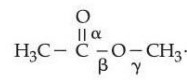
- (A) \(\alpha > \beta > \gamma\)
- (B) \(\alpha < \beta < \gamma\)
- (C) \(\alpha = \beta = \gamma\)
- (D) \(\alpha < \beta = \gamma\)
Show answer and solution
Correct Answer: (B)
In methyl acetate, the \(\alpha\) bond is a \(C=O\) double bond, which is the shortest among the three.
The \(\beta\) bond is a \(C-O\) single bond adjacent to a carbonyl group. Due to resonance (\(CH_3-C(=O)-O-CH_3 \leftrightarrow CH_3-C(-O^-)=O^+-CH_3\)), the \(\beta\) bond acquires partial double bond character, making it shorter than a pure single bond.
The \(\gamma\) bond is a pure \(C-O\) single bond between an \(sp^3\) hybridized carbon and oxygen, with no resonance involvement. Thus, it is the longest bond.
Therefore, the correct order of bond lengths is \(\alpha < \beta < \gamma\).
Answer: \(\alpha < \beta < \gamma\) -
- (A) A < B < C < D
- (B) A < D < C < B
- (C) D < C < B < A
- (D) D < C < A < B
Show answer and solution
Correct Answer: (B)
Explanation:
Let us determine the correct order of bond lengths step-by-step by analyzing the two primary factors involved: bond order and atomic size.
1. Effect of Bond Order:
For a given pair of atoms, bond length decreases as the bond order increases because more shared electrons pull the nuclei closer together. Therefore, a triple bond is shorter than a double bond, which is shorter than a single bond: \(\text{Triple} < \text{Double} < \text{Single}\). This explains why the carbonyl double bond \(C=O(C)\) is shorter than the ether single bond \(C-O(B)\).
2. Effect of Atomic Size (The C-H Exception):
When comparing bonds with different atoms, the size of the atoms is crucial. Hydrogen belongs to the first period and has the smallest atomic radius because it possesses only a single \(1s\) orbital shell. Because the hydrogen atom is exceptionally small, the \(C-H(A)\) single bond is uniquely compressed, measuring only around \(107\text{ pm}\). This is shorter than the \(C \equiv N(D)\) triple bond (\(116\text{ pm}\)), where both carbon and nitrogen are larger second-period atoms.
3. Summary of Bond Length Values:
- \(C-H(A)\): \(107\text{ pm}\)
- \(C \equiv N(D)\): \(116\text{ pm}\)
- \(C=O(C)\): \(121\text{ pm}\)
- \(C-O(B)\): \(143\text{ pm}\)
Arranging these values from shortest to longest gives: A < D < C < B.
Hence, Option B is the correct choice. -
- (A) \(6\)
- (B) \(4\)
- (C) \(3\)
- (D) \(5\)
Show answer and solution
Correct Answer: (B)
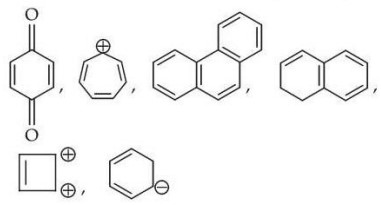
A species is aromatic if it is cyclic, planar, fully conjugated (continuous cyclic overlap of \(p\)-orbitals) and contains \((4n + 2)\,\pi\) electrons (Huckel's rule). Let us analyse each species.
\(1,4\)-Benzoquinone:
The six-membered ring has only \(4\pi\) electrons (from the two \(C=C\) bonds); the two \(C=O\) groups are cross-conjugated and do not contribute to a continuous \((4n + 2)\,\pi\) ring system. Hence, it is non-aromatic.
Tropylium cation:
A planar, cyclic, fully conjugated seven-membered system with three \(C=C\) bonds and a positive charge (empty \(p\)-orbital). It has \(6\,\pi\) electrons, satisfying Huckel's rule with \(n = 1\). It is aromatic.
Phenanthrene:
A fused tricyclic, planar, fully conjugated hydrocarbon with \(14\,\pi\) electrons. It obeys Huckel's rule with \(n = 3\). It is aromatic.
\(1,2\)-Dihydronaphthalene:
It contains an intact benzene ring fused to a partially saturated six-membered ring. Because of the benzene ring, the molecule as a whole is classified as aromatic.
Cyclobutadiene dication:
A planar, four-membered ring with one \(C=C\) bond and two positive charges (two empty \(p\)-orbitals), giving \(2\,\pi\) electrons. It satisfies Huckel's rule with \(n = 0\). It is aromatic.
Cyclohexadienyl anion (as drawn with a \(-CH_2-\) group):
The \(sp^3\) \(-CH_2-\) carbon breaks the continuous cyclic conjugation, so the ring is not fully conjugated. Hence, it is non-aromatic.
Counting the aromatic species: tropylium cation, phenanthrene, \(1,2\)-dihydronaphthalene and cyclobutadiene dication give a total of \(4\) aromatic species.
Hence, the correct option is \((2)\ 4\). -
- (A) 4,2,2
- (B) 3,3,2
- (C) 2,4,2
- (D) 2,2,4
Show answer and solution
Correct Answer: (A)
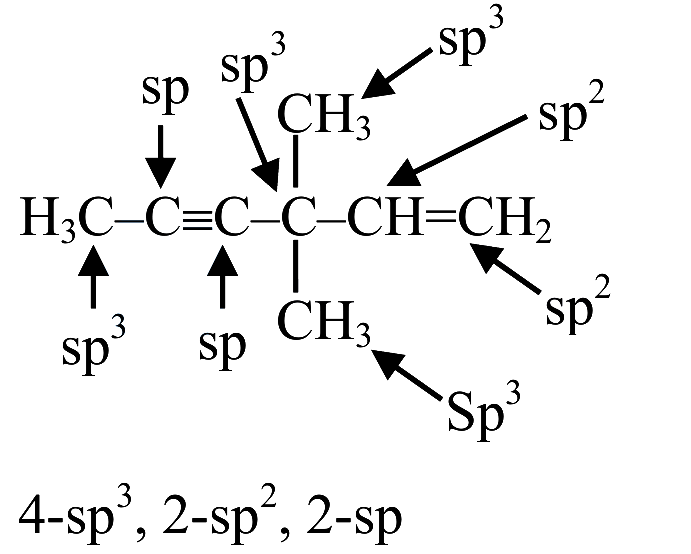
1. Priority Rule in IUPAC: Your assumption about priority is slightly reversed for this case. When numbering the parent carbon chain, multiple bonds (double and triple bonds) are actually given higher priority than alkyl substituents (like methyl groups) to get the lowest possible numbers (locants). While principal functional groups (like -OH, -COOH) have the highest priority, simple substituents like alkyl groups or halogens have lower priority than multiple bonds.
2. Numbering the Chain:
- Numbering from left to right: The multiple bonds get positions 2 and 5.
- Numbering from right to left: The multiple bonds get positions 1 and 4.
Since the locant set (1, 4) is lower than (2, 5), the correct numbering must start from the right (alkene side). Thus, the given IUPAC name "3,3-dimethylhex-1-ene-4-yne" is absolutely correct.
3. Structure & Hybridization Count:
Based on the correct name, the structure is: \( \text{CH}_3-\text{C}\equiv\text{C}-\text{C}(\text{CH}_3)_2-\text{CH}=\text{CH}_2 \)
Let's break down the hybridization of each carbon atom in this molecule:
- \( \text{C}_1 \) (\( =\text{CH}_2 \)): \( \text{sp}^2 \) hybridized (due to double bond)
- \( \text{C}_2 \) (\( -\text{CH}= \)): \( \text{sp}^2 \) hybridized (due to double bond)
- \( \text{C}_3 \) (\( -\text{C}- \)): \( \text{sp}^3 \) hybridized (attached to 4 single bonds)
- Two \( -\text{CH}_3 \) groups attached to \( \text{C}_3 \): Both are \( \text{sp}^3 \) hybridized
- \( \text{C}_4 \) (\( -\text{C}\equiv \)): \( \text{sp} \) hybridized (due to triple bond)
- \( \text{C}_5 \) (\( \equiv\text{C}- \)): \( \text{sp} \) hybridized (due to triple bond)
- \( \text{C}_6 \) (\( -\text{CH}_3 \)): \( \text{sp}^3 \) hybridized (attached to 4 single bonds)
Total Count:
- \( \text{sp}^3 \) carbons: \( 1 \) (at C3) + \( 2 \) (methyls) + \( 1 \) (at C6) = 4
- \( \text{sp}^2 \) carbons: \( 2 \) (C1 and C2) = 2
- \( \text{sp} \) carbons: \( 2 \) (C4 and C5) = 2
Hence, the sequence is 4, 2, 2. Option A is indeed the correct choice. -
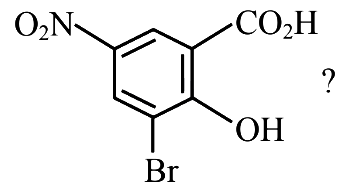
- (A) 3-Bromo-2-hydroxy-5-nitrobenzoic acid
- (B) 3-Bromo-4-hydroxy-1-nitrobenzoic acid
- (C) 2-Hydroxy-3-bromo-5-nitrobenzoic acid
- (D) 5-Nitro-3-bromo-2-hydroxybenzoic acid
Show answer and solution
Correct Answer: (A)
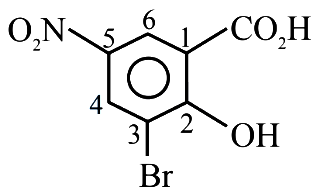
IUPAC 3-Bromo-2-hydroxy-5-nitro-Benzoic acid - 10. Which of the following is the correct IUPAC name of given organic compound \((\mathrm{X})\) ?
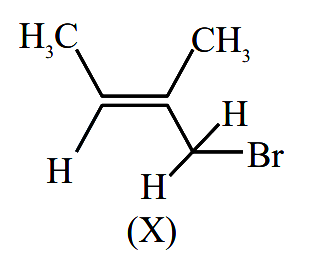
2025 Medium- (A) 2-Bromo-2-methylbut-2-ene
- (B) 3-Bromo-3-methylprop-2-ene
- (C) 1-Bromo-2-methylbut-2-ene
- (D) 4-Bromo-3-methylbut-2-ene
Show answer and solution
Correct Answer: (C)
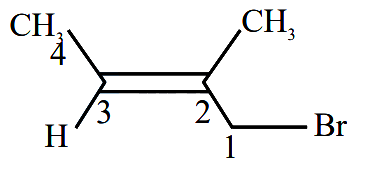
1-Bromo-2-methyl but-2-ene -
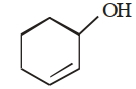
- (A) Cyclohex-\(1\)-en-\(2\)-ol
- (B) \(1\)-Hydroxyhex-\(2\)-ene
- (C) Cyclohex-\(1\)-en-\(3\)-ol
- (D) Cyclohex-\(2\)-en-\(1\)-ol
Show answer and solution
Correct Answer: (D)
Cyclohex-\(2\)-en-\(1\)-ol -
- (A) Benzenoid aromatic
- (B) Benzenoid non-aromatic
- (C) Acyclic
- (D) Alicyclic
Show answer and solution
Correct Answer: (D)
is Alicyclic
-
- (A) \(\mathrm{SO}_4 \mathrm{H}\)
- (B) \(\mathrm{SO}_3 \mathrm{H}\)
- (D) \(-\mathrm{SO}_2\)
Show answer and solution
Correct Answer: (B)
Group present in sulphonic acids
-
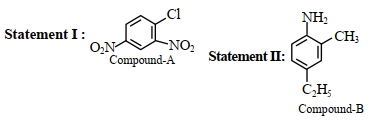
- (A) Both Statement \(I\) and Statement \(II\) are correct
- (B) Statement \(I\) is incorrect but Statement \(II\) is correct
- (C) Statement \(I\) is correct but Statement \(II\) is incorrect
- (D) Both Statement \(I\) and Statement \(II\) are incorrect
Show answer and solution
Correct Answer: (B)
\(IUPAC\) name
\(\Rightarrow \)\(1\)-chloro-\(2, 4-\)dinitrobenzene
\(\Rightarrow \)statement-\(I\) is incorrect
\(\Rightarrow\)\(4\)-ethy\(l-2\)-methylaniline
\(\Rightarrow\)statement-\(II\) is correct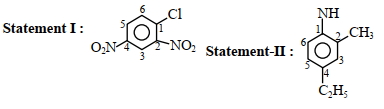
-
- (A) Statement \(I\) is correct but Statement \(II\) is incorrect.
- (B) Both Statement \(I\) and Statement \(II\) are incorrect.
- (C) Both Statement \(I\) and Statement \(II\) are correct.
- (D) Statement \(I\) is incorrect but Statement \(II\) is correct.
Show answer and solution
Correct Answer: (A)
\(7\)-Hydroxyheptan-\(2\)-one is correct \(IUPAC\) name. -
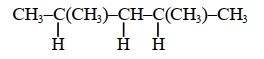
- (A) Three
- (B) One
- (C) Two
- (D) Four
Show answer and solution
Correct Answer: (B)
only one \(2^{\circ}\) carbon is present in this compound.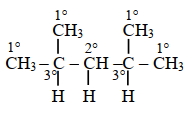
-
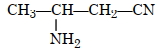
- (A) \(2\)-Aminopentanenitrile
- (B) \(2\)-Aminobutanenitrile
- (C) \(3\)-Aminobutanenitrile
- (D) \(3\)-Aminopropanenitrile
Show answer and solution
Correct Answer: (C)
\(3\)-Aminobutanenitrile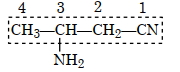
-
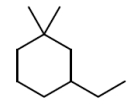
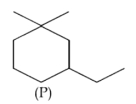
- (A) \(1-\)Ethyl\(-5,\) \(5-\)dimethylcyclohexane
- (B) \(3-\)Ethyl\(-1\),\(1-\)dimethylcyclohexane
- (C) \(1-\)Ethyl\(-3\), \(3-\)dimethylcyclohexane
- (D) \(1\),\(1-\)Dimethyl\(-3-\)ethylcyclohexane
Show answer and solution
Correct Answer: (B)
\(image\)\(3-\) \(1,\) dimenthylcyclohexane
-
- (A) \(2\)-Ethyl-\(3,6\)-dimethylheptane
- (B) \(2\)-Ethyl-\(2,6\)-diethylheptane
- (C) \(2,5,6\)-Trimethyloctane
- (D) \(3,4,7\)-Trimethyloctane
Show answer and solution
Correct Answer: (C)
\(2,5,6-\) trimethyloctane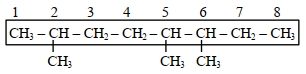
- 20. Number of \(\sigma\) and \(\pi\) bonds present in ethylene molecule is respectively _______. 2024 Medium
- (A) \(3\) and \(1\)
- (B) \(5\) and \(2\)
- (C) \(4\) and \(1\)
- (D) \(5\) and \(1\)
Show answer and solution
Correct Answer: (D)
\(1 \pi\) bond.
-
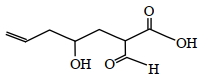
- (A) \(2\)-carboxy-\(4\)-hydroxyhept-\(6\)-enal
- (B) \(2\)-carboxy-\(4\)-hydroxyhept-\(7\)-enal
- (C) \(2\)-formy\(l-4\)-hydroxyhept-\(6\)-enoic acid
- (D) \(2\)-formy\(l-4\)-hydroxyhept-\(7\)-enoic acid
Show answer and solution
Correct Answer: (C)
\(2\)-formly-\(4\)-hydroxyhept-\(6\)-enoic acid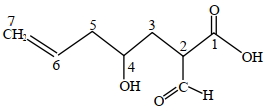
-
- (A) The \(\mathrm{C}-\mathrm{C}\) bonds in ethyne is shorter than that in ethene
- (B) Both carbons are sp hybridised
- (C) Ethyne is linear
- (D) The carbon-carbon bonds in ethyne is weaker than that in ethene
Show answer and solution
Correct Answer: (D)
Explanation:
Let us analyze each statement regarding ethyne (\( \text{H}-\text{C}\equiv\text{C}-\text{H} \)) to identify the incorrect one based on standard chemical bonding principles:
1. Bond Length (Statement A): Ethyne contains a carbon-carbon triple bond (\( \text{C}\equiv\text{C} \)) with a bond length of approximately 120 pm, whereas ethene (\( \text{CH}_2=\text{CH}_2 \)) contains a carbon-carbon double bond (\( \text{C}=\text{C} \)) with a bond length of approximately 134 pm. Since a triple bond is shorter than a double bond, this statement is factually correct.
2. Hybridization (Statement B): Each carbon atom in ethyne forms two sigma bonds and two pi bonds, which corresponds to \( \text{sp} \) hybridization. This statement is factually correct.
3. Geometry (Statement C): Due to the \( \text{sp} \) hybridization of both carbon atoms, the bond angle is \( 180^\circ \), giving ethyne a linear molecular geometry. This statement is factually correct.
4. Bond Strength (Statement D): A carbon-carbon triple bond consists of one sigma bond and two pi bonds, making it significantly stronger (bond dissociation enthalpy of \( 839\text{ kJ/mol} \)) than the carbon-carbon double bond in ethene (bond dissociation enthalpy of \( 614\text{ kJ/mol} \)). Therefore, stating that the bond in ethyne is weaker is factually incorrect.
Since the question specifically asks for the incorrect statement, Option D is the correct choice. - 23. The molecular formula of second homologue in the homologous series of mono carboxylic acids is___________. 2024 Hard
- (A) \(\mathrm{C}_3 \mathrm{H}_6 \mathrm{O}_2\)
- (B) \(\mathrm{C}_2 \mathrm{H}_4 \mathrm{O}_2\)
- (C) \(\mathrm{CH}_2 \mathrm{O}\)
- (D) \(\mathrm{C}_2 \mathrm{H}_2 \mathrm{O}_2\)
Show answer and solution
Correct Answer: (B)
\(\mathrm{HCOOH}, \mathrm{CH}_3 \mathrm{COOH}\)\(\uparrow\)
Second homologue
-
- (A) \(1\)
- (B) \(10\)
- (C) \(18\)
- (D) \(20\)
Show answer and solution
Correct Answer: (C)
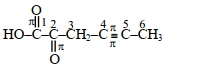
\(2\)-Oxohex-\(4\)-ynoic acid\(\text { Number of } \sigma \text {-bonds }=14\)
\(\text { Number of } \pi \text {-bonds }=4\)
\(=18\)
-
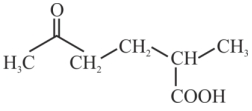
- (A) \(5-\)Formyl\(-2-\)methylhexanoic acid
- (B) \(2-\)Methyl\(-5-\)oxohexanoic acid
- (C) \(2-\)Formyl\(-5-\)methylhexan\(-6-\)oic acid
- (D) \(5-\)Methyl\(-2-\)oxohexan\(-6-\)oic acid
Show answer and solution
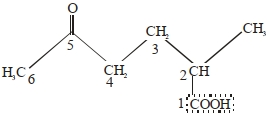
Correct Answer: (B)
IUPAC NAME\(2-\)Methyl\(-5-\)oxohexanoic acid
-
- (A) \(- COOH >- CONH _{2}>- COCl >- CHO\)
- (B) \(- SO _{3} H >- COCl >- CONH _{2}>- CN\)
- (C) \(- COOR >- COCl >- NH _{2}> C = O\)
- (D) \(- COOH >- COOR >- CONH _{2}>- COCl\)
Show answer and solution
Correct Answer: (B)
\(- SO _{3} H >- COCl >- CONH { }_{2}>- CN\) -
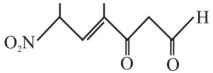
- (A) \(4-\)methyl\(-2-\)nitro\(-5-\)oxohept\(-3-\)enal
- (B) \(4-\)methyl\(-5-\)oxo\(-2-\)nitrohept\(-3-\)enal
- (C) \(4-\)methyl\(-6-\)nitro\(-3-\)oxohept\(-4-\)enal
- (D) \(6-\)formyl\(-4-\)methyl\(-2-\)nitrohex\(-3-\)enal
Show answer and solution
Correct Answer: (C)
\(4-\)methyl\(-6-\)nitro\(-3-\)oxohept\(-4-\)enal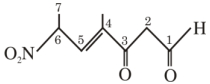
-
- (A) \(1-\)Chloroethene
- (B) \(1-\)Chloroethyne
- (C) \(1,2-\)Dichloroethane
- (D) \(1,1-\)Dichloroethane
Show answer and solution
Correct Answer: (D)
"\(1,1-\)Dichloroethane is Ethylidene chloride"
-
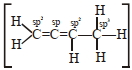
- (A) \(sp ^{3}, sp , sp ^{3}, sp ^{3}\)
- (B) \(sp ^{2}, sp ^{2}, sp ^{2}, sp ^{3}\)
- (C) \(sp ^{2}, sp , sp ^{2}, sp ^{3}\)
- (D) \(sp ^{2}, sp ^{3}, sp ^{2}, sp ^{3}\)
Show answer and solution
Correct Answer: (C)
\(CH _{2} = C = C H - C H _{3}\)\(\quad 1\quad \quad 2\quad \quad 3\quad \quad \quad 4\)
-
- (A) \(10\)
- (B) \(11\)
- (C) \(12\)
- (D) \(13\)
Show answer and solution
Correct Answer: (A)
Numbers of \(\sigma\) bonds \(=10\)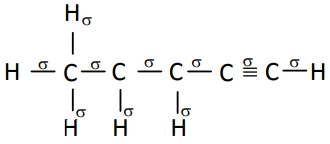
-
- (A) \(4-\)Bromo\(-2-\)methylcyclopentane carboxylic acid
- (B) \(5-\)Bromo\(-3-\)methylcyclopentanoic acid
- (C) \(3-\)Bromo\(-5-\)methylcyclopentane carboxylic acid
- (D) \(3-\)Bromo\(-5-\)methylcyclopentanoic acid
Show answer and solution
Correct Answer: (A)
\(4-\)bromo\(-2-\)methyl cyclopentane carboxylic Acid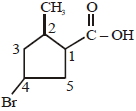
-
- (A) \(24\)
- (B) \(6\)
- (C) \(12\)
- (D) \(18\)
Show answer and solution
Correct Answer: (D)
Each carbon atom is \(sp^{2}\) hybridized Therefore each carbon has \(3 sp^{2}\) hybrid orbitals. Hence total \(\mathrm{sp}^{2}\) hybrid orbitals are \(18 .\)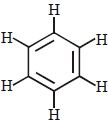
-
- (A) \(Cl-CH=CH-OCH_3\)
- (B) \(Cl-CH=CH-CH_3\)
- (C) \(Cl-CH=CH_2\)
- (D) \(Cl-CH=CH-NO_2\)
Show answer and solution
Correct Answer: (D)
Explanation:
Let us analyze the bond length of the given vinyl chloride derivatives step-by-step using electronic effects in organic chemistry:
1. Resonance in Vinylic Halides:
In all the given options, the chlorine atom is directly attached to an \(sp^2\) hybridized carbon atom belonging to a carbon-carbon double bond (\(C=C\)). The lone pairs of electrons on the chlorine atom can undergo delocalization with the adjacent pi-bond through resonance (mesomeric effect). This resonance introduces a partial double bond character into the \(C-Cl\) bond, making it shorter and stronger than a standard single bond.
2. Role of the Substituent Group:
The degree of partial double bond character depends heavily on the nature of the substituent group attached at the opposite end of the conjugated system.
Effect in Option D:
The nitro group (\(-NO_2\)) is a very strong electron-withdrawing group via the resonance (\(-M\)) effect. It pulls electron density away from the double bond, which strongly facilitates the push of electrons from the chlorine lone pair into the conjugated system.
Impact of Delocalization:
This extensive delocalization significantly enhances the stability and contribution of the resonating structure containing the \(C=Cl^+\) double bond.
3. Comparison:
Because the \(-M\) effect of the \(-NO_2\) group maximizes the double-bond character of the \(C-Cl\) linkage, it results in the greatest contraction of bond distance. In contrast, groups like \(-OCH_3\) (Option A) and \(-CH_3\) (Option B) are electron-donating and oppose this delocalization.
Therefore, \(Cl-CH=CH-NO_2\) has the shortest \(C-Cl\) bond length.
Hence, Option D is the correct choice.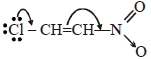
-
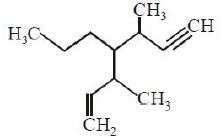
- (A) \(3, 5-\) dimethyl \(-4-\) propylhept \(-1-\) en \(-6-\) yne
- (B) \(3-\) methyl \(-4-\) (\(1-\) methylprop \(-2-\) ynyl) \(-1-\) heptene
- (C) \(3-\) methyl \(-4-\) (\(3-\) methylprop \(-1-\) enyl) \(-1-\) heptyne
- (D) \(3, 5-\) dimethyl \(-4-\) propylhept \(-6-\) en \(-1-\) yne
Show answer and solution
Correct Answer: (A)
According to \(IUPAC\) rules, select the largest chain including functional group, if alkene and alkyne are present at equivalent position then priority is given to alkene. -
- (A) \((A)-(s); (B)-(r); (C)-(q); (D)-(p)\)
- (B) \((A)-(r); (B)-(s); (C)-(p); (D)-(q)\)
- (C) \((A)-(r); (B)-(s); (C)-(q); (D)-(p)\)
- (D) \((A)-(s); (B)-(r); (C)-(p); (D)-(q)\)
Show answer and solution
Correct Answer: (B)
\(\to \) Phenelzine contains hydrazine
\(\to \) Chloroxylenol contains phenol
\(\to \) Uracil is the pyrimidine base
\(\to \) Ranitidine contains furan ring -
- (A) \(2, 2-\) dimethyl \(-4-\) pentene
- (B) \(4, 4- \) dimethyl pentene
- (C) Isopropyl \(-2- \) butene
- (D) \(2, 2-\) dimethyl \(-3-\) pentene
Show answer and solution
Correct Answer: (B)
\(\begin{array}{*{20}{c}}
{\begin{array}{*{20}{c}}
{\,\,\,\,\,\,C{H_3}\,}\\
|
\end{array}\,\,\,\,\,\,\,\,\,\,\,\,\,\,\,\,\,\,\,\,\,\,\,\,\,\,\,\,\,\,\,\,\,\,\,\,\,\,\,\,\,\,}\\
{{H_3}C - C - C{H_2} - CH = C{H_2}}\\
{\,|\,\,\,\,\,\,\,\,\,\,\,\,\,\,\,\,\,\,\,\,\,\,\,\,\,\,\,\,\,\,\,\,\,\,\,\,\,\,\,\,\,\,}\\
{\,C{H_3}\,\,\,\,\,\,\,\,\,\,\,\,\,\,\,\,\,\,\,\,\,\,\,\,\,\,\,\,\,\,\,\,\,\,\,\,\,\,\,}
\end{array}\) This is the hydrocabon with \(7\) carbon atoms containing a neopentyl and a vinyl group. -
- (A) \(sp\) and \(sp^3\)
- (B) \(sp^2\) and \(sp\)
- (C) only \(sp^2\)
- (D) \(sp^2\) and \(sp^3\)
Show answer and solution
Correct Answer: (B)
\(\,\begin{matrix}
^{H} \\
_{H} \\
\end{matrix}\begin{matrix}
\text{ }\!\!\backslash\!\!\text{ } \\
/ \\
\end{matrix}\overset{s{{p}^{2}}}{\mathop{C}}\,=\overset{s{{p}^{2}}}{\mathop{C}}\,=\overset{s{{p}^{2}}}{\mathop{C}}\,\begin{matrix}
/ \\
\text{ }\!\!\backslash\!\!\text{ } \\
\end{matrix}_{H}^{H}\) -
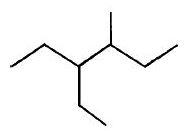
- (A) \(4 -\) methyl \(- 3 -\) ethylhexane
- (B) \(3 -\) ethyl \(- 4 -\) methylhexane
- (C) \(3, 4 -\) ethylmethylhexane
- (D) \(4 -\) ethyl \(- 3 -\) methylhexane
Show answer and solution
Correct Answer: (B)
\(\mathop {\begin{array}{*{20}{c}}
{\,\,\,\,\,\,\,\,\,\,\,\,\,\,\,\,\,\,\,C{H_3}} \\
{\,\,\,\,\,\,\,\,\,\,\,\,\,|} \\
{C{H_3}C{H_2} - CH - CH - C{H_2}C{H_3}} \\
{|\,\,\,\,\,\,\,\,\,\,\,\,\,\,\,\,\,\,} \\
{\,\,\,\,\,\,C{H_2}\,\,\,\,\,\,\,\,\,\,\,\,\,\,} \\
{|\,\,\,\,\,\,\,\,\,\,\,\,\,\,} \\
{\,\,\,\,\,\,\,C{H_3}\,\,\,\,\,\,\,\,\,\,\,\,\,\,\,}
\end{array}}\limits_{3 - ethyl - 4 - methyl\,hexane} \)


No questions on this page match these filters.
About Organic chemistry Nomenclature of organic compounds PYQs
Organic chemistry Nomenclature of organic compounds has 38 questions from 2014–2026. The most came in 2024 (14), 2026 (7) and 2025 (3).
The most asked topics are Nomenclature of organic compounds, Bonding and hybridisation in organic compounds and Classification of organic compounds.
13% are easy, 53% medium and 34% hard.
Organic chemistry Nomenclature of organic compounds PYQs by year
Frequently asked
How many Organic chemistry Nomenclature of organic compounds questions came in JEE Mains?
38 questions from 2014–2026, each with the correct answer and a full solution.
Which Organic chemistry Nomenclature of organic compounds topic is asked the most?
Nomenclature of organic compounds, with 21 questions, followed by Bonding and hybridisation in organic compounds with 11.
Which year had the most Organic chemistry Nomenclature of organic compounds questions?
2024, with 14 questions.
How difficult are Organic chemistry Nomenclature of organic compounds questions?
13% are easy, 53% medium and 34% hard.