


Questions
Newest firstShowing 1–25 of 25 questions
-
- (A) 300, 200
- (B) 600, 400
- (C) 400, 300
- (D) 500, 200
Show answer and solution
Correct Answer: (D)
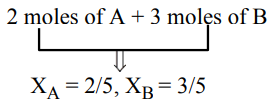
\(P_S=X_A P_A^{\circ}+X_B P_B^{\circ}\)
\(320= P _{ A }^{\circ}\left(\frac{2}{5}\right)+ P _{ B }^{\circ}\left(\frac{3}{5}\right)\)
\(2 P_{A}^{\circ}+3 P_{B}^{\circ}=1600\) ...(I)
Now 1 mole of A & 1 mole of B is added
\(X _{ A }^{\prime}=\frac{3}{7}, X _{ B }^{\prime}=\frac{4}{7}\)
\(P _{ S }^{\prime}=328.6= P _{ A }^{\circ}\left(\frac{3}{7}\right)+ P _{ B }^{\circ}\left(\frac{4}{7}\right)\)
\(3 P _{ A }^{\circ}+4 P _{ B }^{\circ}=2300.2\) ....(II)
Now eq \(( I ) \times 3-\) eq \(( II ) \times 2\)
\(6 P _{ A }^{\circ}+9 P _{ B }^{\circ}=4800\)
\(6 P _{ A }^{\circ}+8 P _{ B }^{\circ}=4600.4\)
\(P _{ B }^{\circ} \simeq 200 mm\) of Hg
\(P _{ A }^{\circ} \simeq 500 mm\) of Hg -
- (A) 0.5217
- (B) 0.480
- (C) 0.663
- (D) 0.340
Show answer and solution
Correct Answer: (A)
\(\frac{Y_{A}}{Y_{B}}=\frac{P_{A}^{0}}{P_{B}^{0}}.\frac{X_{A}}{X_{B}}\)
\(\frac{0.8}{0.2}=\frac{55}{15}\times\frac{X_{A}}{X_{B}}\)
\(\frac{X_{A}}{X_{B}}=\frac{60}{55}=\frac{12}{11}\)
\(X_{A}=\frac{12}{23}=0.5217\) -
- (A) 100
- (B) 200
- (C) 300
- (D) 400
Show answer and solution
Correct Answer: (B)
\(X _{ A }=\frac{3}{4}, X _{ B }=\frac{1}{4}\)
\(P_S=P_A^o X_A+P_B^o X_B\)
\(500= P _{ A }^{ o } \times \frac{3}{4}+ P _{ B }^{ o } \times \frac{1}{4}\)
\(3 P _{ A }^{ o }+ P _{ B }^{ o }=2000\)\(\quad\)....(1)
Now 1 moles of A is further added so \(n _{ A }=4\) mole,
\(n _{ B }=1\) mole
\(X _{ A }^{\prime}=\frac{4}{5}, X _{ B }^{\prime}=\frac{1}{5}\)
\(P _{ s }=520= P _{ A }^{ o } \times \frac{4}{5}+ P _{ B }^{ o } \times \frac{1}{5}\)
\(4 P _{ A }^{ o }+ P _{ B }^{ o }=2600\)\(\quad\)...(2)
By equation (2) - equation (1)
\(P _{ A }^{ o }=600 mm Hg\)
\(P _{ B }^{ o }=200 mm Hg\) -
- (A) \(50\%\)
- (B) \(60\%\)
- (C) \(70\%\)
- (D) \(80\%\)
Show answer and solution
Correct Answer: (D)
Moles of solute, \(n_B = 0.25\)
Moles of solvent, \(n_A = 1\)
Mole fraction of solvent, \(X_A = \dfrac{n_A}{n_A + n_B} = \dfrac{1}{1 + 0.25} = \dfrac{1}{1.25} = 0.8\)
According to Raoult's law, the vapor pressure of the solution is given by \(P_s = P^0 X_A\)
\(P_s = 0.8 P^0 = 80\% \text{ of } P^0\)
Thus, the vapor pressure of the solution is \(80\%\) of the vapor pressure of the pure solvent.
Answer: \(80\%\) -
- (A) \(1400 \mathrm{~mm} \mathrm{Hg}, \mathrm{A}\)
- (B) \(1400 \mathrm{~mm} \mathrm{Hg}, \mathrm{B}\)
- (C) \(600 \mathrm{~mm} \mathrm{Hg}, \mathrm{B}\)
- (D) \(600 \mathrm{~mm} \mathrm{Hg}, \mathrm{A}\)
Show answer and solution
Correct Answer: (D)
\(\begin{aligned}
& \mathrm{P}_{\mathrm{S}}=\mathrm{P}_{\mathrm{A}}^{\mathrm{o}} \cdot \mathrm{X}_{\mathrm{A}}+\mathrm{P}_{\mathrm{B}}^{\mathrm{o}} \cdot \mathrm{X}_{\mathrm{B}} \\
& 500=200 \times \frac{1}{4}+\mathrm{P}_{\mathrm{B}}^{\mathrm{o}} \cdot \frac{3}{4} \\
& \mathrm{P}_{\mathrm{B}}^{\mathrm{o}}=600 \mathrm{~mm} \mathrm{Hg}
\end{aligned}\)
As \(\mathrm{P}_{\mathrm{A}}^{\mathrm{o}} \lt \mathrm{P}_{\mathrm{B}}^{\mathrm{o}} \Rightarrow \mathrm{A}\) is least volatile. -
- (A) \(4.26,19.3\)
- (B) \(2.59,11.85\)
- (C) \(5.46,17.8\)
- (D) \(2.96,11.2\)
Show answer and solution
Correct Answer: (D)
\(\frac{\mathrm{P}_{\mathrm{N}_2}}{\mathrm{Po}_2}=\frac{\mathrm{x}_{\mathrm{N}_2} \cdot \mathrm{P}_{\mathrm{T}}}{\mathrm{x}_{\mathrm{O}_2} \cdot \mathrm{P}_{\mathrm{T}}}=\frac{\mathrm{n}_{\mathrm{N}_2}}{\mathrm{n}_{\mathrm{O}_2}}\) {using Dalton's law of partial pressure}
\(\begin{aligned} & =\frac{70 / 28}{27 / 32}=2.96 \\ & \frac{\mathrm{P}_{\mathrm{O}_2}}{\mathrm{P}_{\mathrm{Ar}}}=\frac{\mathrm{n}_{\mathrm{O}_2}}{\mathrm{n}_{\mathrm{Ar}}}=\frac{27 / 32}{3 / 40}=11.25\end{aligned}\) -
- (A) \(\frac{\mathrm{P}_2^0}{\mathrm{P}_1^0}, \frac{\mathrm{P}_2^0-\mathrm{P}_1^0}{\mathrm{P}_2^0}\)
- (B) \(\frac{\mathrm{P}_1^0}{\mathrm{P}_2^0}, \frac{\mathrm{P}_2^0-\mathrm{P}_1^0}{\mathrm{P}_2^0}\)
- (C) \(\frac{\mathrm{P}_1^0}{\mathrm{P}_2^0}, \frac{\mathrm{P}_1^0-\mathrm{P}_2^0}{\mathrm{P}_2^0}\)
- (D) \(\frac{\mathrm{P}_2^0}{\mathrm{P}_1^0}, \frac{\mathrm{P}_1^0-\mathrm{P}_2^0}{\mathrm{P}_2^0}\)
Show answer and solution
Correct Answer: (B)
Given mole fraction of liquid 1 in liquid and vapour phase is \(x_1\) and \(y_1\) respectively.
\(\begin{aligned} & \mathrm{P}_1=\mathrm{P}_{\mathrm{T}} y_1=\mathrm{P}_1^0 x_1 \\ & \frac{\mathrm{P}_{\mathrm{T}}}{x_1}=\frac{\mathrm{P}_1^0}{y_1} \\ & \frac{\mathrm{P}_2^0+x_1\left(\mathrm{P}_1^0+\mathrm{P}_2^0\right)}{x_1}=\frac{\mathrm{P}_1^0}{y_1} \\ & \frac{\mathrm{P}_2^0}{x_1}+\left(\mathrm{P}_1^0+\mathrm{P}_2^0\right)=\frac{\mathrm{P}_1^0}{y_1} \\ & \frac{\mathrm{P}_2^0}{x_1}=\frac{\mathrm{P}_1^0}{y_1}-\left(\mathrm{P}_1^0+\mathrm{P}_2^0\right) \\ & \frac{1}{x_1}=\frac{1}{y_2}\left(\frac{\mathrm{P}_1^0}{\mathrm{P}_2^0}\right)-\frac{\left(\mathrm{P}_1^0+\mathrm{P}_2^0\right)}{\mathrm{P}_2^0}\end{aligned}\)
\(\begin{aligned} & \frac{1}{x_1}=\frac{1}{y_2}\left(\frac{P_1^0}{P_2^0}\right)+\frac{\left(P_2^0-P_1^0\right)}{P_2^0} \\ & y=m x+c \\ & \text { Slope }=\frac{P_1^0}{P_2^0} ; \text { Intercept }=\frac{P_2^0-P_1^0}{P_2^0}\end{aligned}\) -
- (A) Volume of system increases .
- (B) The solid phase (ice) disappears completely.
- (C) Liquid phase disappears completely.
- (D) The amount of ice decreases.
Show answer and solution
Correct Answer: (B)
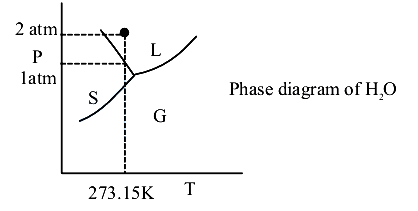
If pressure is made two time then mixture of ice and water will completely convert into water (liquid) form. -
- (A) \(\frac{\mathrm{x}_{\mathrm{A}}}{\mathrm{x}_{\mathrm{B}}} \lt \frac{\mathrm{y}_{\mathrm{A}}}{\mathrm{y}_{\mathrm{B}}}\)
- (B) \(\frac{\mathrm{x}_{\mathrm{A}}}{\mathrm{x}_{\mathrm{B}}}=\frac{\mathrm{y}_{\mathrm{A}}}{\mathrm{y}_{\mathrm{B}}}\)
- (C) \(\frac{\mathrm{x}_{\mathrm{A}}}{\mathrm{x}_{\mathrm{B}}} \gt \frac{\mathrm{y}_{\mathrm{A}}}{\mathrm{y}_{\mathrm{B}}}\)
- (D) \(\left(\mathrm{x}_{\mathrm{A}}-\mathrm{y}_{\mathrm{A}}\right) \lt \left(\mathrm{x}_{\mathrm{B}}-\mathrm{y}_{\mathrm{B}}\right)\)
Show answer and solution
Correct Answer: (C)
\(\begin{aligned} & \mathrm{P}_{\mathrm{A}}^{\mathrm{o}} \lt \mathrm{P}_{\mathrm{B}}^{\mathrm{o}} \\ & \frac{\mathrm{P}_{\mathrm{A}}^o}{\mathrm{P}_{\mathrm{B}}^o} \lt 1 \\ & \frac{\mathrm{y}_{\mathrm{A}}}{\mathrm{y}_{\mathrm{B}}}=\frac{\mathrm{P}_{\mathrm{A}}^o}{\mathrm{P}_{\mathrm{B}}^o} \frac{\mathrm{x}_{\mathrm{A}}}{\mathrm{x}_{\mathrm{B}}} \\ & \frac{\mathrm{y}_{\mathrm{A}}}{\mathrm{y}_{\mathrm{B}}} \\ & \frac{\mathrm{x}_{\mathrm{A}}}{\mathrm{x}_{\mathrm{B}}}\end{aligned}\) -
- (A) \(3.72 \mathrm{~K} \mathrm{~kg} \mathrm{~mol}^{-1}\)
- (B) \(1.86 \mathrm{~K} \mathrm{~kg} \mathrm{~mol}^{-1}\)
- (C) \(4.43 \mathrm{~K} \mathrm{~kg} \mathrm{~mol}^{-1}\)
- (D) \(5.12 \mathrm{~K} \mathrm{~kg} \mathrm{~mol}^{-1}\)
Show answer and solution
Correct Answer: (D)
\(\begin{aligned} \Delta \mathrm{T}_{\mathrm{f}} & =\mathrm{K}_{\mathrm{b}} \cdot \mathrm{m} \\ 0.4 & =\mathrm{K}_{\mathrm{b}} \frac{\frac{1}{256}}{50 \times 10^{-3}} \\ \mathrm{~K}_{\mathrm{b}} & =5.12 \mathrm{~K} \mathrm{~kg} / \mathrm{mol}\end{aligned}\) -
- (A) \(47\)
- (B) \(48\)
- (C) \(46\)
- (D) \(45\)
Show answer and solution
Correct Answer: (B)
\(MgCl _2 \rightarrow Mg ^{+2}+2 Cl ^{-}\)\(1-\alpha \quad \alpha \quad 2 \alpha\)
\(i =1+2 \alpha(\alpha=0.8)\)
\(i =2.6\)
\(\frac{\Delta p }{ p ^{\circ}}=\frac{ i \times n _2}{ n _1}\)
\(\Delta p =2.34\)
\(p _s=47.66\)
\(p _{ s } \cong 48\)
-
- (A) \(1112\)
- (B) \(1113\)
- (C) \(1114\)
- (D) \(1111\)
Show answer and solution
Correct Answer: (D)
\(\frac{ P ^0- P _{ s }}{ P _{ s }}=\frac{ n _{\text {solute }}}{ n _{\text {solvent }}}=\frac{\frac{ x }{60}}{\frac{1000}{18}}=\frac{ P ^0-0.75 P ^0}{0.75 P ^0}\)\(\Rightarrow x =\frac{10000}{9}=1111\,gm\)
-
- (A) \(314\)
- (B) \(312\)
- (C) \(311\)
- (D) \(310\)
Show answer and solution
Correct Answer: (A)
Let \(V.P.\) of pure \(A\) be \(P _{ A }^0\)Let \(V.P\) of pure \(B\) be \(P _B^0\)
When \(X _{ A }=0.7 \& X _{ B }=0.3\) \(P _{ s }=350\)
\(\Rightarrow P _{ A }^0 \times 0.7+ P _{ B }^0 \times 0.3=350\)
When \(X _{ A }=0.2 \& X _{ B }=0.8\)
\(P _{ s }=410\)
\(\Rightarrow P _{ A }^0 \times 0.2+ P _{ B }^0 \times 0.8=410\)
Solving \((i)\) and \((ii)\) \(P _{ A }^0=314\,mm\,Hg\)
\(P _{ B }^0=434\,mm\,Hg\)
\(=(314)\)
-
- (A) \(23\)
- (B) \(22\)
- (C) \(21\)
- (D) \(24\)
Show answer and solution
Correct Answer: (A)
\(\frac{24- P _{ s }}{ P _{ s }}=\frac{ m \times 18}{1000}\)wt of solute \(=30\,gm\)
Volume of solution \(=100\,mL\)
wt. of solution \(=1.2 \times 100=120\,gm\)
wt. of solvent \(=120-30=90\,gm\)
\(m =\frac{30 \times 1000}{180 \times 90}=1.85\)
\(\frac{24- P _{ s }}{ P _{ s }}=\frac{1.85 \times 18}{1000}\)
\(24- P _{ s }=0.0333 P _{ s }\)
\(P _{ s }(1.033)=24\)
\(P _{ s }=23.22\)
-
- (A) \(4.69\,g\)
- (B) \(3.59\,g\)
- (C) \(2.59\,g\)
- (D) \(3.69\,g\)
Show answer and solution
Correct Answer: (D)
\(\frac{ P ^0- P _5}{ P ^0}=\frac{ n }{ N }\) (for dilute solution)\(\frac{0.2}{54.2}=\frac{ n \times 18}{100}\)
\(n =\frac{100}{271 \times 18}\)
\(w =\frac{100 \times 180}{271 \times 18} ; w =3.69\,g\)
-
- (A) \(2\)
- (B) \(3\) or \(6\)
- (C) \(4\)
- (D) \(5\)
Show answer and solution
Correct Answer: (B)
\(\because\) Diliute solution given:\(\frac{ P ^{0}- P _{ s }}{ P ^{0}} \sim \frac{{ }^{n} \text { solute }}{{ }^{n} \text { solvent }}\)
\(\frac{ P ^{0}- P ^{0} / 2}{ P ^{0}}=\frac{{ }^{n} \text { solute }}{ n _{\text {solvent }}}\)
" solute \(\sim \frac{{ }^{ n } \text { solvent }}{2}=\frac{100}{18 \times 2}=2.78\,mol\)
More accurate approach:
\(\frac{ P ^{0}- P _{ S }}{ P _{ S }}=\frac{{ }^{ n } \text { solute }}{{ }^{n} \text { solvent }}\)
\(\frac{ P ^{0}- P ^{0} / 2}{ P ^{0} / 2}=\frac{{ }^{n} \text { solute }}{{ }^{n} \text { solvent }}\)
\(\text { " solute }={ }^{n} \text { solvent }=\frac{100}{18}=5.55\,mol\)
-
- (A) \(50\)
- (B) \(12\)
- (C) \(67\)
- (D) \(89\)
Show answer and solution
Correct Answer: (B)
\(SO _{2}+ NaOH \rightarrow NaHSO _{3}\)\(9.2\quad \quad \quad 10\quad \quad \quad \quad -\)
\(- \quad \quad \quad 0.8 \quad \quad \quad \quad \quad 9.2\)
\(\Delta P = P ^{0} \cdot X _{\text {solute }}\)
\(=24 \times \frac{(1.6+18.4)}{2020}\)
\(=0.2376=23.76 \times 10^{-2}\)
-
- (A) \((A)\)
- (B) \((C)\)
- (C) \((B)\)
- (D) \((A)\) and \((C)\)
Show answer and solution
Correct Answer: (C)
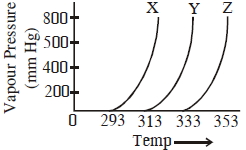
Order of B.P. is : \(Z>Y>X\)Order of vapour pressure \(: Z < Y < X\)
order of intermolecular interaction \(: Z>Y>X\)
-
- (A) \(A>B>C\)
- (B) \(A>C>B\)
- (C) \(C>B>A\)
- (D) \(B > C > A\)
Show answer and solution
Correct Answer: (A)
Relative lowering of \(V . P. =\frac{\Delta P }{ P ^{0}}= x _{\text {solute }}\)\(\left(\frac{\Delta P }{ P ^{0}}\right)_{ A }=\frac{\frac{10}{100}}{\frac{10}{100}+\frac{180}{18}}:\left(\frac{\Delta P }{ P ^{0}}\right)_{ B }=\frac{\frac{10}{200}}{\frac{10}{200}+\frac{180}{18}}\)
\(\left(\frac{\Delta P }{ P ^{0}}\right)_{ C }=\frac{\frac{10}{10,000}}{\frac{10}{10,000}+\frac{180}{18}}:\left(\frac{\Delta P }{ P ^{0}}\right)_{ A }>\left(\frac{\Delta P }{ P ^{0}}\right)_{ B }>\left(\frac{\Delta P }{ P ^{0}}\right)_{ C }\)
-
- (A) \(0.027\)
- (B) \(0.031\)
- (C) \(0.028\)
- (D) \(0.017\)
Show answer and solution
Correct Answer: (D)
Lowering of vapour pressure \( = \,{p^o}\, - \,p\, = \,{p^o}.{X_{solute}}\)\(\therefore \,\,\Delta p\, = \,35\, \times \,\frac{{0.6/60}}{{\frac{{0.6}}{{60}} + \frac{{360}}{{18}}}}\)
\( = 35\, \times \,\frac{{0.01}}{{0.01 + 20}}\, = 35\, \times \,\frac{{0.1}}{{20.01}}\)
\(= \,0.017\,mm\,Hg\)
-
- (A) \(37.5\)
- (B) \(75\)
- (C) \(150\)
- (D) \(50\)
Show answer and solution
Correct Answer: (C)
Molar mass of octane \(=\,114\,g/mol\)From the lowering of vapour pressure we have,
\(\frac{{\Delta P}}{P} = \frac{{\frac{{{W_2}}}{{{M_2}}}}}{{\frac{{{W_2}}}{{{M_2}}} + \frac{{{W_1}}}{{{M_1}}}}}\)
\(\frac{{75}}{{100}} = \frac{{\frac{{{W_2}}}{{50\,g/mol}}}}{{\frac{{{W_2}}}{{50\,g/mol}} + \frac{{114\,g}}{{114\,g/mol}}}}\)
\(0.75 = \frac{{\frac{{{W_2}}}{{50}}}}{{\frac{{{W_2}}}{{50\,}} + 1}}\)
\(\frac{{{W_2}}}{{50}} + 1\, = \,\frac{{{W_2}}}{{50\, \times \,0.75}}\)
\({W_2}\, = \,150\,g\)
Note : \(W_2\) vand \(M_2\) are mass and molar mass of solute and \(W_1\) and \(M_1\) are mass and molar mass of octane.
-
- (A) \(\frac{3}{4}\)
- (B) \(\frac{1}{2}\)
- (C) \(\frac{1}{4}\)
- (D) \(\frac{4}{3}\)
Show answer and solution
Correct Answer: (A)
The relationship between molar masses of the two solvents is\(M_X\,=\,\frac {3}{4}M_Y\) .... \((i)\)
The relative lowering of vapour pressure of two solution is
\({\left( {\frac{{\Delta P}}{P}} \right)_X}\, = \,m{\left( {\frac{{\Delta P}}{P}} \right)_Y}\)
But, the relative loering of vaoour pressure of solutin is directly proportional to the mole fraction of solution.
Given \(5\,molal\) solution , mans \(5\,molal\) of solute are dissolved in \(1\,kg\) (or \(1000\,g\)) of solvent.
The number of moles of solvent \(=\,\frac {1000\,g}{M}\)
The mole fraction of solution \(=\,\frac {5}{1000/M}\)
\(=M\times \,\frac {5}{1000}\)
hence \(M_X\times \frac {5}{1000}\) \(=\,m\times M_Y\times \frac {5}{1000}\) .... \((ii)\)
Substitute equation \((i)\) in equation \((ii)\)
\(\frac {3}{4}\times M_Y\times \frac {5}{1000}\) \(=\,m\times M_Y\times \frac {5}{1000}\)
\(m=\frac {3}{4}\)
-
- (A) \(752.4\)
- (B) \(759.0\)
- (C) \(7.6\)
- (D) \(76.0\)
Show answer and solution
Correct Answer: (A)
According to Raoult's Law\(\frac{P^{\circ}-P_{s}}{P_{s}}=\frac{W_{B} \times M_{A}}{M_{B} \times W_{A}} \quad \ldots(i)\)
Here \(P^{\circ}=\) Vapour pressure of pure solvent,
\(P_{s}=\) Vapour pressure of solution
\(W_{B}=\) Mass of solute,
\(W_{A}=\) Mass of solvent
\(M_{B}=\) Molar mass of solute,
\(M_{A}=\) Molar Mass of solvent
Vapour pressure of pure water at \(100\,{\,^o}C\)
(by assumption \(=760\,torr\) )
By substituting values in equation \((i)\) we get,
\(\frac{760-P_{x}}{P_{x}}=\frac{18 \times 18}{180 \times 178.2} \quad \ldots(i i)\)
On solving \((i i)\) we get
\(P_{s}=752.4\,torr\)
-
- (A) \(128\)
- (B) \(488\)
- (C) \(32\)
- (D) \(64\)
Show answer and solution
Correct Answer: (D)
\(\frac{P^{o}-P_{x}}{P_{x}}=\frac{w_{2} M_{1}}{w_{1} M_{2}}\)where \(w_{1}, \,M_{1}=\) mass in \(g\)
and mol. mass of solvent
\(w_{2}, M_{2}=\) mass in \(g\)
and mol. mass of solute
Let \(M_{2}=x\)
\(P^{o}=185\,torr\) ; \(P_{s}=183\,torr\)
\(\frac{185-183}{183}=\frac{1.2 \times 58}{100 x}\)
(Mol. mass of acetone \(=58\) )
\(x=64\)
Molar mass of substance \(=64\)
-
- (A) \(80\)
- (B) \(60\)
- (C) \(20\)
- (D) \(40\)
Show answer and solution
Correct Answer: (C)
\(\frac{{{P^o}\, - \,{P_s}}}{{{P^o}}}\, = \,\frac{n}{N}\, = \,\frac{w}{m}\, \times \,\frac{M}{W}\)\(0.1\, = \,\frac{{12}}{m}\, \times \,\frac{{18}}{{108}}\)
\(m\, = \,\frac{{12\, \times \,18}}{{0.1\, \times \,108}}\, = \,20\)
No questions on this page match these filters.
Other STD 12 -Solution and colligative properties topics
- 25Qs Depression of freezing point of the solvent
- 4Qs Colligative properties
- 23Qs Osmosis and Osmotic pressure of the solution
- 32Qs Method of expressing concentration of solution
- 25Qs Solubility
- 20Qs Elevation of boiling point of the solvent
- 2Qs Colligative properties of electrolyte
- 28Qs Abnormal molecular mass
- 2Qs Azeotropic mixture
- 2Qs Ideal and Non-ideal solution
Frequently asked
How many Lowering of vapour pressure questions came in JEE Mains?
25 questions from 2013–2026, each with the correct answer and a full solution.
How difficult are Lowering of vapour pressure questions?
20% are easy, 56% medium and 24% hard.