


Questions
Newest firstShowing 1–11 of 11 questions
-
- (A) \(\alpha > \beta > \gamma\)
- (B) \(\alpha < \beta < \gamma\)
- (C) \(\alpha = \beta = \gamma\)
- (D) \(\alpha < \beta = \gamma\)
Show answer and solution
Correct Answer: (B)
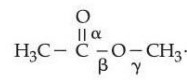
In methyl acetate, the \(\alpha\) bond is a \(C=O\) double bond, which is the shortest among the three.
The \(\beta\) bond is a \(C-O\) single bond adjacent to a carbonyl group. Due to resonance (\(CH_3-C(=O)-O-CH_3 \leftrightarrow CH_3-C(-O^-)=O^+-CH_3\)), the \(\beta\) bond acquires partial double bond character, making it shorter than a pure single bond.
The \(\gamma\) bond is a pure \(C-O\) single bond between an \(sp^3\) hybridized carbon and oxygen, with no resonance involvement. Thus, it is the longest bond.
Therefore, the correct order of bond lengths is \(\alpha < \beta < \gamma\).
Answer: \(\alpha < \beta < \gamma\) -
- (A) A < B < C < D
- (B) A < D < C < B
- (C) D < C < B < A
- (D) D < C < A < B
Show answer and solution
Correct Answer: (B)
Explanation:
Let us determine the correct order of bond lengths step-by-step by analyzing the two primary factors involved: bond order and atomic size.
1. Effect of Bond Order:
For a given pair of atoms, bond length decreases as the bond order increases because more shared electrons pull the nuclei closer together. Therefore, a triple bond is shorter than a double bond, which is shorter than a single bond: \(\text{Triple} < \text{Double} < \text{Single}\). This explains why the carbonyl double bond \(C=O(C)\) is shorter than the ether single bond \(C-O(B)\).
2. Effect of Atomic Size (The C-H Exception):
When comparing bonds with different atoms, the size of the atoms is crucial. Hydrogen belongs to the first period and has the smallest atomic radius because it possesses only a single \(1s\) orbital shell. Because the hydrogen atom is exceptionally small, the \(C-H(A)\) single bond is uniquely compressed, measuring only around \(107\text{ pm}\). This is shorter than the \(C \equiv N(D)\) triple bond (\(116\text{ pm}\)), where both carbon and nitrogen are larger second-period atoms.
3. Summary of Bond Length Values:
- \(C-H(A)\): \(107\text{ pm}\)
- \(C \equiv N(D)\): \(116\text{ pm}\)
- \(C=O(C)\): \(121\text{ pm}\)
- \(C-O(B)\): \(143\text{ pm}\)
Arranging these values from shortest to longest gives: A < D < C < B.
Hence, Option B is the correct choice. -
- (A) \(6\)
- (B) \(4\)
- (C) \(3\)
- (D) \(5\)
Show answer and solution
Correct Answer: (B)
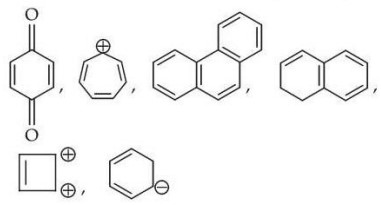
A species is aromatic if it is cyclic, planar, fully conjugated (continuous cyclic overlap of \(p\)-orbitals) and contains \((4n + 2)\,\pi\) electrons (Huckel's rule). Let us analyse each species.
\(1,4\)-Benzoquinone:
The six-membered ring has only \(4\pi\) electrons (from the two \(C=C\) bonds); the two \(C=O\) groups are cross-conjugated and do not contribute to a continuous \((4n + 2)\,\pi\) ring system. Hence, it is non-aromatic.
Tropylium cation:
A planar, cyclic, fully conjugated seven-membered system with three \(C=C\) bonds and a positive charge (empty \(p\)-orbital). It has \(6\,\pi\) electrons, satisfying Huckel's rule with \(n = 1\). It is aromatic.
Phenanthrene:
A fused tricyclic, planar, fully conjugated hydrocarbon with \(14\,\pi\) electrons. It obeys Huckel's rule with \(n = 3\). It is aromatic.
\(1,2\)-Dihydronaphthalene:
It contains an intact benzene ring fused to a partially saturated six-membered ring. Because of the benzene ring, the molecule as a whole is classified as aromatic.
Cyclobutadiene dication:
A planar, four-membered ring with one \(C=C\) bond and two positive charges (two empty \(p\)-orbitals), giving \(2\,\pi\) electrons. It satisfies Huckel's rule with \(n = 0\). It is aromatic.
Cyclohexadienyl anion (as drawn with a \(-CH_2-\) group):
The \(sp^3\) \(-CH_2-\) carbon breaks the continuous cyclic conjugation, so the ring is not fully conjugated. Hence, it is non-aromatic.
Counting the aromatic species: tropylium cation, phenanthrene, \(1,2\)-dihydronaphthalene and cyclobutadiene dication give a total of \(4\) aromatic species.
Hence, the correct option is \((2)\ 4\). -
- (A) 4,2,2
- (B) 3,3,2
- (C) 2,4,2
- (D) 2,2,4
Show answer and solution
Correct Answer: (A)
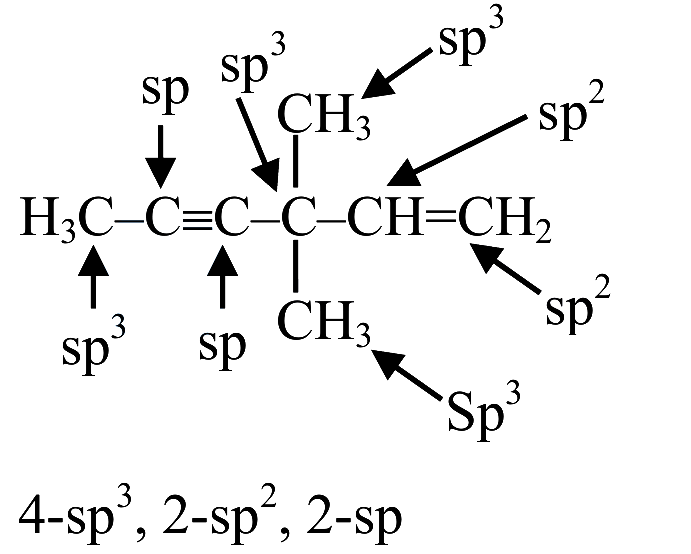
1. Priority Rule in IUPAC: Your assumption about priority is slightly reversed for this case. When numbering the parent carbon chain, multiple bonds (double and triple bonds) are actually given higher priority than alkyl substituents (like methyl groups) to get the lowest possible numbers (locants). While principal functional groups (like -OH, -COOH) have the highest priority, simple substituents like alkyl groups or halogens have lower priority than multiple bonds.
2. Numbering the Chain:
- Numbering from left to right: The multiple bonds get positions 2 and 5.
- Numbering from right to left: The multiple bonds get positions 1 and 4.
Since the locant set (1, 4) is lower than (2, 5), the correct numbering must start from the right (alkene side). Thus, the given IUPAC name "3,3-dimethylhex-1-ene-4-yne" is absolutely correct.
3. Structure & Hybridization Count:
Based on the correct name, the structure is: \( \text{CH}_3-\text{C}\equiv\text{C}-\text{C}(\text{CH}_3)_2-\text{CH}=\text{CH}_2 \)
Let's break down the hybridization of each carbon atom in this molecule:
- \( \text{C}_1 \) (\( =\text{CH}_2 \)): \( \text{sp}^2 \) hybridized (due to double bond)
- \( \text{C}_2 \) (\( -\text{CH}= \)): \( \text{sp}^2 \) hybridized (due to double bond)
- \( \text{C}_3 \) (\( -\text{C}- \)): \( \text{sp}^3 \) hybridized (attached to 4 single bonds)
- Two \( -\text{CH}_3 \) groups attached to \( \text{C}_3 \): Both are \( \text{sp}^3 \) hybridized
- \( \text{C}_4 \) (\( -\text{C}\equiv \)): \( \text{sp} \) hybridized (due to triple bond)
- \( \text{C}_5 \) (\( \equiv\text{C}- \)): \( \text{sp} \) hybridized (due to triple bond)
- \( \text{C}_6 \) (\( -\text{CH}_3 \)): \( \text{sp}^3 \) hybridized (attached to 4 single bonds)
Total Count:
- \( \text{sp}^3 \) carbons: \( 1 \) (at C3) + \( 2 \) (methyls) + \( 1 \) (at C6) = 4
- \( \text{sp}^2 \) carbons: \( 2 \) (C1 and C2) = 2
- \( \text{sp} \) carbons: \( 2 \) (C4 and C5) = 2
Hence, the sequence is 4, 2, 2. Option A is indeed the correct choice. -
- (A) Three
- (B) One
- (C) Two
- (D) Four
Show answer and solution
Correct Answer: (B)
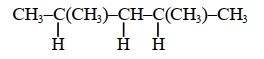
only one \(2^{\circ}\) carbon is present in this compound.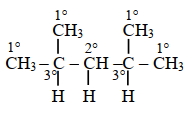
- 6. Number of \(\sigma\) and \(\pi\) bonds present in ethylene molecule is respectively _______. 2024 Medium
- (A) \(3\) and \(1\)
- (B) \(5\) and \(2\)
- (C) \(4\) and \(1\)
- (D) \(5\) and \(1\)
Show answer and solution
Correct Answer: (D)
\(1 \pi\) bond.
-
- (A) The \(\mathrm{C}-\mathrm{C}\) bonds in ethyne is shorter than that in ethene
- (B) Both carbons are sp hybridised
- (C) Ethyne is linear
- (D) The carbon-carbon bonds in ethyne is weaker than that in ethene
Show answer and solution
Correct Answer: (D)
Explanation:
Let us analyze each statement regarding ethyne (\( \text{H}-\text{C}\equiv\text{C}-\text{H} \)) to identify the incorrect one based on standard chemical bonding principles:
1. Bond Length (Statement A): Ethyne contains a carbon-carbon triple bond (\( \text{C}\equiv\text{C} \)) with a bond length of approximately 120 pm, whereas ethene (\( \text{CH}_2=\text{CH}_2 \)) contains a carbon-carbon double bond (\( \text{C}=\text{C} \)) with a bond length of approximately 134 pm. Since a triple bond is shorter than a double bond, this statement is factually correct.
2. Hybridization (Statement B): Each carbon atom in ethyne forms two sigma bonds and two pi bonds, which corresponds to \( \text{sp} \) hybridization. This statement is factually correct.
3. Geometry (Statement C): Due to the \( \text{sp} \) hybridization of both carbon atoms, the bond angle is \( 180^\circ \), giving ethyne a linear molecular geometry. This statement is factually correct.
4. Bond Strength (Statement D): A carbon-carbon triple bond consists of one sigma bond and two pi bonds, making it significantly stronger (bond dissociation enthalpy of \( 839\text{ kJ/mol} \)) than the carbon-carbon double bond in ethene (bond dissociation enthalpy of \( 614\text{ kJ/mol} \)). Therefore, stating that the bond in ethyne is weaker is factually incorrect.
Since the question specifically asks for the incorrect statement, Option D is the correct choice. -
- (A) \(sp ^{3}, sp , sp ^{3}, sp ^{3}\)
- (B) \(sp ^{2}, sp ^{2}, sp ^{2}, sp ^{3}\)
- (C) \(sp ^{2}, sp , sp ^{2}, sp ^{3}\)
- (D) \(sp ^{2}, sp ^{3}, sp ^{2}, sp ^{3}\)
Show answer and solution
Correct Answer: (C)
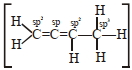
\(CH _{2} = C = C H - C H _{3}\)\(\quad 1\quad \quad 2\quad \quad 3\quad \quad \quad 4\)
-
- (A) \(10\)
- (B) \(11\)
- (C) \(12\)
- (D) \(13\)
Show answer and solution
Correct Answer: (A)
Numbers of \(\sigma\) bonds \(=10\)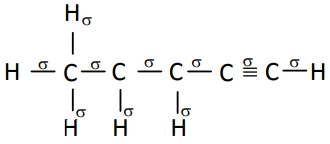
-
- (A) \(24\)
- (B) \(6\)
- (C) \(12\)
- (D) \(18\)
Show answer and solution
Correct Answer: (D)
Each carbon atom is \(sp^{2}\) hybridized Therefore each carbon has \(3 sp^{2}\) hybrid orbitals. Hence total \(\mathrm{sp}^{2}\) hybrid orbitals are \(18 .\)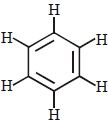
-
- (A) \(sp\) and \(sp^3\)
- (B) \(sp^2\) and \(sp\)
- (C) only \(sp^2\)
- (D) \(sp^2\) and \(sp^3\)
Show answer and solution
Correct Answer: (B)
\(\,\begin{matrix}
^{H} \\
_{H} \\
\end{matrix}\begin{matrix}
\text{ }\!\!\backslash\!\!\text{ } \\
/ \\
\end{matrix}\overset{s{{p}^{2}}}{\mathop{C}}\,=\overset{s{{p}^{2}}}{\mathop{C}}\,=\overset{s{{p}^{2}}}{\mathop{C}}\,\begin{matrix}
/ \\
\text{ }\!\!\backslash\!\!\text{ } \\
\end{matrix}_{H}^{H}\)
No questions on this page match these filters.
Other STD 11 - Organic chemistry Nomenclature of organic compounds topics
Frequently asked
How many Bonding and hybridisation in organic compounds questions came in JEE Mains?
11 questions from 2014–2026, each with the correct answer and a full solution.
How difficult are Bonding and hybridisation in organic compounds questions?
18% are easy, 55% medium and 27% hard.