


Questions
Newest firstShowing 1–37 of 37 questions
-
- (A) 40
- (B) 45
- (C) 50
- (D) 55
Show answer and solution
Correct Answer: (B)
Let moles of \(\mathrm{CO}_2=\mathrm{n}\)
moles of \(\mathrm{Ca}(\mathrm{OH})_2\) total initially \(=2 \mathrm{n}\)
excess \(\mathrm{Ca}(\mathrm{OH})_2=\mathrm{n}\)
gm equivalent of \(\mathrm{Ca}(\mathrm{OH})_2=\mathrm{gm}\) equivalent of HCl
\(\begin{aligned}
& \mathrm{n} \times 2=0.1 \times \frac{40}{1000} \times 1 \\
& \mathrm{n}=2 \times 10^{-3}
\end{aligned}\)
Volume of \(\mathrm{CO}_2=2 \times 10^{-3} \times 22400=44.8 \mathrm{~cm}^3\) -
- (A) \(4\)
- (B) \(3\)
- (C) \(8\)
- (D) \(7\)
Show answer and solution
Correct Answer: (C)
\( \mathrm{PbS}+4 \mathrm{O}_3 \rightarrow \mathrm{PbSO}_4+4 \mathrm{O}_2 \)\( \mathrm{x}=4, \mathrm{y}=4\)
-
- (A) \(8\)
- (B) \(7\)
- (C) \(6\)
- (D) \(9\)
Show answer and solution
Correct Answer: (A)
Reduction Half Oxidation Half\(2 \mathrm{MnO}_4^{-} \rightarrow 2 \mathrm{MnO}_2\) \(2 \mathrm{I}^{-} \rightarrow \mathrm{I}_2+2 \mathrm{e}^{-}\)
\(2 \mathrm{MnO}_4^{-}+4 \mathrm{H}_2 \mathrm{O}+6 \mathrm{e}^{-} \rightarrow 2 \mathrm{MnO}_2+8 \mathrm{OH}^{-}\) \(6 \mathrm{I}^{-} \rightarrow 3 \mathrm{I}_2+6 \mathrm{e}^{-}\)
Adding oxidation half and reduction half, net reaction is
\(2 \mathrm{MnO}_4^{-}+6 \mathrm{I}^{-}+4 \mathrm{H}_2 \mathrm{O} \rightarrow 3 \mathrm{I}_2+2 \mathrm{MnO}_2+8 \mathrm{OH}^{-}\)
\({z}=8\)
\({ Ans. }8\)
-
- (A) \(1\), \(2\), \(1\) and \(1\)
- (B) \(2\), \(2\), \(1\) and \(3\)
- (C) \(3\),\(4\),\(4\) and \(2\)
- (D) \(2\), \(4\), \(1\) and \(3\)
Show answer and solution
Correct Answer: (A)
\(\Rightarrow \mathrm{Cl}_2+2 \overline{\mathrm{O}} \mathrm{H} \longrightarrow \mathrm{Cl}^{-}+\mathrm{ClO}^{-}+\mathrm{H}_2 \mathrm{O}\)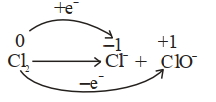
-
- (A) Statement \(I\) is correct but statement \(II\) is incorrect.
- (B) Statement \(I\) is incorrect but statement \(II\) is correct
- (C) Both statement \(I\) and statement \(II\) are incorrect
- (D) Both statement \(I\) and statement \(II\) are correct
Show answer and solution
Correct Answer: (A)
\(\mathrm{S}_1: \mathrm{S}_{\mathrm{8}}+12 \mathrm{OH}^{\ominus} \rightarrow 4 \mathrm{~S}^{2-}+2 \mathrm{~S}_2 \mathrm{O}_3^{2-}+6 \mathrm{H}_2 \mathrm{O}\)\(\mathrm{S}_2: \mathrm{ClO}_4^{\ominus}\) cannot undergo disproportionation reaction as chlorine is present in it's highest oxidation state.
-
- (A) \(8, 6, 4\) and \(\mathrm{Cr}_2 \mathrm{O}_3\)
- (B) \(14,7,6\) and \(\mathrm{Cr}^{3+}\)
- (C) \(8,4,6\) and \(\mathrm{Cr}_2 \mathrm{O}_3\)
- (D) \(14,6,7\) and \(\mathrm{Cr}^{3+}\)
Show answer and solution
Correct Answer: (D)
The balanced reaction is,\(\mathrm{Cr}_2 \mathrm{O}_7^{2-}+14 \mathrm{H}^{+}+6 \mathrm{e}^{-} \rightarrow 2 \mathrm{Cr}^{3+}+7 \mathrm{H}_2 \mathrm{O}\)
\(\mathrm{X}=14\), \(\mathrm{Y}=6\), \(\mathrm{~Z}=7\), \(\mathrm{A}=\mathrm{Cr}^{3+}\)
-
- (A) \((A)-(I), (B)-(II), (C)-(III), (D)-(IV)\)
- (B) \((A)-(III), (B)-(II), (C)-(I), (D)-(IV)\)
- (C) \((A)-(II), (B)-(III), (C)-(IV), (D)-(I)\)
- (D) \((A)-(IV), (B)-(I), (C)-(II), (D)-(III)\)
Show answer and solution
Correct Answer: (D)
\(\mathrm{A} \rightarrow \text { (IV) }\)
\(\mathrm{B} \rightarrow(\mathrm{I})\)
\(\mathrm{C} \rightarrow \text { (II) }\)
\(\mathrm{D} \rightarrow \text { (III) }\) -
- (A) \(8\)
- (B) \(10\)
- (C) \(15\)
- (D) \(20\)
Show answer and solution
Correct Answer: (A)
\(2 \mathrm{MnO}_4^{-}+5 \mathrm{C}_2 \mathrm{O}_4^{2-}+16 \mathrm{H}^{+} \longrightarrow 2 \mathrm{Mn}^{2+}+10 \mathrm{CO}_2+8 \mathrm{H}_2 \mathrm{O}\)\(\therefore\) Number of moles of \(\mathrm{H}^{+}\)ions required by 1 mole of \(\mathrm{MnO}_4^{-}\)to oxidise oxalate ion to \(\mathrm{CO}_2\) is 8.
- 9. On reaction of Lead Sulphide with dilute nitric acid which of the following is not formed? 2024 Medium
- (A) Nitric oxide
- (B) Nitrous oxide
- (C) Lead nitrate
- (D) Sulphur
Show answer and solution
Correct Answer: (B)
\(PbS + HNO _3 \rightarrow Pb\left( NO _3\right)_2+ NO + S + H _2 O\) Nitrous oxide \(\left( N _2 O \right)\) is not formed during the reaction. -
- (A) 8
- (B) 6
- (C) 5
- (D) 10
Show answer and solution
Correct Answer: (A)
\(\text { eq. }\left(\mathrm{KMnO}_4\right)=\text { eq. }\left(\mathrm{H}_2 \mathrm{C}_2 \mathrm{O}_4\right)\)\(\mathrm{M} \times 2 \times 5=2 \times 20 \times 2\)
\(\mathrm{M}=8 \mathrm{M}\)
-
- (A) Bromine undergoes oxidation and iodine undergoes reduction by iodine in these reactions
- (B) Thiosulphate undergoes oxidation by bromine and reduction by iodine in these reaction
- (C) Bromine is a stronger oxidant than iodine
- (D) Bromine is a weaker oxidant than iodine
Show answer and solution
Correct Answer: (C)
In the reaction of \(\mathrm{S}_2 \mathrm{O}_3{ }^{2-}\) with \(\mathrm{I}_2\), oxidation state of sulphur changes to +\(2\) to +\(2.5\)In the reaction of \(\mathrm{S}_2 \mathrm{O}_3{ }^{2-}\) with \(\mathrm{Br}_2\), oxidation state of sulphur changes from +\(2\) to +\(6\) .
\(\therefore\) Both \(\mathrm{I}_2\) and \(\mathrm{Br}_2\) are oxidant (oxidising agent) and \(\mathrm{Br}_2\) is stronger oxidant than \(\mathrm{I}_2\).
-
- (A) \(4\)
- (B) \(5\)
- (C) \(6\)
- (D) \(7\)
Show answer and solution
Correct Answer: (C)
Intermediate oxidation state of element can undergo disproportionation.\(\mathrm{H}_2 \mathrm{O}_2, \mathrm{ClO}_3^{-}, \mathrm{P}_4, \mathrm{Cl}_2, \mathrm{Cu}^{+1}, \mathrm{NO}_2\)
-
- (A) \((A), (B)\)
- (B) \((B), (C), (D)\)
- (C) \((A), (B), (C)\)
- (D) \((A),(D)\)
Show answer and solution
Correct Answer: (A)
When a particular oxidation state becomes less stable relative to other oxidation state, one lower, one higher, it is said to undergo disproportionation.\(\mathrm{Cu}^{+} \rightarrow \mathrm{Cu}^{2+}+\mathrm{Cu}\)
\(3 \mathrm{MnO}_4^{2-}+4 \mathrm{H}^{+} \rightarrow 2 \mathrm{MnO}_4^{-}+\mathrm{MnO}_2+2 \mathrm{H}_2 \mathrm{O}\)
- 14. \(2 IO _3^{-}+ xI ^{-}+12 H ^{+} \rightarrow 6 I _2+6 H _2 O\) What is the value of \(x\) ? 2023 Easy
- (A) \(12\)
- (B) \(2\)
- (C) \(6\)
- (D) \(10\)
Show answer and solution
Correct Answer: (D)
Number of atoms of iodine on reactant side \(=\) number of atoms of Iodine on product side\(2+ x =6 \times 2\)
\(X =10\)
\(2 IO _3^{-}+10 I ^{-}+12 H ^{+} \rightarrow 6 I _2+6 H _2 O\)
-
- (A) Both statement \(I\) and statement \(II\) are correct.
- (B) Statement \(I\) is incorrect but Statement \(II\) is correct.
- (C) Statement \(I\) is correct but Statement \(II\) is incorrect.
- (D) Both statement \(I\) and statement \(II\) are incorrect.
Show answer and solution
Correct Answer: (D)
In redox titration, indicators are sensitive to oxidation potential and in acid base titration, indicators are sensitive to change in \(pH\) of solution Both statement are false. -
- (A) \(22\)
- (B) \(21\)
- (C) \(20\)
- (D) \(23\)
Show answer and solution
Correct Answer: (D)
\(Cr _2 O _7^{2-}+14 H ^{+}+6 Fe ^{2+} \rightarrow 6 Fe ^{3+}+2 Cr ^{3+}+7 H _2 O\)\(x =14\)
\(y =2\)
\(z =7\)
Hence \((x+y+z)=14+2+7=23\)
-
- (A) \(A\) and \(B\) only
- (B) \(A\) only
- (C) \(C\) and \(D\) only
- (D) \(A\) and \(D\) only
Show answer and solution
Correct Answer: (A)
\(2\left[\stackrel{+1}{ Au ( CN )_2}\right]^{-}+\stackrel{0}{ Z } n ( s ) \longrightarrow 2 \stackrel{0}{ Au }+\left[\stackrel{+2}{ Zn }( CN )_4\right]^{-2}\)\(Zn\) displaced \(Au ^{+}\)
Reduction and Oxidation both are taking place.
-
- (A) \(3\)
- (B) \(4\)
- (C) \(5\)
- (D) \(6\)
Show answer and solution
Correct Answer: (B)
\(n _{\text {eq. }}\) of \(I _{2}= n _{ eq }\) of \(Na _{2} S _{2} O _{3}=20 \times 0.002 \times 1\)\(2 \times n _{ mol }\) of \(I _{2}=0.4\)
\(n _{ mol }\) of \(I _{2}=0.2 m mol\)
\(n _{ mol }\) of \(Cu ^{+2}=0.2 \times 2 \times 10^{-3}\)
\(\left[ Cu ^{+2}\right]=\frac{0.4 \times 10^{-3}}{10 \times 10^{-3}}=0.04=4 \times 10^{-2}\)
-
- (A) \(22\)
- (B) \(23\)
- (C) \(24\)
- (D) \(25\)
Show answer and solution
Correct Answer: (C)
Eq. of \(K _{2} Cr _{2} O _{7}=\) Eq. of \(Fe ^{2+}\)\((Molarity\) \(\times\) \(volume\) \(\times\) \(n.f)\) of \(K _{2} Cr _{2} O _{7}=\) (molarity \(\times\) volume \(\times\) n.f ) of \(Fe ^{2+}\)
\(0.02 \times 20 \times 6= M \times 10 \times 1\)
\(M =0.24\)
Molarity \(=24 \times 10^{-2}\)
-
- (A) \(13\)
- (B) \(130\)
- (C) \(65\)
- (D) \(70\)
Show answer and solution
Correct Answer: (A)
\(MnO _{2}+ HCl \longrightarrow Cl _{2}+ Mn ^{+2}\)\(6\, meq\quad\quad\quad\quad\quad\quad\quad 6\, meq\)
\(=3 m mol\)
\(Cl _{2}+ KI \longrightarrow Cl ^{-}+ I _{2}\)
\(6\, meq\quad\quad\quad\quad\quad\quad\quad6\, meq\)
\(I _{2}+ Na _{2} S _{2} O _{3} \longrightarrow I ^{-}+ Na _{2} S _{4} O _{6}\)
\(6\, meq\quad\quad\quad\quad\quad\quad\quad 6\, m\,mol\)
\(\quad=6 meq\)
\(\% \,MnO _{2}=\frac{3 \times 10^{-3} \times 87}{2} \times 100\)
\(=13.05\, \%\)
- 21. In the titration of \(KMnO _{4}\) and oxalic acid in acidic medium, the change in oxidation number of carbon at the end point is 2022 Medium
- (A) \(1\)
- (B) \(0\)
- (C) \(2\)
- (D) \(3\)
Show answer and solution
Correct Answer: (A)
Oxidation state of carbon changes from \(+3\) to \(+4\).\(2 KMnO _{4}+5 H _{2} C _{2} O _{4}+3 H _{2} SO _{4}(\text { dil. }) \)\(\rightarrow K _{2} SO _{4}+2 MnSO _{4}+10 CO _{2}+8 H _{2} O\)
-
- (A) \(2 H _{2} O _{2} \rightarrow 2 H _{2} O + O _{2}\)
- (B) \(2 NO _{2}+ H _{2} O \rightarrow HNO _{3}+ HNO _{2}\)
- (C) \(MnO _{4}^{-}+4 H ^{+}+3 e ^{-} \rightarrow MnO _{2}+2 H _{2} O\)
- (D) \(3 MnO _{4}{ }^{2-}+4 H ^{+} \rightarrow 2 MnO _{4}{ }^{-}+ MnO _{2}+2 H _{2} O\)
Show answer and solution
Correct Answer: (C)
\(2 NO _{2}+ H _{2} O \rightarrow HNO _{3}+ HNO _{2} : Disproportionation\)\(MnO _{4}^{-}+4 H ^{+}+3 e ^{-} \rightarrow MnO _{2}+2 H _{2} O : reduction\)
\(3 MnO _{4}^{+-}+4 H ^{+} \rightarrow 2 MnO _{4}^{-}+ MnO _{2}^{+4}+2 H _{2} O :Disproportionation\)
-
- (A) \(22\)
- (B) \(10\)
- (C) \(14\)
- (D) \(16\)
Show answer and solution
Correct Answer: (D)
Writting the half reaction oxidation half reaction\(MnO _{4}^{-} \rightarrow Mn ^{2+}\)
balancing oxygen
\(MnO _{4}^{-} \rightarrow Mn ^{2+}+4 H _{2} O\)
balancing Hydrogen
\(8 H ^{+}+ MnO _{4}^{-} \rightarrow Mn ^{2+}+4 H _{2} O\)
balancing charge
\(5 e ^{-}+8 H ^{+}+ MnO _{4}^{-} \rightarrow Mn ^{2+}+4 H _{2} O\)
Reduction half
\(C _{2} O _{4}^{2-} \rightarrow CO _{2}\)
Balancing carbon
\(C _{2} O _{4}^{2-} \rightarrow 2 CO _{2}\)
Balancing charge
\(C _{2} O _{4}^{2-} \rightarrow 2 CO _{2}+2 e ^{-}\)
Net equation
\(16 H ^{+}+2 MnO _{4}^{-}+5 C _{2} O _{4}^{2-} \rightarrow 10 CO _{2}+2 Mn ^{2+}+8 H _{2} O\)
So \(\quad c=16\)
-
- (A) \(\mathrm{C}_{2} \mathrm{O}_{4}^{2-} \rightarrow 2 \mathrm{CO}_{2}\)
- (B) \(\mathrm{CrO}_{4}^{2-} \rightarrow \mathrm{Cr}^{3+}\)
- (C) \(\mathrm{Cr}_{2} \mathrm{O}_{7}^{2-} \rightarrow 2 \mathrm{Cr}^{3+}\)
- (D) \(\mathrm{MnO}_{4}^{-} \rightarrow \mathrm{Mn}^{2+}\)
Show answer and solution
Correct Answer: (D)
\(\underset{(+7)}{\mathrm{MnO}_{4}^{-}} \rightarrow \underset{(+2)}{\mathrm{Mn}^{2+}} 5 \mathrm{e}^{-}\)change -
- (A) \(29\)
- (B) \(17\)
- (C) \(12\)
- (D) \(22\)
Show answer and solution
Correct Answer: (C)
\(16 e ^{\ominus}+ S _{8} \longrightarrow 8 S ^{2-}\)\(\frac{12 H _{2} O + S _{8} \longrightarrow 4 S _{2} O _{3}^{2-}+24 H ^{+}+16 e ^{\circ}}{2 S _{8}+12 H _{2} O \longrightarrow 8 S ^{2-}+4 S _{2} O _{3}^{2-}+24 H }\)
for balancing in basic medium add equal number of \(OH ^{\ominus}\) that of \(H ^{+}\)
\(2 S _{8}+12 H _{2} O +24 OH ^{\ominus} \longrightarrow 8 S ^{2-}+4 S _{2} O _{8}^{2-}\)
\(+24 H _{2} O\)
\(2 S _{8}+24 OH ^{\ominus} \rightarrow 8 S ^{2-}+4 S _{2} O _{8}^{2-}+12 H _{2} O\)
\(S _{8}+12 OH ^{\ominus} \rightarrow 4 S ^{2-}+2 S _{2} O _{8}^{2-}+6 H _{2} O\)
\(a =12\)
-
- (A) \(\mathrm{BrO}_{2}^{-}\)
- (B) \(\mathrm{BrO}_{4}^{-}\)
- (C) \(\mathrm{BrO}^{-}\)
- (D) \(\mathrm{BrO}_{3}^{-}\)
Show answer and solution
Correct Answer: (B)
In \(\mathrm{BrO}_{4}^{\ominus}, \mathrm{Br}\) is in highest oxidation state \((+7),\) Soit cannot oxidise further it only reduced hence it cannot show disproportionation reaction -
- (A) \(14\)
- (B) \(16\)
- (C) \(18\)
- (D) \(20\)
Show answer and solution
Correct Answer: (C)
\(4 \mathrm{NaCl}+\mathrm{K}_{2} \mathrm{Cr}_{2} \mathrm{O}_{7}+6 \mathrm{H}_{2} \mathrm{SO}_{4}\)\(\quad \quad \quad \quad \quad \downarrow\)
\(2 \mathrm{CrO}_{2} \mathrm{Cl}_{2}+4 \mathrm{NaHSO}_{4}+2 \mathrm{KHSO}_{4}+3 \mathrm{H}_{2} \mathrm{O}\)
\((\mathrm{A})\)
\(\mathrm{CrO}_{2} \mathrm{Cl}_{2}+4 \mathrm{NaOH} \longrightarrow \mathrm{Na}_{2} \mathrm{CrO}_{4}+2 \mathrm{NaCl}+2 \mathrm{H}_{2} \mathrm{O}\)
\(\quad \quad \quad \quad \quad \quad \quad \quad \quad \quad \quad (B)\)
\(\mathrm{Na}_{2} \mathrm{CrO}_{4}+2 \mathrm{H}_{2} \mathrm{SO}_{4}+2 \mathrm{H}_{2} \mathrm{O}_{2}\)
\(\mathrm{CrO}_{5}+2 \mathrm{NaHSO}_{4}+3 \mathrm{H}_{2} \mathrm{O}\)
\((\mathrm{C})\)
\(A=C r O_{2} C l_{2}\)
\({B}=\mathrm{Na}_{2} \mathrm{CrO}_{4}\)
\({C}={C r O}_{5}\)
Total number of atom in \(\mathrm{A}+\mathrm{B}+\mathrm{C}=18\)
-
- (A) \(0\)
- (B) \(5\)
- (C) \(2\)
- (D) \(19\)
Show answer and solution
Correct Answer: (D)
\(\left[ Fe ^{2+} \rightarrow Fe ^{3+}+ e ^{-}\right] \times 2\)\(\frac{ H _{2} O _{2}+2 e ^{-} \rightarrow 2 HO ^{\ominus}}{2 Fe ^{2+}+ H _{2} O _{2} \rightarrow 2 Fe ^{3+}+2 HO _{(q\omega)}^{\ominus}}\)
\(x =2 \quad y =2\)
\(\left[8 H ^{+}+ MnO _{4}^{-}+5 e ^{-} \rightarrow Mn ^{2+}+4 H _{2} O \right] \times 2\)
\(\left[ H _{2} O _{2} \rightarrow O _{2( g )}+2 H ^{+}+2 e ^{-}\right] \times 5\)
\(\Rightarrow 16 H ^{+}+2 MnO _{4}^{-}+5 H _{2} O _{2}\)
\(\rightarrow 2 Mn ^{2+}+8 H _{2} O +5 O _{2(g)}+10 H ^{+}\)
\(\Rightarrow 6 H ^{+}+2 MnO _{4}^{-}+5 H _{2} O _{2}\)
\(\rightarrow 2 Mn ^{2+}+8 H _{2} O +5 O _{2( g )}\)
So \(\quad x^{\prime}=2 \quad y^{\prime}=8 \quad z^{\prime}=5\)
so \(\quad x+y+x^{\prime}+y^{\prime}+z^{\prime}\)
\(\Rightarrow 2+2+2+8+5\)
\(\Rightarrow 19\)
-
- (A) Combination of dinitrogen with dioxygen at \(2000 \;K\)
- (B) Formation of ozone from atmosphereic oxygen in the presence of sunlight
- (C) Reaction of \(\mathrm{H}_{2} \mathrm{SO}_{4}\) with \(\mathrm{NaOH}\)
- (D) Reaction of \(\left[\mathrm{Co}\left(\mathrm{H}_{2} \mathrm{O}\right)_{6}\right] \mathrm{Cl}_{3}\) with \(\mathrm{AgNO}_{3}\)
Show answer and solution
Correct Answer: (A)
\(\mathrm{N}_{2}+\mathrm{O}_{2} \stackrel{2000 \mathrm{K}}{\longrightarrow} 2 \mathrm{NO} \quad\) (Redox reaction)during the reaction, oxidation of nitrogen take place from \(0\) to \(2\) and reduction of oxygen take place from \(0\) to \(-2 .\) It means this reaction is redox reaction.
\(3 \mathrm{O}_{2} \stackrel{\mathrm{hv}}{\longrightarrow} 2 \mathrm{O}_{3} \quad\) (Non - redox reaction)
\(\mathrm{H}_{2} \mathrm{SO}_{4}+2 \mathrm{NaOH} \rightarrow \mathrm{Na}_{2} \mathrm{SO}_{4}+2 \mathrm{H}_{2} \mathrm{O}\) (neutralization reaction)
\(\left[\mathrm{Co}\left(\mathrm{H}_{2} \mathrm{O}\right)_{6}\right] \mathrm{Cl}_{3}+3 \mathrm{AgNO}_{3}\)
\(\rightarrow 3 \mathrm{AgCl} \downarrow+\left[\mathrm{Co}\left(\mathrm{H}_{2} \mathrm{O}\right)_{6}\right]\left(\mathrm{NO}_{3}\right)_{3}\)
(White ppt.)
-
- (A) \(55\)
- (B) \(52\)
- (C) \(60\)
- (D) \(50\)
Show answer and solution
Correct Answer: (D)
\(K _{2} Cr _{2} O _{7}+ FeC _{2} O _{4} \longrightarrow Cr ^{+3}+ Fe ^{+3}+ CO _{2}\)\(n=6 \quad \quad n=3\)
\(\frac{0.02 \times 6 \times V ( mL )}{1000}=\frac{0.288}{144} \times 3\)
\(\Rightarrow \quad V =50 mL\)
-
- (A) \(2KMnO_4 \longrightarrow K_2MnO_4 + MnO_2 + O_2\)
- (B) \(2NaBr + Cl_2 \longrightarrow 2NaCl + Br_2\)
- (C) \(2CuBr \longrightarrow CuBr_2 + Cu\)
- (D) \(2MnO_4^ - + 10{I^ - } + 16{H^ + } \longrightarrow 2M{n^{2 + }} + 5{I_2} + 8{H_2}O\)
Show answer and solution
Correct Answer: (C)
\(2C{u^ \oplus }\) \(\longrightarrow\) \(C{u^{2 + }} + Cu\) -
- (A) \(1\)
- (B) \(1.5\)
- (C) \(2\)
- (D) \(3\)
Show answer and solution
Correct Answer: (C)
\(n-\) factors of \(KMnO_4=5,\,n-\) factor of \(FeSO_4=1\)\(n-\) factors of \(FeC_2O_4=3,\,Fe_2(SO_4)_3\) does not react
\(n-\) factors of \(Fe_2(C_2O_4)_3=6\),
\(n_{eq}\,KMnO_4=n_{eq}[FeC_2O_4+Fe_2(C_2O_4)_3+FeSO_4]\)
or, \(x \times 5=1 \times 3+1\times 6+1\times1 \)
\(x=2\)
- 33. In the reaction of oxalate with permanganate in acidic medium, the number of electrons involved in producing one molecule of \(CO_2\) is 2019 Medium
- (A) \(1\)
- (B) \(10\)
- (C) \(2\)
- (D) \(5\)
Show answer and solution
Correct Answer: (A)
Explanation:
The redox reaction between oxalate ions (\( \text{C}_2\text{O}_4^{2-} \)) and permanganate ions (\( \text{MnO}_4^- \)) in an acidic medium consists of oxidation and reduction half-reactions.
To find the number of electrons involved per molecule of \( \text{CO}_2 \) produced, we look at the balanced oxidation half-reaction of the oxalate ion:
\( \text{C}_2\text{O}_4^{2-} \rightarrow 2\text{CO}_2 + 2e^- \)
From this balanced half-reaction:
- Oxidation of \( 1 \) molecule of oxalate ion (\( \text{C}_2\text{O}_4^{2-} \)) produces \( 2 \) molecules of \( \text{CO}_2 \).
- This process releases a total of \( 2 \) electrons.
Therefore, the number of electrons involved in producing one single molecule of \( \text{CO}_2 \) is calculated as:
\( \text{Number of electrons} = \frac{2\text{ electrons}}{2\text{ molecules of CO}_2} = 1\text{ electron} \)
Hence, Option A is the correct choice. -
- (A) \(XeF_4 + O_2F_2 \rightarrow XeF_6 + O_2\)
- (B) \(XeF_2 + PF_5 \rightarrow [XeF]^+ PF_6^-\)
- (C) \(XeF_6 + H_2O \rightarrow XeOF_4 + 2HF\)
- (D) \(XeF_6 + 2H_2O \rightarrow XeO_2F_2 + 4HF\)
Show answer and solution
Correct Answer: (A)
The following reaction is an example of redox reaction as xenon undergoes oxidation from state \(+4\) to \(+6\) and oxygen undergoes reduction from state \(+1\) to \(0 .\)\(\stackrel{+4}{\mathrm{X}} \mathrm{eF}_{4}+\stackrel{+1}{\mathrm{O}_{2}} \mathrm{F}_{2} \rightarrow \stackrel{+6}{\mathrm{Xe}} \mathrm{F}_{6}+\stackrel{0}{\mathrm{O}_{2}}\)
-
- (A) \(MnO_4^-\)
- (B) \(Cr_2O_7^{2-}\)
- (C) \(SO_3^{2-}\)
- (D) \(KI\)
Show answer and solution
Correct Answer: (A)
\(H_2O_2\) acts as a reducing agent only in presence of strong oxidising agents (\(i.e.,MnO_4^-\) ) in acidic as well as alkaline medium. \(2KMnO_4 + 3H_2SO_4 + 5H_2O_2 \to K_2SO_4 + 2MnSO_4 + 8H_2O + 5O_2\) -
- (A) \(Li_2O + 2KCl \rightarrow 2LiCl + K_2O\)
- (B) \([ CoCl( NH_3 )_5]^+ +5H^+ \rightarrow Co^{2+} +5NH_4^+ +Cl^-\)
- (C) \([ Mg(H_2O)_6]^{2+} +(EDTA)^{4-} \xrightarrow{{excess\,NaOH}} \) \([Mg(EDTA)]^{2+} +6H_2O\)
- (D) \(CuSO_4 + 4KCN \rightarrow K_2[Cu(CN)_4]+K_2SO_4\)
Show answer and solution
Correct Answer: (B)
Equation \(-1\) is not balanced with respect to charge.Equation \(-2\) gives \(K _3\left[ Cu ( CN )_4\right]\) as product.
Equation \(-3\) reaction is unfavourable in the forward direction \(\left( K _2 O\right.\) is unstable, while \(LiO _2\) is stable).
Equation \(-4\) is correct and balanced.
-
- (A) \(2,1,2\)
- (B) \(2,1,3\)
- (C) \(3, 1,6\)
- (D) \(3, 1, 4\)
Show answer and solution
Correct Answer: (C)
On balancing the given reaction, we find\(3Na_2HAsO_3 + NaBrO_3 + 6HCl \longrightarrow\)
\(6NaCl + 3H_3AsO_4 + NaBr\)
No questions on this page match these filters.
Other STD 11 - Redox reactions topics
Frequently asked
How many Auto oxidation and Disproportionation questions came in JEE Mains?
37 questions from 2013–2025, each with the correct answer and a full solution.
How difficult are Auto oxidation and Disproportionation questions?
5% are easy, 46% medium and 49% hard.