


Questions
Newest firstShowing 1–27 of 27 questions
-
- (A) A-IV, B-III, C-I, D-II
- (B) A-III, B-II, C-IV, D-I
- (C) A-III, B-IV, C-II, D-I
- (D) A-III, B-IV, C-I, D-II
Show answer and solution
Correct Answer: (C)
For A: Molar mass of \(H_2O = 18\) g/mol. Moles of \(H_2O = \dfrac{1.8 \times 10^{-3}}{18} = 10^{-4}\). Since each \(H_2O\) molecule has \(3\) atoms, the number of atoms = \(3 \times 10^{-4} \times N_A\).
For B: Molar mass of \(H_2SO_4 = 98\) g/mol. Moles of \(H_2SO_4 = \dfrac{9.8 \times 10^{-3}}{98} = 10^{-4}\). Since each \(H_2SO_4\) molecule has \(7\) atoms, the number of atoms = \(7 \times 10^{-4} \times N_A\).
For C: Molar mass of \(C = 12\) g/mol. Moles of \(C = \dfrac{1.8 \times 10^{-3}}{12} = 1.5 \times 10^{-4}\). The number of atoms = \(1.5 \times 10^{-4} \times N_A\).
For D: Molar mass of \(NaCl = 58.5\) g/mol. Moles of \(NaCl = \dfrac{5.85 \times 10^{-3}}{58.5} = 10^{-4}\). Since each \(NaCl\) formula unit has \(2\) atoms, the number of atoms = \(2 \times 10^{-4} \times N_A\).
Thus, the correct matching is A-III, B-IV, C-II, D-I.
Answer: A-III, B-IV, C-II, D-I - 2. Number of moles and number of molecules in \(1.4187\) L of \(SO_2\) at STP respectively are: 2026 Medium
- (A) \(0.1266; 3.812 \times 10^{22}\)
- (B) \(0.0633; 3.812 \times 10^{22}\)
- (C) \(0.1266; 7.6238 \times 10^{22}\)
- (D) \(0.0633; 7.6238 \times 10^{22}\)
Show answer and solution
Correct Answer: (B)
Volume of \(SO_2\) at STP \(= 1.4187\) L
Molar volume of an ideal gas at STP is approximately \(22.414\) L.
Number of moles \(n = \dfrac{\text{Volume}}{\text{Molar Volume}} = \dfrac{1.4187}{22.414} = 0.0633\)
Number of molecules \(= n \times N_A\)
Number of molecules \(= 0.0633 \times 6.022 \times 10^{23} = 3.812 \times 10^{22}\)
Answer: \(0.0633; 3.812 \times 10^{22}\) -
- (A) \(C>A>B\)
- (B) \(C>B>A\)
- (C) \(B>C>A\)
- (D) \(B>A>C\)
Show answer and solution
Correct Answer: (D)
For (A):
Formula of cyclohexane is \(C_6H_{12}\).
Number of atoms per molecule = \(6 + 12 = 18\).
Total number of atoms in \(2\) moles = \(2 \times 18 \times N_A = 36 N_A\).
For (B):
Formula of sucrose is \(C_{12}H_{22}O_{11}\).
Molar mass of sucrose = \(342\) g/mol.
Number of moles = \(\dfrac{684}{342} = 2\) moles.
Number of atoms per molecule = \(12 + 22 + 11 = 45\).
Total number of atoms = \(2 \times 45 \times N_A = 90 N_A\).
For (C):
Formula of dihydrogen is \(H_2\).
Number of moles at STP = \(\dfrac{90.8}{22.7} = 4\) moles.
Number of atoms per molecule = \(2\).
Total number of atoms = \(4 \times 2 \times N_A = 8 N_A\).
Comparing the total number of atoms:
\(90 N_A > 36 N_A > 8 N_A\)
Therefore, the correct order is \(B > A > C\).
Answer: \(B>A>C\) -
- (A) A and B only
- (B) B and C only
- (C) C and D only
- (D) A, C and E only
Show answer and solution
Correct Answer: (D)
Number of atoms is calculated as the product of the number of moles, atomicity, and Avogadro's number (\(N_A\)).
For A: Moles of O\(_2\) = \(\dfrac{2}{32} = \dfrac{1}{16}\) mol. Atomicity of O\(_2\) is \(2\).
Number of atoms = \(\dfrac{1}{16} \times 2 \times N_A = \dfrac{1}{8} N_A\)
For B: Moles of SO\(_2\) = \(\dfrac{4}{64} = \dfrac{1}{16}\) mol. Atomicity of SO\(_2\) is \(3\).
Number of atoms = \(\dfrac{1}{16} \times 3 \times N_A = \dfrac{3}{16} N_A\)
For C: Moles of O\(_2\) at STP = \(\dfrac{1400}{22400} = \dfrac{1}{16}\) mol. Atomicity of O\(_2\) is \(2\).
Number of atoms = \(\dfrac{1}{16} \times 2 \times N_A = \dfrac{1}{8} N_A\)
For D: Moles of He at STP = \(\dfrac{0.05}{22.4} = \dfrac{1}{448}\) mol. Atomicity of He is \(1\).
Number of atoms = \(\dfrac{1}{448} \times 1 \times N_A = \dfrac{1}{448} N_A\)
For E: Moles of H\(_2\) = \(0.0625 = \dfrac{1}{16}\) mol. Atomicity of H\(_2\) is \(2\).
Number of atoms = \(\dfrac{1}{16} \times 2 \times N_A = \dfrac{1}{8} N_A\)
Comparing the number of atoms, A, C, and E contain the same number of atoms.
Answer: A, C and E only -
- (A) 200
- (B) 320
- (C) 100
- (D) 150
Show answer and solution
Correct Answer: (C)
Organic compound \(\xrightarrow{\text { combustion }} \underset{\substack{\mathrm{0.9} \mathrm{gm}}}{\mathrm{H}_2 \mathrm{O}}\)
\(\therefore\) mole of \(\mathrm{H}_2 \mathrm{O}=\frac{0.9}{18}=0.05 \mathrm{~mole}\)
\(\therefore\) mole of H in \(\mathrm{H}_2 \mathrm{O}=0.05 \times 2=0.1\) mole
\(=\) mole of H in 0.01 mole
Organic compound
\(\therefore\) wt of H atom in 0.01 mole compound \(=0.1 \times 1\) \(=0.1 \mathrm{gm}\)
\(\therefore\) wt of H atom in one mole compound
\(=\frac{0.1}{0.01}=10 \mathrm{gm}\)
\(\because \mathrm{wt} . \%\) of \(\mathrm{H}=\frac{\mathrm{wt} \text {. of } \mathrm{H} \text { in one mole compound }}{\text { Molar mass of compound }} \times 1\)
\(\begin{aligned}
& 10=\frac{10}{M} \times 100 \\
& \therefore M=100
\end{aligned}\) -
- (A) 98 .3 mg
- (B) 48.2 mg
- (C) 196 .2 mg
- (D) 150 .4 mg
Show answer and solution
Correct Answer: (C)
Moles of removed \(\mathrm{CO}_2=\frac{10^{21}}{6.02 \times 10^{23}} \mathrm{~mol}\)
\(=1.66 \times 10^{-3} \mathrm{~mol}\)
mole of \(\mathrm{CO}_2\) left \(=2.8 \times 10^{-3} \mathrm{moles}\) total moles of \(\mathrm{CO}_2\) taken initially
\(=(2.8+1.66) \times 10^{-3} \mathrm{~mol}\)
mass of \(\mathrm{CO}_2\) taken initially
\(\begin{aligned}
& =4.46 \times 10^{-3} \times 44 \\
& =196.24 \times 10^{-3} \mathrm{~g} \\
& =196.24 \mathrm{mg}
\end{aligned}\) -
- (A) Po
- (B) Pr
- (C) Pb
- (D) Pt
Show answer and solution
Correct Answer: (B)
\(\text { No. of atoms }=\frac{\text { Massin } g}{\operatorname{Molar} \operatorname{Mas}(\mathrm{~g} / \mathrm{mol})} \times \mathrm{N}_{\mathrm{A}}\)
Therefore for the same Mass element having the least Molar mass will have the higher no. of atoms.
- \(\mathrm{M}_{\mathrm{Po}}=209\)
- \(\mathrm{M}_{\mathrm{Pr}}=141\)
- \(\mathrm{M}_{\mathrm{Pb}}=207\)
- \(\mathrm{M}_{\mathrm{Pt}}=195\) -
- (A) 400
- (B) 420
- (C) 440
- (D) 460
Show answer and solution
Correct Answer: (B)
\(\begin{aligned}
& \text { moles of } \mathrm{Fe}_3 \mathrm{O}_4=\frac{2.32 \times 10^3 \times 10^3}{232}=10000 \mathrm{~mol} \\
& \text { moles of } \mathrm{CO}=\frac{2.8 \times 10^2 \times 10^3}{28}=10000 \mathrm{~mol} \\
& \mathrm{Fe}_3^3 \mathrm{O}_4+4 \mathrm{CO} \longrightarrow 3 \mathrm{Fe}+4 \mathrm{CO}_2 \\
& 10^4 \mathrm{~mol} \quad 10^4 \mathrm{~mol}
\end{aligned}\)
CO is L.R.
mole of \(\mathrm{Fe}=\frac{3}{4} \times 10^4\)
mass of \(\mathrm{Fe}=\frac{3}{4} \times \frac{10^4 \times 56}{1000} \mathrm{~kg}=420 \mathrm{~kg}\) -
- (A) 150
- (B) 153
- (C) 145
- (D) 140
Show answer and solution
Correct Answer: (B)
\(\begin{aligned} & 4 \mathrm{Al}+3 \mathrm{O}_2 \longrightarrow 2 \mathrm{Al}_2 \mathrm{O}_3 \\ & \frac{81}{27}=3 \text { mole } \frac{128}{32}=4 \mathrm{~mole}\end{aligned}\)
Limiting reagent
\(\begin{aligned}
& \therefore \text { mole of } \mathrm{Al}_2 \mathrm{O}_3 \text { formed }=\frac{1}{2} \times 3 \text { mole } \\
& \therefore \text { wt. of } \mathrm{Al}_2 \mathrm{O}_3 \text { formed }=\frac{3}{2} \times 102 \\
& \quad=153 \mathrm{gm}
\end{aligned}\) -
- (A) \(1361\)
- (B) \(1362\)
- (C) \(1360\)
- (D) \(1368\)
Show answer and solution
Correct Answer: (B)
Mole of \(CO _2=0.2\,M \times\left(300 \times 10^{-3}\right)\,L\)\(=0.06 Mole\)
Volume of \(0.06\) mole \(CO _2\) at S.T.P
\(=0.06 \times 22.7\)
\(=1.362\,L\)
-
- (A) \(A-I, B-III, C-II, D-IV\)
- (B) \(A-II, B-III, C-IV, D-I\)
- (C) \(A-II, B-IV, C-III, D-I\)
- (D) \(A-II, B-IV, C-I, D-III\)
Show answer and solution
Correct Answer: (D)
\(16\,g\,CH _4=1\) mole \(CH _4\) contains \(10 \times 6.02 \times 10^{23}\) electrons\(=60.2 \times 10^{23}\)
\(1\,g\,H _2=0.5\) mole \(H _2\) gas occupy \(11.35\) litre volume at STP
\(1 \text { mole of } N _2=28\,g\)
\(0.5 \text { mole of } SO _2=32\,g\)
- 12. The number of molecules and moles in \(2.8375\) litres of \(O _2\) at STP are respectively 2023 Hard
- (A) \(7.527 \times 10^{22}\) and \(0.250\,mol\)
- (B) \(1.505 \times 10^{23}\) and \(0.250\,mol\)
- (C) \(7.527 \times 10^{23}\) and \(0.125\,mol\)
- (D) \(7.527 \times 10^{22}\) and \(0.125\,mol\)
Show answer and solution
Correct Answer: (D)
Number of moles of \(O _2=\frac{2.8375}{22.7}=0.125\)Number of molecules \(=0.125\,N _{ A }\)
\(=7.525 \times 10^{22}\)
-
- (A) \(2\)
- (B) \(6\)
- (C) \(8\)
- (D) \(4\)
Show answer and solution
Correct Answer: (D)
\(Zn +2 HCl \rightarrow ZnCl _2+ H _2 \uparrow\)Moles of \(Zn\) used \(=\frac{11.5}{65.4}=\) Moles of \(H _2\) evolved
Volume of \(H _2=\frac{11.5}{65.4} \times 22.7\,L =3.99\, L\)
-
- (A) \(3\)
- (B) \(1\)
- (C) \(2\)
- (D) \(0\)
Show answer and solution
Correct Answer: (D)
\(n _{ H _{2} SO _{4}}\) in \(Sol ^{ n } A =50 \%\) of original solution\(=0.01\, m \,mol\).
\(n _{ H _{2} SO _{4}}\) in Final solution \(=0.01+0.01\)
\(=0.02 \,m\,mol\)
\(=0.00002 \times 10^{3} \,m\,mol\)
-
- (A) \(22\)
- (B) \(24\)
- (C) \(23\)
- (D) \(20\)
Show answer and solution
Correct Answer: (B)
\(ppm =\frac{ W _{ Mg }}{ V _{ soln }} \times 10^{6}=48\)\(W _{ Mg }=\frac{48 \times 2 \times 1000}{10^{6}}\)
\(=48 \times 2 \times 10^{-3} g\)
\(n _{ Mg }=\frac{ W _{ Mg }}{24}=\frac{48 \times 2 \times 10^{-3}}{24}\)
\(=4 \times 10^{-3}\)
Number of \(Mg\) atoms \(=4 \times 10^{-3} \times 6.02 \times 10^{23}\)
\(=4 \times 6.02 \times 10^{20}\)
\(=24.08 \times 10^{20}\)
\(\therefore \quad x =24.08\)
-
- (A) \(1.21 \times 10^{5}\)
- (B) \(12.0 \times 10^{16}\)
- (C) \(1.21 \times 10^{20}\)
- (D) \(3.4 \times 10^{22}\)
Show answer and solution
Correct Answer: (C)
No. of Fe atoms \(=\frac{0.34}{100} \times \frac{3.3}{56} \times 6.022 \times 10^{23}\) \(=1.206 \times 10^{20}\) -
- (A) \(1143\)
- (B) \(1500\)
- (C) \(951\)
- (D) \(442\)
Show answer and solution
Correct Answer: (A)
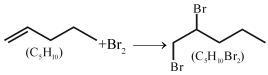
moles of \(Br _{2}=\) moles of \(C _{5} H _{10}\)\(\Rightarrow \frac{ w }{160}=\frac{5}{70}\)
\(\Rightarrow w =\frac{5 \times 160}{70}\, g\)
\(=11.428 \,g\)
\(=1142.8 \times 10^{-2}\, g\)
\(\approx 1143 \times 10^{-2}\, g\)
-
- (A) \(6418\)
- (B) \(5418\)
- (C) \(5118\)
- (D) \(5948\)
Show answer and solution
Correct Answer: (B)
M.M. of \(C _{7} H _{5} N _{3} O _{6}\) is \(84+5+42+96=227\)\(n _{ C _{7} H _{5} N _{3} O _{6}}=\frac{681}{227}=3\)
\(n _{ N }=\frac{681}{227} \times 3=9 mol\)
no. of \(N\) atoms \(=9 \times 6.02 \times 10^{23}\)
\(=5418 \times 10^{21}\)
\(\therefore\) The answer is \(5418 .\)
-
- (A) \(19\)
- (B) \(13\)
- (C) \(17\)
- (D) \(10\)
Show answer and solution
Correct Answer: (B)
\(Na ^{+}\) present in \(50\, ml\)\(=\frac{70\, mg }{1\, ml } \times 50\, ml =3500 mg =3.5\, gm\)
moles of \(Na ^{+}=\frac{3.5}{23}=\) moles of \(NaNO _{3}\)
weight of \(NaNO _{3}=\frac{3.5}{23} \times 85=12.993\, gm\)
-
- (A) \(6\)
- (B) \(8\)
- (C) \(2\)
- (D) \(34\)
Show answer and solution
Correct Answer: (C)
\(\text { No. of atoms }=\frac{8}{23} \times 6.02 \times 10^{23}= 2.09 \times 10^{23}\)\(\quad\quad\quad\quad\quad\quad\quad\quad\quad\quad\quad\quad\quad\quad\simeq 2 \times 10^{23}\)
\(\quad\quad\quad\quad\quad\quad\quad\quad\quad\quad\quad\quad\quad\quad=\mathrm{x} \times 10^{23}\)
\(\mathrm{x}=2\)
- 21. The ratio of number of water molecules in Mohr's salt and potash alum is \(....\,\times 10^{-1}\) 2021 Hard
- (A) \(5\)
- (B) \(3\)
- (C) \(4\)
- (D) \(1\)
Show answer and solution
Correct Answer: (A)
Mohr's salt : \(\left(\mathrm{NH}_{4}\right)_{2} \mathrm{Fe}\left(\mathrm{SO}_{4}\right)_{2} \cdot 6 \mathrm{H}_{2} \mathrm{O}\)The number of water molecules in Mohr's salt \(=6\)
Potash alum : \(\mathrm{KAl}\left(\mathrm{SO}_{4}\right)_{2} \cdot 12 \mathrm{H}_{2} \mathrm{O}\)
The number of water molecules in potash alum \(=12\)
So ratio of number of water molecules in Mohr's salt and potash alum \(=\frac{6}{12}\)
\(=\frac{1}{2}\)
\(=0.5\)
\(=5 \times 10^{-1}\)
-
- (A) \(1\) and \(0.5\)
- (B) \(2\) and \(0.5\)
- (C) \(1\) and \(1\)
- (D) \(1\) and \(2\)
Show answer and solution
Correct Answer: (A)
IE values indicate, that the metal belongs to Ist group since second IE is very high ( only one valence electron) Metal hydroxide will be of type, \(MOH\). \(\mathrm{MOH}+\mathrm{HCl} \rightarrow \mathrm{MCl}+\mathrm{H}_{2} \mathrm{O}\)\((1mol)\) \((1 \mathrm{mol})\)
\(\mathrm{MOH}+\frac{1}{2} \mathrm{H}_{2} \mathrm{SO}_{4} \rightarrow \frac{1}{2} \mathrm{M}_{2} \mathrm{SO}_{4}+\mathrm{H}_{2} \mathrm{O}\)
\((1mol) \)\(\left(\frac{1}{2} \mathrm{mol}\right)\)
So one mole of HCl required to react with one mole \(MOH.\)
So \(\frac{1}{2}\) mole of \(\mathrm{H}_{2} \mathrm{SO}_{4}\) required to react with one mole \(MOH.\)
-
- (A) \(80\)
- (B) \(20\)
- (C) \(75\)
- (D) \(25\)
Show answer and solution
Correct Answer: (B)
In \(CH_4\)Mole of carbon \(n_C = 1\)
Mole of hydrogen \(= n_H = 4\)
\(\%\) of \(n_C\) \( = \frac{{{n_C}}}{{{n_C} + {n_H}}} \times 100 = \frac{1}{5} \times 100 = 20\% \)
-
- (A) \(6.023 \times {10^9}\)
- (B) \(6.023 \times {10^{23}}\)
- (C) \(6.023 \times {10^{21}}\)
- (D) \(6.023 \times {10^{20}}\)
Show answer and solution
Correct Answer: (D)
Given percentage of chlorine in an hydrocarbon \(= 3.55\%\) i,e.,\(100\,g\) of chlorohydrocarbon has \(3.55\,g\) of chlorine.
\(1\,g\) of chlorohydrocarbon will have \(\frac{{3.55}}{{100}} = 0.0355\,g\) of chlorine.
Atomic wt. of \(Cl = 35.5\,g/mol\)
Number of moles of \(Cl\) \( = \frac{{0.0355\,g}}{{35.5\,g/mol}} = 0.001\) \(mole\)
Number of atoms of \(Cl = 0.001\,mole\) \(\times 6.023 \times 10^{23}\,mol^{-1}\)
\(= 6.023 \times 10^{20}\)
-
- (A) \(Ba(N_3)_2(s)\to Ba(C) + 3N_2(g)\)
- (B) \((NH_4)_2Cr_2O_7(s) \to \)\(N_2(g) + 4H_2O(g) + Cr_2O_3(s)\)
- (C) \(2NH_3(g)\to N_2(g) + 3H_2(g)\)
- (D) \(2NH_4NO_3(s) \to \)\(2N_2(g) + 4H_2O(g) + O_2(g)\)
Show answer and solution
Correct Answer: (C)
\((a)\) Molar mass of \(Ba(N_3)_2(s) = 221\,g/mol\)\(1\) mole of \(Ba(N_3)_2(s)\) will give \(3\) moles of \(N_2\)
hence \(\frac{{1\,g}}{{221\,g/mol}}\) moles of \(Ba(N_3)_2(s)\) will give \(3 \times \frac{1}{{221}} = 0.014\) moles of \(N_2\)
\((b)\) Molar mass of \({(N{H_4})_2}C{r_2}{O_7} = 252\,g/mol.\,\)
\(1\) mole of \({(N{H_4})_2}C{r_2}{O_7}\) will give \(1\) mole of \(N_2\)
hence \(\frac{{1\,g}}{{252\,g/mol}}\) moles of \({(N{H_4})_2}C{r_2}{O_7}\) will give \(1 \times \frac{1}{{252}} = 0.0039\) moles of \(N_2\)
\((c)\) Molar mass of \(NH_3 = 17\,g/mol.\)
\(2\) mole of \(NH_3\) will give \(1\) mole of \(N_2\)
hence \(\frac{{1\,g}}{{17\,g/mol}}\) moles of \(NH_3\) will give \(\frac{1}{{2 \times 17}} = 0.0297\) moles of \(N_2.\)
\((d)\) Molar mass of \(NH_4NO_3 = 80\,g/mol.\)
\(1\) mole of \(NH_4NO_3\) will give \(1\) mole of \(N_2\)
hence \(\frac{{1\,g}}{{80\,g/mol}}\) moles \(NH_4NO_3\) will give \(1 \times \frac{1}{{80}} = 0.0125\) moles of \(N_2\)
Hence Thermal decomposition of \(NH_3\) will produce maximum amount of \(N_2\)
-
- (A) \(115.2\)
- (B) \(57.6\)
- (C) \(28.8\)
- (D) \(18.4\)
Show answer and solution
Correct Answer: (B)
\(1\, mole\) of water contains \(= 16\, gm\) of \(O_2\)
\(\therefore \) \(3 .6\, mole\) of water contains
\(=16\times 3.6=57.6\,g\) -
- (A) \(4.0\, g\) of hydrogen
- (B) \(71.0\, g\) of chlorine
- (C) \(127.0\, g\) of iodine
- (D) \(48.0\, g\) of magnesium
Show answer and solution
Correct Answer: (A)
\(4\,g\) of hydrogen \(= 4\) mole of hydrogen\(= 4 \times 6.023 \times 10^{23}\) atoms
\(71.0\,gm\) of chlorine \( = \frac{{71.0}}{{71.0}} = 1\) moles of chlorine
\(= 6.023 \times 10^{23}\) atoms
\(127\,gm\) of iodine \( = \frac{1}{2}\) mole of \(I_2\)
\( = \frac{{127}}{{254}} = 6.023 \times {10^{23}} \times \frac{1}{2}\) atoms
\(48.0\,gm\) of magnesium
\( = \frac{{48.0}}{{24.0}} = 2 \times 6.023 \times {10^{23}}\) atoms
\(\therefore \) \(4.0\,gm\,H_2\) has largest number of atoms
No questions on this page match these filters.
Other STD 11 - Some basic concept of chemistry topics
Frequently asked
How many The mole concept questions came in JEE Mains?
27 questions from 2013–2026, each with the correct answer and a full solution.
How difficult are The mole concept questions?
7% are easy, 30% medium and 63% hard.